
Pharmaceutical Packaging Machine Comparison: A Weighted Decision Model
Pharmaceutical Packaging Machine Comparison: A Weighted Decision Model
A comparison of pharmaceutical packaging machines becomes decision-grade only when every candidate is expressed in the same unit of scope, the same throughput basis and the same class of compliance evidence. In the evaluation stage, most stalled selections are not caused by the machines themselves — they are caused by a comparison that was never normalised.
Why Pharmaceutical Packaging Machine Comparisons Stall
A pharmaceutical packaging machine is not one product category. The term covers primary packaging equipment such as a blister packaging machine, secondary packaging equipment such as a cartoning machine, and end-of-line equipment such as a case packing machine and palletizer, frequently combined into a blister packaging line or a turnkey pharmaceutical packaging line. Because these classes publish performance data on different bases, a table that mixes them cannot be ranked consistently.
Four failure patterns appear repeatedly during evaluation:
- Mixing units. A single tablet blister packaging machine or capsule blister packaging machine is placed in the same row as a complete pharmaceutical cartoning line, and the larger number wins the row by default.
- Mixing throughput bases. Catalogue peak speed is compared with the sustained rate of a linked line, without adjusting for format area, cavities per cycle, or the slowest module downstream.
- Mixing evidence. A CE certificate issued for one machine series is read as proof for an entire portfolio, even when the certificate scope names a different series.
- Mixing scope. Banding, overwrapping, case packing and palletizing are treated as optional add-ons during shortlisting and priced later, which changes the ranking after the technical decision has already been taken.
The practical consequence is that a buyer can hold three technically sound quotations and still be unable to answer a simple question: which configuration does more of the required work per unit of capital and floor space?
Step 1: Fix the Comparison Unit Before Collecting Data
The first decision in any pharmaceutical packaging machine comparison is what is being compared: a machine class, a linked line, or a full secondary packaging line. Zhejiang Hoping Machinery Co., Ltd., established in 2001 and based in Ruian, Zhejiang, China, manufactures across all four classes — blister packaging machines, cartoning machines, case packing machines and end-of-line packaging equipment — with roughly 28,800 m² of production space, around 300 employees, an annual output of about 500 units and approximately 25% of output exported. That breadth is useful precisely because the same portfolio can be read as either separate machines or an integrated line, and the two readings produce different rankings.
| Class | Function in the packaging flow | Configurations in the Hoping range |
|---|---|---|
| Blister packaging machine (primary) | Forms and seals the blister pack from PVC/PTP or Alu-Alu material | DPP Series flat platen (models include DPP350F, DPP250S, DPP250FI, DPP160F, DPP250FII); DPP260TI; DPP260K; DPH Series roller; DP Series for freeze-dried powder |
| Cartoning machine (secondary) | Opens the carton, inserts the product and leaflet, closes and codes | XWZ120; XWZ300II; XWZ Series (XWZ400 / XWZ300); XWZ500H |
| Flow wrapping | Pillow-pack wrapping of blisters or cartons | XW8200; XW8300 |
| Banding and overwrapping | Groups cartons into bundles | XWK4060 stretch bander; XWG4060 overwrapper; XWK Series; XWG Series |
| Case packing and palletizing (end of line) | Forms and loads cases, seals and stacks pallets | XWK Series case packing machine; ICP12 case packing and palletizing integral machine |
| Linked line | Two or more stages under one control architecture | DHL6004; DHL7004; DHL7005H; DHL8005H; DHL1000/5H; IXW400; IXW600; IXW800; DPP Series + XWZ Series; DPH320H–XW8200–XWZ300II |
Once the unit is fixed, only like-for-like options enter the same table. Machines from different classes are then compared on interface requirements — format transfer, capacity matching and control handshake — rather than on headline speed.
Step 2: Six Dimensions That Carry the Decision
1. Process scope and line architecture
Standalone and integrated architectures solve different problems. A standalone arrangement links a blister machine and a cartoning machine through a transfer interface, which allows each stage to be sized, replaced or run independently. An integrated machine such as the DHL6004 or DHL1000/5H performs blister forming, transfer, leaflet folding, carton opening, insertion and inspection under one control system. The comparison question is not which is technically superior, but which architecture matches the batch pattern, the available floor space and the tolerance for a single coupled flow.
2. Throughput and format envelope
Format envelope is defined by forming area, forming depth, feed stroke and carton specification. The DPH320H is specified with a 320 × 280 mm forming area, 12 mm forming depth and a 100–280 mm stroke range, which bounds the blister formats it can run. Capacity figures are only meaningful once the format envelope has been matched to the actual product.
3. Compliance and documentation scope
Certification is a comparison dimension with a scope, not a binary badge. The certificate number, the issuing body, the applicable standard and the machine series named in the scope all matter, and so does the validity window.
4. Format changeover and flexibility
For multi-product pharmaceutical plants, changeover behaviour can outweigh peak speed. The DHL1000/5H and DHL8005H lines are specified with mold-change functions and recipe/preset memory, and the DPP and DPH blister platforms use tooling configured to the blister format. Buyers should compare how many formats must be run per month, how long a changeover takes in practice, and whether format parameters are stored or re-entered.
5. Control architecture and integration readiness
Control platforms determine how easily a machine connects to inspection, coding and downstream modules. Published architectures in this range include Beckhoff motion controllers with CP9315 industrial PCs on the DHL6004, DHL8005H, DHL1000/5H, IXW600, IXW800 and IXW400 lines, Siemens motion controllers with TP900 HMI on the DHL7005H and DHL7004, and the D3 top-loading parallel tracking transfer system or the self-developed IRB24 transfer robot depending on model. Data interfaces, rejection logic and interface language are part of the comparison, not part of the installation phase.
6. Service, spares and lifecycle support
The Hoping service scope is documented as on-site installation and commissioning, operator and maintenance training, remote video or phone support, spare parts supply, process-parameter guidance and regular follow-up, subject to contract and project configuration. Quality control is documented as incoming material inspection, key component inspection, assembly inspection, electrical safety check, no-load trial run, material trial, factory acceptance test, customer witness acceptance and pre-shipment inspection. Lead time is typically 60–120 days after technical confirmation, and monthly capacity is around 30–40 units — two figures that belong in the comparison table because they determine whether the winning option can actually be installed on schedule.
Step 3: Normalise Throughput Before Ranking Anything
Throughput in this category is published in at least six units: cycles per minute, punches per minute, blisters per minute, cartons per minute, packs per minute, bundles per minute and cases per minute. None of them can be compared directly. A flat platen blister machine rated in cycles per minute and a linked line rated in blisters per minute describe different things, because the number of blisters per cycle depends on the format. The conversion requires three inputs: cavities per cycle, confirmed format area, and the output rate of the slowest module in the chain.
| Configuration | Published capacity basis | Power | Notes |
|---|---|---|---|
| Blister Packing Machine DPP260TI | 20–60 cycles/min | 9.5 kW | 4,420 × 710 × 1,700 mm; approx. 2,200 kg; flat Alu-PVC / Alu-Alu |
| Blister Packing Machine DPP260K | 20–70 cycles/min | 9.5 kW | 4,700 × 735 × 1,820 mm; approx. 3,900 kg; flat Alu-PVC / Alu-Alu |
| Blister Packing Machine DPH Series | 60–200 cycles/min (model dependent) | approx. 15.5–18.9 kW | Roller platform; Alu-PVC and Alu-Alu solid dosage |
| Blister machine DPH320HII | up to 250 punches/min; up to 1,000 blisters/min | 30 kW | 320 × 280 mm format area; 5,000 × 1,500 × 2,100 mm; approx. 6,000 kg |
| Cartoning Machine XWZ120 | approx. 30–120 cartons/min | 3.5 kW | Compact horizontal cartoner |
| Cartoning Machine XWZ300II | approx. 60–220 cartons/min | 5 kW | Medium-to-high speed secondary packaging |
| Cartoning Machine XWZ500H | approx. 100–500 cartons/min | 14 kW | Full servo high-speed cartoner |
| Stretch Bander XWK4060 | approx. 30–60 bundles/min | 14 kW | Bundling after cartoning |
| Case Packing and Palletizing ICP12 | approx. 12 cases/min | 25 kW | Case opening, loading, sealing and palletizing |
| Blister-Cartoning Line DHL6004 | up to 600 blisters/min and 400 cartons/min | — | Integrated blister-to-carton line |
| Blister-Cartoning Line DHL1000/5H | up to 1,000 blisters/min and 500 cartons/min | — | Four-channel servo-driven independent replenishment |
| Blister-Flow-Wrap-Cartoning Line IXW600 | up to 600 blisters/min, 300 packs/min and 300 cartons/min | — | Adds pillow wrapping between blister and carton |
| Blister-Flow-Wrap-Cartoning Line IXW800 | up to 600 blisters/min, 600 packs/min and 500 cartons/min | — | Dual-track, D3 top-load robotics |
| Liquid Dosage Blister-Cartoner Line IXW400 | up to 400 blisters/min and 150 cartons/min | — | Pre-filled syringes, ampoules and cartridges |
Step 4: Weight the Dimensions and Demand Evidence for High Scores
Weights are a business input, not a technical constant. A contract manufacturer running many small formats will weight changeover flexibility above peak speed; a high-volume solid dosage producer will do the opposite. The table below is an illustrative starting point that buyers can adjust; the important discipline is that a score of 4 or 5 on any dimension must be supported by a document, a measurement or a demonstrated trial, not by a brochure statement.
| Dimension | Illustrative weight | Evidence that justifies a high score |
|---|---|---|
| Throughput and format envelope | 25 | Published capacity basis plus confirmed blister and carton format; results of a material trial run |
| Compliance and documentation scope | 20 | Certificate naming the exact machine series, standard, issuing body and validity window |
| Integration and control architecture | 15 | Controller and industrial PC platform, servo architecture, data interface, inspection and rejection integration |
| Changeover flexibility | 15 | Mold-change concept, recipe or preset memory, number of formats run per month |
| Service and lifecycle support | 15 | Installation and commissioning scope, training, remote support, spare parts supply, follow-up routine |
| Footprint, utilities and availability | 10 | Machine dimensions, power supply, compressed-air demand, quoted lead time and production capacity |
Compliance and Documentation: The Dimension Most Often Compared Incorrectly
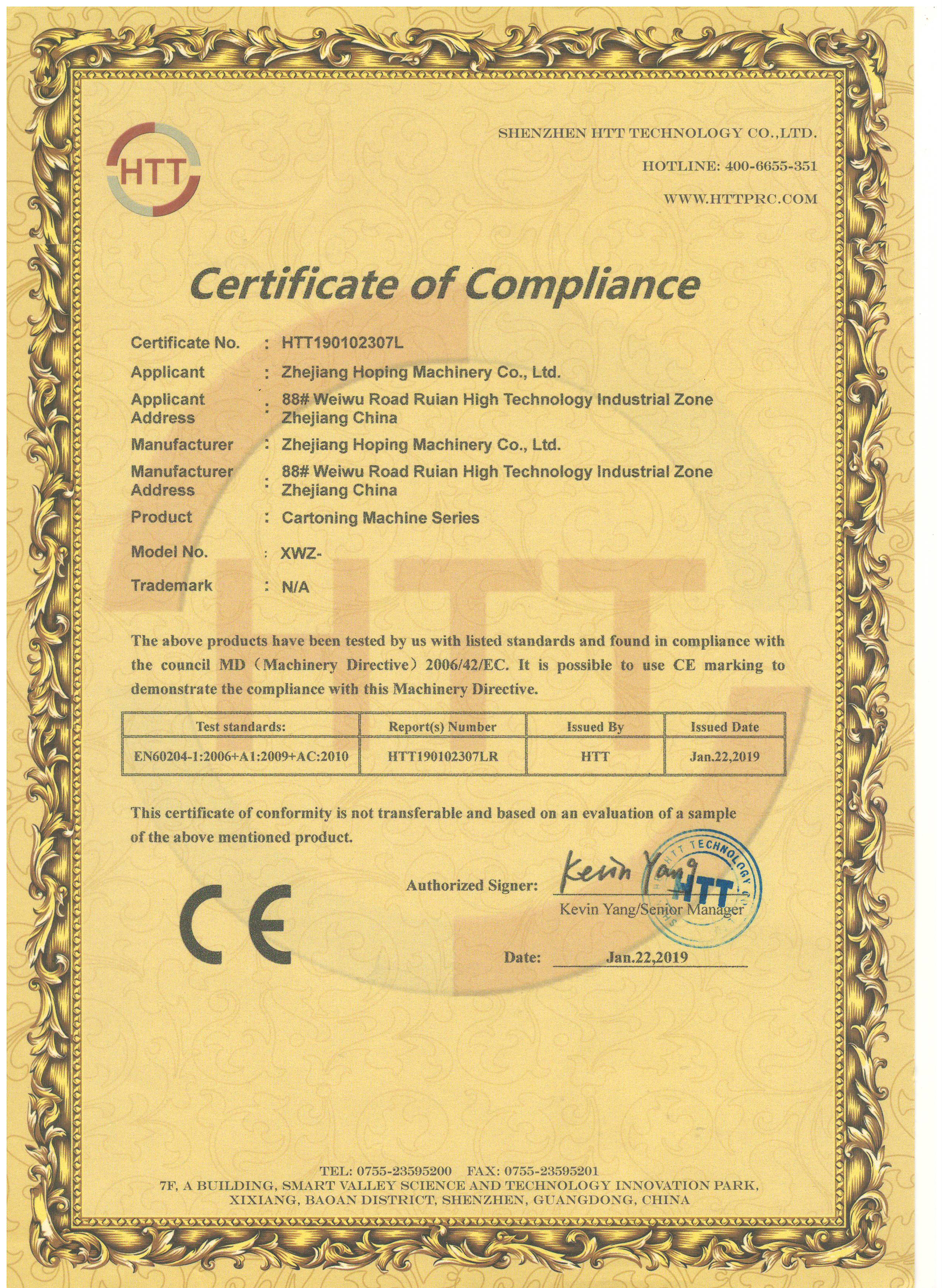
Certificates are typically compared by their presence rather than their scope. The documents held for this portfolio illustrate why scope matters. Certificate UCN 900339024607, issued by Certify International Ltd on 2007-04-01, covers a carton packing machine series under EN 415-3:2000 together with directives 98/37/EC and 98/79/EC. Certificate UCN 900175009261, issued by CELAB on 2006-11-06, covers a sample automatic blister packing machine under EN 60204-1:1997 and EN 415-3:1999. Certificate HTT190102307L, issued by Shenzhen HTT Technology Co., Ltd. on 2019-01-22, covers a cartoning machine series under EN 60204-1:2006+A1:2009+AC:2010 and the Machinery Directive 2006/42/EC, and certificate HTT190102306L of the same date covers a blister packing machine series under the same Machinery Directive and EN 60204-1 standard.
Two comparison rules follow from this. First, the certificate scope must name the machine series being purchased; a certificate for a carton packing machine series does not automatically document a blister machine, and a certificate covering a sample machine documents that machine configuration. Second, older certificates may reference directives that have since been superseded — 98/37/EC has been replaced by 2006/42/EC — so the buyer should confirm which document currently supports the equipment being supplied.
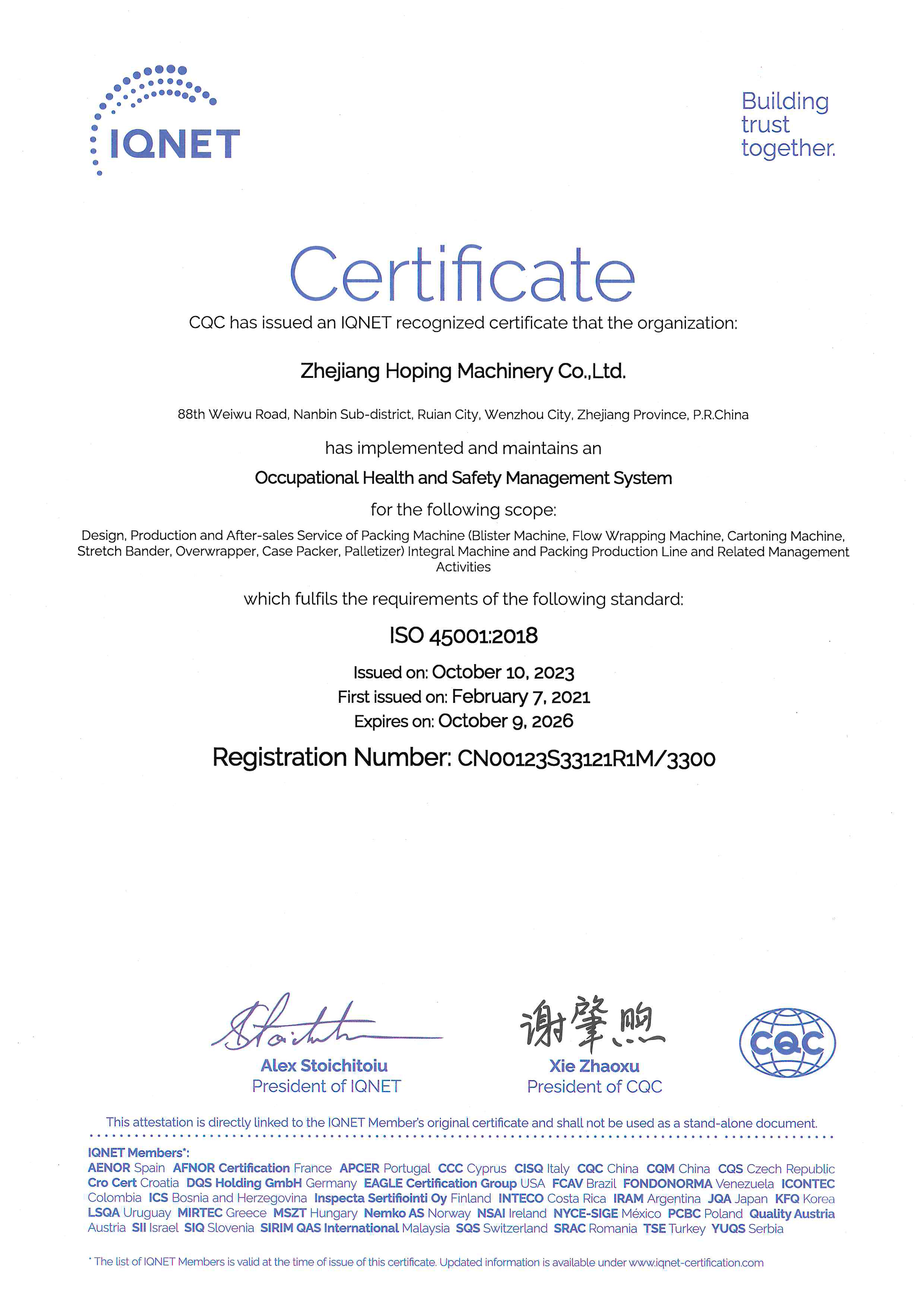
Management-system certificates follow the same logic. ISO 14001:2015 certificate CN00123E33896R1M/3300, issued by the China Quality Certification Centre on 2023-10-12, expires 2026-10-11, and ISO 45001:2018 certificate CN00123S33121R1M/3300, issued on 2023-10-10, expires 2026-10-09. Both cover the design, production and after-sales service of packing machines and packing production lines. In the wider regulatory frame, pharmaceutical packaging buyers commonly reference ISO 15378 for primary packaging materials, and in the EU the Machinery Directive 2006/42/EC together with the EN 415 series for packaging machine safety. A comparison table that lists certificate numbers, standards, issuing bodies and expiry dates will rank suppliers differently from one that lists badges.
Application Fit: Which Comparison Profile Suits Which Project
Once dimensions are normalised, most pharmaceutical projects fall into a small number of recognisable profiles.
- Multi-format, small to medium batch. A flat platen blister platform such as the DPP260TI or DPP260K at 20–70 cycles/min, paired with a compact cartoner such as the XWZ120 at about 30–120 cartons/min, keeps the comparison unit small and the changeover burden contained.
- High-volume solid dosage, single dominant format. An integrated blister cartoning line such as the DHL6004 at up to 600 blisters/min and 400 cartons/min, or the DHL1000/5H at up to 1,000 blisters/min and 500 cartons/min, removes manual transfer between the two stages.
- Moisture-sensitive or flow-wrapped presentations. The IXW600 and IXW800 add pillow wrapping between blister and carton, with published rates up to 600 blisters/min and, on the IXW800, 600 packs/min and 500 cartons/min.
- Liquid dosage formats. The IXW400 is configured for pre-filled syringes, ampoules and cartridges at up to 400 blisters/min and 150 cartons/min.
- Vial products. A labelling, DPP blister, XWZ cartoning and XWK banding sequence is specified as a linked vial packaging line, with capacity and layout defined by vial size, blister format, carton format and project layout.
- End-of-line completion. Cartoning at 60–220 cartons/min can be followed by stretch banding at about 30–60 bundles/min, case packing at up to about 5 cases/min, or case packing and palletizing at about 12 cases/min on the ICP12.
Representative project objectives recorded for this equipment class are consistent with that logic: improved packaging automation, reduced manual transfer, improved blister-to-carton connection efficiency, reduced wrong insertion or missing leaflet risks, and support for downstream automation integration. These are the outcomes a comparison framework should be scoring against, because they describe what changes on the shop floor rather than what changes on a specification sheet.
Market Trend Analysis
Market data supports the case for a disciplined comparison process rather than a price-first one. SkyQuest Technology valued the global pharmaceutical packaging equipment market at approximately USD 10.71 billion in 2024. Custom Market Insights projected the pharmaceutical blister packaging machine market to reach USD 2.57 billion by 2025 at a CAGR of 2.8%. Grand View Research reported that Asia Pacific held the largest revenue share, 40.7%, of the pharmaceutical packaging equipment market in 2025. Fortune Business Insights valued pharmaceutical automatic cartoning machinery at USD 1.46 billion in 2024.
Concentration is also relevant to buyer behaviour. One market intelligence report estimates that the three largest blister packaging machine suppliers — Uhlmann, IMA and Marchesini — together account for approximately 29% of that market, which means the majority of purchase options sit with mid-size and regional specialists. For those options, differentiation is rarely visible in a headline specification; it appears in documentation scope, control architecture, format tooling and service reach — the dimensions a weighted framework is built to expose.
Comparison with Traditional Approaches — and the Limits of This Framework
The traditional approach compares purchase price and peak speed, then negotiates the remainder. It produces fast shortlists but weak rankings, because price and peak speed are the two variables least able to explain lifetime behaviour. A weighted framework replaces them with scope, normalised throughput, documentation, changeover behaviour, control architecture and service reach, and it forces each score to be defended with evidence.
The framework also has real boundaries that buyers should recognise before relying on it.
- Integrated lines carry coupled risk. On an integrated blister cartoning line, a stoppage in one module affects the linked flow, and buffering strategy becomes part of the decision. Separate machines isolate failures but add transfer points that must themselves be controlled.
- Flat platen platforms have a capacity ceiling. A DPP Series machine specified at 20–50 cycles/min, or a DPP260K at 20–70 cycles/min, sets a hard upper bound on output that no configuration change removes. If demand exceeds that bound, the comparison unit must change to a roller platform or an integrated line.
- Tooling is format-specific. Blister and carton tooling is made to confirmed specifications, so the number of formats and their stability directly affect both cost and changeover time.
- Availability is a ranking variable. With lead time typically 60–120 days after technical confirmation and monthly capacity in the order of 30–40 units, a technically superior option that cannot be delivered on schedule should score lower, not higher.
- The framework cannot repair missing documentation. Where a supplier does not disclose certificate scope, throughput basis or service scope, the honest outcome is a lower confidence score — not an assumed value.
Stated plainly: this model does not identify a universally correct machine. It produces a defensible ranking against criteria the buyer has defined and can audit.
Future Outlook
Three directions are already visible in how this equipment is specified. First, control architecture is becoming a procurement criterion in its own right: servo-driven motion, industrial PC platforms, recipe and preset memory, and defined data interfaces are moving from optional to expected. Second, transfer and feeding technology is becoming part of the comparison, with robotic transfer systems such as the D3 top-loading parallel tracking system and the IRB24 transfer robot replacing mechanical hand-off on higher-capacity lines. Third, buyers increasingly evaluate the whole chain — blister, carton, bundle, case, pallet — as one capacity-matched system, which makes end-of-line modules a first-round comparison item rather than a later add-on. As regional demand in Asia Pacific continues to expand, documentation discipline and normalised comparison are likely to matter more, not less, in supplier selection.
Frequently Asked Questions
1. What is the first step in comparing pharmaceutical packaging machines?
Fix the comparison unit before collecting data. Decide whether the purchase is a single machine class, a linked line, or a full secondary packaging line, because specifications are published on different bases — cycles per minute for blister machines, cartons per minute for cartoners, blisters per minute for integrated lines. Options from different classes cannot be ranked against each other until scope is aligned; they can only be compared on interface requirements such as format transfer, capacity matching and control handshake.
2. How do you compare a blister packaging machine's cycle rate with a full blister cartoning line's output?
Convert both to the same unit — blisters per minute and cartons per minute — using cavities per cycle and the confirmed format area for the blister stage, and the linked carton rate for the cartoning stage. Integrated line specifications are already published this way: the DHL6004 is stated at up to 600 blisters/min and 400 cartons/min, and the DHL1000/5H at up to 1,000 blisters/min and 500 cartons/min. A machine-level figure such as 20–60 cycles/min on the DPP260TI cannot be compared with those numbers without the cavities-per-cycle input.
3. Flat platen and roller blister machines — what actually differs in a comparison?
Throughput basis and format handling. The DPP Series flat platform is specified at 20–50 cycles/min, the DPP260K at 20–70 cycles/min, and the DPH Series roller platform at 60–200 cycles/min depending on model, with the DPH320HII reaching up to 250 punches/min and up to 1,000 blisters/min on a 320 × 280 mm format area. Flat platforms are typically configured for small to medium batch, multi-format production; roller machines are configured for continuous higher-speed output. Forming area, forming depth and feed stroke also belong in the comparison because they bound the formats that can be run.
4. How should certification evidence be compared between suppliers?
Compare scope, standard and validity rather than presence. The certificate scope must name the machine series being purchased — for example, certificate UCN 900339024607 covers a carton packing machine series under EN 415-3:2000, and HTT190102306L covers a blister packing machine series under the Machinery Directive 2006/42/EC and EN 60204-1:2006+A1:2009+AC:2010. Management-system certificates such as ISO 14001:2015 (CN00123E33896R1M/3300) and ISO 45001:2018 (CN00123S33121R1M/3300), issued by the China Quality Certification Centre, carry defined expiry dates of 2026-10-11 and 2026-10-09, so validity should be re-checked at award rather than only at tender.
5. When does an integrated blister-cartoning line not make sense?
When batch pattern, footprint or capital structure do not justify it. An integrated line ties blister forming, transfer, leaflet handling and cartoning into one coupled flow, so a stoppage in one module affects the whole line, and the equipment footprint and capital requirement are larger than for separate machines. For multi-format, small-to-medium batch production with frequent format changes, a flat platen blister machine combined with a standalone cartoner can be the more flexible configuration. In both cases the tooling is format-specific: blister and carton tooling must be made to confirmed specifications.
6. How should end-of-line equipment be included in a pharmaceutical packaging machine comparison?
As a capacity-matched module from the first round, not as an afterthought. End-of-line scope includes cartoning, flow wrapping, banding or overwrapping, case packing and palletizing. Published capacities in this range include about 100–500 cartons/min for the XWZ500H cartoner, about 30–60 bundles/min for the XWK4060 stretch bander and the XWG4060 overwrapper, up to about 5 cases/min for XWK series case packing machines, and about 12 cases/min for the ICP12 case packing and palletizing machine. If the bander or case packer cannot absorb the cartoner's output, the real line rate is set by the slowest module.
7. Which commercial factors belong in the same comparison table as the technical specifications?
Lead time, production capacity, minimum order quantity, acceptance testing and after-sales scope. For this equipment class, lead time is typically 60–120 days after technical confirmation, subject to model, configuration, project complexity and contract terms; monthly capacity is in the order of 30–40 units; and the minimum order quantity is one set or one complete line. Quality control is documented as incoming material inspection, key component inspection, assembly inspection, electrical safety check, no-load trial run, material trial, factory acceptance test, customer witness acceptance and pre-shipment inspection. These factors determine whether the technically preferred option can be installed and supported as planned.