
Pharmaceutical Packaging Machine: Technical Procurement FAQ
A pharmaceutical packaging machine is specified from a project, not selected from a catalogue. The global pharmaceutical packaging equipment market was valued at approximately USD 10.71 billion in 2024 (SkyQuest Technology), and the pharmaceutical blister packaging machine segment is projected to reach USD 2.57 billion by 2025 with a CAGR of 2.8% (Custom Market Insights). Buyers arriving at the research and evaluation stage rarely hold a finished specification. They hold a dosage form, a batch size, a carton format, a floor plan and a validation schedule, plus a set of technical questions that will decide whether the quoted configuration runs at the quoted output.
Zhejiang Hoping Machinery Co., Ltd. (Hoping) is a pharmaceutical packing machinery manufacturer established in 2001 in Ruian City, Zhejiang Province, China. The company builds blister packing machines, cartoning machines, flow wrappers, bundlers, case packers, palletizers and linked blister lines. Its published product specifications and project data are used throughout this article as concrete reference points for the technical questions that buyers most often raise before a technical agreement is signed.
Why Technical Questions Decide the Outcome of a Packaging Project
The first technical question in a pharmaceutical packaging project is not how fast a machine is, but what the slowest mandatory step in the process allows. Blister output is measured in blisters per minute, cartoning output in cartons per minute, banding output in bundles per minute and end-of-line output in cases per minute. These units are not interchangeable, and a line is only as stable as the interface between them.
Before a configuration can be quoted responsibly, five project variables need to be fixed:
- Product and material structure. Tablets, capsules, soft capsules and freeze-dried powder formats behave differently during forming and sealing, and Alu-PVC and Alu-Alu structures place different demands on the blister module.
- Target output in the correct unit. Blister capacity must be converted into carton demand through the number of blisters per carton before a cartoner can be sized.
- Packaging formats. Blister format area, carton size, leaflet format, bundle configuration and case configuration all generate tooling.
- Site conditions. Connected electrical load, clean compressed air supply, cleanroom conditions, ceiling height and available footprint constrain machine family choice.
- Acceptance criteria. Factory acceptance testing, documentation expectations and traceability requirements define what evidence the supplier must provide.
How an Integrated Blister-Cartoning Line Is Assembled
A linked pharmaceutical packaging line normally combines a blister packing machine, a cartoner, a leaflet folder, a coding machine, vision inspection, a checkweigher, a stretch bander, a case packer and a palletizer, with an optional ERP/MES data interface. The line completes blister packaging, leaflet folding, carton opening, blister insertion, batch and date coding, inspection and rejection, and downstream connection to improve automation and reduce manual transfer.
Control architecture matters as much as mechanical speed. The line operates in fully servo-linked mode with a PLC/HMI interface and synchronized multi-station control, and supports alarm stop, fault indication, recipe storage and format changeover according to configuration. Recipe storage is what allows a high-capacity line to remain usable across a multi-product portfolio; without it, every batch change becomes a manual re-adjustment exercise.
Not every project requires every module. The practical decision is where the linked section begins and ends, and where a buffer, a manual station or a standalone machine is acceptable. That boundary is a project decision, not a catalogue decision.
Blister Module Options: Flat-Plate and Roller Machine Families
For most pharmaceutical projects the choice between a flat-plate and a roller blister machine is driven by three variables: target output, blister format area and material structure. Flat-plate machines are commonly selected for small and medium batch production, while roller machines are selected where continuous higher-speed output is the priority.
| Model | Type | Typical capacity | Power | Air demand | Dimensions |
|---|---|---|---|---|---|
| DPP260K | Intelligent flat Alu-PVC / Alu-Alu blister machine | 20-70 cycles/min | 380V 50Hz, 9.5 kW | >0.4 m³/min at 0.5-0.7 MPa | About 4700 x 735 x 1820 mm; ~3,900 kg |
| DPP260TI | Intelligent flat Alu-PVC / Alu-Alu blister machine | 20-60 cycles/min | 380V 50Hz, 9.5 kW | >0.4 m³/min at 0.5-0.7 MPa | About 4420 x 710 x 1700 mm; ~2,200 kg |
| DPP Series (DPP350F, DPP250S, DPP250FI, DPP160F, DPP250FII) | Intelligent flat Alu-PVC / Alu-Alu blister machine | 20-50 cycles/min | 380V 50Hz, about 5.6-12 kW | Generally >0.3-0.5 m³/min | Varies by model |
| DPH320H | Fully servo high-speed roller blister machine | Punching frequency 12 times/min; forming area 320 x 280 mm; forming depth 12 mm; stroke 100-280 mm | 380V 50Hz, 29.5 kW | >0.6 m³/min at 0.5-0.7 MPa | About 5000 x 1500 x 2100 mm |
| DPH Series (DPH320H, DPH260H, DPH260) | Intelligent high-speed roller Alu-PVC / Alu-Alu blister machine | 60-200 cycles/min depending on model | 380V 50Hz, about 15.5-18.9 kW | >0.5 m³/min at 0.5-0.7 MPa | Varies by model |
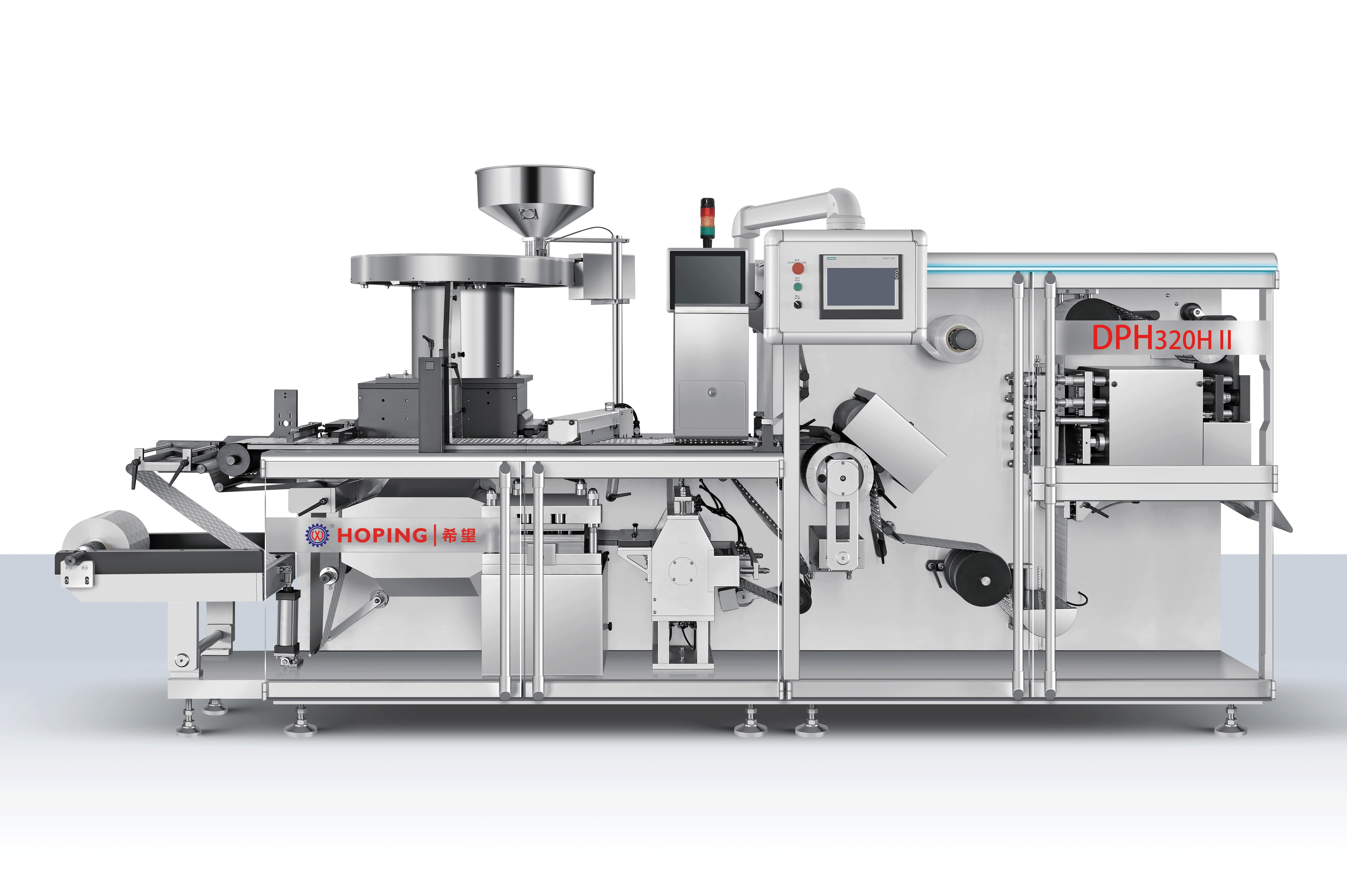
Two boundary conditions deserve equal attention. First, the higher the speed class, the higher the connected load and clean-air demand, which affects plant utility planning rather than the machine itself. Second, roller and flat-plate machines require tooling built around confirmed blister formats; until the format is frozen, capacity figures remain indicative.
Cartoning and Downstream: Where Line Speed Is Balanced
A cartoner is normally specified below the blister machine's maximum output, because the cartoner also has to absorb leaflet insertion, closing and coding time. The conversion is arithmetic: if a format holds two blisters per carton, an output of 700 blisters/min corresponds to roughly 350 cartons/min of demand, which sits comfortably within a 400-500 cartons/min cartoner.
| Module | Model | Capacity | Power | Notes |
|---|---|---|---|---|
| Horizontal cartoner | XWZ120 | 30-120 cartons/min | 380V 50Hz, 3.5 kW | Carton magazine 600-700 pieces; balcony-style frame for cleaning; SEW gear motor and Siemens control; eccentric suction-counter suction box design |
| High-speed cartoner | XWZ300II | 60-220 cartons/min | 380V 50Hz, 5 kW | Carton forming, insertion and closing; ~4,800 kg |
| Full servo cartoner | XWZ500H | 100-500 cartons/min | 380V 50Hz, 14 kW | Leaflet insertion and coding/inspection integration by configuration; GUK folding unit rated at 500 A4 sheets/min; carton magazine holding 1,800 cartons |
| Bander / overwrapper | XWK4060 / XWG4060 | 30-60 bundles/min | 380V 50Hz, 14 kW | Stretch banding or transparent film overwrapping of cartons and bundles |
| Case packing and palletizing | ICP12 | About 12 cases/min | 380V 50Hz, 25 kW | Case opening, loading, sealing, conveying and palletizing; ~8900 x 3000 x 2400 mm |
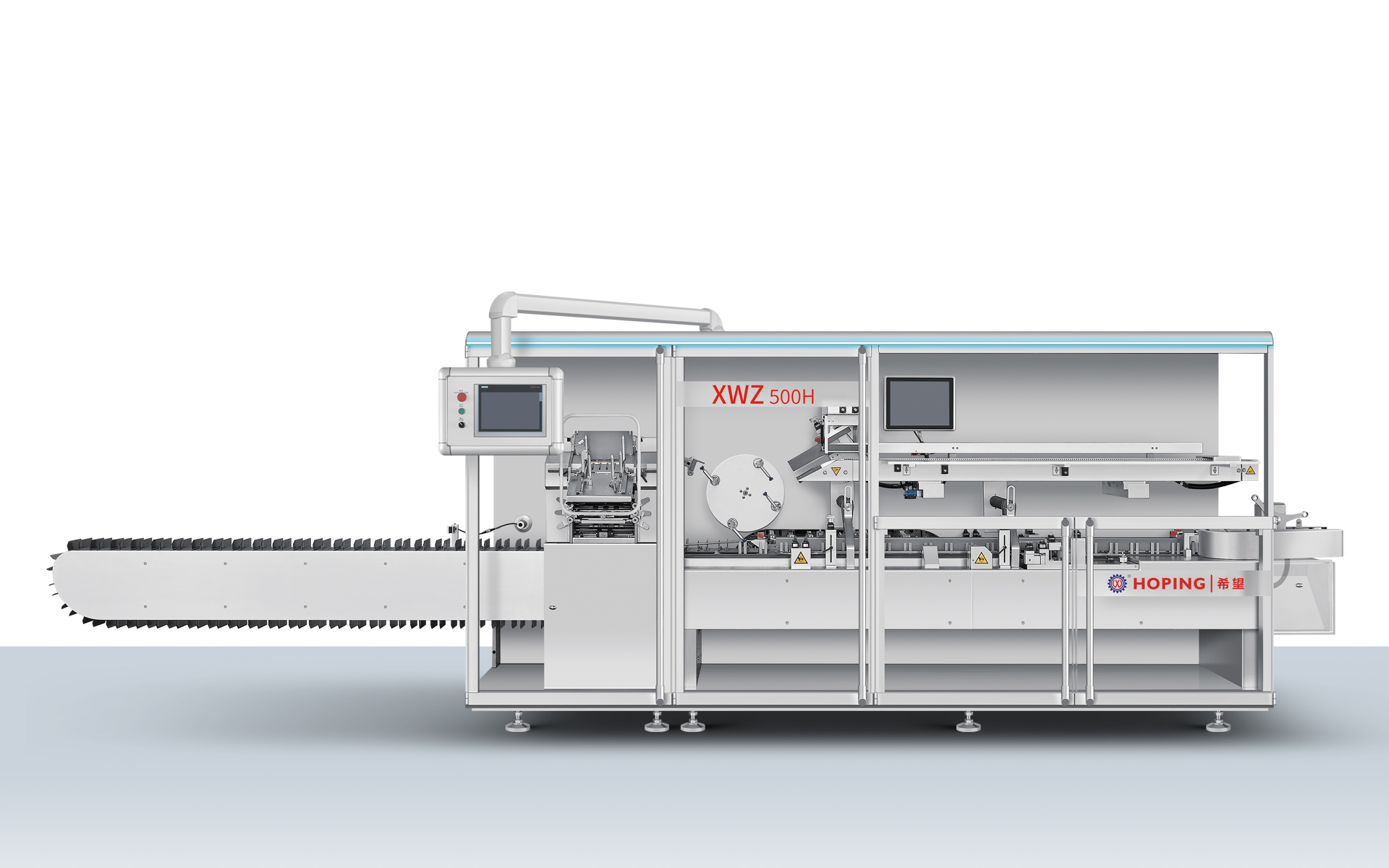
Downstream modules are frequently underestimated during evaluation. The XWK4060 stretch bander runs at about 30-60 bundles/min and the XWG4060 overwrapper at the same range, while the XWK Series case packer runs at approximately 5 cases/min and the ICP12 case packing and palletizing machine at about 12 cases/min. Where a plant measures success in shipped cases rather than packed cartons, these figures — not the blister machine's headline speed — determine whether the line can clear a shift's output.
What Hoping Machinery Supplies and How Customization Is Scoped
Hoping operates as an ODM/OEM and customizable supplier rather than a fixed-catalogue vendor. Established in 2001, the company reports a factory area of 28,800 ㎡, more than 300 employees, 56 engineers, an annual output of 500 units and an export ratio of 25%, with main markets in Southeast Asia, the Middle East, Eastern Europe, South America and Africa. Its product scope covers blister packing machines, cartoning machines, flow wrappers, bundlers, case packers, palletizers and blister lines for pharmaceutical, food, electronics and cosmetics applications.
The customization scope that buyers can negotiate includes blister size, blister materials, quantity per carton, carton specification, leaflet format, coding and inspection method, feeding method, downstream bundling, case packing and palletizing connection, interface language, electrical component brand and data interface. Monthly capacity is reported at 30-40 units, and typical lead time is 60-120 days after technical confirmation, subject to model, configuration, project complexity and contract terms. Minimum order quantity is one set or one complete line.
Quality control follows a defined sequence: incoming material inspection, key component inspection, assembly inspection, electrical safety check, no-load trial run, material trial, factory acceptance test, customer witness acceptance and pre-shipment inspection. After-sales scope includes on-site installation and commissioning, operator and maintenance training, remote video and phone support, spare parts supply, process-parameter guidance, regular follow-up and troubleshooting, subject to contract and project configuration. Publicly available company information also lists CE and ISO 9001/14001 certifications for the manufacturer; buyers should still verify certificate scope and validity against their own market requirements.
Project Scenarios These Configurations Fit
Linked blister-cartoning systems are specified across five recurring project types: a new solid dosage blister packaging line, an upgrade of an existing packaging line, a high-capacity expansion, an intelligent packaging workshop retrofit, and blister-cartoning-bundling or case-packing downstream integration projects. Each type changes the emphasis of the specification. A new line optimizes layout and utilities from the start; an upgrade is constrained by existing conveyors, room height and the interfaces of equipment already installed.
Operating conditions are equally specific. These systems are designed for GMP-oriented cleanroom or pharmaceutical packaging workshop environments, for continuous high-speed operation, and for multi-batch, multi-format production. Typical special requirements include cleanability and maintainability, reduced false rejection and downtime where configured, non-standard customization, and defined capacity, blister format, carton size, leaflet format and downstream connection.
A representative project profile for this class of equipment involves a large pharmaceutical manufacturer or solid dosage production company ordering 5-10 lines for tablets, capsules and other solid dosage forms, in either new line construction, capacity expansion or an existing line upgrade. Documented project objectives include improving packaging automation, reducing manual transfer, improving blister-to-carton connection efficiency, reducing wrong insertion or missing leaflet risks, and supporting downstream automation integration. Supplier-side claims about results should always be read as stated objectives until verified against authorized project records.
Site Conditions, Utilities and Layout: The Checklist Buyers Underestimate
Utility planning is the most common source of late-stage project delay, because it is usually handled by the plant engineering team rather than the packaging team. The following thresholds are drawn from published machine specifications and are worth confirming before any configuration is frozen.
| Requirement | Typical specification | Where it appears |
|---|---|---|
| Electrical supply | 380V 50Hz for blister machines, cartoners and case packing modules; certain high-speed banders are available in 220V/50Hz or 220V/60Hz versions | DPP260K, DPH320H, XWZ500H, XWK Series |
| Connected load | From 3.5 kW on a horizontal cartoner to 29.5 kW on a high-speed roller blister machine, and 25 kW on a case packing and palletizing unit | XWZ120, DPH320H, ICP12 |
| Clean compressed air | 0.5-0.7 MPa; consumption from >0.15 m³/min (cartoners, banders) to >0.6 m³/min (roller blister machine) | XWZ120, XWK4060, DPH320H |
| Footprint and headroom | From about 3650 x 1330 x 1700 mm for a compact cartoner to about 8900 x 3000 x 2400 mm for a combined case packing and palletizing unit | XWZ120, ICP12 |
| Environment | GMP-oriented cleanroom or pharmaceutical packaging workshop; transparent guarding and easy-clean surfaces | Line-level design requirement |
Two further items belong on the same checklist: interface language and electrical component brand, both of which are customisable, and the data interface where an ERP/MES connection is required. These are configuration decisions rather than afterthoughts, because they affect both operator training and long-term spare parts planning.
Market Signals Shaping 2026 Procurement
Three market characteristics are relevant to buyers building a shortlist. First, demand is concentrated in Asia Pacific, which held the largest revenue share of 40.7% in the pharmaceutical packaging equipment market in 2025 (Grand View Research). Second, the market remains fragmented at the top: the three largest blister packaging machine players — Uhlmann, IMA and Marchesini — collectively hold approximately 29% of that segment (Market Intelligence Report), which means most projects are supplied by regional and specialist manufacturers operating to the same equipment standards. Third, secondary packaging is a substantial category in its own right: the global cartoning machinery market in the pharmaceutical sector was valued at USD 1.46 billion in 2024 (Fortune Business Insights).
On the standards side, pharmaceutical packaging machines are expected to comply with ISO 15378, which integrates GMP requirements for primary packaging materials, and EU market access for packaging machinery is governed by the Machinery Directive 2006/42/EC together with the EN 415 series for packaging machines. For a buyer, these references translate into documentation requests rather than marketing claims: a declared compliance statement, a risk assessment, guarding conformity and traceable test records.
How Automatic Lines Compare with Manual and Standalone Setups
Automation is not automatically the right answer for every project. The comparison below is a decision aid, not a ranking.
| Criterion | Manual / semi-automatic | Standalone automatic machines | Linked blister-cartoning line |
|---|---|---|---|
| Output consistency | Operator-dependent; tends to drift across shifts | Stable within one machine's envelope | Stable when module speeds are balanced |
| Manual transfer | High, between each step | Moderate, between machines | Reduced; transfer handled by robot or conveyor |
| Insertion and leaflet risk | Human-error exposure | Depends on cartoner and feeding design | Addressable through vision inspection and rejection |
| Format changeover | Fast but not repeatable | Tooling change per machine | Recipe memory and mold change; requires tooling sets |
| Capital and utilities | Lowest | Moderate | Highest: higher connected load and clean-air demand |
| Downtime exposure | Localized to one station | Localized to one machine | A single module fault can stop the linked section |
Future Outlook
The direction of equipment development is toward configurability rather than raw speed alone. Full servo drive, intelligent transfer robots, independent servo-driven replenishment, automatic splicing of PVC and aluminium foil, recipe memory and integration with ERP/MES data interfaces have moved from premium options to specification points that buyers now ask about directly. The practical effect is that the decisive competitive question is shifting from “how many blisters per minute” to “how quickly and repeatably can this line change between products, and how much of that change is documented.”
For buyers, the sensible response is to freeze formats earlier, request utility and tooling documentation as part of the technical agreement, and treat acceptance testing as a project milestone rather than a formality. For manufacturers, the equivalent pressure is on engineering documentation quality, because a line that runs well but cannot be validated cleanly still fails a pharmaceutical project.
Frequently Asked Questions
A blister packaging machine forms the blister cavity, seals the lidding material and punches the finished blister. A blister cartoning line links that machine to a cartoner and downstream modules so blisters are transferred, inserted into cartons, coded and inspected without manual handling. The two are measured in different units: blister output in blisters per minute, for example up to 700 blisters/min on the DHL7005H, and cartoning output in cartons per minute, up to 500 on the same line.
The decision usually rests on batch size, target output, blister format area and material structure. Flat-plate machines in the DPP family run at roughly 20-70 cycles/min with connected loads around 5.6-12 kW, and are commonly applied to small and medium batch production. Roller machines in the DPH family run at roughly 60-200 cycles/min with loads around 15.5-18.9 kW; the DPH320H offers a 320 x 280 mm forming area with a 12 mm forming depth. Higher speed also means higher clean-air demand, so plant utilities must be checked before the family is selected.
The core list is electrical supply, connected load, clean compressed air, footprint and environment. Most blister machines, cartoners and case packing modules specify 380V 50Hz; some high-speed banders are available in 220V/50Hz or 220V/60Hz versions. Clean compressed air is typically 0.5-0.7 MPa, with consumption ranging from more than 0.15 m³/min on cartoners and banders to more than 0.6 m³/min on a high-speed roller blister machine. Footprint ranges from about 3650 x 1330 x 1700 mm for a compact cartoner to about 8900 x 3000 x 2400 mm for a combined case packing and palletizing unit.
The verification sequence published for this equipment category runs through incoming material inspection, key component inspection, assembly inspection, electrical safety check, no-load trial run, material trial, factory acceptance test, customer witness acceptance and pre-shipment inspection. In practice, buyers should confirm that the material trial uses their own blister format, carton and leaflet, that inspection and rejection functions are demonstrated rather than described, and that the test records identify the machine and the configuration tested.
An integrated line is usually not the best fit where batch volumes are small, where formats change frequently, where the plant cannot supply 380V/50Hz power and 0.5-0.7 MPa clean compressed air, or where a stoppage in a linked section is unacceptable. Integrated lines also require format-specific tooling and carry typical lead times of 60-120 days after technical confirmation. In those situations, standalone blister and cartoning machines with an intermediate buffer or manual transfer are often more appropriate.
Every confirmed blister format, carton size and leaflet format generates its own tooling, so multi-product production depends on how quickly those tooling sets can be exchanged and how much of the changeover is handled by stored parameters. Machines in this category support mold change and recipe memory functions, which reduce the number of manual adjustments per changeover. The limiting factor for planning purposes is not the changeover mechanism but the number of tooling sets purchased and how they are stored, identified and validated.
Reference material: the manufacturer's full pharmaceutical packaging machinery catalog is available for download at https://cdn.socialarks.com/sbsp/24974/common/2026/0613/Hoping%20Machinery%20Catalog.pdf. The catalog is provided as configuration reference only; buyers should confirm current specifications, tooling scope and certification documents directly against their own project requirements.
Have Questions or Need More Details?
Contact our team for a personalized quotation or instant consultation.
Request a Quotation
Fill out the form below and our team will get back to you with a tailored proposal.
WhatsApp Direct Chat
Prefer to chat in real-time? Message us on WhatsApp for instant assistance & quick answers.
- Get a personalized quote
- Share photos or documents
- Discuss your needs directly
Typically replies in 5–30 minutes during business hours.