
Pharmaceutical Packaging Machines: Trends in Integrated Blister-Cartoning
The global pharmaceutical packaging equipment market reached an estimated USD 10.71 billion in 2024, driven by rising demand for speed, compliance, and flexible production. Within this landscape, the pharmaceutical packaging machine segment is evolving rapidly, particularly in the integration of blister and cartoning functions into seamless, high-speed lines. Zhejiang Hoping Machinery Co., Ltd., established in 2001, is a specialized manufacturer of such integrated solutions, combining R&D, production, marketing, and service under one roof.
The Efficiency Imperative in Pharma Packaging
Pharmaceutical manufacturers face increasing pressure to reduce manual handling, minimize contamination risks, and accelerate time-to-market. Traditional stand-alone blister packaging machines and cartoning machines require separate operators, intermediate transport, and additional space. An integrated pharmaceutical packaging line addresses these pain points by linking blister forming, sealing, leaflet insertion, carton opening, and closing in a single automated flow. This not only cuts labor and footprint but also improves overall equipment effectiveness (OEE).
HOPING’s Approach: Fully Servo Blister-Cartoning Lines
HOPING’s portfolio includes a range of automatic blister-cartoning lines classified as intelligent fully servo high-speed blister-cartoner integrated machines. These lines, such as the DHL series, are designed for solid dosage turnkey packaging and are built with stainless steel and aluminum-alloy structures, transparent safety guards, and GMP-oriented layouts. Key models include the DHL8005H, which achieves up to 800 blisters per minute and 500 cartons per minute, and the DHL1000/5H, capable of 1000 blisters per minute. Both feature Beckhoff motion controllers, CP9315 industrial PCs, and D3 intelligent top-loading parallel tracking transfer systems.
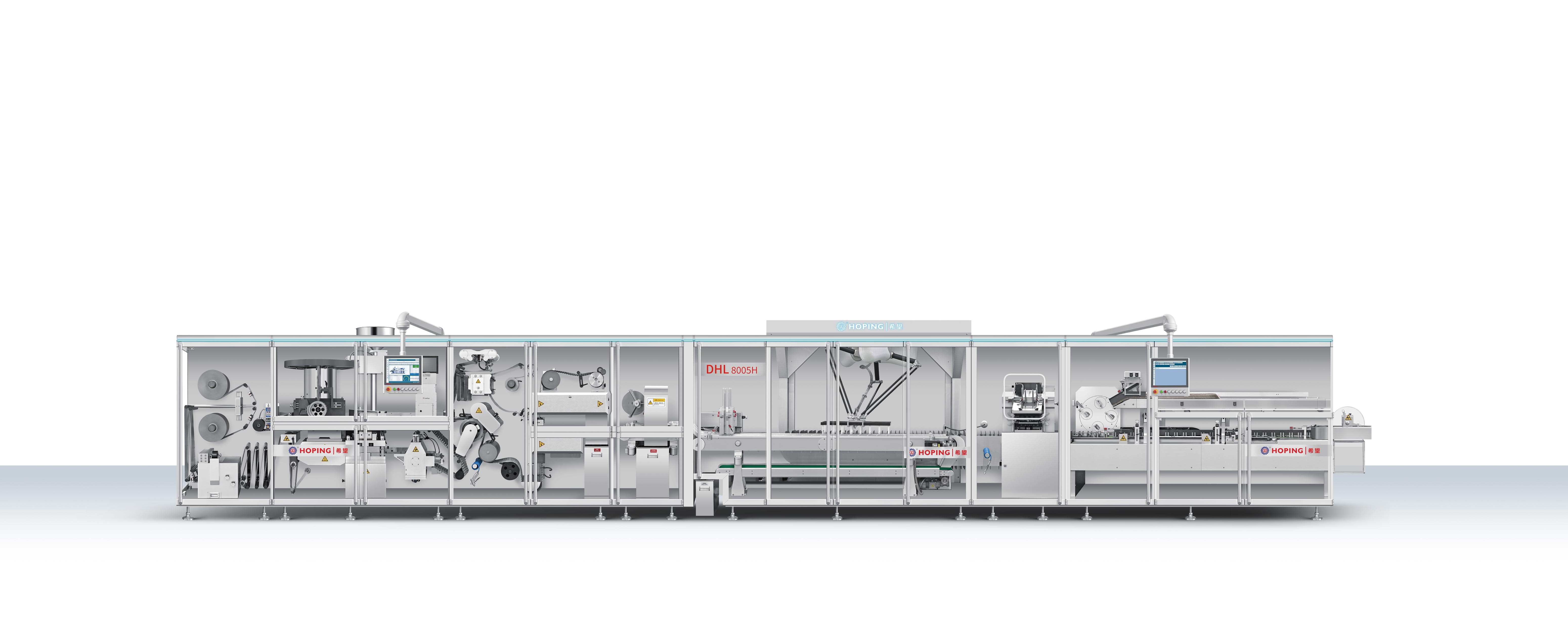
The blister packaging machine front-end of these lines uses roller technology for Alu-PVC and Alu-Alu formats, with models like DPH320HII (up to 1000 blisters/min) offering features such as PID-controlled PVC preheating, dual water-cooling heat sealing, and vision inspection for 100% online quality control. On the cartoning side, high-speed cartoning machines like the XWZ500H (100–500 cartons/min) integrate servo-driven carton magazines, leaflet folders, and batch coding stations.
Technical Architecture of the Integrated Line
The core innovation lies in the synchronous servo linkage between blister output and carton input. A D3 intelligent top-loading parallel robot transfers blisters from the blister punch to the cartoner in-feed, maintaining speed matching and reducing product drop. PVC and aluminum foil are automatically spliced without stopping the line. The control system (Beckhoff or Siemens) handles recipe management, allowing quick format changeovers via mold-change and preset-memory functions. These features are critical for multi-batch, multi-format production environments common in solid dosage pharmaceutical, nutraceutical, food, and cosmetic packaging.

Application Scenarios and Typical Projects
HOPING’s blister cartoning lines are deployed globally in solid dosage pharmaceutical production, nutraceutical manufacturing, food packaging, cosmetic packaging, and daily chemical industries. Typical projects include new line installations, capacity expansion, and intelligent workshop retrofits. The lines can be configured with downstream bundling (XWK4060 stretch bander, up to 60 bundles/min), case packing (ICP12, up to 12 cases/min), and palletizing for a complete end-of-line solution. For liquid dosage formats such as pre-filled syringes and ampoules, the IXW400 integrated line delivers up to 400 blisters/min and 150 cartons/min with specialized handling.
Market Trends and Outlook
The pharmaceutical blister packaging machine market is projected to reach USD 2.57 billion by 2025, with Asia Pacific holding the largest revenue share (40.7% in 2025). The top three global players (Uhlmann, IMA, Marchesini) collectively account for about 29% of the market, indicating room for specialized manufacturers like HOPING to gain share through integrated, cost-effective solutions. The industry trend is moving toward fully servo-driven, GMP-compliant lines that can handle multiple blister and carton formats with minimal changeover time.
Integrated vs. Standalone: A Balanced View
Compared to buying separate blister and cartoning machines, an integrated line reduces intermediate buffers, labor, and floor space. However, it requires a higher initial investment and careful alignment of line speeds. HOPING addresses this with modular designs that can be started as a simple blister-cartoner link and expanded downstream. One honest limitation is that integrated lines may be less flexible for extreme product variety, but with recipe memory and quick-change tooling, HOPING’s equipment offers practical versatility for most mid-to-high volume production.
Frequently Asked Questions
Q: What is the maximum output of HOPING’s blister-cartoning lines?
A: The DHL1000/5H achieves up to 1000 blisters per minute and 500 cartons per minute, making it suitable for high-capacity solid dosage packaging.
Q: Are HOPING machines compliant with pharmaceutical regulations?
A: Yes, the lines are designed with GMP-oriented construction, using stainless steel and aluminum-alloy with easy-to-clean surfaces. Product-contact parts meet FDA-compliant pharmaceutical-grade materials.
Q: What industries beyond pharmaceuticals can use these machines?
A: HOPING’s blister packaging and cartoning equipment also serves nutraceutical, food, cosmetic, and daily-use product industries, as per the company’s product scope.
Download HOPING Machinery Catalog (PDF)
Have Questions or Need More Details?
Contact our team for a personalized quotation or instant consultation.
Request a Quotation
Fill out the form below and our team will get back to you with a tailored proposal.
WhatsApp Direct Chat
Prefer to chat in real-time? Message us on WhatsApp for instant assistance & quick answers.
- Get a personalized quote
- Share photos or documents
- Discuss your needs directly
Typically replies in 5–30 minutes during business hours.