
Pharmacy Automation Evaluation: Certifications, Specs & Traceability
Evaluating Automated Pharmacies: Compliance Before Capability
The pharmacy automation market is expanding quickly, but procurement evaluation is ultimately a test of constraints—certification coverage, physical footprint, throughput numbers, and traceability depth—before it is a test of brand preference.
The global pharmacy automation devices market was estimated at USD 6.7 billion in 2024, according to Insightace Analytic, and is projected to grow to USD 11.6 billion by 2030 at a compound annual growth rate of 9.9%, based on Grand View Research data. Hospital pharmacies accounted for the largest share of this demand in 2024, reflecting high patient volumes and complex medication regimens. For a hospital pharmacy team moving from initial research into formal supplier evaluation, the central question is not whether automation can improve dispensing performance. The question is which system—with which certifications, configurations, and barcode-driven verification capabilities—can satisfy the hospital's specific operational constraints.

Haier Biomedical Technology (Suzhou) Co., Ltd operates a 13,000 m² facility in Suzhou, China.
Why Pharmacy Automation Evaluation Begins with Constraints
Automation in hospital pharmacy is often justified by workload and medication safety. Industry reporting from Omnicell indicates that approximately 75% of pharmacist time can be spent on non-clinical tasks, and pharmacy automation has been reported to reduce drug wastage by up to 90% in certain clinical settings. These benefits explain why automated medication dispensing, prescription verification, and drug traceability systems are now considered mainstream technology rather than experimental infrastructure. The same benefits, however, also raise the cost of getting a purchasing decision wrong.
During the Research and Evaluation stages, buyers are typically comparing systems against a defined set of constraints: EU or local market certification, physical dimensions and available pharmacy space, medication types and SKU counts, peak prescription volume, integration requirements with the hospital information system (HIS), and long-term service capacity. Barcode scanning is one of the most important technical constraints because it directly determines whether a system can identify medications correctly, support first-expiry-first-out inventory control, and create a full traceability chain from storage to patient. A system that cannot demonstrate strong medication identification cannot meet the traceability expectations of a modern smart hospital.
Brand Solution: Haier Biomedical's Modular Dispensing Portfolio
Haier Biomedical Technology (Suzhou) Co., Ltd is a healthcare technology company under Haier Group, specializing in intelligent pharmacy automation for hospitals, clinics, and healthcare organizations. The company's product line includes outpatient automated dispensing systems, inpatient pharmacy automation, automated PIVAS systems, and medication management cabinets. Its Suzhou facility spans 13,000 m² and employs roughly 500 people, including an engineering team of 100 engineers. The company holds ISO 13485 medical device quality management system certification and ships products to markets including Southeast Asia, Latin America, the Middle East, and Europe.
For buyers whose evaluation is constrained by regulatory compliance, Haier's dispensing equipment carries verifiable EU conformity documentation. The HOH-KF-Smart Robotic Arm Dispenser is covered by an ISET Voluntary Compliance Certificate (ISETC.000220220323) that references EN ISO 12100:2010 and EN 60204-1:2018. The HOH-KF-1200 automatic dispensing system and HOH-GF high-speed dispenser series are covered by ICR Verification of Conformity certificates (ICR/VC/HB250402 and ICR/VC/HB250403 respectively). The HOH-FB-D400-HD automatic sub-packaging and verification machine holds ICR certificate ICR/VC/HB250802, and the anesthetic medication dispensing cabinet family—including HOH-MJ-01 and HOH-BQ-A—is covered by ICR VoC certificate ICR/VC/HB240501. These certifications give procurement teams a documented basis for checking safety and machine-directive compliance before deployment.
The product architecture is organized around different pharmacy constraints rather than a single dispenser model:
- High-volume outpatient dispensing: The HOH-KF-1200 chute-type dispenser supports more than 1,100 medication types and stores more than 15,000 boxes in a footprint below 12.85 m². It is designed for pharmacies handling 350 to 500 prescriptions per hour.
- Large-scale robotic storage: The HOH-KF-Smart robotic arm dispenser handles at least 1,500 medication types and 20,000 boxes, with a dispensing speed of at least 300 prescriptions per hour and replenishment of at least 700 boxes per hour.
- High-frequency boxed medication dispensing: The HOH-GF (2 Modules) high-speed dispenser stores at least 5,000 boxes and dispenses at a rate of at least 2 boxes per second per channel, with high-precision photoelectric sensors for dispensing detection.
- Unit-dose packaging and verification: The HOH-FB-D400-HD integrates automatic unit-dose packaging with AI-powered visual verification. It packs 40 to 60 packs per minute and checks drug type, quantity, and prescription accuracy in real time.
- Controlled substance management: The HOH-MJ-01 anesthetic medication dispensing cabinet and the HOH-BQ-A intelligent integrated management cabinet support closed-loop control of anesthetic and psychotropic drugs, with 44 compartments in the HOH-MJ-01 and full traceability features designed for hospital 'Five-Specialty Management' requirements.
For a project-based purchase, Haier's manufacturing capability allows customization of equipment size, storage capacity, SKU quantity, robotic modules, software functionality, HIS interface, and language. The minimum order quantity is one unit, lead time is typically 60 to 90 days depending on project configuration, and each system requires a factory acceptance test before shipment. This flexibility matters in the Evaluation stage because pharmacy layout and local medication packaging are rarely identical across hospitals.
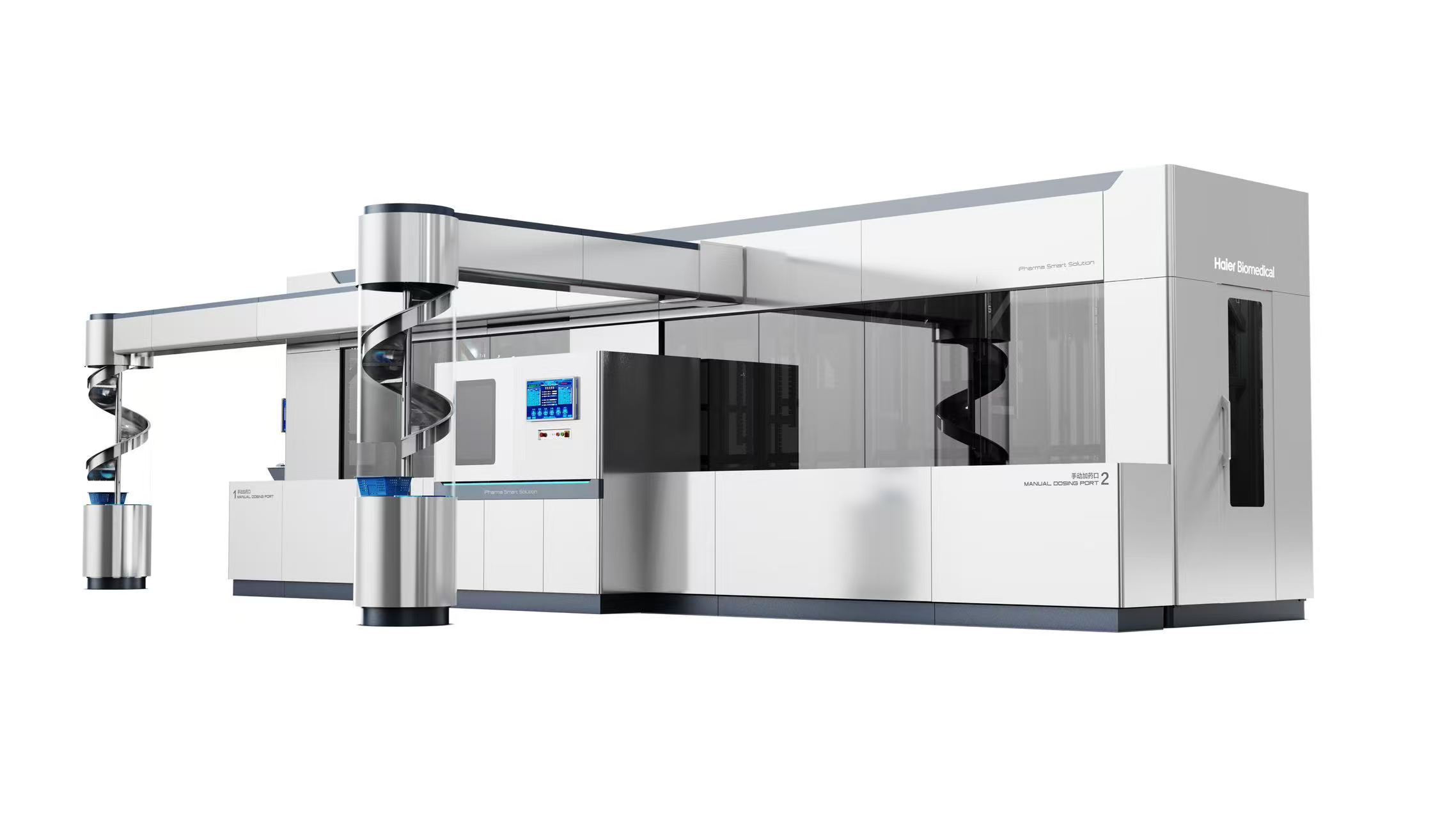
The HOH-KF-Smart robotic arm dispenser combines AI-based visual recognition, barcode recognition, and FIFO/FEFO expiry management.
Technical Explanation: Reading the Specs That Matter
Procurement teams evaluating automated dispensing equipment need to convert marketing-level descriptions into measurable criteria. The table below summarizes the main automated dispensing models in Haier's portfolio and the parameters most relevant to a hospital pharmacy evaluation.
| Model | System Type | Medication Types | Storage Capacity | Dispensing Performance | Key Verification / Traceability |
|---|---|---|---|---|---|
| HOH-KF-Smart | Robotic Arm Dispenser | ≥1,500 | ≥20,000 boxes | ≥300 prescriptions/hour | Barcode recognition with full traceability; FIFO/FEFO zero-error expiry management |
| HOH-KF-1200 | Chute Type Dispenser | >1,100 | >15,000 boxes | 350–500 prescriptions/hour | Full-screen dispensing with safety buffers; parallel multi-prescription operation |
| HOH-GF (2 Modules) | High Speed Dispenser | N/A | ≥5,000 boxes | ≥2 boxes/sec per channel | High-precision photoelectric sensors; automatic positioning guidance with indicator lights |
| HOH-FB-D400-HD | Automatic Sub-packaging and Verification Machine | 400 medication boxes | N/A | 40–60 packs/min | AI-powered visual verification; real-time drug type, quantity, and prescription check |
Two types of technical capabilities deserve close attention in a constrained evaluation: barcode-driven medication identification and integrated verification.
Barcode recognition is not an accessory feature in modern pharmacy automation; it is the structural backbone of track-and-trace. In the HOH-KF-Smart, barcode recognition supports full-chain monitoring, and the system's expiration management uses FIFO (first-in, first-out) and FEFO (first-expiry, first-out) logic. This allows the system to select the correct batch at the moment of dispensing and reduces the risk of expired or near-expired medication reaching patients. In the HOH-GF high-speed dispenser, high-precision photoelectric sensors perform dispensing detection, while automatic positioning guidance with indicator lights helps operators identify error locations quickly. In the HOH-FB-D400-HD, AI-powered visual verification checks the packaged medication against the physician order, closing the loop between unit-dose packaging and prescription verification.
The conformity standards referenced in the EU certificates are also directly relevant to procurement. EN ISO 12100:2010 is a machinery safety standard that defines principles for risk assessment and risk reduction. EN 60204-1:2018 covers electrical equipment safety for machines. A VoC or Voluntary Compliance Certificate that references these standards provides a documented basis for assessing whether a device meets the safety expectations of the intended market. Beyond these, pharmacy automation systems generally need to align with medical electrical equipment standards such as IEC 60601-1 and quality management expectations under ISO 13485, which Haier Biomedical holds.
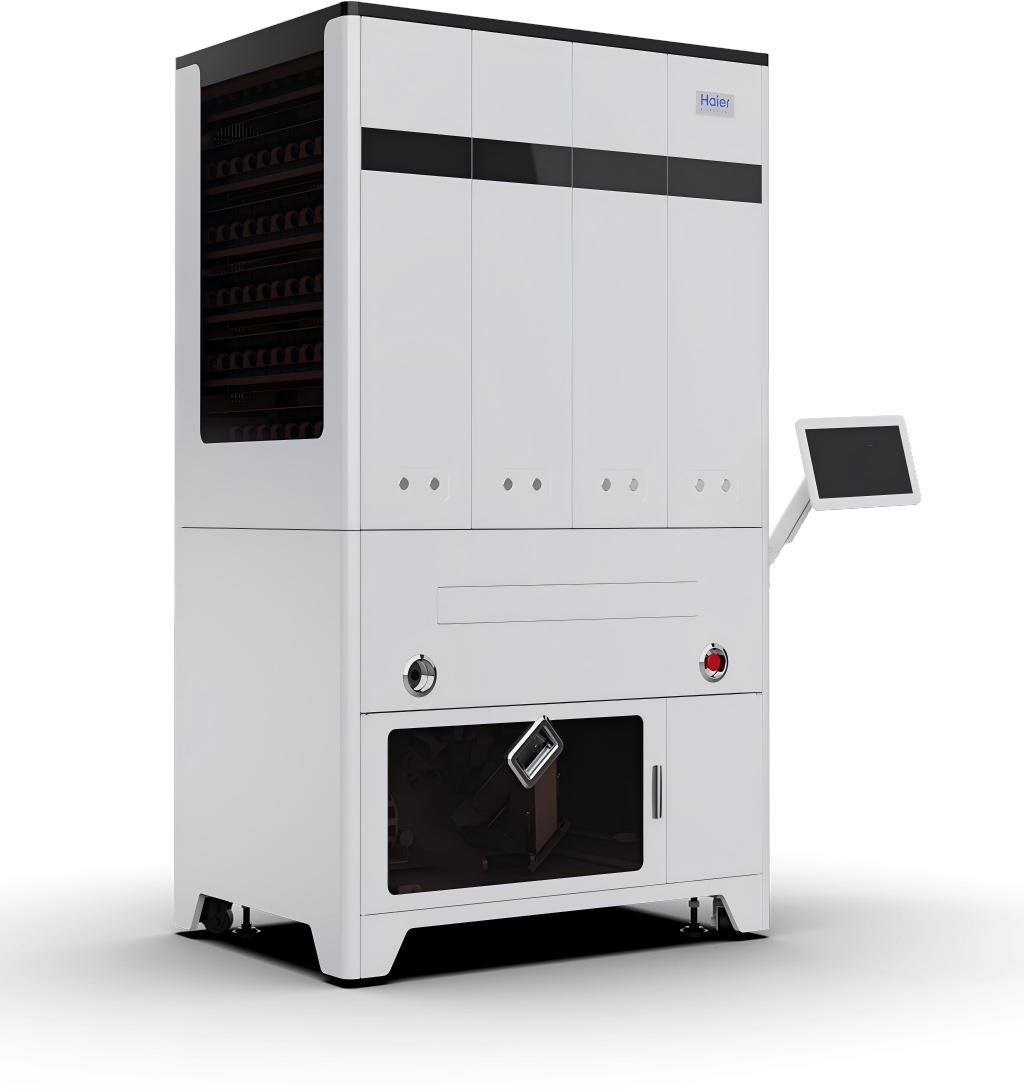
The HOH-FB-D400-HD creates a closed-loop packaging and verification workflow, reducing mispackaging risk through AI visual checks.
Application / Use Cases: Customization in Real Deployments
The practical value of a constraint-based evaluation becomes visible in deployment records. Haier has documented two hospital projects that illustrate how configuration, local packaging compatibility, and HIS integration shape the final solution.
In a private hospital in Thailand, a customized universal dispenser system was installed in the outpatient pharmacy. The system was developed specifically for Thai medication packaging characteristics, which means it can handle local medication formats that a standard machine might struggle with. It supports HIS integration, uses a modular design, and was selected to improve dispensing efficiency during peak hours while reducing repetitive tasks for pharmacists. The project was documented over a 10-year period, and the hospital reported stable automated dispensing performance and improved dispensing accuracy.
In a general hospital in Vietnam, an intelligent pharmacy automation system was deployed in the outpatient pharmacy for automated medication storage, dispensing, and intelligent medication management. The system was customized according to the hospital's pharmacy layout and workflow requirements, with seamless HIS integration supporting intelligent storage, automated dispensing, and end-to-end digital pharmacy management. The reported outcome was a reduction in patient waiting time and an improved patient service experience, achieved by optimizing the dispensing workflow rather than simply adding more staff.
These cases carry a common pattern: the equipment had to match local medication formats, pharmacy layout, and existing information systems. This is why machine availability alone is rarely the deciding factor; the configuration, integration capability, and after-sales support model are equally important procurement constraints.
Market Trend Analysis: From Dispensing Units to Data-Driven Pharmacy
Market data points toward several structural shifts that procurement teams should incorporate into their evaluation criteria.
First, automated medication dispensing is the largest and fastest-moving product segment. Dataintelo estimates that medication dispensing systems accounted for 32.5% of the pharmacy automation market in 2025, and Grand View Research projects an above-10% CAGR for automated medication compounding systems. The implication is that vendors are concentrating R&D on dispensing hardware and associated verification software, making the performance gap between suppliers wider.
Second, software is becoming the differentiator. MarketsandMarkets expects pharmacy automation software to grow at the fastest rate among components between 2024 and 2030. For hospitals, this means a system's ability to generate analytics, support AI-powered prescription analysis, and integrate with future clinical decision support functions is becoming part of the hardware decision. Haier Biomedical's own 2025 annual report attributes 15% of the company's total revenue to AI-powered applications, a signal that AI features are moving from optional extras to core system capabilities.
Third, the market architecture is shifting toward decentralized distribution. Fortune Business Insights expects decentralized distribution models, driven by automated dispensing cabinets, to account for approximately 79.8% of the market in 2026. This explains growing demand for cabinets and compact dispensing systems placed close to clinical wards, in addition to central outpatient pharmacy automation.
Regionally, North America still holds the largest share of global revenue—estimated between 38.2% and 47.8% in 2024 by Dataintelo and MarketsandMarkets. In Asia, the China market is expected to grow at a 5.6% CAGR from 2025 to 2030, and overseas markets such as Southeast Asia and the Middle East are actively adopting automated pharmacy systems. Haier Biomedical reported that its overseas revenue grew 17.9% year-on-year to 840 million yuan in 2025, a sign that Chinese automation suppliers are becoming more relevant to hospital procurement beyond the domestic market.
Comparison with Traditional Solutions and Practical Boundaries
Comparing automated dispensing with traditional shelving is not a simple efficiency argument; it is a workflow design decision. Traditional pharmacy shelves rely on pharmacists to locate and retrieve medications manually. A carousel or automated storage system identifies the required medication position and brings it to the dispensing point, reducing walking time and manual search. Similarly, traditional visual inspection of dispensed drugs is replaced by barcode scanning and AI-based visual verification in automated workflows, which can reduce mispackaging risk by checking drug type, quantity, and prescription accuracy before the medication reaches the patient.
However, automation has real boundaries that buyers should acknowledge during evaluation:
- Automation does not replace clinical judgment. Automated prescription verification checks the dispensed medication against prescription data, but it does not assess drug interactions, allergies, or patient-specific appropriateness. The pharmacist remains responsible for the final clinical review.
- Physical footprint can be a binding constraint. The HOH-KF-Smart main unit is 8,650 mm wide before the replenishment module is added. A hospital with limited space may need a chute-type dispenser such as the HOH-KF-1200, which occupies under 12.85 m², or a compact high-speed dispenser such as the HOH-GF.
- Automation is throughput-dependent. For a very low prescription volume, conventional shelving with manual picking may remain the more cost-effective option. The investment thesis for automation strengthens as prescription volume, SKU complexity, and labor costs increase.
These boundaries help procurement teams define when a given technology is appropriate and when it is not, instead of assuming that more automation is always better.
Future Outlook: Toward Medication-Ready Data Platforms
The next phase of pharmacy automation is likely to be defined by data integration, not just mechanical throughput. Hospitals are beginning to expect features such as intelligent inventory management, drug expiration monitoring, intelligent replenishment, medication reminders, and drug interaction detection as part of the pharmacy software platform. As dispensing systems become connected to HIS and EMR environments, the boundary between physical dispensing and clinical data analytics is dissolving.
For system suppliers, the implication is that hardware must be designed with open interfaces and scalable software architecture. Haier Biomedical's orientation toward this direction can be seen in its engineering structure: a 100-engineer team, OEM/ODM customization for HIS interfaces and language, FAT testing before shipment, and global after-sales support covering remote technical support, on-site installation, operator training, software upgrades, and spare parts supply. The company's main markets include Southeast Asia, Latin America, and the Middle East, where hospital pharmacy workloads and medication formats often differ significantly from Western markets.
Procurement teams that prepare for this shift will evaluate vendors not only on current dispensing speed and certification documents, but also on the vendor's ability to support a longer-term roadmap of automation, data analysis, and eventually unmanned or semi-unmanned pharmacy operations. A detailed overview of Haier's full-scenario intelligent pharmacy portfolio is available in the company brochure: Full-scenario Intelligent Pharmacy (PDF).
FAQ
Is pharmacy automation suitable for every hospital?
Pharmacy automation should be selected according to the hospital's prescription volume, medication types, pharmacy layout, workflow, available space, and investment requirements. Different automation solutions—including robotic arm dispensers, chute-type dispensers, and high-speed dispensers—address different pharmacy scenarios. For a pharmacy with a large volume of boxed medications and a high priority on dispensing accuracy, a robotic arm dispenser may be the appropriate choice. For an outpatient pharmacy with a very high daily prescription volume, a chute-type dispenser that supports simultaneous dispensing and replenishment is often more suitable. The final configuration should be based on the hospital's specific operational requirements and site conditions.
What types of hospitals are suitable for a Robotic Arm Dispenser?
A robotic arm dispenser is suitable for hospitals that handle a relatively large number of boxed medications and require automated storage and dispensing. Haier's HOH-KF-Smart can be configured with multiple modules and integrated into the overall pharmacy workflow according to medication volume, available space, and dispensing requirements. The system performs automated picking and placement based on system instructions, moving medications between configured storage locations and dispensing points.
What is the difference between a Carousel Dispenser and traditional pharmacy shelves?
A carousel dispenser provides organized medication storage and automated access to configured medication positions, while traditional shelves rely more heavily on pharmacists to locate and retrieve medications manually. The carousel identifies the required medication position and rotates or moves the storage structure to bring the corresponding medication location to the dispensing position. Haier carousel solutions can be configured for outpatient pharmacy workflows based on SKU requirements, medication volume, and available space.
Can pharmacy automation reduce medication picking errors?
Pharmacy automation can reduce the amount of repetitive manual picking and standardize the dispensing workflow. When automated dispensing is combined with a medication verification process, such as an automatic sub-packaging and verification machine, the workflow provides an additional check on medication information before dispensing. This helps reduce the risk of incorrect drug type, quantity, or packaging reaching the patient.
How can an automated dispensing machine improve pharmacy efficiency?
Automated dispensing equipment transfers repetitive medication picking and dispensing tasks from manual operation to automated equipment. This allows pharmacists to spend less time on routine handling and more time on professional pharmacy services. Haier's robotic arm dispenser and chute-type dispenser can be configured according to different pharmacy workflows and dispensing requirements to achieve this efficiency gain.
Can pharmacy automation systems integrate with a hospital HIS?
Yes. Pharmacy automation solutions can be integrated with hospital information systems to support automated prescription processing and dispensing workflows. Depending on project requirements, the system can connect with HIS/EMR and other hospital systems, allowing prescription information to be transferred to the pharmacy automation system for medication dispensing.