
Pharmacy Automation Fit Guide: Which System Suits Which Department
Pharmacy Automation Fit Guide: Which System Suits Which Department
Hospital pharmacy automation is usually debated as a single yes-or-no decision. In practice it is a matching problem. A cytotoxic compounding robot in a PIVAS and a dispensing machine in a ground-floor outpatient pharmacy solve different problems, occupy different footprints, and depend on different data flows from the hospital information system (HIS). The planning question that actually determines whether a project succeeds is narrower: which system fits which department, and under what constraints does that fit hold?
Haier Biomedical Technology(Suzhou)Co., Ltd is a healthcare technology company under Haier Group, founded in 2015 and based in Suzhou, China, with a 13,000 m² manufacturing facility, approximately 500 employees and a 100-engineer R&D team. Its pharmacy automation business unit develops medication storage, automated dispensing, verification, IV compounding and inventory management systems for hospitals, clinics and healthcare organizations, and the company holds ISO 13485 medical device quality management system certification. The portfolio referenced throughout this guide includes the Anesthetic Medication Dispensing Cabinet HOH-MJ-01, the Intelligent Integrated Management Cabinet HOH-BQ-A, the Fully Automated Cytotoxic Drug Compounding Robot HOH-Robot-Plus, the Robotic Arm Dispenser HOH-KF-Smart, the Chute Type Dispenser HOH-KF-1200, the High Speed Dispenser HOH-GF(2 Modules) and the Automatic Sub-packaging and Verification Machine HOH-FB-D400-HD.
Why fit, not feature lists, decides pharmacy automation projects
The global pharmacy automation devices market was estimated at USD 6.7 billion in 2024 (Insightace Analytic) and is projected to reach USD 11.6 billion by 2030, a compound annual growth rate of 9.9% (Grand View Research). Published estimates for 2024 range from USD 6.65 billion to USD 7.52 billion depending on which hardware, software and service categories are counted — a divergence that itself signals how heterogeneous the category is. Hospital pharmacies accounted for the largest segment share in 2024, driven by patient volume and complex medication regimens (Fortune Business Insights).
The operational pressure behind that spending is well documented. Omnicell has reported that roughly 75% of pharmacist time has traditionally been absorbed by non-clinical tasks, which is one reason hospitals examine automation as a way to move repetitive picking, storage and inventory work away from the pharmacist's desk. Category-level purchasing does not deliver that outcome on its own. A system specified against the wrong department profile produces the opposite of the intended result: capital committed to equipment running below its design workload, while the department that actually bottlenecks the medication process stays manual.
Three constraints decide whether a system fits
Three constraint families tend to explain whether a given system will be productive in a given hospital, and they are not interchangeable with each other.
- Drug class and department function. Anesthetic and psychotropic drugs, cytotoxic preparations and general boxed medications are handled under different regulatory regimes, different access-control requirements and different physical handling methods. A cabinet designed for controlled-substance custody is not a substitute for a high-volume boxed medication dispenser, and vice versa.
- Physical space and room environment. Footprints in this category range from roughly 620 × 700 mm for a storage cabinet to an 8,650 mm main unit for a robotic dispensing system. Some systems additionally require a defined cleanroom classification or an operating temperature and humidity band.
- Information flow. Automated dispensing depends on prescription data arriving in a usable form. HIS or EMR integration is listed as supporting equipment for automated dispensing scenarios, and where a facility cannot expose prescription information reliably through a defined interface, the workflow gain from automation is limited regardless of equipment quality.
A scenario-to-system fit map
The following mapping is drawn from the specified parameters of each system and the hospital scenarios they are documented for. It is a starting point for technical discussion, not a substitute for a site survey.
| Hospital scenario | Core requirement | Fitting Haier system | Key documented parameters |
|---|---|---|---|
| Outpatient, emergency and inpatient pharmacies | Controlled-substance custody, access control and traceability | Anesthetic Medication Dispensing Cabinet HOH-MJ-01 | 9 drawers, 44 compartments, 745 × 700 × 1800 mm, 15-inch touch screen, 220 V / 400 W |
| High-volume outpatient pharmacy with tight floor area | High prescription throughput in a compact footprint | Chute Type Dispenser HOH-KF-1200 | Space requirement < 12.85 m², > 350–500 prescriptions/hour, > 2400 boxes/hour replenishment, ≥ 2 buffer channels |
| High-volume outpatient pharmacy with wide SKU range | Large SKU count and deep boxed-medication storage | Robotic Arm Dispenser HOH-KF-Smart | ≥ 1500 medication types, ≥ 20,000 boxes, ≥ 300 prescriptions/hour, FIFO/FEFO, barcode traceability |
| High-frequency boxed medication picking | Dense boxed storage and fast batch dispensing | High Speed Dispenser HOH-GF(2 Modules) | ≥ 100 storage slots, ≥ 5000 boxes, ≥ 2 boxes/sec single channel, 2180 × 1230 × 2800 mm |
| Operating rooms and pharmacy preparation areas | Storage, monitoring and traceability of narcotic and psychotropic drugs | Intelligent Integrated Management Cabinet HOH-BQ-A | 620 × 700 × 1240 mm, 32 small pillboxes (150 pcs each, by 1 mL ampoule), 8 large pillboxes, 23-inch touch screen |
| PIVAS | Cytotoxic compounding under controlled cleanroom conditions | Fully Automated Cytotoxic Drug Compounding Robot HOH-Robot-Plus | 25 preparations/hour, 100% compounding accuracy, > 95% vial compatibility, Class 100 (ISO 5) environment |
| Inpatient unit-dose distribution | Packaging with real-time verification of drug type and quantity | Automatic Sub-packaging and Verification Machine HOH-FB-D400-HD | 400 medication boxes, 40–60 packs/min, 75 × 70 mm bags, 0–40 °C and 10–80% humidity |
Outpatient, emergency and inpatient pharmacies: controlled-substance handling
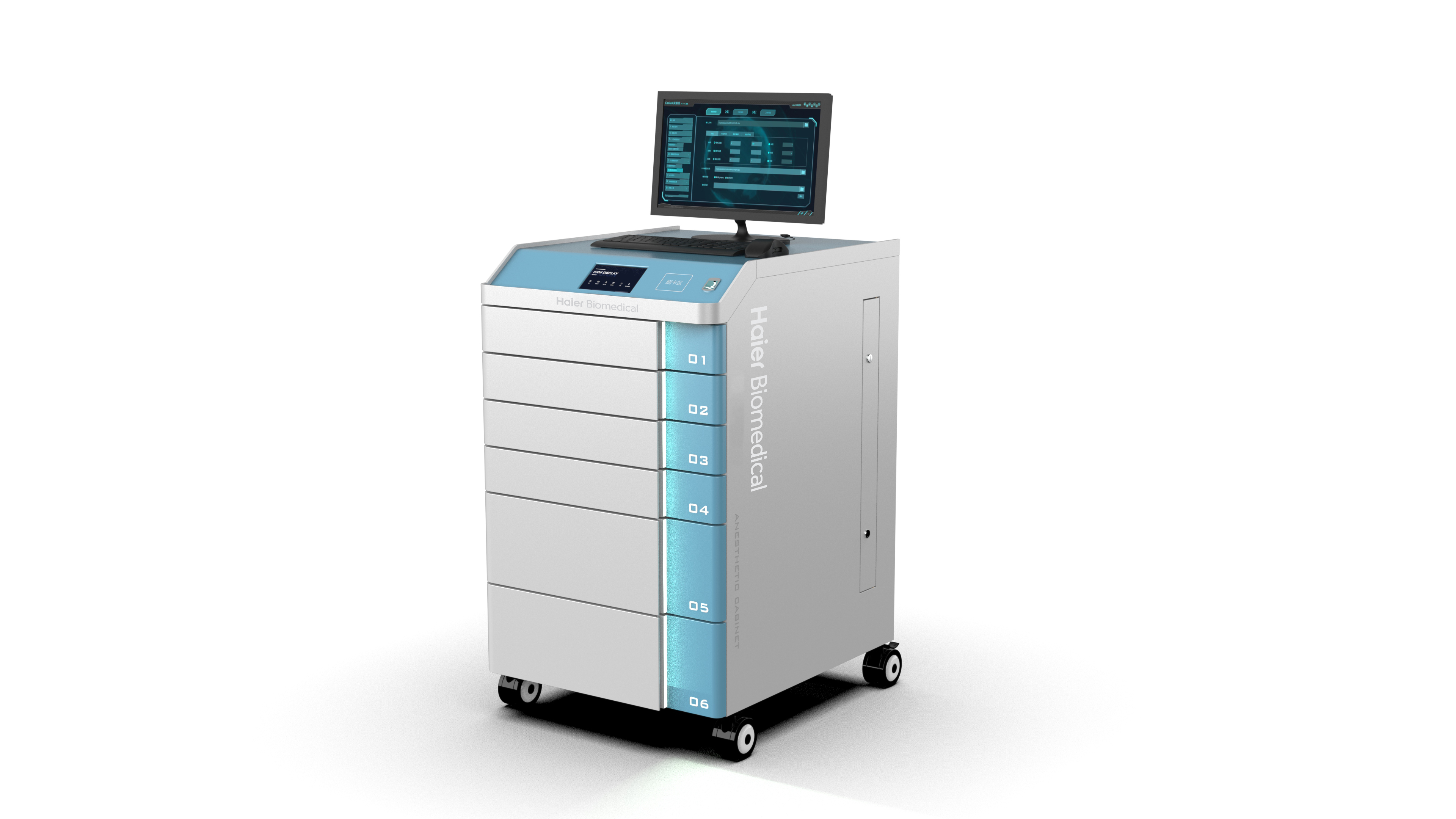
The Anesthetic Medication Dispensing Cabinet HOH-MJ-01 is a full-process intelligent control device for anesthetic and psychotropic drugs, designed for hospital outpatient pharmacies, emergency pharmacies, inpatient pharmacies and similar settings. It is built around three design principles — safety and compliance, intelligence and efficiency, and closed-loop data — and is aligned with the hospital "Five-Specialty Management" requirements for anesthetic and psychotropic drugs. The practical targets are the recurring weaknesses of manual controlled-substance management: difficult traceability, disordered access control and low inventory accuracy.
In configuration terms, the cabinet provides nine drawers totalling 44 compartments: the first seven drawers use a six-grid layout and the bottom two a single-grid layout, all with lids. Single-layer maximum volume is 28.3 L. Small drawer dimensions are 243 × 128 × 85 mm (42 units) and large drawer dimensions are 477 × 491 × 108 mm (2 units). The unit measures 745 × 700 × 1800 mm, operates on 220 V at 50/60 Hz, draws 400 W, weighs 400 kg, and is operated through a 15-inch touch screen.
Its fit boundary matters as much as its specification. This is a controlled-substance custody device. It does not replace a high-volume outpatient dispenser for general boxed medication, and specifying it as one will leave the outpatient queue unresolved.
Operating rooms and pharmacy preparation areas: narcotic and psychotropic storage
The Intelligent Integrated Management Cabinet HOH-BQ-A is designed for the storage, management and monitoring of narcotic and psychotropic drugs in operating rooms or pharmacy preparation areas. It complies with national regulations for the management of controlled substances and applies those controls to full traceability, precise access and compliant operation across the whole process — the areas where operating-room drug handling is most exposed to documentation gaps.
The main cabinet measures 620 × 700 × 1240 mm, which allows it to be positioned close to the point of use rather than in a central store. Standard configuration includes 32 small pillboxes with a capacity of 150 pieces each (counted by 1 mL ampoule) and 8 large pillboxes with a capacity of 20 pieces each, operated through a 23-inch touch screen on AC 220 V at 50/60 Hz. Because it is a point-of-use cabinet rather than a dispensing engine, it fits departments that need custody and monitoring density, not departments that need prescription throughput.
PIVAS: cytotoxic compounding under Class 100 (ISO 5) conditions
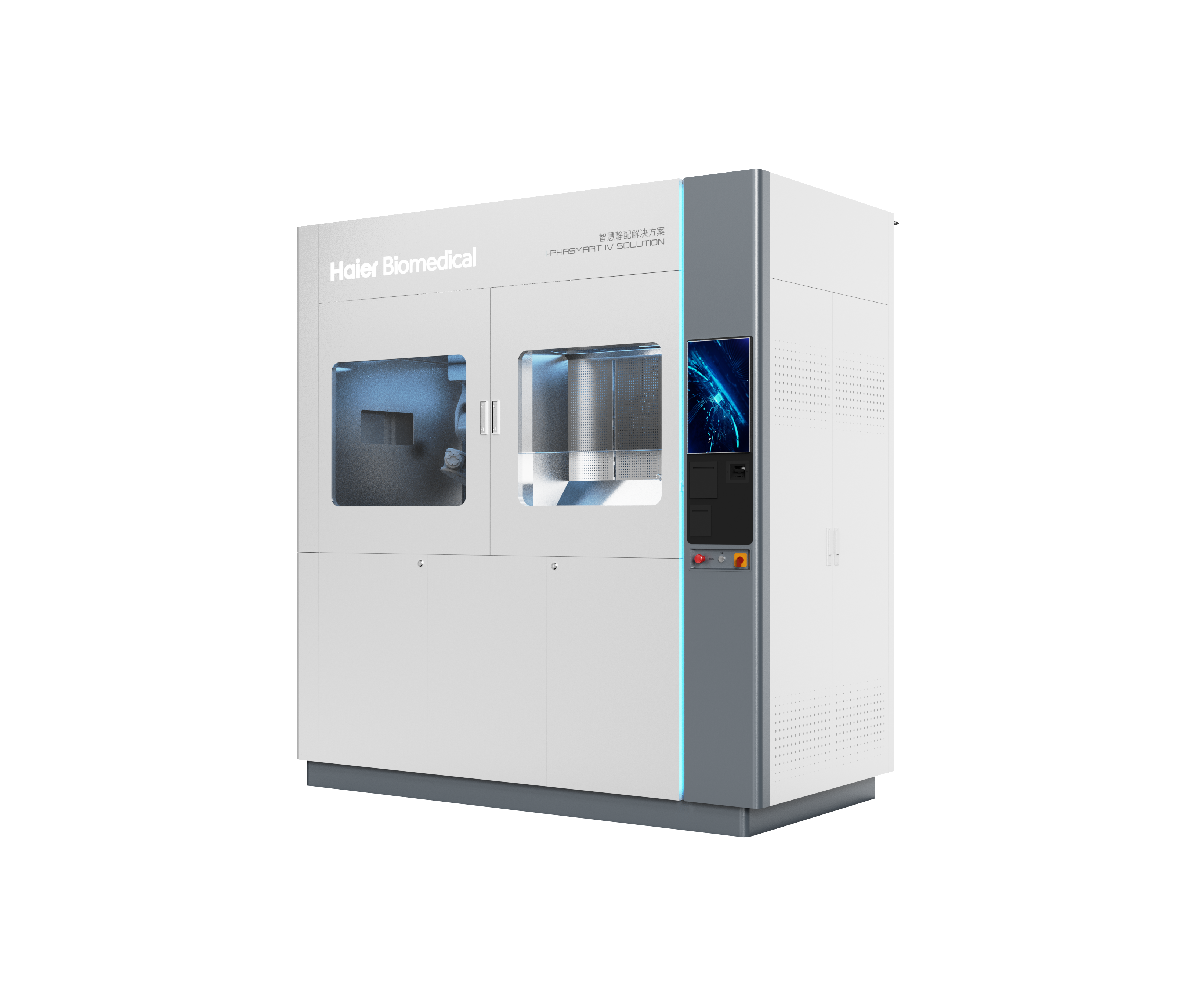
The Fully Automated Cytotoxic Drug Compounding Robot HOH-Robot-Plus performs drug injection, dissolution, aspiration and mixing automatically inside a Class 100 (ISO 5) cleanroom environment, using AI vision recognition and high-precision weighing. Documented compounding efficiency is 25 preparations per hour with 100% compounding accuracy, and vial compatibility exceeds 95% of vial types. Solvent compatibility covers 50–1000 mL soft bags, plastic bottles and stand-up pouches, with Luer-lock general-purpose syringes and dedicated needles as the consumable set. The unit measures 2200 × 1520 × 2370 mm and weighs 1300 kg.
The fit case for PIVAS is occupational rather than purely throughput-driven: the system enables human–machine separation, which removes cytotoxic exposure risk for compounding staff, and supports continuous drug supply together with automatic medical waste classification and storage. The constraint is equally clear. This system belongs only in a facility that operates a PIVAS with cytotoxic compounding demand and has — or will build — the required Class 100 (ISO 5) compounding environment. Without that environment and without adequate floor area for a 2.2 × 1.5 m machine footprint plus service clearance, it is not a viable candidate regardless of budget.
High-volume outpatient pharmacies: two different answers to the same department
Outpatient pharmacies are frequently treated as one scenario, but the binding constraint inside them differs. Where floor space is the limiting factor, the Chute Type Dispenser HOH-KF-1200 is the relevant configuration: its space requirement is under 12.85 m², and it handles more than 1100 medication types and more than 15,000 boxes. Dispensing speed is above 350–500 prescriptions per hour with replenishment above 2400 boxes per hour. Structurally it is modular — dispensing, storage and loading units — and uses full-screen dispensing with safety buffers and parallel multi-prescription operation, with at least two buffer channels supporting side buffering and front-end output. This is the configuration to examine when the objective is parallel multi-prescription throughput in a constrained area.
Where SKU breadth and storage depth are the limiting factors instead, the Robotic Arm Dispenser HOH-KF-Smart is the relevant configuration. It handles at least 1500 medication types and at least 20,000 boxes, dispenses at 300 or more prescriptions per hour with replenishment above 700 boxes per hour, and supports FIFO/FEFO expiry management with barcode recognition across the full chain. It combines industrial-grade robotics with AI-based visual recognition and receives prescription data from the HIS in real time. The main unit measures 8650 × 1747 × 2850 mm, excluding the replenishment module — a footprint that makes it unsuitable for a narrow or awkwardly shaped outpatient area, which is precisely why the two dispenser families are not interchangeable.
For high-frequency boxed medication picking, the High Speed Dispenser HOH-GF(2 Modules) adds dense storage: at least 100 storage slots and 5000 boxes, a single-channel dispensing speed of at least 2 boxes per second, batch dispensing for multiple boxes, high-precision photoelectric dispensing detection, and automatic positioning guidance with indicator lights. Its dual-level stacked structure with adjustable bin width measures 2180 × 1230 × 2800 mm.
Inpatient unit-dose work: packaging bound to verification
The Automatic Sub-packaging and Verification Machine HOH-FB-D400-HD integrates unit-dose packaging with AI-powered visual verification. It is fully interoperable with hospital HIS systems, executes unit-dose dispensing based on physician orders, and verifies drug type, quantity and prescription accuracy in real time, creating a closed loop of "packaging + verification". Documented parameters include 400 medication boxes, a packaging speed of 40–60 packs per minute, 75 × 70 mm packaging bags, a 72-slot external output tray, overall dimensions of 1200 × 880 × 2025 mm, 2000 W rated power, a net weight of 700 kg, and an operating environment of 0–40 °C with 10–80% humidity.
This system fits wards with a unit-dose distribution model and an order stream that can be pushed into the packaging workflow. It does not fit facilities without that unit-dose structure, because the verification loop depends on order-level data, not on packaging hardware alone.
Space is often the binding constraint, not budget
Comparing documented footprints makes the point directly. The parameters below are the manufacturers' stated dimensions and, where applicable, the stated space requirement; real projects must add service access, replenishment routes and operator clearance.
| System | Model | Footprint / space requirement |
|---|---|---|
| Intelligent Integrated Management Cabinet | HOH-BQ-A | 620 × 700 × 1240 mm |
| Anesthetic Medication Dispensing Cabinet | HOH-MJ-01 | 745 × 700 × 1800 mm |
| Automatic Sub-packaging and Verification Machine | HOH-FB-D400-HD | 1200 × 880 × 2025 mm |
| High Speed Dispenser | HOH-GF(2 Modules) | 2180 × 1230 × 2800 mm |
| Fully Automated Cytotoxic Drug Compounding Robot | HOH-Robot-Plus | 2200 × 1520 × 2370 mm |
| Chute Type Dispenser | HOH-KF-1200 | < 4690 × 2850 × 2735 mm; space requirement < 12.85 m² |
| Robotic Arm Dispenser | HOH-KF-Smart | 8650 × 1747 × 2850 mm (replenishment module excluded) |
The spread is more than an order of magnitude in one dimension. A hospital with a constrained outpatient hall and a large SKU list is not choosing between a cheap and an expensive robotic option; it is choosing between a chute-type configuration that fits the room and a robotic configuration that does not, with a different throughput and storage profile attached to each.
HIS integration requirements differ by department
Automated dispensing is documented as operating in fully automatic mode under continuous dispensing conditions, with high reliability requirements and with the Hospital Information System listed as supporting equipment. Haier pharmacy automation solutions are designed to integrate with hospital information systems including HIS and EMR platforms, and customization scope explicitly covers the HIS interface and interface language. What that means in practice varies by department.
- Outpatient pharmacy. The system consumes the live prescription stream and must synchronise dispensing with queue behaviour. Buffer channels and parallel multi-prescription operation on the chute-type dispenser exist precisely because outpatient order arrival is bursty rather than smooth.
- Inpatient ward and unit-dose. Integration is order-timing driven: packaging and verification depend on receiving physician orders in a structured, unit-dose-compatible form.
- Operating room and pharmacy preparation area. The integration requirement is access-record driven rather than throughput driven — who removed which controlled substance, when, and under whose authority.
- PIVAS. Integration is compounding-order driven, covering preparation orders and the associated waste and consumable records.
Delivered projects illustrate the variation. In a Southeast Asian hospital, one set of a customized universal dispenser system was configured for automated dispensing and medication management, with customization according to the hospital's pharmacy layout and workflow requirements, seamless HIS integration, and support for intelligent storage, automated dispensing and end-to-end digital pharmacy management. In a Vietnamese general hospital, one intelligent pharmacy automation system was applied in the outpatient pharmacy for automated medication storage, dispensing and intelligent medication management; the configuration associated with that project includes the High Speed Dispenser HOH-GF(2 Modules) and the Chute Type Dispenser HOH-KF-1200, and the reported outcome was improved medication management efficiency and reduced patient waiting time. A separate Thai private hospital project required a customized universal dispenser adapted to local medication packaging characteristics, which is a reminder that packaging format — not robot specification — often decides whether dispensing hardware works in a given market.
Carousel machines versus traditional shelving: a fit question
A Carousel Dispenser provides organised medication storage and automated access to configured medication positions. The system identifies the required medication position and rotates or moves the storage structure so that the corresponding location arrives at the dispensing point. Traditional shelving relies much more heavily on pharmacists locating and retrieving medications manually. Carousel configurations can be matched to outpatient pharmacy workflows based on SKU requirements, medication volume and available space.
The boundary is configuration elasticity. A carousel is organised around a defined SKU set and a defined physical layout; significant changes to the drug list, packaging formats or pharmacy layout require reconfiguration. Shelving can be rearranged quickly and at low cost, and in low-volume pharmacies with slow SKU turnover, the case for a carousel is correspondingly weaker. The reasonable decision rule is frequency and volume first, layout flexibility second.
Where automation does not fit — or does not fit yet
This is the part of a fit guide that procurement teams most often have to argue for internally, so it is worth stating plainly.
- Low boxed-medication volume. Robotic dispensing is particularly suited to high-volume boxed medication storage and dispensing scenarios, and the HOH-KF-Smart is specified for at least 1500 medication types and 20,000 boxes. A hospital that does not generate that order profile should evaluate smaller configurations or partial automation rather than a large robotic installation.
- No reliable prescription data path. Where HIS integration cannot be delivered or the data is not structured, automated dispensing cannot receive the instructions it depends on. In that situation the hospital is paying for equipment that will be operated manually alongside it.
- Building and services constraints. Units such as the 8650 mm robotic dispenser or the 4690 mm chute dispenser require more than floor area; they require replenishment routes, power of the specified rating, and service access. Buildings that cannot provide these need a different configuration, not a different vendor.
- Environment-dependent systems. The cytotoxic compounding robot requires the Class 100 (ISO 5) environment as a precondition; the sub-packaging and verification machine operates within 0–40 °C and 10–80% humidity.
- Project obligations beyond hardware. Installation is a project, not a shipment. After-sales scope covers remote technical support, on-site installation and commissioning, operator training, software upgrades and spare parts supply, and production lead time is typically 60–90 days depending on project size and configuration, with project-based production capacity and a minimum order quantity of one unit. Automation is also a change-management exercise: staff who are not trained on the new workflow will revert to the old one.
Market trend: the growth is shifting toward fit-specific segments
Several published trends point in the same direction. Decentralised distribution models are expected to account for 79.8% of the pharmacy automation devices market in 2026, driven by the adoption of Automated Dispensing Cabinets (Fortune Business Insights) — an indicator that point-of-use custody and control, not central automation alone, is where deployment is growing. Automated medication compounding systems are projected to be the fastest-growing product segment with a CAGR exceeding 10% (Grand View Research), which is consistent with the PIVAS case described above. Medication dispensing systems still held the largest product segment share at 32.5% in 2025 (Dataintelo), and software is expected to grow at the fastest rate among components from 2024 to 2030 (MarketsandMarkets). Regionally, North America held the largest revenue share in 2024 at approximately 38.2% to 47.8% of global revenue (Dataintelo / MarketsandMarkets), the United States pharmacy automation market is projected to reach USD 1.9 billion by 2026 (Fortune Business Insights), and the China market is estimated to grow at a 5.6% CAGR between 2025 and 2030 (Grand View Research).
The compliance backdrop reinforces department-level fitting. Pharmacy automation systems are expected to comply with IEC 60601-1 for medical electrical equipment safety and ISO 13485 for quality management, and in the United States, FDA 21 CFR Part 11 governs electronic records and electronic signatures, which directly affects controlled-substance traceability and audit trails. Systems that generate access records are therefore held to data-integrity standards, not only to mechanical performance.
Future outlook
The next planning cycle is likely to reward hospitals that specify by department rather than by product category. Three shifts support that view. First, software growth outpacing hardware growth means integration depth — not unit count — will increasingly separate successful installations from stalled ones. Second, growth in decentralised dispensing cabinets and compounding automation moves the decision closer to the point of care, where the constraints are room dimensions, access control and staff workflow rather than central store capacity. Third, as traceability expectations tighten under frameworks such as 21 CFR Part 11, hospitals will separate systems by what record they produce, not only by how fast they dispense.
For a hospital evaluating whether automation suits it at all, the useful sequence is: identify the department with the biggest medication-handling risk or bottleneck, confirm the drug class and regulatory regime involved, measure the available footprint and services, confirm the HIS data path, and only then compare specifications. Automation does not suit every hospital equally, and it rarely suits every department of one hospital in the same way.
FAQ
How can an automated dispensing machine improve pharmacy efficiency?
Automated dispensing equipment takes over repetitive medication picking and dispensing tasks, so pharmacists spend less time on routine handling and more on professional pharmacy services. Systems such as the Robotic Arm Dispenser HOH-KF-Smart and the Chute Type Dispenser HOH-KF-1200 can be configured according to different pharmacy workflows and dispensing requirements. Operationally, the equipment receives dispensing instructions, identifies the corresponding medication storage location or dispensing unit, and performs the configured dispensing operation according to the system workflow.
Can pharmacy automation systems integrate with a hospital HIS?
HIS integration is a standard configuration consideration. Depending on project requirements, pharmacy automation systems can connect with HIS/EMR and other hospital systems, allowing prescription information to be transferred to the pharmacy automation system for medication dispensing. The hospital system sends prescription information through the defined interface, and the automation system processes the prescription according to configured dispensing rules and equipment workflows. In automated dispensing scenarios the Hospital Information System is treated as supporting equipment, and customization scope explicitly includes the HIS interface and interface language.
What types of hospitals are suitable for a Robotic Arm Dispenser?
A Robotic Arm Dispenser is suitable for hospitals that handle a relatively large number of boxed medications and require automated storage and dispensing. It can be configured with multiple modules and integrated into the overall pharmacy workflow according to medication volume, available space and dispensing requirements. The documented specification of the HOH-KF-Smart — at least 1500 medication types, at least 20,000 boxes and 300 or more prescriptions per hour — indicates the volume band it is designed for. Hospitals below that profile are usually better served by a different configuration rather than a smaller version of the same one.
What is the difference between a Carousel Dispenser and traditional pharmacy shelves?
A Carousel Dispenser provides organised medication storage and automated access to configured medication positions, while traditional shelves rely more heavily on pharmacists to locate and retrieve medications manually. In a carousel, the system identifies the required medication position and rotates or moves the storage structure to bring the corresponding location to the dispensing position. Carousel configurations can be matched to outpatient pharmacy workflows based on SKU requirements, medication volume and available space. The trade-off is configuration elasticity: a carousel is organised around a defined SKU set and layout, whereas shelving can be rearranged more easily.
Can pharmacy automation reduce medication picking errors?
Pharmacy automation can reduce the amount of repetitive manual picking and standardise the dispensing workflow. When automated dispensing is combined with a medication verification process — for example an automated verification machine that checks drug type, quantity and prescription accuracy in real time — the workflow provides an additional layer of checking on medication information before dispensing. In this model the dispensing system follows predefined medication and prescription information, while the verification process checks the dispensed medication against the relevant information according to the configured workflow. The effect depends on both steps being implemented together, not on the dispensing hardware alone.
A full-scenario overview of the intelligent pharmacy portfolio referenced in this guide, including system documentation and configuration scope, is available in the downloadable brochure: Full-scenario Intelligent Pharmacy brochure.