
Pharmacy Automation Market Trends and Vendor Evaluation
Hospital pharmacies are moving from manual, pharmacist-driven workflows toward automated dispensing, verification and inventory management. The shift is visible in market data: the global pharmacy automation devices market was estimated at USD 6.7 billion in 2024, and forecasts point to USD 11.6 billion by 2030, with a compound annual growth rate of 9.9%.
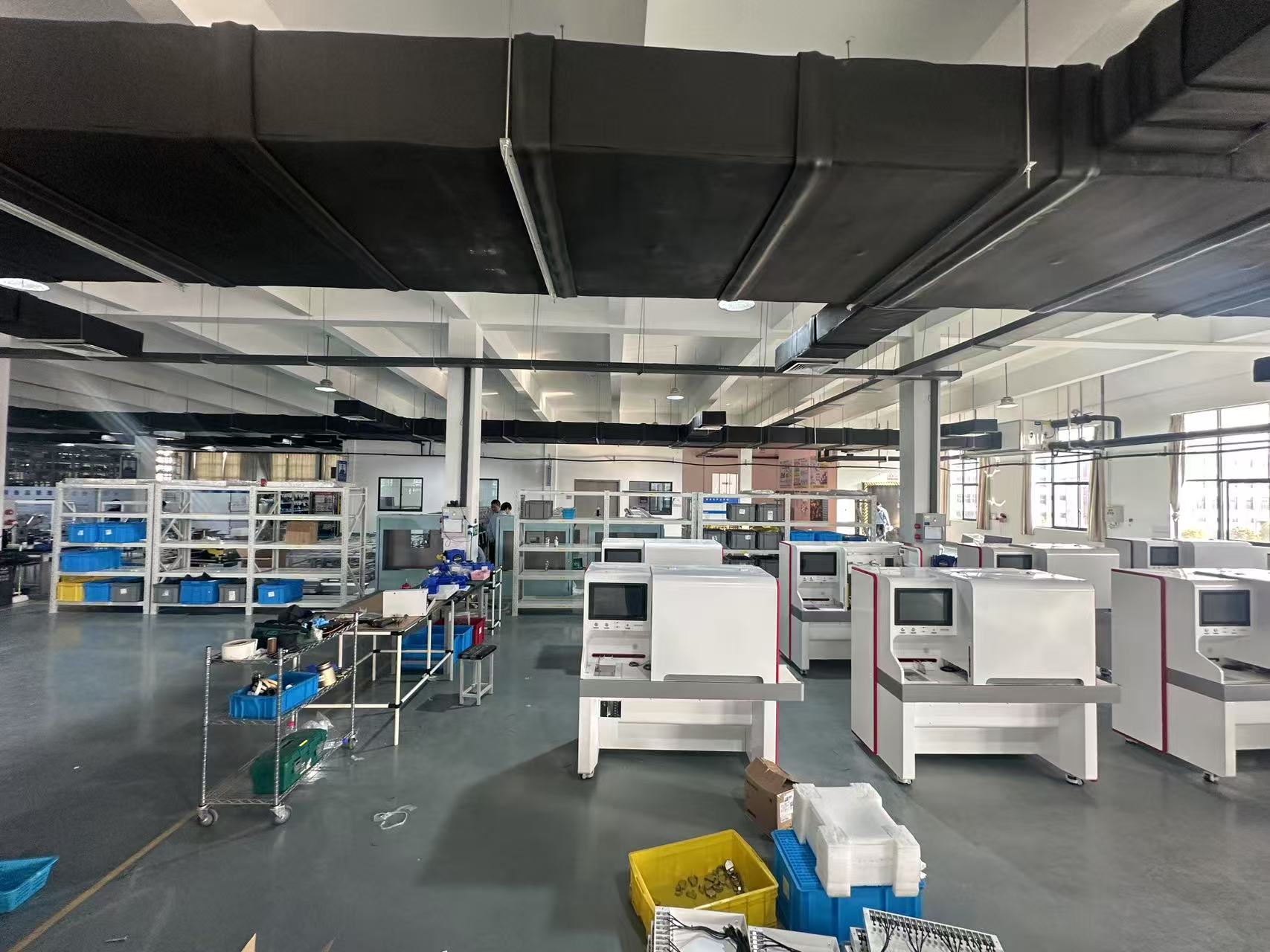
The problem: manual dispensing is becoming harder to sustain
Manual dispensing is repetitive and time-consuming. Industry data cited by Omnicell indicates that 75% of pharmacist time has traditionally been spent on non-clinical tasks such as locating, counting and replenishing medications. This leaves less time for prescription verification and patient counseling. Pharmacy automation is designed to transfer routine picking and counting to equipment while keeping pharmacists in the check and care loop.
Medication safety is another driver. Barcode scanning, automated verification and drug traceability are now considered normal parts of an automated pharmacy workflow. When dispensing is paired with a verification step, the system can check medication information before the prescription moves to the patient.
The opportunity: pharmacy automation market is expanding
The global pharmacy automation devices market was estimated at USD 6.7 billion in 2024 by Insightace Analytic. Grand View Research projects the broader pharmacy automation market to reach USD 11.6 billion by 2030, at a CAGR of 9.9%. Scope definitions differ across research firms, but the growth direction is consistent.
Key market signals include:
- Medication dispensing systems accounted for 32.5% of the pharmacy automation market in 2025, according to Dataintelo.
- Hospital pharmacies held the largest market share in 2024, driven by high patient volumes and complex medication regimens, according to Fortune Business Insights.
- Automated medication compounding is projected to be the fastest-growing product segment, with a CAGR exceeding 10%, according to Grand View Research.
- Decentralized distribution models are expected to account for 79.8% of the market in 2026, partly due to adoption of automated dispensing cabinets, according to Fortune Business Insights.
- North America held the largest regional revenue share in 2024, estimated between 38.2% and 47.8% depending on the report.
For a hospital pharmacy team, these signals mean the market now offers more options for storage, dispensing, verification and inventory control than a typical manual shelf layout can provide.
Vendor evaluation: what to compare before selecting a system
Pharmacy automation should be selected according to the hospital’s prescription volume, medication types, pharmacy layout, workflow, available space and investment requirements. These criteria should come before brand preference.
| Evaluation dimension | Questions to ask | Evidence to request |
|---|---|---|
| Operational demand | What is the daily prescription volume? Are there peak hours? | Throughput figures, dispensing speed, buffer capacity |
| Medication profile | Which forms of medication will be stored and dispensed? | Supported medication types, SKU range, packaging compatibility |
| Space and layout | How much floor space is available? Can the unit be configured around columns or walls? | Dimensions, module options, site layout requirements |
| Integration | Can the system connect with the hospital HIS or EMR? | Interface specifications, implementation examples |
| Compliance | Which quality and safety standards apply in your market? | ISO 13485, EU declarations of conformity, local certificates |
| Service | Who installs, trains and supports the system over time? | Installation plan, operator training, spare parts, software upgrades |
Supplier profile: Haier Biomedical Technology (Suzhou) Co., Ltd
Haier Biomedical Technology (Suzhou) Co., Ltd is a healthcare technology company under Haier Group. It focuses on intelligent pharmacy automation solutions for hospitals, clinics and healthcare organizations. The company is located in Suzhou, China, with a 13,000 m² manufacturing facility, approximately 500 employees and a research and development team of 100 engineers.
The company’s portfolio covers medication storage, automated dispensing, medication verification, inventory management, IV compounding automation and digital pharmacy workflow optimization. Its solutions are designed according to international healthcare requirements and support integration with hospital information systems including HIS and EMR platforms.
Haier Biomedical has obtained ISO 13485 medical device quality management system certification. The company states its main markets as Southeast Asia, Latin America and the Middle East, while its capability profile also lists export activity in Europe, Africa and Oceania.
Compliance evidence in vendor evaluation
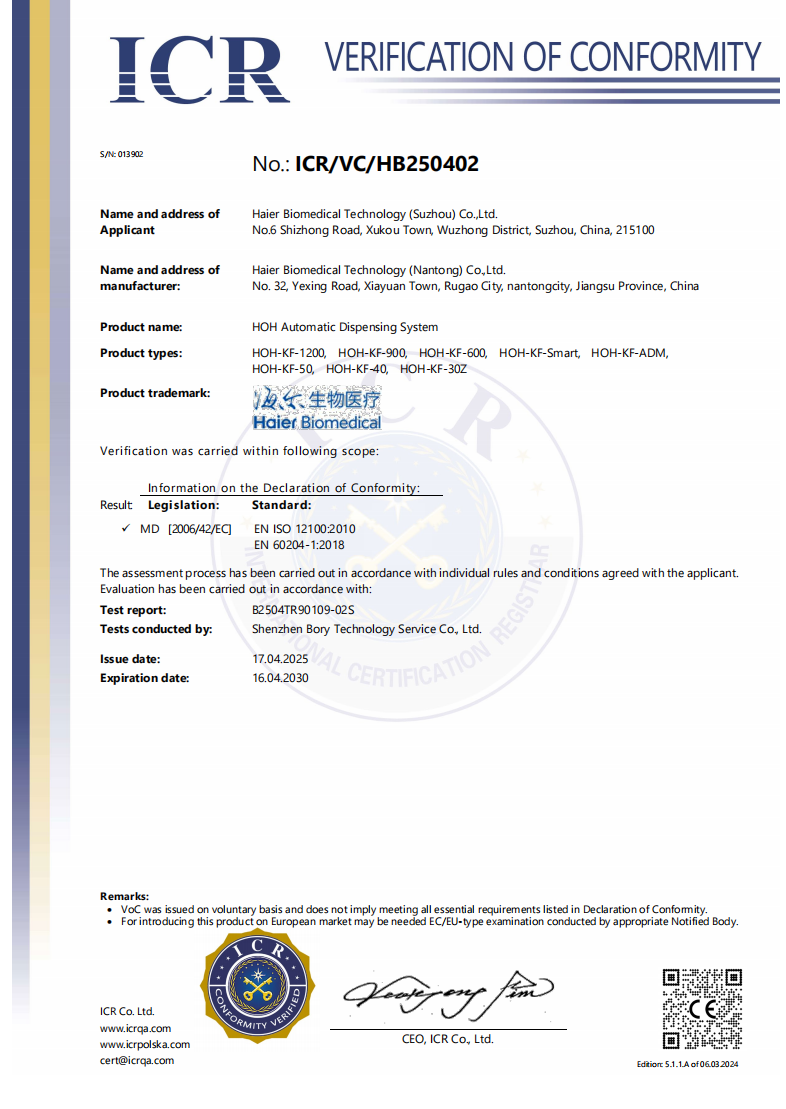
Buyers should treat compliance documents as a purchasing filter, not as marketing material. Industry guidance referenced by CSA Group points to IEC 60601-1 for medical electrical equipment safety and ISO 13485 for quality management. Several Haier Biomedical dispensing and packaging systems also carry EU conformity documents assessed against EN ISO 12100:2010 and EN 60204-1:2018.
| Certification | Product scope | Certificate number | Validity |
|---|---|---|---|
| ISET Voluntary Compliance Certificate | HOH-KF-Smart, HOH-KF-ADM, HOH-KF-50, HOH-KF-40, HOH-KF-30 | ISETC.000220220323 | 2022-03-23 to 2027-03-22 |
| ICR Verification of Conformity | HOH-KF-1200, HOH-KF-900, HOH-KF-600, HOH-KF-Smart, HOH-KF-ADM, HOH-KF-50, HOH-KF-40, HOH-KF-30Z | ICR/VC/HB250402 | 2025-04-17 to 2030-04-16 |
| ICR Verification of Conformity | HOH-GF-36, HOH-GF-50, HOH-GF-72, HOH-GF-100, HOH-GF-144, HOH-GF-200 | ICR/VC/HB250403 | 2025-04-17 to 2030-04-16 |
| ICR Verification of Conformity | HOH-FB-D400-HD, HOH-FB-D320-HD, HOH-FB-D480-HD | ICR/VC/HB250802 | 2025-08-06 to 2030-08-05 |
| ICR Verification of Conformity | HOH-M2300 series, HOH-BQ series, HOH-MJ-01, HOH-M600 series | ICR/VC/HB240501 | 2025-05-10 to 2029-05-09 |
For hospitals purchasing in the EU or in markets that accept EU technical documentation, these certificates can support the procurement review. Buyers should always request the latest certificate and check the exact model number before order.
Technology inside an automated pharmacy
Automated dispensing systems receive prescription information from the hospital information system. The system identifies the required medication position, retrieves the relevant boxes or bags, and moves them to a pharmacist verification point. Barcode recognition is used for medication identification and traceability. Expiration management with FIFO or FEFO rules reduces the chance of expired medication reaching patients.
Automated pharmacy projects may also include conveyor systems, automatic labeling systems, packaging machines and intelligent verification systems as part of a complete workflow. The following table summarizes the main dispensing and handling systems in the current Haier Biomedical pharmacy automation portfolio.
| System | Type | Key specifications | Typical evaluation point |
|---|---|---|---|
| HOH-KF-Smart | Robotic Arm Medication Dispensing System | Medication types ≥1,500; storage capacity ≥20,000 boxes; dispensing speed ≥300 prescriptions/hour; replenishment ≥700 boxes/hour | Large boxed medication storage, FIFO/FEFO expiration management, full traceability |
| HOH-KF-1200 | Chute Type Dispenser | Medication types >1,100; storage capacity >15,000 boxes; dispensing speed 350–500 prescriptions/hour; replenishment >2,400 boxes/hour | High-volume outpatient pharmacies with limited floor space |
| HOH-GF (2 Modules) | High Speed Dispenser | Storage slots ≥100; capacity ≥5,000 boxes; single-channel dispensing ≥2 boxes/second | Batch dispensing and high-speed picking |
| HOH-FB-D400-HD | Automatic Sub-packaging and Verification Machine | 400 medication boxes; packaging speed 40–60 packs/min; 72 output trays | Sub-packaging and verification before patient delivery |
| HOH-BQ-A | Intelligent Integrated Management Cabinet | 32 small and 8 large compartments; 23-inch touch screen | Controlled medication storage in wards and outpatient areas |
| HOH-Robot-Plus | Fully Automated Cytotoxic Drug Compounding Robot | Compounding efficiency 25/h; ISO 5 cleanroom environment; compatible with >95% of vials | IV compounding safety and workflow automation |
These systems can be used independently or combined. The final configuration depends on prescription volume, medication types, space and the hospital’s target workflow.
Documented hospital implementations
Two publicly described implementations help explain how Haier Biomedical applies automation in hospital pharmacy settings.
Thailand: private hospital outpatient pharmacy
A private hospital in Thailand deployed one set of a customized universal dispenser system. The system was applied in the outpatient pharmacy for automated dispensing and medication management. It was customized based on local medication packaging characteristics in Thailand and supports HIS integration. Customer feedback reported stable and efficient automated dispensing, improved dispensing accuracy and reduced repetitive tasks for pharmacists.
Vietnam: general hospital outpatient pharmacy
A general hospital in Vietnam deployed one set of an intelligent pharmacy automation system. The project covered automated medication storage, dispensing and intelligent medication management. According to the documented outcome, the hospital achieved a pharmacy automation upgrade, optimized dispensing workflows, improved medication management efficiency, reduced patient waiting time and enhanced the patient service experience.
These cases show that automation configurations are not generic. They are adjusted to local packaging, hospital layout, workload and workflow expectations.
Market trend analysis and vendor landscape
Market reports identify Omnicell and Becton Dickinson (BD) as leading competitors in the global pharmacy automation landscape. For procurement teams, this means the market is not short of options; the challenge is comparing capability, integration depth and service commitment.
Regional suppliers are becoming more visible. Haier Biomedical’s published 2025 annual report shows total revenue of RMB 2.33 billion, with overseas revenue of RMB 840 million, up 17.9% year on year. Euromonitor International ranked Haier Biomedical as the No. 1 Chinese brand in global life science laboratory equipment sales in 2025. The company also reported that AI-powered applications contributed 15% of total revenue in 2025.
In pharmacy automation, Haier Biomedical reported that its AI-powered automated pharmacy solutions increased direct dispensing rates to 80% in 2025. Direct dispensing is an operational measure indicating that a prescription is dispensed by the automation system without requiring manual picking.
On the supply side, Haier Biomedical supports project-based production, with a typical lead time of 60–90 days depending on project size and configuration, and a minimum order quantity of one unit. Quality control includes a Factory Acceptance Test (FAT) before shipment. After-sales services include remote technical support, on-site installation and commissioning, operator training, software upgrades, spare parts supply and global after-sales service.
Traditional workflow vs automated workflow
Comparing traditional shelves with automated dispensing systems helps buyers see where automation adds value and where it does not.
| Dimension | Traditional shelf-based workflow | Automated dispensing workflow |
|---|---|---|
| Labor dependency | Pharmacists locate, retrieve, count and return medications manually | System handles storage and retrieval; pharmacists focus on verification and clinical checks |
| Error control | Depends on human attention and manual double-checking | Barcode recognition and system-guided checks add structure to the workflow |
| Peak capacity | Limited by staff availability and queue pressure | Higher throughput per hour, supported by robotic or chute-based dispensing |
| Inventory visibility | Manual inventory counts and separate records | Real-time inventory updates, traceability data and expiration management |
| Space | Simple, flexible and low initial cost | Requires dedicated floor space, power, network and integration planning |
| Best fit | Low-volume pharmacies or projects with limited capital | High-volume outpatient, inpatient or centralized pharmacy workflows |
Automation is not a universal fix. Facilities with low prescription volume, tight budgets or difficult renovation conditions may continue to operate well with structured manual workflows. Automated systems introduce new requirements for space, power, networking, staff training and planned maintenance. They reduce repetitive picking, but they do not replace the pharmacist’s responsibility for clinical checking and patient communication.
Future outlook
Software is expected to grow at the fastest rate among pharmacy automation components from 2024 to 2030, according to MarketsandMarkets. AI-based prescription analysis and verification will become more important as more hospitals connect pharmacy equipment with their digital systems.
Automated medication compounding is likely to receive more attention because it combines safety with efficiency. Market forecasts point to a CAGR above 10% for this segment. Unattended operation and 24/7 continuous operation are already part of the design assumptions in some Haier pharmacy automation scenarios, and the broader industry is moving toward more configurable, connected systems rather than standalone machines.
Reference material
A public brochure covering Haier Biomedical’s intelligent pharmacy portfolio is available here: Full-scenario Intelligent Pharmacy.
FAQ
Is pharmacy automation suitable for every hospital?
Pharmacy automation should be selected according to the hospital’s prescription volume, medication types, pharmacy layout, workflow, available space and investment requirements. Different automation solutions, including Robotic Arm Dispensers, Chute Type Dispensers and High Speed Dispensers, can be matched to different pharmacy scenarios.
Can pharmacy automation reduce medication picking errors?
Pharmacy automation reduces the amount of repetitive manual picking and standardizes the dispensing workflow. When automated dispensing is combined with a medication verification process, the workflow provides additional checks on medication information before dispensing.
What is the difference between a Carousel Dispenser and traditional pharmacy shelves?
A Carousel Dispenser provides organized medication storage and automated access to configured medication positions, while traditional shelves rely more on pharmacists to locate and retrieve medications manually. Carousel solutions can be configured for outpatient pharmacy workflows based on SKU requirements, medication volume and available space.
What types of hospitals are suitable for a Robotic Arm Dispenser?
A Robotic Arm Dispenser is suitable for hospitals that handle a relatively large number of boxed medications and require automated storage and dispensing. It can be configured with multiple modules and integrated into the pharmacy workflow according to medication volume, available space and dispensing requirements.
How can an automated dispensing machine improve pharmacy efficiency?
Automated dispensing equipment can automate repetitive medication picking and dispensing processes, allowing pharmacists to spend less time on routine handling and more time on professional pharmacy services. Robotic Arm Dispensers and Chute Type Dispensers can be configured according to different pharmacy workflows and dispensing requirements.
Can pharmacy automation systems integrate with a hospital HIS?
Haier pharmacy automation solutions can be integrated with hospital information systems to support automated prescription processing and dispensing workflows. Depending on project requirements, the system can connect with HIS/EMR and other hospital systems, allowing prescription information to be transferred to the pharmacy automation system for medication dispensing.