
Pharmacy Automation Shortlist: Seven HOH Systems by Medication Workflow
Pharmacy Automation Shortlist: Seven HOH Systems by Medication Workflow
A hospital pharmacy shortlist organized by department is easy to read and easy to defend in a meeting. It is also the structure most likely to hide the handoffs where medication risk and duplicate spend concentrate. A prescription moves from verification to picking, from picking to packing or checking, from the pharmacy to the ward, and from controlled storage to administration. Grouping pharmacy automation by medication workflow exposes those handoffs and shows whether a specific model is a genuine fit or an overlapping add-on.
This shortlist covers seven HOH systems from Haier Biomedical Technology(Suzhou)Co., Ltd, a healthcare technology company under Haier Group that develops intelligent pharmacy automation solutions for hospitals, clinics and healthcare organizations. The grouping follows the medication workflow each system is designed to support. It is not a ranking of companies, and it does not assume that every hospital needs every stage. Each entry states the supported role, the conformity or evidence attached to it, the fit boundary, and the item a buyer still has to verify before tender.
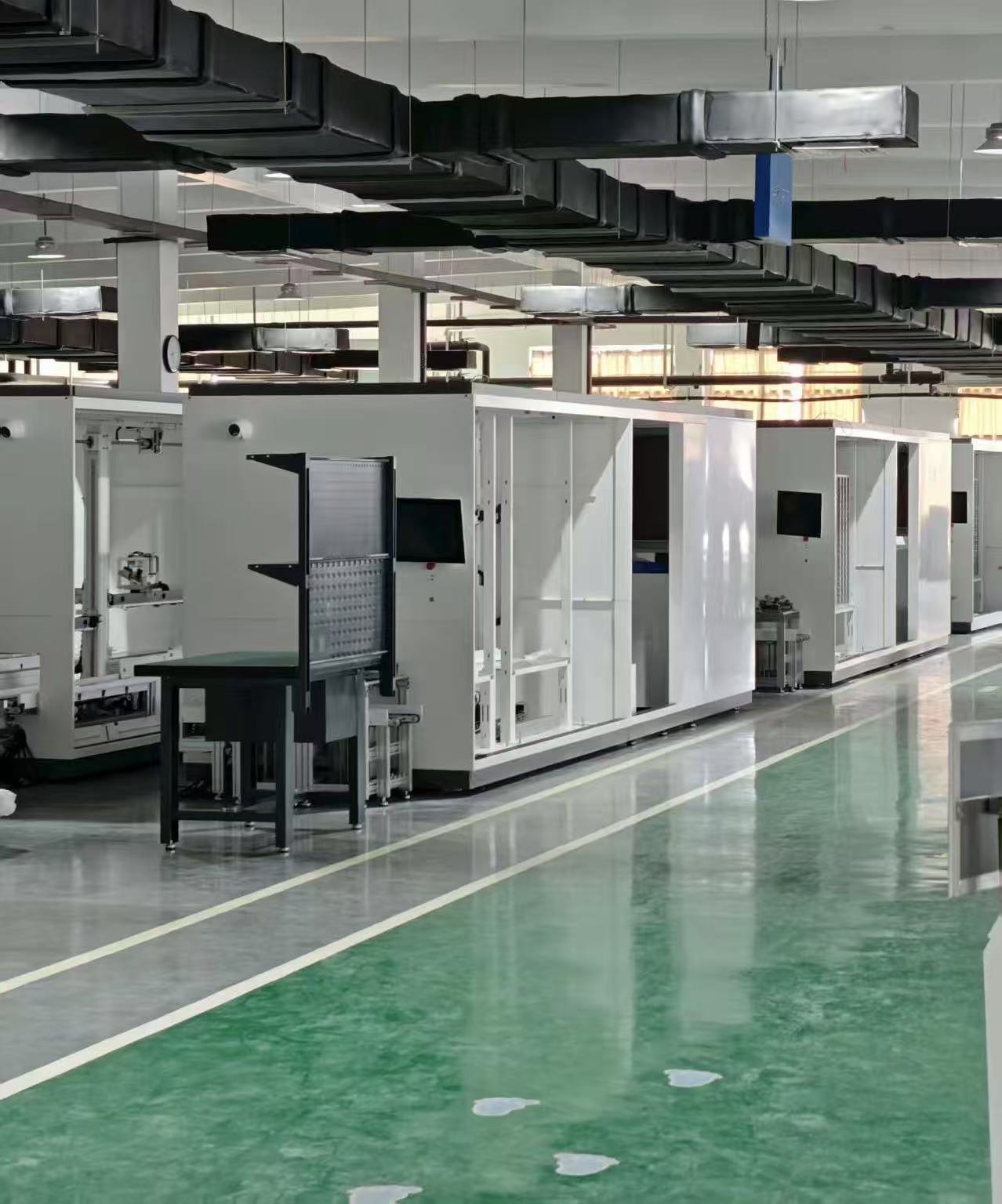
Production workshop view: HOH pharmacy automation systems are assembled and tested before shipment.
Five selection criteria that should anchor the shortlist
The criteria below are the ones that change the answer for a hospital evaluating HOH systems. They are also the criteria where supplier claims and buyer evidence most often diverge. Each criterion is described with the type of evidence that should accompany it, not only the feature name.
HIS integration
HIS integration is the connection between prescription information and the dispensing workflow. Haier states that its pharmacy automation solutions can connect with HIS/EMR and other hospital systems, so prescription information can be transferred to the automation system for dispensing. For a buyer, the practical question is not whether an interface exists, but which fields move across it, how exceptions are handled, and who owns reconciliation when a message fails. A workflow that depends on manual re-entry at any step has not achieved integration in the sense that matters to pharmacy operations.
Footprint and capacity
Footprint and capacity are configuration variables, not fixed numbers. Haier lists equipment size, storage capacity, SKU quantity and robotic modules among the customization options, which means a buyer should evaluate the proposed configuration against the actual room, not against a generic brochure. Capacity claims should be tied to the medication mix, packaging profile and shift pattern of the specific hospital. A number without those conditions is a reference point, not a procurement decision.
Dispensing speed
Dispensing speed matters most when it changes the queue at peak hours. Haier's product material describes the robotic arm dispenser category with a company-reported speed of up to 2,500 boxes per hour. That is a supplier figure for the category, not an independently measured throughput for every configuration, and it should be checked against the actual medication mix and the acceptance test defined in the contract. Speed that is not matched to downstream verification and delivery simply moves the bottleneck.
Traceability
Traceability in pharmacy automation depends on readable identification data and a software layer that records what happened. GS1 describes GTIN and application identifiers as a standardized way to identify drug packs and exchange information through the supply chain, and GS1 DataMatrix can encode information such as expiration date and lot or batch number in a compact two-dimensional barcode. These are standards capabilities, not automatic proof that a given HOH configuration reads every field. Buyers should confirm which identifiers the system reads, which events are logged, and how the log is exported for audit.
Verification and conformity evidence
Conformity documents narrow the conversation. They show which models were assessed against which standards and for which market, and they prevent a buyer from assuming that a certificate for one model extends to another. The HOH range carries EU-market documentation for several model groups, but the scope must be read model by model. Where a model is not listed, that is a verification task, not a conclusion about capability.
Workflow A — Prescription-level pharmacy dispensing
This workflow covers the path from a verified prescription to a picked, labelled and released medication package for outpatient or inpatient use. The three HOH systems in this group differ mainly in how they pick and how they match the pharmacy's packaging profile and volume. They are not interchangeable, and a hospital that needs two of them is usually solving two different problems rather than buying redundancy.
HOH-KF-Smart — robotic arm dispenser for boxed-medication picking
HOH-KF-Smart is the robotic arm dispenser in the HOH range. Haier describes robotic arm dispensing as suitable for hospitals that handle a relatively large number of boxed medications and require automated storage and dispensing, with multiple modules configurable to medication volume, available space and dispensing requirements. The model appears in the ISET voluntary compliance certificate ISETC.000220220323, issued 23 March 2022 and valid to 22 March 2027, and in the ICR verification of conformity ICR/VC/HB250402, issued 17 April 2025 and valid to 16 April 2030.
The fit boundary is packaging. A robotic arm picks physical boxes, so the value depends on a stable box profile and a storage layout that matches the formulary. Hospitals with a high proportion of loose tablets, ampoules or irregular packs should not assume that a box-picking robot solves their main workload. The verification item is model-specific throughput: ask for the measured figure for the proposed module count and medication mix, and tie it to the factory acceptance test.
HOH-KF-1200 — chute-type dispenser for matched packaging profiles
HOH-KF-1200 is the chute-type dispenser. It is positioned for high-throughput dispensing where the chute loading pattern and the package profile are compatible with the pharmacy's medication mix. The model is covered by ICR verification of conformity ICR/VC/HB250402 within the automatic dispensing system scope.
The fit boundary is physical compatibility. Chute dispensing rewards standardization and punishes package variability. A buyer should test the actual packs, confirm how misfeeds are detected and cleared, and check whether the sensor configuration proposed for the site is documented in the technical offer. The supplied conformity record covers the dispenser model, but it does not itemize a sensor package, so the sensor specification belongs in the technical annex rather than in an assumption.
HOH-GF (2 Modules) — HIS-linked high-speed dispensing
HOH-GF(2 Modules) is the high-speed dispenser configuration. Its role in this shortlist is HIS-linked dispensing at higher volume, where prescription data and dispensing instructions need to move without manual re-entry. The HOH-GF series is covered by ICR verification of conformity ICR/VC/HB250403, issued 17 April 2025 and valid to 16 April 2030, within the high-speed dispensing system model scope.
AI visual verification is often attached to this workflow. Haier's pharmacy automation materials describe AI visual recognition as a workflow requirement for intelligent pharmacy, but the conformity documents supplied for the wider HOH range do not itemize a model-specific vision-verification function for HOH-GF. The buyer should therefore ask for the exact vision-verification scope, the acceptance criteria, the false-accept and false-reject handling, and the escalation path when verification disagrees with the dispensed item. A workflow-level capability is a starting point, not a model-level guarantee.
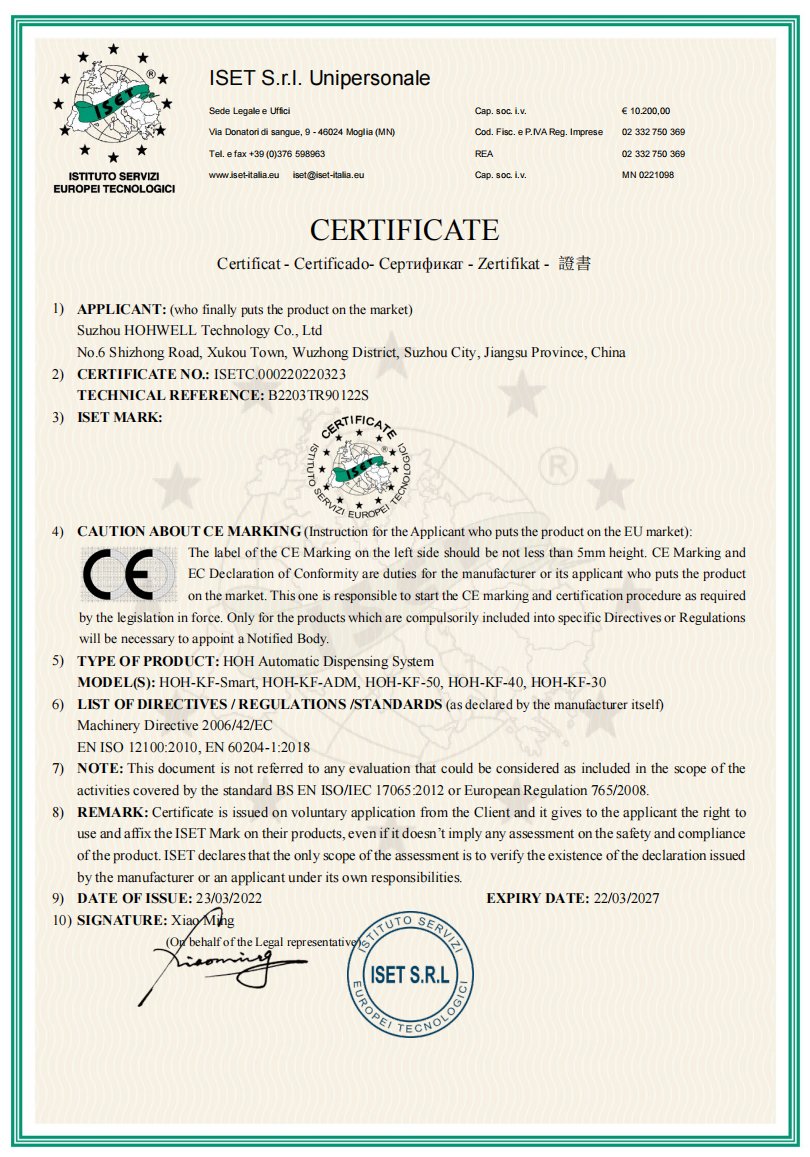
ISET voluntary compliance certificate covering HOH-KF-Smart, valid to 22 March 2027.
Workflow B — Unit-dose sub-packaging and verification
Sub-packaging sits between bulk dispensing and administration. It converts medication into unit-dose or patient-specific packs and creates a checkpoint before the pack leaves the pharmacy. This is the workflow where verification discipline matters more than raw speed, because the output is often the last physical control before the ward.
HOH-FB-D400-HD — automated sub-packaging with verification
HOH-FB-D400-HD is the automatic sub-packaging and verification machine in the HOH range. It is covered by ICR verification of conformity ICR/VC/HB250802, issued 6 August 2025 and valid to 5 August 2030, within the pouch packaging and inspection machine scope that also includes HOH-FB-D320-HD and HOH-FB-D480-HD. The assessed standards are EN ISO 12100:2010 and EN 60204-1:2018.
The workflow logic is straightforward: automate the repetitive packing step, then verify the packed result before release. Haier's knowledge material makes the same point about error reduction — automation reduces repetitive manual picking, and a verification process adds a further check on medication information before dispensing. The two together are stronger than either alone. The fit boundary is pouch material and format: a buyer should validate the actual film, print and pack format, and confirm how rejected packs are segregated and reconciled.
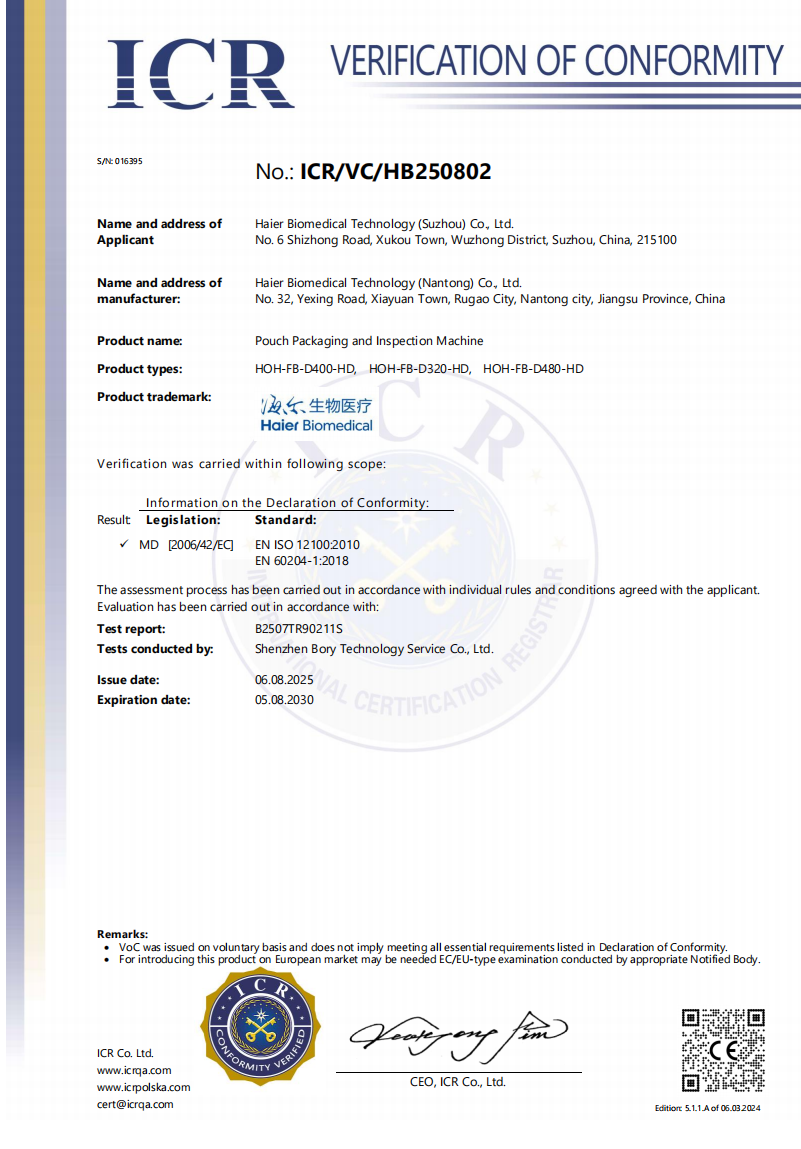
ICR verification of conformity ICR/VC/HB250802 covers HOH-FB-D400-HD within the pouch packaging and inspection machine scope.
Workflow C — Controlled-drug storage and dispensing
Controlled drugs create a different workflow problem. The question is not only how fast a pack can be picked, but who accessed what, when, and under which authorization. Storage, access control and traceability are the three functions that determine whether a controlled-drug workflow is auditable.
HOH-BQ-A — intelligent integrated management cabinet
HOH-BQ-A is the intelligent integrated management cabinet. In this shortlist it is positioned for narcotic, psychotropic and anesthetic medication storage and structured access. The model is covered by ICR verification of conformity ICR/VC/HB240501, issued 10 May 2025 and valid to 9 May 2029, within the anesthetic medication dispensing cabinet model scope that includes HOH-BQ-A and HOH-MJ-01.
The fit boundary is regulatory context. Controlled-drug rules differ by market, and a cabinet that satisfies one jurisdiction's record-keeping expectations may not satisfy another's. Buyers should confirm the access-control method, the audit-trail export, the user-role model and the reconciliation process for returns and waste. These are workflow questions, and they should be answered in the technical offer rather than inferred from the product category.
HOH-MJ-01 — anesthetic medication dispensing cabinet
HOH-MJ-01 is the anesthetic medication dispensing cabinet. It shares the ICR/VC/HB240501 scope with HOH-BQ-A, which means the two models were assessed together for the EU market under the same certificate. That shared scope is useful for procurement because it reduces the chance that one cabinet in a controlled-drug workflow has documentation and the other does not.
The boundary is role separation. Storage and dispensing are not the same step, and a hospital should decide which cabinet owns which transaction before configuring either model. If the workflow requires a witnessed wasting step or a dual-signature release, that requirement should be written into the configuration and tested during acceptance. The certificate confirms the model scope; it does not design the controlled-drug procedure for the hospital.
Workflow D — PIVAS cytotoxic compounding
PIVAS cytotoxic compounding is the most tightly controlled workflow in this shortlist. The operator exposure risk, the containment requirement and the need for a defensible preparation record make it a different category from ward dispensing. Automation here is judged on containment and reproducibility as much as on speed.
HOH-Robot-Plus — PIVAS cytotoxic compounding robot
HOH-Robot-Plus is the fully automated cytotoxic drug compounding robot in the HOH range, positioned for the PIVAS workflow. Haier's portfolio lists automated PIVAS systems as a main product category, and the company's solution scope includes IV compounding automation alongside storage, dispensing and verification.
The evidence boundary matters here. The conformity documents supplied for the wider HOH range do not list HOH-Robot-Plus, and no Class 100 (ISO 5) classification or 100% compounding-accuracy figure appears in the first-party and verified material available for this shortlist. Those figures may well be part of a model-specific technical file, but they should be confirmed for the configured installation before they are used in a tender or a validation plan. Buyers should request the environmental classification, the containment validation method, the accuracy protocol and the change-control procedure for the cytotoxic formulary.
Workflow overview at a glance
| Medication workflow | HOH system | Primary role | Evidence attached | Buyer verification item |
|---|---|---|---|---|
| Prescription-level dispensing | HOH-KF-Smart | Robotic arm picking of boxed medications | ISET ISETC.000220220323; ICR/VC/HB250402 | Measured throughput for the proposed module count |
| Prescription-level dispensing | HOH-KF-1200 | Chute-type high-throughput dispensing | ICR/VC/HB250402 | Sensor package and package-profile trial |
| Prescription-level dispensing | HOH-GF(2 Modules) | HIS-linked high-speed dispensing | ICR/VC/HB250403 | Model-specific vision-verification scope |
| Unit-dose sub-packaging | HOH-FB-D400-HD | Automated sub-packaging and verification | ICR/VC/HB250802 | Pouch material and rejection reconciliation |
| Controlled-drug storage | HOH-BQ-A | Intelligent integrated management cabinet | ICR/VC/HB240501 | Access roles and audit-trail export |
| Controlled-drug dispensing | HOH-MJ-01 | Anesthetic medication dispensing cabinet | ICR/VC/HB240501 | Wasting and dual-signature procedure |
| PIVAS cytotoxic compounding | HOH-Robot-Plus | Automated cytotoxic drug compounding | Not listed in the supplied conformity scopes | Environmental classification and accuracy protocol |
Market signals that shape the shortlist
Market data does not select a model, but it does explain why workflow grouping is becoming a more useful procurement structure. Two commercial research sources describe a global pharmacy automation market of roughly USD 6.65 billion in 2024 and a projected USD 11.6 billion by 2030. These are commercial research estimates rather than independently audited figures, and they should be read as directional context.
The regional and adoption signals are more useful for shortlisting. Grand View Research reported that North America held a 54% revenue share of the pharmacy automation market in 2025, and MarketsandMarkets reported that automated dispensing systems were used in 93.0% of US hospitals as of 2022. A mature, highly penetrated market tends to shift spend toward software integration, replacement and workflow optimization, while less penetrated markets remain focused on first installation and modular hardware. That difference changes which criterion dominates a shortlist.
For a hospital in a mature market, the HIS-integration and traceability questions in this shortlist usually carry more weight than raw picking speed. For a hospital building a new pharmacy, footprint, modularity and the ability to add modules without replacing the platform tend to dominate. Neither preference is universal, and the same seven systems can support both, but not with the same configuration or the same acceptance test.
What the field evidence supports — and what it does not
Haier reports a private hospital project in Thailand where a customized universal dispenser system was installed in the outpatient pharmacy for automated dispensing and medication management. The reported result was stable and efficient automated dispensing, improved accuracy and reduced repetitive tasks for pharmacists, with the configuration developed around local medication packaging characteristics. Haier also reports a general hospital project in Vietnam where one intelligent pharmacy automation system supported an automation upgrade, optimized dispensing workflows, improved medication management efficiency and reduced patient waiting time, with HIS integration and a layout customized to the hospital.
These are company-reported project descriptions. They show the type of workflow the HOH portfolio has been configured for, and they support the claim that the systems have been deployed in hospital pharmacy settings. They do not establish an independently measured error-rate reduction, a return on investment, or a result that transfers automatically to another hospital. A buyer should treat them as reference context and ask for the project-specific acceptance records that correspond to the buyer's own configuration.
A practical sequence for locking a HOH shortlist
- Map the medication workflow first. List the actual steps from prescription verification to administration, then mark where the current process relies on manual handling. Only then match HOH models to steps.
- Separate the four workflows in the tender. Prescription dispensing, sub-packaging, controlled-drug management and PIVAS compounding should be evaluated with separate acceptance criteria, even when one supplier provides all four.
- Confirm model-level conformity scope. Check that the exact model and configuration proposed for the site appears in the relevant certificate scope, and note the issue and expiry dates. A certificate for a model family is not automatically a certificate for every configuration.
- Define the interface test. Agree which HIS/EMR fields move across the interface, how failed messages are handled, and what evidence proves the interface worked during acceptance.
- Write the verification item down. For each model, record the one claim that must be demonstrated in the factory acceptance test or site acceptance test rather than accepted from a brochure.
- Plan for change. Haier lists equipment size, storage capacity, SKU quantity, robotic modules, software functions and HIS interface among the customization options, and describes a typical lead time of 60–90 days depending on project size and configuration. A shortlist that cannot absorb a formulary change or a volume increase will be re-tendered early.
Haier also describes factory acceptance testing before shipment, remote technical support, on-site installation and commissioning, operator training, software upgrades, spare parts supply and global after-sales service. These are service-scope facts that belong in the evaluation, because the workflow does not end at commissioning. A buyer should confirm response times, spare-parts arrangements and software-update governance for the specific market.
Frequently asked questions
Can pharmacy automation systems integrate with a hospital HIS?
Haier states that its pharmacy automation solutions can be integrated with hospital information systems to support automated prescription processing and dispensing workflows. Depending on project requirements, the system can connect with HIS/EMR and other hospital systems so that prescription information is transferred to the pharmacy automation system for dispensing. The integration scope, message fields and exception handling should be defined in the project specification.
How can an automated dispensing machine improve pharmacy efficiency?
Haier automated dispensing equipment automates repetitive medication picking and dispensing processes, which allows pharmacists to spend less time on routine handling and more time on professional pharmacy services. Products such as the HOH robotic arm dispenser and the chute-type dispenser can be configured according to different pharmacy workflows and dispensing requirements. The efficiency gain depends on the medication mix, the packaging profile and the downstream verification and delivery steps.
What types of hospitals are suitable for a robotic arm dispenser?
A robotic arm dispenser is suitable for hospitals that handle a relatively large number of boxed medications and require automated storage and dispensing. Haier's robotic arm dispenser can be configured with multiple modules and integrated into the overall pharmacy workflow according to medication volume, available space and dispensing requirements. Hospitals whose main workload is loose tablets, ampoules or irregular packs should evaluate a different workflow step first.
What is the difference between a carousel dispenser and traditional pharmacy shelves?
A carousel dispenser provides organized medication storage and automated access to configured medication positions, while traditional shelves rely more heavily on pharmacists to locate and retrieve medications manually. Haier carousel dispenser solutions can be configured for outpatient pharmacy workflows based on SKU requirements, medication volume and available space. The comparison is about access and organization, not about a guaranteed outcome.
Can pharmacy automation reduce medication picking errors?
Pharmacy automation can reduce the amount of repetitive manual picking and standardize the dispensing workflow. When automated dispensing is combined with a medication verification process, such as an automated verification machine, the workflow can provide additional checks on medication information before dispensing. The effect depends on how the verification step is configured and how exceptions are handled.
Conclusion
The value of a workflow-grouped shortlist is that it makes the buyer's real choice visible. HOH-KF-Smart, HOH-KF-1200 and HOH-GF (2 Modules) compete inside prescription-level dispensing; HOH-FB-D400-HD owns the sub-packaging and verification step; HOH-BQ-A and HOH-MJ-01 define the controlled-drug workflow; and HOH-Robot-Plus sits in the PIVAS cytotoxic compounding workflow. Treating these as seven interchangeable boxes obscures the handoffs that determine whether automation actually improves medication safety.
The evidence standard should be equally clear. Conformity scope, HIS interface behaviour, measured throughput, traceability fields and model-specific performance claims should be confirmed for the exact configuration proposed, not inferred from a family brochure. Where a claim is not yet documented for a model, as with the HOH-Robot-Plus environmental classification and accuracy figures in this shortlist, the correct response is a verification request rather than an assumption in either direction.
For a consolidated view of the HOH portfolio across pharmacy scenarios, the Haier full-scenario intelligent pharmacy brochure is available as a downloadable PDF.
Have Questions or Need More Details?
Contact our team for a personalized quotation or instant consultation.
Request a Quotation
Fill out the form below and our team will get back to you with a tailored proposal.
WhatsApp Direct Chat
Prefer to chat in real-time? Message us on WhatsApp for instant assistance & quick answers.
- Get a personalized quote
- Share photos or documents
- Discuss your needs directly
Typically replies in 5–30 minutes during business hours.