
Pharmacy Automation by Hospital Department: A Project-Fit Guide for 2026
Introduction: Automation Should Follow the Pharmacy Workflow
Pharmacy automation is not a single product decision. Hospital pharmacies operate under different demand patterns: an outpatient pharmacy may process hundreds of prescriptions per day, an inpatient pharmacy may need unit-dose packages for nursing wards, and an IV compounding area may handle hazardous drugs under strict containment. The right automation configuration should reflect those differences.
For hospital project teams now in the Research and Evaluation stages, the practical question is not only which vendor but also which configuration fits this pharmacy scenario. This article outlines a scenario-based approach to pharmacy automation, explains how different equipment types address different workflow bottlenecks, and uses project examples to show how vendors such as Haier Biomedical Technology (Suzhou) Co., Ltd. approach this matching problem.
The Problem: Manual Workflows Are Reaching Their Limits
Traditional manual dispensing workflows often require pharmacy staff to walk to storage shelves, locate a medication by name, count or pick the required quantity, place it in a basket, and repeat the process for each line item. As prescription volumes and medication complexity rise, these manual steps create cumulative inefficiency and increase the risk of picking errors, missing labels, inventory mismatches, and incomplete documentation.
The situation is especially visible in hospital pharmacies that serve large outpatient populations or operate around the clock. Labor constraints add further pressure: experienced pharmacists are often occupied with routine retrieval and packaging rather than clinical verification and patient counseling. In parallel, many hospitals are starting smart pharmacy construction or digital transformation projects that expect automated storage, continuous operation, and real-time information exchange.
The Opportunity: Scenario-First Pharmacy Automation
The opportunity is to design automation around the actual workflow. Automated dispensing equipment can take over repetitive picking, counting, labeling, and record-keeping tasks, while pharmacists focus on clinical checks, medication interactions, and patient communication. Automation also creates a digital record of each dispensed item, supporting drug traceability and inventory control.
For a hospital project, the goal should be to select a system whose storage capacity, dispensing speed, footprint, and integration features match the specific prescription mix. A high-volume outpatient pharmacy with boxed oral medications may benefit from a chute-type dispenser or a robotic arm. An inpatient pharmacy may benefit from a unit-dose repackaging and verification machine. A PIVAS with hazardous drugs may need a fully automated compounding robot.
How to Evaluate a Hospital Pharmacy Project
The following factors usually govern the selection of pharmacy automation equipment:
- Daily prescription volume and peak-hour profile
- Medication types and packaging forms (boxes, bottles, ampoules, soft bags)
- SKU count and required storage capacity
- Available floor space and ceiling height
- HIS/EMR integration requirements
- Shift model and whether continuous automatic operation is required
- Regulatory and compliance expectations for controlled substances
- Future expansion plans and capital budget
- Desired verification depth (barcode scanning, visual verification, unit-dose repackaging)
These requirements align with the typical operating conditions documented for smart pharmacy construction projects: hospital pharmacy settings, fully automatic operation, continuous dispensing, high reliability, and HIS integration. In typical hospital pharmacy applications, the product is used in the healthcare industry, particularly in hospital pharmacies. It is suitable for smart pharmacy construction projects and supports automated dispensing. The product operates in fully automatic mode under continuous dispensing conditions, with high reliability requirements. It requires supporting equipment such as a Hospital Information System (HIS).
Automation Options by Hospital Scenario
One reference point for scenario-based automation is Haier Biomedical Technology (Suzhou) Co., Ltd. Founded in 2015 and based in Suzhou, the company operates a 13,000 m² facility and employs around 500 people. Its pharmacy automation business unit is part of Haier Biomedical, which operates under Haier Group and reported RMB 2.33 billion in revenue in 2025. The company provides intelligent pharmacy solutions for hospitals and healthcare institutions, covering medication storage, automated dispensing, verification, inventory management, IV compounding, and digital workflow optimization. It also holds ISO 13485 medical device quality management system certification.
High-Volume Outpatient Pharmacies with Boxed Oral Medications
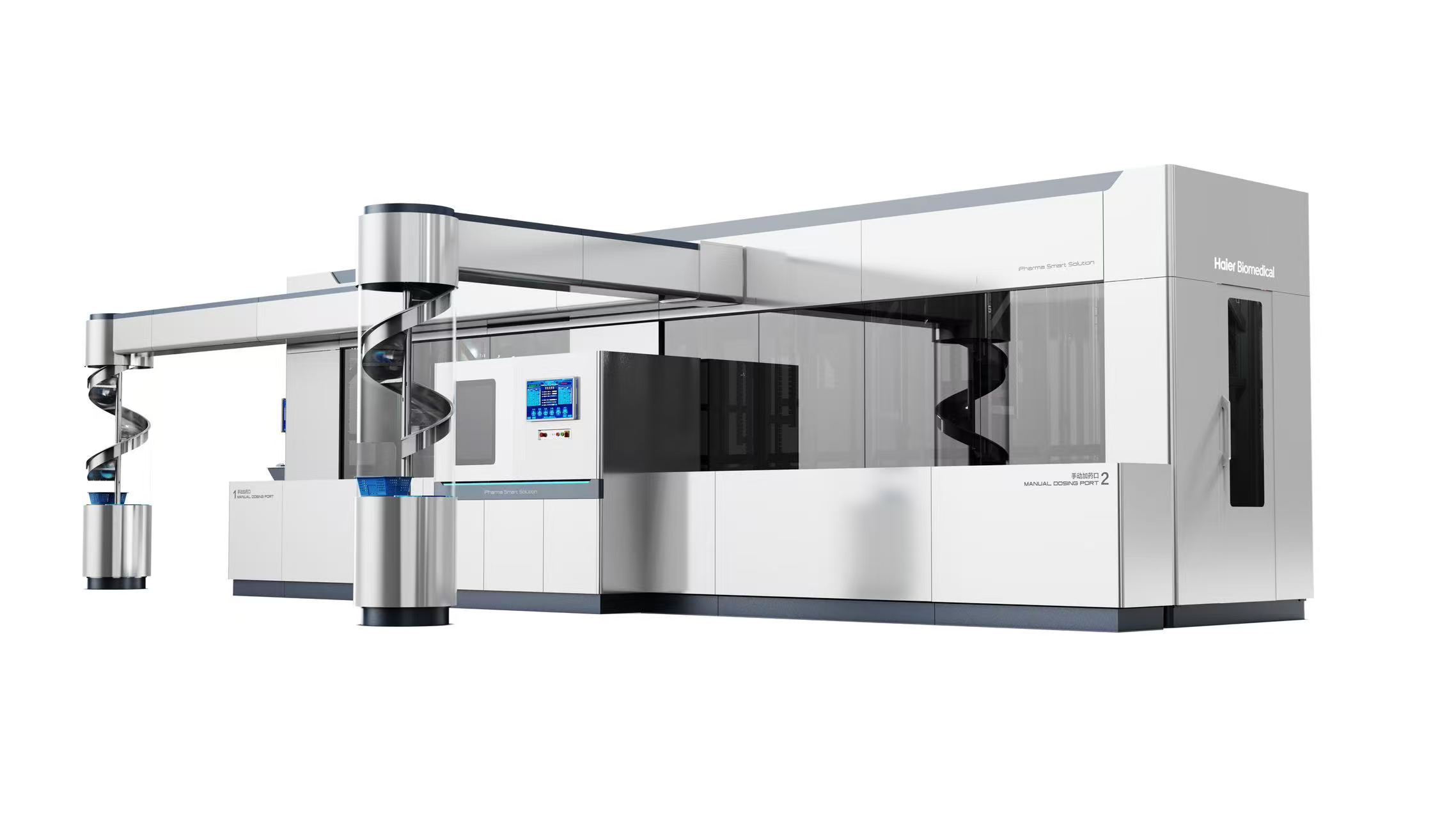
Haier offers two relevant platforms in this category: the Robotic Arm Dispenser (HOH-KF-Smart) and the Chute Type Dispenser (HOH-KF-1200). The robotic arm system stores up to 20,000 boxes across at least 1,500 medication types and is capable of more than 300 prescriptions per hour. It supports FIFO/FEFO expiration management and barcode recognition for full traceability. The chute-type system is designed for faster throughput, with more than 1,100 medication types, more than 15,000 boxes, and a dispensing speed of roughly 350–500 prescriptions per hour. Its modular structure includes dispensing, storage, and loading units, and its compact footprint is less than 12.85 m².
For replenishment in high-throughput settings, the High Speed Dispenser (HOH-GF, 2 Modules) can batch-dispense multiple boxes, with a single-channel dispensing speed of at least 2 boxes per second and high-precision photoelectric detection. This allows pharmacies to keep upstream stock moving while the main dispenser handles prescriptions.
Inpatient Pharmacies and Unit-Dose Repackaging
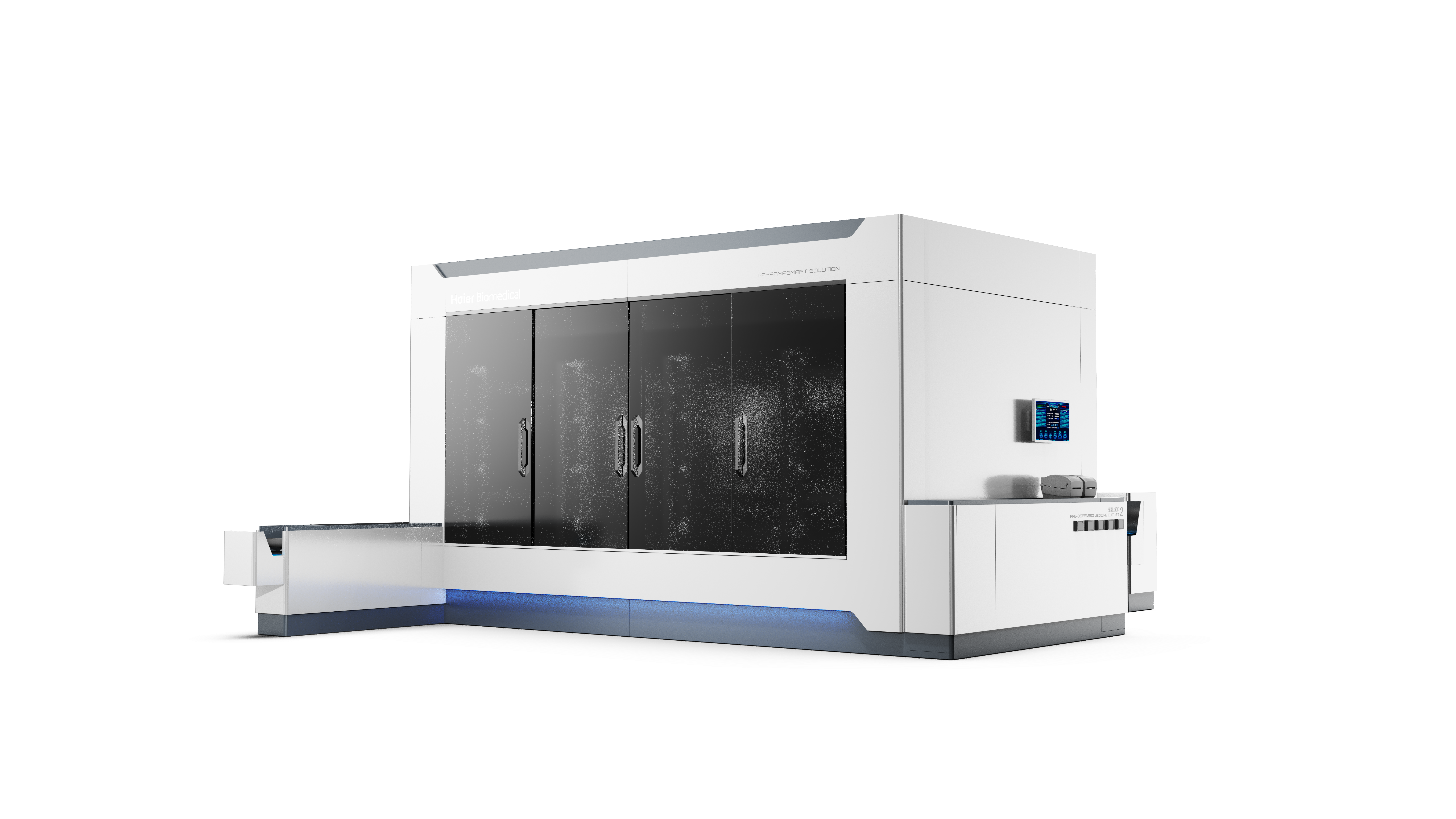
For hospitals that prepare unit-dose packages for ward delivery, the Automatic Sub-packaging and Verification Machine (HOH-FB-D400-HD) combines automatic unit-dose packaging with AI-powered visual verification. It holds 400 medication boxes and packs at 40–60 packs per minute. Because it interoperates with hospital HIS systems, it can execute unit-dose dispensing from physician orders while verifying drug type, quantity, and prescription accuracy in real time. This creates a closed-loop packaging-plus-verification workflow that reduces mispackaging risk and supports a higher level of medication safety.
Controlled Substances and Anesthesia Storage
Haier offers the Anesthetic Medication Dispensing Cabinet (HOH-MJ-01), designed for hospital outpatient pharmacies, emergency pharmacies, and inpatient pharmacies. It provides 44 compartments in nine lidded drawers and is built for full-process intelligent control of anesthetic and psychotropic drugs. The Intelligent Integrated Management Cabinet (HOH-BQ-A) is a separate cabinet for operating rooms or pharmacy preparation areas; it uses small and large pillboxes, a 23-inch touch screen, and a controlled-substance monitoring system to enforce traceability, access control, and inventory accuracy. Both products address the compliance challenge of managing high-risk drugs with a closed-loop data record.
PIVAS and Cytotoxic Compounding
For hospital pharmacies that prepare cytotoxic drugs, the Fully Automated Cytotoxic Drug Compounding Robot (HOH-Robot-Plus) operates inside a Class 100 (ISO 5) environment. It uses AI vision recognition and high-precision weighing to perform drug injection, dissolution, aspiration, and mixing. The manufacturer specifies a compounding efficiency of 25 cycles per hour and compatibility with more than 95% of vials and 50–1000 mL soft bags, plastic bottles, and stand-up pouches. By isolating the operator from hazardous drug handling, the system supports human-machine separation and reduces occupational exposure risk.
| Hospital Scenario | Haier Product Line | Key Selection Data |
|---|---|---|
| High-volume outpatient pharmacy | Chute Type Dispenser (HOH-KF-1200) | >1,100 medication types; >15,000 boxes; 350–500 prescriptions/hour; <12.85 m² footprint |
| Central pharmacy with large SKU count | Robotic Arm Dispenser (HOH-KF-Smart) | ≥1,500 types; ≥20,000 boxes; ≥300 prescriptions/hour; FIFO/FEFO; barcode traceability |
| Batch replenishment | High Speed Dispenser (HOH-GF, 2 Modules) | ≥100 storage slots; ≥5,000 boxes; single channel ≥2 boxes/sec |
| Inpatient unit-dose packaging | Automatic Sub-packaging and Verification Machine (HOH-FB-D400-HD) | 400 medication boxes; 40–60 packs/min; AI visual verification; 72 output trays |
| Controlled substances / anesthesia | Anesthetic Medication Dispensing Cabinet (HOH-MJ-01) | 44 compartments; 9 lidded drawers; touchscreen interface |
| Operating room / pharmacy prep area | Intelligent Integrated Management Cabinet (HOH-BQ-A) | 32 small pillboxes; 8 large pillboxes; 23-inch touch screen |
| PIVAS / cytotoxic compounding | Fully Automated Cytotoxic Drug Compounding Robot (HOH-Robot-Plus) | Class 100 (ISO 5); 25 cycles/hour; compatibility with >95% of vials |
Specifications in the table are manufacturer-published values and should be reviewed against the hospital's actual workflow during project design.
How Automated Pharmacy Systems Work
Automated dispensing systems typically follow the same logical sequence. The physician order is sent from the hospital information system to the pharmacy automation platform through an integration interface. The system identifies the medication storage location, activates the robotic arm or chute channel, and moves the medication to a picking or packaging position. Sensors check the dispensed item and count; in more advanced systems, AI-based visual verification compares the medication with the prescription data before release. Inventory levels and traceability records are updated automatically.
In a unit-dose repackaging machine, the workflow adds an extra step: medications are placed in sealed packs, labeled, and verified in one pass. For PIVAS robots, the sequence includes vial recognition, solvent injection, drug dissolution, aspiration, and mixing inside a ventilated containment environment. Haier's robotic arm dispenser uses AI-based visual recognition and high-precision sensors to pick and position medications; barcode recognition provides full traceability. The sub-packaging machine, in turn, uses AI-powered visual verification in real time, creating a closed-loop packaging-plus-verification workflow. In 2025, Haier Biomedical reported that its AI-powered automated pharmacy solutions increased direct dispensing rates to 80%.
Evidence from Real Projects
Published project references offer a useful check on how scenario-based configuration works in practice.
Vietnam: General Hospital Outpatient Pharmacy
At a general hospital in Vietnam, Haier delivered one intelligent pharmacy automation system for the outpatient pharmacy. The project scope included automated medication storage, dispensing, and intelligent medication management. The system was customized according to the hospital's pharmacy layout and workflow, with seamless HIS integration to support intelligent storage, automated dispensing, and end-to-end digital pharmacy management. According to project documentation, the hospital reported optimized dispensing workflows, improved medication management efficiency, reduced patient waiting time, and enhanced service experience.
Thailand: Private Hospital Customized Dispenser
At a private hospital in Thailand, the project involved one set of a customized universal dispenser system. The product was used for automated dispensing and medication management. The system was developed for Thai medication packaging formats and supports multiple medication pack styles. The hospital reported stable and efficient automated dispensing, improved dispensing accuracy, and reduced repetitive tasks for pharmacists. The project highlight was a modular design that could support HIS integration, high reliability, and future scalability.
Market Trends Supporting Scenario-Based Procurement
Several market signals support the shift toward scenario-specific pharmacy automation. Independent estimates put the global pharmacy automation devices market at USD 6.7 billion in 2024; the broader pharmacy automation market is projected to reach USD 11.6 billion by 2030 at a CAGR of 9.9%. North America held the largest regional share in 2024, accounting for an estimated 38.2%–47.8% of global revenue, while hospital pharmacies remained the largest end-user segment due to high patient volumes and complex medication regimens.
Automated medication compounding systems are projected to be the fastest-growing product segment, with a CAGR exceeding 10%. Pharmacy automation software is expected to grow at the fastest rate among components from 2024 to 2030, reflecting the increasing importance of data integration. Decentralized distribution models are expected to account for 79.8% of the market in 2026 as hospitals adopt automated dispensing cabinets. In Asia-Pacific, the China pharmacy automation market is projected to expand at a CAGR of 5.6% from 2025 to 2030. For hospital buyers, these trends reinforce the value of evaluating automation as a long-term platform, not just a single dispenser.
Automated vs. Traditional Pharmacy Workflows
Compared with traditional pharmacy shelves, automation systems reduce walking and repetitive handling, improve traceability, and standardize the dispensing process. Traditional shelves offer lower upfront cost and flexibility for very low-volume tasks, but they rely heavily on the pharmacist's ability to locate, verify, and record medications manually.
The decision is not always fully automated versus manual. Many hospitals adopt a hybrid model: use automation for high-volume categories and keep manual storage for slow-moving or unusual items. This reduces project risk and helps control costs.
A realistic limitation of automation is scope. Not every hospital is an immediate candidate for a large robotic system. If daily prescription volume is low, or if floor space and HIS infrastructure are constrained, a lower-throughput configuration or phased implementation may be more appropriate. In broader terms, pharmacy automation should be selected according to the hospital's prescription volume, medication types, pharmacy layout, workflow, available space, and investment requirements.
Future Outlook: Modularity, Software, and Phased Adoption
The future of pharmacy automation is likely to become more modular and software-centric. Buyers will increasingly expect systems that can be expanded as patient volumes grow, integrated with hospital information systems, and updated through software upgrades. The strong growth projections for automated compounding and pharmacy software suggest that validation, data analytics, and robotic handling will become part of standard hospital pharmacy design.
For project teams, the practical implication is to ask suppliers how their equipment can be customized for the hospital's specific packaging types, SKU count, floor space, and interface requirements. The ability to build a staged plan—starting with a dispenser or verification machine and expanding later—may provide more value than a single machine with a very high headline speed.
FAQ: Pharmacy Automation Project Fit
Is pharmacy automation suitable for every hospital?
Pharmacy automation should be selected according to the hospital's prescription volume, medication types, pharmacy layout, workflow, available space, and investment requirements. A modular portfolio can address different scenarios: robotic arm dispensers for large boxed-medication volumes, chute-type dispensers for high-throughput outpatient work, and high-speed dispensers for replenishment.
What types of hospitals are suitable for a Robotic Arm Dispenser?
A Robotic Arm Dispenser is generally suitable for hospitals that handle a relatively large number of boxed medications and require automated storage and dispensing. It can be configured with multiple modules and integrated into the overall pharmacy workflow according to medication volume, available space, and dispensing requirements.
How can an automated dispensing machine improve pharmacy efficiency?
Automated dispensing equipment can automate repetitive picking and dispensing tasks, allowing pharmacists to spend less time on routine handling and more time on professional pharmacy services. Robotic arm and chute-type dispensers are examples of systems that can be configured according to different pharmacy workflows and dispensing requirements.
Can pharmacy automation systems integrate with a hospital HIS?
Yes. Pharmacy automation solutions can be integrated with Hospital Information Systems (HIS/EMR) to support automated prescription processing and dispensing. Prescription information is transferred to the automation system through a defined interface, and the system processes it according to configured dispensing rules and equipment workflows.
Can pharmacy automation reduce medication picking errors?
Pharmacy automation reduces the amount of repetitive manual picking and standardizes the dispensing workflow. When automated dispensing is combined with a medication verification process, such as an automated verification machine, the workflow provides additional checks on medication information before dispensing.
Have Questions or Need More Details?
Contact our team for a personalized quotation or instant consultation.
Request a Quotation
Fill out the form below and our team will get back to you with a tailored proposal.
WhatsApp Direct Chat
Prefer to chat in real-time? Message us on WhatsApp for instant assistance & quick answers.
- Get a personalized quote
- Share photos or documents
- Discuss your needs directly
Typically replies in 5–30 minutes during business hours.