
Pharmacy Automation: A Buyer's Look at Haier Biomedical
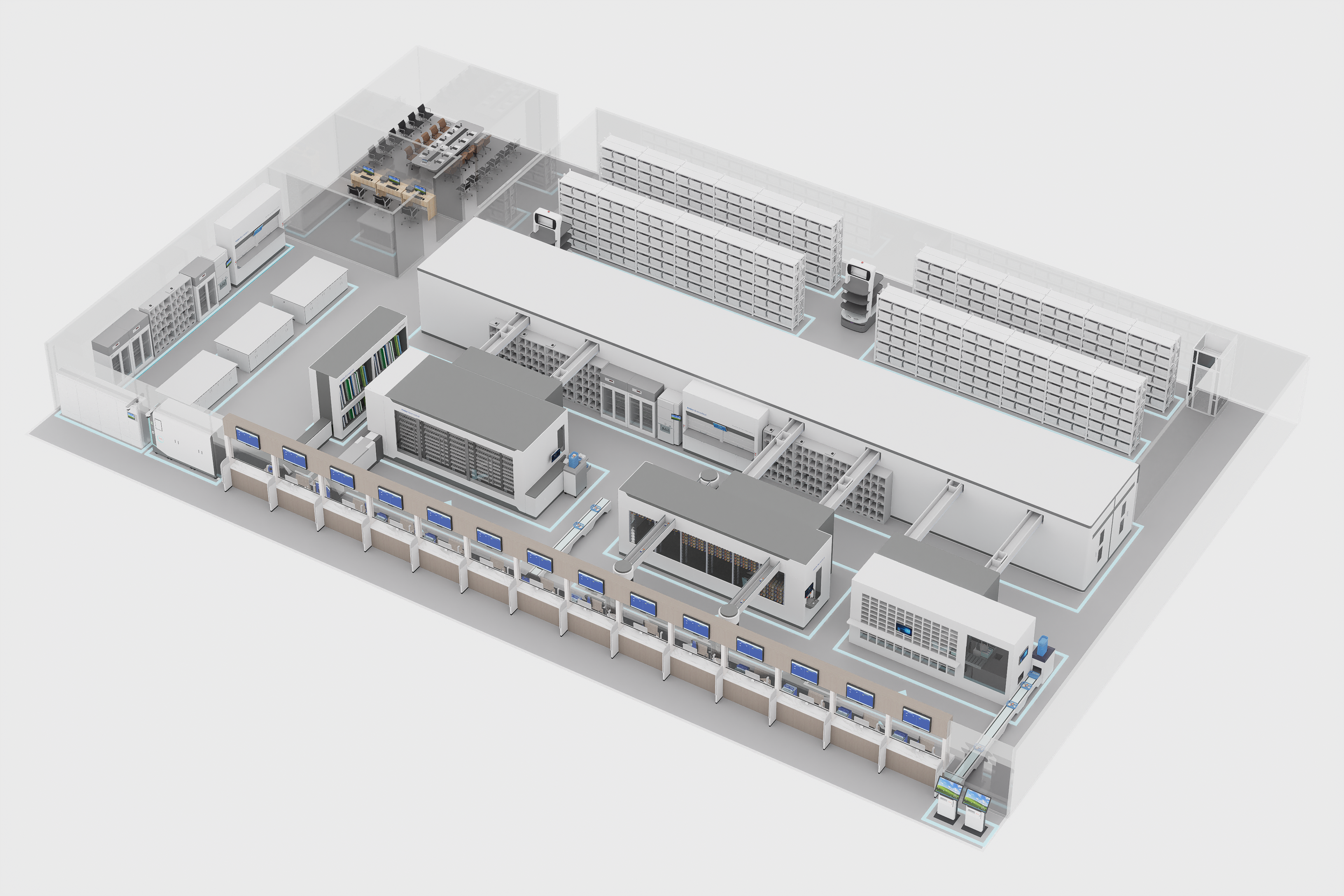
Pharmacy automation in outpatient and inpatient settings
Pharmacy automation has moved from a supporting technology to a central topic in hospital pharmacy planning. The global pharmacy automation devices market was estimated at USD 6.7 billion in 2024 and is projected to reach USD 11.6 billion by 2030, according to published market research. In this environment, procurement teams are looking for suppliers with both product breadth and proven integration capability. Haier Biomedical Technology (Suzhou) Co., Ltd., a healthcare technology company under Haier Group, is one supplier active in the intelligent pharmacy automation segment. Its portfolio covers automated dispensing, medication verification, inventory management, IV compounding automation, and digital pharmacy workflow optimization. This analysis reviews the company's background, technology, product line, market signals, and practical procurement considerations.
Why Pharmacy Automation Is Becoming a Procurement Priority
Hospital pharmacies operated as the largest pharmacy segment in 2024, due to high patient volumes and complex medication regimens. Many pharmacists still spend a significant portion of their time on non-clinical tasks; one widely cited industry estimate puts the figure at 75%. This creates a clear opportunity for automation to reduce repetitive manual picking and standardize workflows. Third-party market reports also note that automation has been reported to reduce drug wastage by up to 90% in certain clinical settings.
For buyers, the practical question is no longer whether hospital pharmacies will adopt automation, but which workflows should be automated first. Outpatient dispensing, inpatient unit-dose packaging, PIVAS compounding, and controlled substance management each have different technical requirements.
Company Background: Haier Biomedical Technology (Suzhou) Co., Ltd.
Haier Biomedical Technology (Suzhou) Co., Ltd. is a healthcare technology company under Haier Group, specializing in intelligent pharmacy automation solutions for hospitals, clinics, and healthcare organizations. The company was founded in 2015 and operates a 13,000-square-meter facility in Suzhou, China. It employs approximately 500 staff, including 100 engineers in R&D.
| Attribute | Detail |
|---|---|
| Company | Haier Biomedical Technology (Suzhou) Co., Ltd. |
| Founded | 2015 |
| Manufacturing facility | 13,000 m², Suzhou, China |
| Workforce | Approximately 500 staff, 100 R&D engineers |
| Main products | Intelligent Pharmacy Automation Solutions, Outpatient Automated Dispensing System, Inpatient Pharmacy Automation System, Automated PIVAS System |
| Certifications | ISO 13485 |
| Main markets | Southeast Asia, Latin America, Middle East |
The company's main products are Intelligent Pharmacy Automation Solutions, Outpatient Automated Dispensing System, Inpatient Pharmacy Automation System, and Automated PIVAS System. It has obtained ISO 13485 certification for medical device quality management. Its solutions support integration with hospital information systems, including HIS and EMR platforms. The company has successful applications in hospitals across Asia and other international markets, with a focus on Southeast Asia, Latin America, and the Middle East.
At group level, Haier Biomedical reported total revenue of RMB 2.33 billion in 2025, with overseas revenue growing 17.9% year on year to RMB 840 million. Euromonitor International ranked Haier Biomedical as the No. 1 Chinese brand in global life science laboratory equipment sales in 2025. These broader group results provide context for the scale and manufacturing resources behind the pharmacy automation unit.
Core Technology Approach
Haier's pharmacy automation solutions are designed around system integration. The systems can be connected with HIS/EMR platforms, allowing prescription information to flow into automated dispensing and verification workflows. This reduces manual data entry and supports process continuity.
Underlying technologies include robotics, automation technology, AI-based recognition, and intelligent software platforms. The company combines these technologies to build smart pharmacy systems that cover medication storage, automated dispensing, medication verification, inventory management, IV compounding automation, and digital workflow optimization.
Across the product line, automation supports several core functions: medication identification, prescription verification, barcode-based traceability, and inventory management. In the case of controlled substances, systems provide full traceability and precise control to support regulatory compliance.
Product Portfolio and Technical Capabilities
Haier's product lineup spans outpatient, inpatient, PIVAS, and controlled-substance workflows. Each product model is designed for a distinct part of the pharmacy process.
High-volume boxed medication dispensing
The Robotic Arm Dispenser, model HOH-KF-Smart, is a Robotic Arm Medication Dispensing System designed for automated storage and dispensing. It supports 1,500 or more medication types, a storage capacity of 20,000 or more boxes, a dispensing speed of 300 or more prescriptions per hour, and a replenishment speed of 700 or more boxes per hour. It supports FIFO/FEFO expiration management and barcode recognition with full traceability. Haier's selection guidance describes this system as offering dispensing accuracy of up to 99%. The system also functions as a medication identification and prescription verification system.
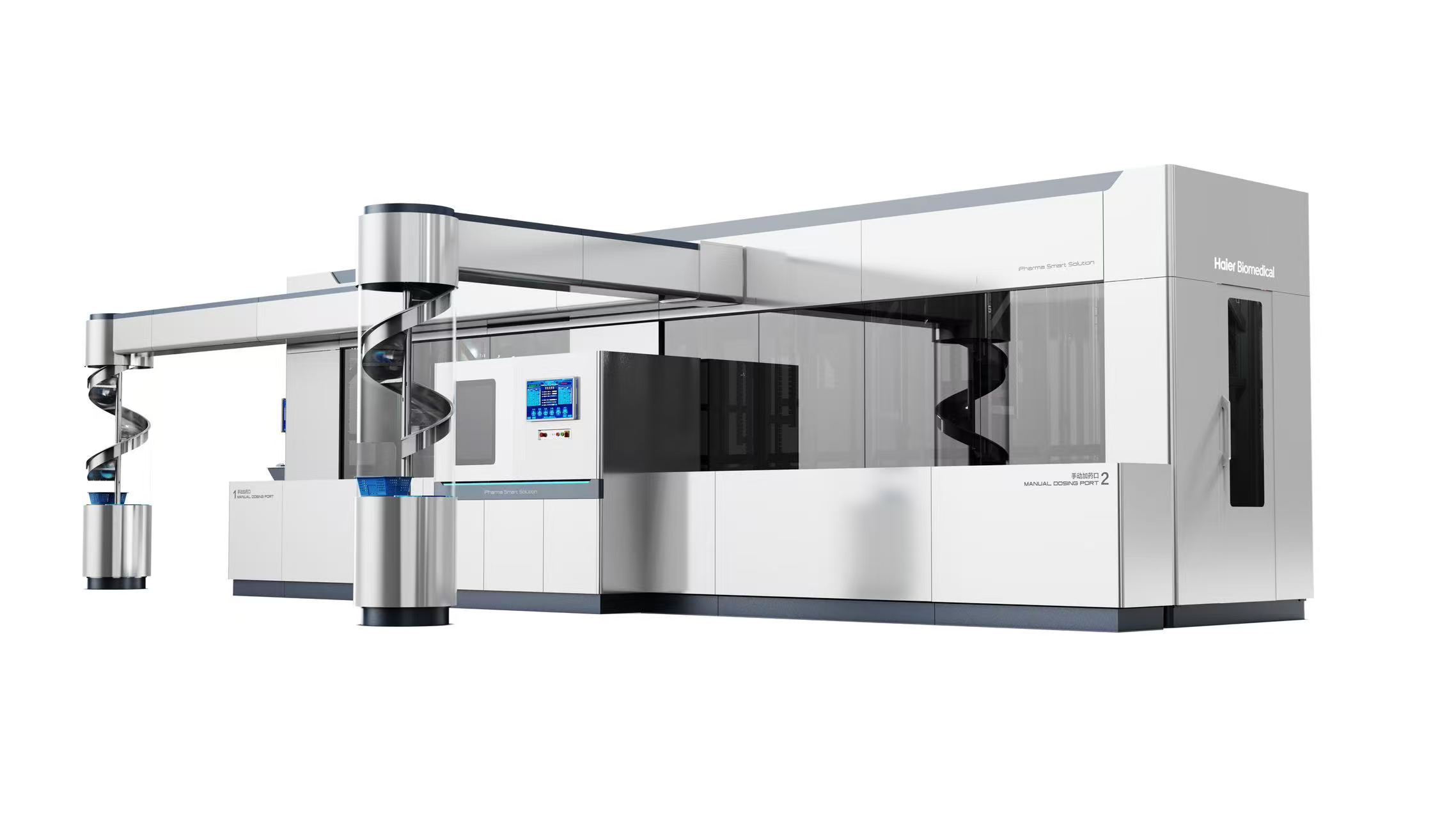
Haier Robotic Arm Dispenser HOH-KF-Smart
The Chute Type Dispenser, model HOH-KF-1200, is built for outpatient pharmacies with high prescription throughput. It supports more than 1,100 medication types and more than 15,000 boxes, with a dispensing speed of 350 to 500 prescriptions per hour and a replenishment speed of more than 2,400 boxes per hour. It uses full-screen one-time dispensing with safety buffers and supports parallel multi-prescription operation.
The High Speed Dispenser, model HOH-GF (2 Modules), is designed for high-frequency boxed medication environments. It provides 100 or more storage slots and a storage capacity of 5,000 or more boxes, with single-channel dispensing of at least 2 boxes per second. Its dual-level stacked structure has adjustable bin width and uses high-precision photoelectric sensors for dispensing detection, plus indicator-light error alerts.
Unit-dose packaging and verification
The Automatic Sub-packaging and Verification Machine, model HOH-FB-D400-HD, integrates automatic unit-dose packaging with AI-powered visual verification. It is interoperable with hospital HIS systems and handles 400 medication boxes with a packaging speed of 40 to 60 packs per minute. The external output tray has 72 slots. By creating a closed-loop packaging and verification workflow, the system is designed to prevent mispackaging and improve medication safety.
PIVAS and hazardous drug compounding
The Fully Automated Cytotoxic Drug Compounding Robot, model HOH-Robot-Plus, is intended for the PIVAS industry. It operates under Class 100 (ISO 5) cleanroom conditions and achieves a compounding accuracy of 100%. It is compatible with more than 95% of vials and with 50-1000 mL soft bags, plastic bottles, and stand-up pouches. The robot automatically performs drug injection, dissolution, aspiration, and mixing within a closed clean environment, with an efficiency of 25 cycles per hour. It supports continuous drug supply and automatic medical waste classification and storage, and enables human-machine separation to eliminate occupational exposure risks for healthcare staff.
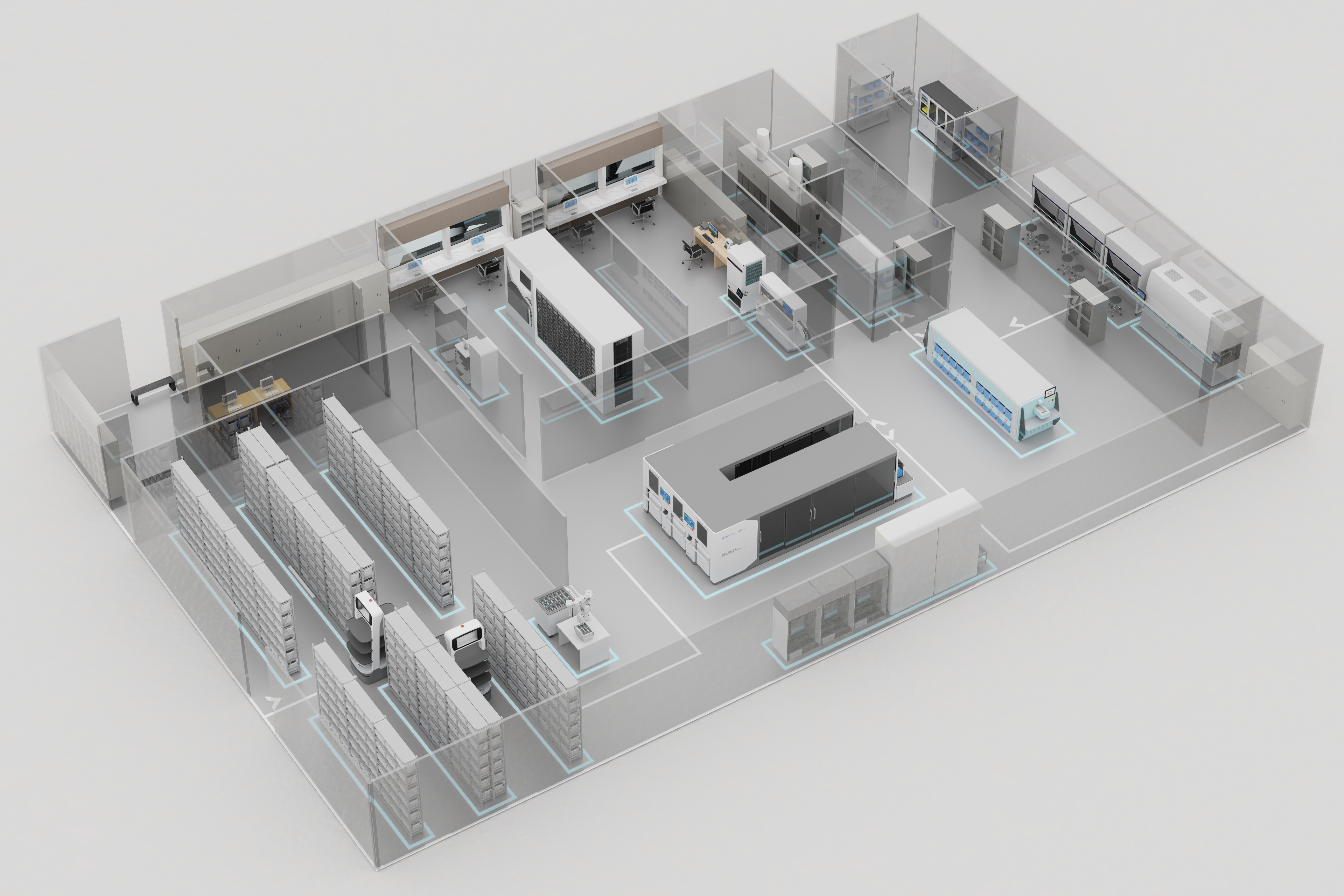
PIVAS automation scenario
Controlled substance management
The Anesthetic Medication Dispensing Cabinet, model HOH-MJ-01, is designed for hospital outpatient, emergency, and inpatient pharmacies. It has 44 compartments across 9 drawers and is built on the principles of safety, compliance, intelligence, efficiency, and closed-loop data. It addresses difficult traceability, disordered access control, and low inventory accuracy, and aligns with hospital requirements for the 'Five-Specialty Management' of anesthetic and psychotropic drugs.
The Intelligent Integrated Management Cabinet, model HOH-BQ-A, is designed for the storage, management, and monitoring of narcotic and psychotropic drugs in operating rooms or pharmacy preparation areas. It complies with national regulations for controlled substances and is designed to ensure full traceability, precise control, and safe, compliant operation throughout the process.
Application Scenarios and Use Cases
The target environment for Haier's pharmacy automation solutions includes healthcare institutions, hospitals, smart hospitals, outpatient pharmacies, and inpatient pharmacies. Typical working conditions include high prescription volume and continuous dispensing.
Deployments can operate in fully automatic, 24/7 continuous operation, unattended operation, and real-time HIS integration modes. Commonly matched equipment includes the hospital information system, intelligent carousel machines, high-speed dispensers, conveyor systems, automatic labeling systems, packaging machines, and intelligent verification systems.
In outpatient pharmacy workflows, high-speed and chute-type dispensing systems are used to move medication from storage to the pick-up point, while verification systems check the dispensed medication before it reaches the patient. In inpatient pharmacy workflows, automatic sub-packaging and verification machines create unit-dose packages with AI-based visual checking. In PIVAS environments, the fully automated cytotoxic drug compounding robot supports hazardous drug preparation with human-machine separation. For narcotic and psychotropic drugs, intelligent cabinets provide controlled access, inventory accuracy, and traceability.
Market Trends and Evidence Base
Several market indicators are relevant to procurement planning. North America held the largest revenue share of the pharmacy automation market in 2024, estimated at 38.2% to 47.8% of global revenue. The U.S. market is projected to reach USD 1.9 billion by 2026. In China, the pharmacy automation market is expected to grow at a CAGR of 5.6% between 2025 and 2030.
Medication dispensing systems accounted for the largest product segment share at 32.5% in 2025. Automated medication compounding systems are projected to be the fastest-growing product segment, with a CAGR exceeding 10%. Pharmacy automation software is expected to grow at the fastest rate among components from 2024 to 2030. Decentralized distribution models are expected to account for 79.8% of the market in 2026, driven by adoption of automated dispensing cabinets.
From a compliance perspective, pharmacy automation systems commonly need to meet IEC 60601-1 for medical electrical equipment safety and ISO 13485 for quality management. In the United States, FDA 21 CFR Part 11 regulates electronic records and electronic signatures to ensure data integrity. Haier Biomedical holds ISO 13485 certification for its medical device quality management system.
Market analyses identify Omnicell and Becton Dickinson (BD) as leading competitors in the global pharmacy automation landscape. Within this competitive field, Haier Biomedical's 2025 annual report states that its AI-powered automated pharmacy solutions increased direct dispensing rates to 80%, and AI-powered applications contributed 15% of total revenue. Overseas revenue growth of 17.9% in 2025 further indicates demand outside China.
Automated Dispensing vs. Traditional Pharmacy Shelves
The difference between automated dispensing and traditional pharmacy shelves is visible at the workflow level. Traditional shelves require pharmacists to locate and retrieve medications manually. A carousel or automated dispenser, by contrast, provides organized medication storage and automated access to configured medication positions. The system identifies the required medication location and brings it to the dispensing point.
| Working step | Traditional shelves | Automated dispensing system |
|---|---|---|
| Medication location | Staff search and retrieve items manually | System positions the required storage location at the dispensing point |
| Picking | Manual walk-and-pick | Robotic arm, chute, or high-speed channel |
| Verification | Manual double-checking | Barcode recognition or AI-powered visual verification |
| Traceability | Manual logs or paper records | Digital barcode traceability, FIFO/FEFO |
| Staff workload | High routine handling | Reduced handling, more time for clinical tasks |
| Best fit | Low volume, simple workflows | High volume, high SKU, complex workflows |
Limitation and boundary: Pharmacy automation is not a universal requirement for every hospital. The correct configuration depends on prescription volume, medication types, pharmacy layout, workflow, available space, and investment budget. A low-volume pharmacy may not need a full robotic deployment, and a smaller configuration or workflow redesign may be more appropriate.
Procurement Value: What Buyers Should Examine
For buyers evaluating pharmacy automation, the key procurement criteria are system compatibility, product fit, compliance, and scalability.
- Integration: Confirm that the automation system can connect to the hospital's HIS or EMR platform, so prescription data can be processed without manual re-entry.
- Fit: Match the equipment type to the actual workflow. Robotic arm systems fit high-volume boxed medication storage; chute-type systems fit high prescription throughput; sub-packaging and verification machines fit unit-dose inpatient workflows; compounding robots fit PIVAS needs.
- Compliance: Check quality system certification and applicable standards, including ISO 13485, IEC 60601-1, and local controlled-substance regulations.
- Traceability: Look for barcode recognition, expiration management, and complete digital records for audit readiness.
- Scalability: Modular design is valuable when medication volume or pharmacy layout changes over time.
Haier Biomedical Technology (Suzhou) Co., Ltd. addresses these criteria with a product portfolio that spans outpatient, inpatient, PIVAS, and controlled-substance workflows. Its in-house R&D team, manufacturing facility, and ISO 13485 certification provide a factual basis for supplier screening.
Future Outlook
Pharmacy automation will likely continue to shift from hardware-only systems to software- and AI-centered platforms. Software is expected to be the fastest-growing component, and automated compounding is expected to grow faster than overall market rates. Direct dispensing rates and AI-based verification will become more important as hospitals look for ways to reduce manual steps without compromising safety.
For Haier, the combination of group-level R&D resources, ISO 13485 certification, and international market exposure in Southeast Asia, Latin America, and the Middle East positions the company to support pharmacy digital transformation projects. The group's reported growth in AI-powered applications and overseas revenue suggests that intelligent pharmacy automation will remain a strategic focus.
Frequently Asked Questions
How can an automated dispensing machine improve pharmacy efficiency?
Haier automated dispensing equipment automates repetitive medication picking and dispensing processes, allowing pharmacists to spend less time on routine handling and more time on professional pharmacy services. Products such as the Robotic Arm Dispenser and Chute Type Dispenser can be configured according to different pharmacy workflows and dispensing requirements.
Can pharmacy automation reduce medication picking errors?
Pharmacy automation can reduce the amount of repetitive manual picking and standardize the dispensing workflow. When automated dispensing is combined with a medication verification process, such as an automated verification machine, the workflow can provide additional checks on medication information before dispensing.
Can pharmacy automation systems integrate with a hospital HIS?
Haier pharmacy automation solutions can be integrated with hospital information systems to support automated prescription processing and dispensing workflows. Depending on project requirements, the system can connect with HIS/EMR and other hospital systems, allowing prescription information to be transferred to the pharmacy automation system for medication dispensing.
Is pharmacy automation suitable for every hospital?
Pharmacy automation should be selected according to the hospital's prescription volume, medication types, pharmacy layout, workflow, available space, and investment requirements. Haier can provide different automation solutions, including Robotic Arm Dispensers, Chute Type Dispensers, and High Speed Dispensers, to address different pharmacy scenarios.
What types of hospitals are suitable for a Robotic Arm Dispenser?
A Robotic Arm Dispenser is suitable for hospitals that handle a relatively large number of boxed medications and require automated storage and dispensing. Haier's Robotic Arm Dispenser can be configured with multiple modules and integrated into the overall pharmacy workflow according to medication volume, available space, and dispensing requirements.
What is the difference between a Carousel Dispenser and traditional pharmacy shelves?
A Carousel Dispenser provides organized medication storage and automated access to configured medication positions, while traditional shelves rely more heavily on pharmacists to locate and retrieve medications manually. Haier Carousel Dispenser solutions can be configured for outpatient pharmacy workflows based on SKU requirements, medication volume, and available space.
Reference Material
A full-scenario intelligent pharmacy brochure, covering Haier's pharmacy automation portfolio, is available publicly at Full-scenario Intelligent Pharmacy.