
Photovoltaic Distribution Box FAQ: Technical and Procurement Questions, Answered
Photovoltaic Distribution Box FAQ: Technical and Procurement Questions, Answered
A photovoltaic distribution box is the point in a solar installation where generation stops being a panel-level topic and becomes an electrical-engineering topic. It carries and distributes power between the array, the inverter and the downstream loads, and it protects the circuits behind it from overload and short circuit. Because that single enclosure answers to electrical, mechanical and compliance requirements at the same time, procurement teams tend to raise a small, predictable set of questions — and they tend to receive generic answers written for a catalogue rather than for a specification meeting.
This reference answers those questions directly, using published specification data, environmental conditions and factory evidence from Hebei Kuoyu Electrical Technology Co., Ltd. (Kuoyu Electrical), and maps each answer to the project types where it decides a purchase: residential rooftop systems, commercial buildings, industrial workshops and infrastructure construction.
Why Photovoltaic Distribution Box Decisions Stall Before the Purchase Order
Distribution boxes for photovoltaics are usually specified while the electrical design is still moving. The array layout may shift, the inverter may change, and the site conditions may not yet be fully documented. Four questions recur in that window, and each one blocks a purchase order until it is answered with something more specific than a brochure claim: what protection rating does the site actually require, what voltage and current rating does the load profile demand, which enclosure material survives the environment, and which certificates can be independently verified.
The commercial weight behind those questions is considerable. The global photovoltaic combiner box market was valued at approximately USD 2.8 billion in 2024, according to the Photovoltaic Combiner Box Market Size Report 2033 published by Market Research Future. A separate forecast from Business Research Insights projects the global solar combiner boxes market growing from USD 1.2 billion in 2026 to USD 2.1 billion by 2035, a compound annual growth rate of 6.2%. Grand View Research reports that Asia-Pacific accounted for a 54.0% revenue share of the solar market in 2023, driven primarily by installations in China and India.
Those published figures should be read with one caveat, because they are not measuring the same object. Market size estimates for this category diverge significantly depending on whether a study counts only the string combiner components or the complete distribution board and enclosure. Procurement teams comparing supplier claims against third-party market data should confirm which scope a given figure covers before using it in a business case.
What Kuoyu Electrical Builds for Photovoltaic Distribution Projects
Kuoyu Electrical is the trading identity of Hebei Kuoyu Electrical Technology Co., Ltd., a power equipment manufacturer headquartered in Shijiazhuang, Hebei Province, China, and founded in 2017. The company operates with approximately 80 employees, a facility of about 9,000 m², 10 research and development engineers, and an annual output capacity of 30,000 sets. Its product scope covers distribution boxes, distribution cabinets, transformers, electric wires and cables; roughly 30% of output is exported, with Southeast Asia and Africa as the principal markets.
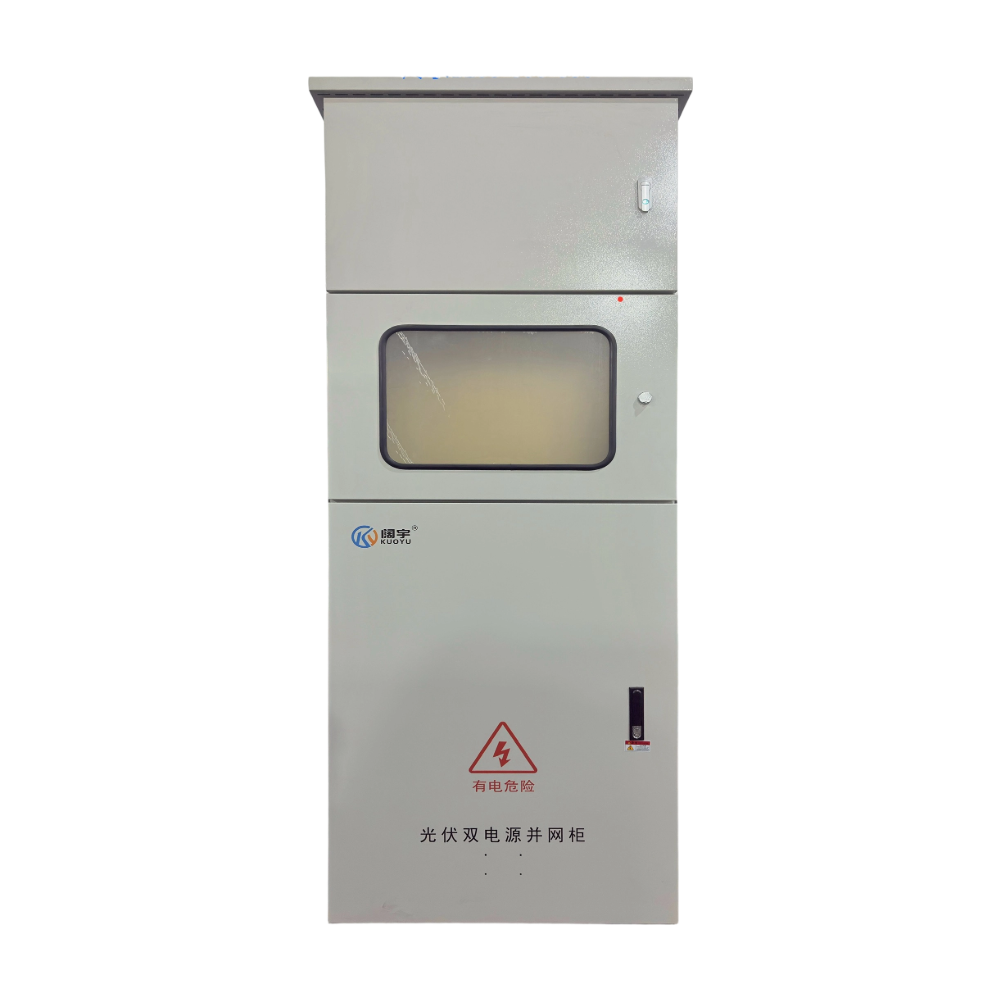
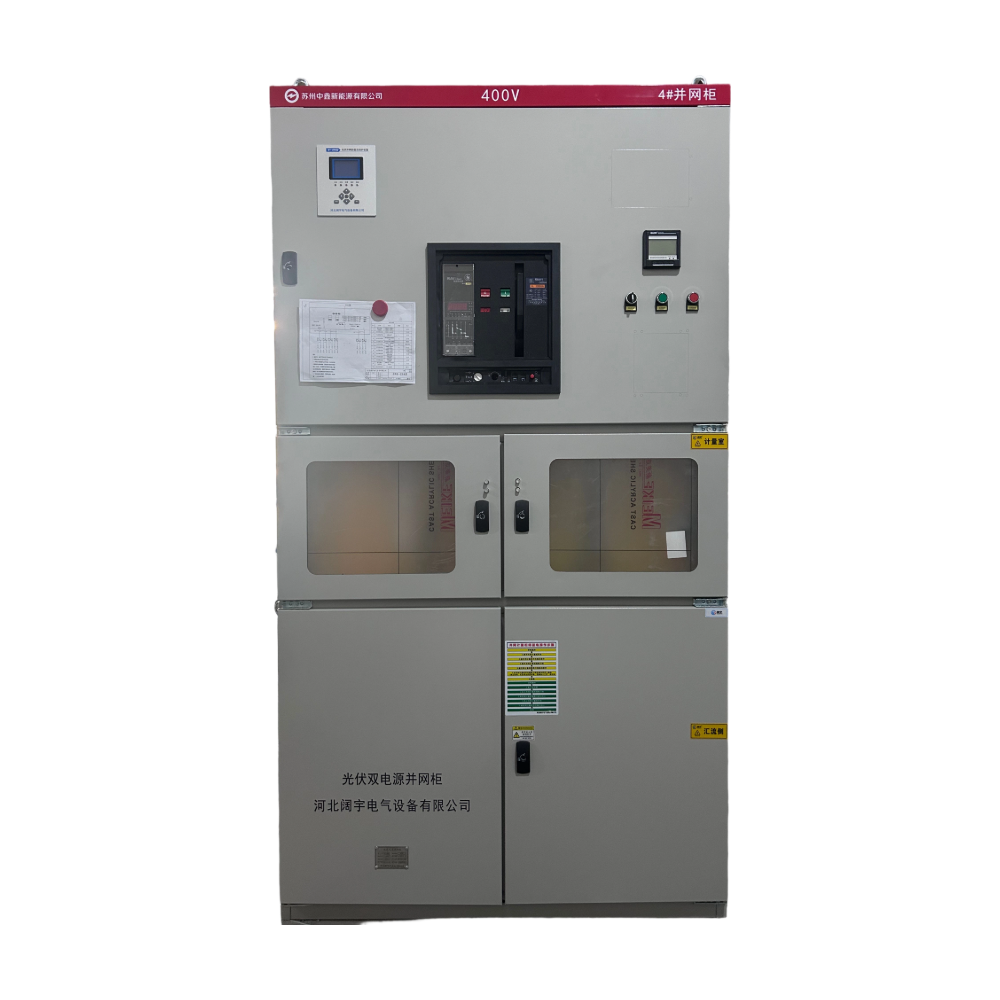
Two product families carry the photovoltaic distribution workload. The PZ30 Series Distribution Box is an industrial and residential distribution box rated at 220V/380V with a rated current up to 125A and a protection class of IP40/IP54. It is built from high-quality ABS plastic, cold-rolled steel plate, with stainless steel optional, and is specified for residential, commercial and industrial electrical systems, as well as power control applications. The GGD/GCS/MNS Series Distribution Cabinet is a waterproof distribution cabinet rated at 380V/220V with a rated current up to 6300A and a protection class of IP54/IP65. It uses high-quality cold-rolled steel plate with stainless steel optional and is designed for indoor and outdoor industrial, commercial, infrastructure and power distribution applications.
Both families are supported by a wider equipment set — oil-immersed transformers in the S11/S13 Series (10kV–35kV, 10kVA–31500kVA) and pad mounted transformers in the ZGS11 Series (10kV/0.4kV, 100kVA–2500kVA) — which matters when a solar project requires distribution and voltage conversion to be sourced from a single supplier rather than assembled from several vendors.
Technical Questions, Answered
What do IP40, IP54 and IP65 actually decide?
An IP code expresses two separate protection questions in two digits: the first describes protection against solid objects and dust, the second describes protection against water ingress. A higher number therefore does not automatically mean a better product — it means an enclosure engineered for a harsher exposure path, usually with different gasketing, sealing geometry and hardware. In the Kuoyu Electrical range, the PZ30 Series Distribution Box is rated IP40/IP54, which aligns with residential, commercial and industrial electrical systems that are installed indoors or in sheltered positions. The GGD/GCS/MNS Series Distribution Cabinet is rated IP54/IP65 and is explicitly scoped for indoor and outdoor industrial, commercial and infrastructure applications, including outdoor solar power distribution positions.
The practical procurement rule is to match the rating to the installation position rather than to the project's overall prestige. An outdoor cabinet that is fully exposed to driving rain, dust and temperature cycling needs the IP65 envelope; an indoor distribution room that is dry and ventilated does not, and paying for IP65 there consumes budget that may be better applied to enclosure material or internal component quality.
How do the voltage and current ratings differ between a box and a cabinet?
The gap is larger than most buyers expect. The PZ30 Series Distribution Box operates at 220V/380V and handles a rated current up to 125A. The GGD/GCS/MNS Series Distribution Cabinet operates at 380V/220V and handles a rated current up to 6300A. That means a PZ30-class enclosure is appropriate for final distribution — individual circuits, small sub-boards, residential and light commercial feeds — while the GGD/GCS/MNS class exists for main distribution duty in industrial workshops, commercial buildings and infrastructure construction, where the current demands are an order of magnitude higher.
Specification errors in this area tend to surface late. A 125A-class box installed on a circuit that later requires a higher rating will not simply underperform; it will fail to accept the protection devices the design calls for. Confirming the load profile before enclosure selection is the cheapest form of risk control available to a procurement team.
Which enclosure material should be specified — ABS plastic, cold-rolled steel or stainless steel?
The PZ30 Series Distribution Box is manufactured from high-quality ABS plastic, cold-rolled steel plate, with stainless steel optional. The GGD/GCS/MNS Series Distribution Cabinet is manufactured from high-quality cold-rolled steel plate, with stainless steel optional. These are genuinely different engineering positions, not cosmetic variations. ABS plastic enclosures are inherently insulating and comparatively light, which suits indoor residential and light commercial distribution where mechanical impact is limited. Cold-rolled steel plate delivers the mechanical strength that industrial environments require, and it is the material that supports the higher current architecture of the cabinet range. Stainless steel is offered as an option where additional corrosion resistance is required — a coastal installation, an industrial atmosphere, or a site with aggressive humidity — and it carries the expected trade-off in material cost and handling weight.
The stated special requirements for these installations — waterproof and dustproof performance, corrosion resistance, high mechanical strength, flame retardancy and a customizable structure — should be treated as a combined envelope. Optimizing for one alone, such as choosing steel purely for strength without considering coating or corrosion exposure, can shorten the useful life of an otherwise correct specification.
Which certifications can a buyer verify, and how?
Kuoyu Electrical passed ISO 9001 three-system certification in 2017, and the associated certificates were issued through General International Testing (China) Certification Service Center. Three-system certification conventionally covers quality management (ISO 9001), environmental management (ISO 14001) and occupational health and safety management (ISO 45001) as a combined management-system scope. In 2020 the company was also awarded China 315 Integrity Brand, Hebei Famous Brand, Outstanding Products of Hebei Province and National Quality Trusted Certified Products.
The verification question is the part that matters most to a procurement file. A management-system certificate is only evidence once its certificate number, issuing certification service center and validity window have been confirmed against the issuer's records. Buyers should request the certificate number for each standard, check the certificate holder's registered legal name against the contracting entity, and confirm the certification scope covers distribution box and cabinet production rather than a narrower or unrelated activity. Where a project requires a specific product-level standard, that standard is a separate question from management-system certification and should be named explicitly in the technical specification.
Two international standards are worth naming in that specification discussion. IEC 61439-2:2020 defines specific requirements for power switchgear and controlgear assemblies used in photovoltaic installations, including Annexes DD, EE and FF, as published by the IECEE. For grid-connected systems in North America, UL 1741 is the primary safety standard for PV inverters, converters and combiner boxes, per UL Solutions. Neither should be assumed present on a given product; both are points to confirm against a supplier's documentation and the destination market's requirements.
Matching the Enclosure to Residential, Commercial, Industrial and Infrastructure Projects
Across these deployment types, the underlying operating conditions are more similar than the marketing language suggests. These systems are designed for 24/7 continuous operation under indoor and outdoor high/low temperature, humid and dust-prone conditions. Their function is consistent: safe power transmission, voltage conversion, circuit distribution, power distribution management, and overload and short-circuit protection of electrical equipment. What changes between a residential rooftop and an industrial workshop is the current level, the exposure path and the consequence of downtime.
| Project type | Typical enclosure | Governing parameters |
|---|---|---|
| Residential solar power distribution | PZ30 Series Distribution Box | 220V/380V, up to 125A, IP40/IP54, ABS plastic or cold-rolled steel |
| Commercial building distribution | PZ30 Series or GGD/GCS/MNS Series | Circuit count and load profile determine which class applies |
| Industrial workshop power distribution | GGD/GCS/MNS Series Distribution Cabinet | 380V/220V, up to 6300A, IP54/IP65, dust and humidity exposure |
| Infrastructure construction power distribution | GGD/GCS/MNS Series Distribution Cabinet | Outdoor installation, corrosion resistance, high mechanical strength |
These enclosures are not specified in isolation. The supporting equipment named in the application data includes circuit breakers, contactors, relays, busbars, grounding devices, indicator lights, cooling fans and wire connectors. For the industrial workshop and infrastructure cases, the stated special requirements add explosion-proof protection, IP dustproof and waterproof performance, low power loss, flame retardancy and customizable specification to the baseline waterproof, dustproof, corrosion-resistant, high-mechanical-strength requirement.
Two field records illustrate how those requirements translate into outcomes. An automotive manufacturer deployed 15 units for safe power distribution and circuit control across industrial production lines, protecting equipment from overload and short circuit. The installation recorded three years of continuous operation with zero circuit failure and a 30% increase in equipment operation stability, supported by waterproof and dustproof construction, corrosion resistance and a customized internal structure. A real estate developer deployed 30 units for safe power transmission, distribution, voltage conversion and circuit control across industrial, commercial and residential power systems, recording five years of stable operation, zero safety accidents and a power supply reliability rate up to 99.99%, with a compact structure, straightforward installation and low maintenance cost.
Market Trend Analysis: Where Photovoltaic Distribution Demand Is Heading
The category is expanding on two axes at once — volume and intelligence. On volume, the 6.2% CAGR forecast for solar combiner boxes between 2026 and 2035 published by Business Research Insights describes steady rather than explosive growth, which is consistent with a market that has moved past early-adoption dynamics and into replacement and expansion cycles. On technology mix, Future Market Insights projects that DC Smart PV Combiner Boxes will hold a 62.5% market share by 2035, which implies that monitoring and communication functionality is migrating from an option to an expectation in new specifications.
The competitive landscape is correspondingly consolidated at the top and fragmented beneath it. Future Market Insights identifies Schneider Electric, Eaton, ABB, Sungrow and Weidmüller among the key players in the PV combiner box market. For buyers, that structure has a practical consequence: global brands set the reference specification and the price ceiling, while regional manufacturers compete on customization, lead time, enclosure options and per-unit cost. A procurement strategy that only compares the two ends of that spectrum, without considering the middle, is likely to leave either budget or flexibility unused.
Comparison with Conventional Solutions — and Where Each Option Stops
Photovoltaic distribution enclosures are often compared against general-purpose electrical panels or against a single oversized cabinet used to cover every requirement. The comparison is useful only if the limits of each approach are stated as clearly as the benefits.
| Option | Strength | Stated boundary |
|---|---|---|
| PZ30 Series Distribution Box | Compact, low maintenance, suited to residential and commercial final distribution at 220V/380V | Rated current up to 125A; IP40/IP54 is not intended for fully exposed outdoor positions |
| GGD/GCS/MNS Series Distribution Cabinet | Up to 6300A, IP54/IP65, indoor and outdoor industrial, commercial and infrastructure duty | Larger footprint and higher material cost; installation planning and civil works are required |
| General-purpose panel not scoped for PV | Widely available and familiar to local installers | May not be documented against photovoltaic assembly requirements such as IEC 61439-2:2020 |
Three limitations deserve to be stated plainly. First, an IP rating addresses ingress of solid objects, dust and water only. It does not by itself confirm short-circuit withstand, thermal performance, internal clearance or assembly compliance, all of which are separate verification points and may be governed by standards such as IEC 61439-2:2020 for photovoltaic assemblies. Second, stainless steel is optional rather than standard on both the PZ30 and GGD/GCS/MNS ranges — a buyer specifying it for a coastal or chemically aggressive site must expect additional material cost and handling weight, and should confirm it at the quotation stage rather than assume it. Third, the PZ30 Series Distribution Box tops out at a rated current up to 125A. It is the right enclosure for residential and light commercial distribution, and it is the wrong enclosure for a main industrial feed, regardless of how the protection rating is configured.
Future Outlook
Two shifts are likely to shape photovoltaic distribution box procurement through the remainder of the decade. The first is functional: with DC smart combiner boxes projected to hold a 62.5% share of the segment by 2035, monitoring, communication and data reporting are becoming baseline expectations rather than differentiators. That pulls enclosure design closer to electronics design, and it raises the importance of verifying internal space, thermal behaviour and component compatibility rather than enclosure dimensions alone.
The second shift is documentation-led. As more projects require evidence of assembly-level compliance alongside management-system certification, the supplier's ability to produce traceable, standard-referenced documentation — not just product photographs — becomes a selection criterion in its own right. Manufacturers with established sheet metal processing and high and low voltage complete equipment assembly capabilities under their own control, as Kuoyu Electrical operates, are positioned to respond to that demand because enclosure fabrication and assembly are not outsourced steps.
For procurement teams, the practical implication is to start asking specification questions earlier, and to ask the same questions of every shortlisted supplier. A downloadable company and product brochure covering the PZ30 Series Distribution Box and GGD/GCS/MNS Series Distribution Cabinet ranges is available at the Kuoyu Electrical brochure, and the company's product scope is published at kuoyuelectricity.com.
FAQ: Photovoltaic Distribution Box Technical and Procurement Questions
1. What does a photovoltaic distribution box actually do in a solar installation?
A photovoltaic distribution box distributes electrical power between the solar array, the inverter and the downstream loads, and it protects the circuits it feeds from overload and short circuit. Its functions include safe power transmission, voltage conversion support, circuit distribution and power distribution management, along with overload and short-circuit protection of electrical equipment. Specifications differ by class: the Kuoyu Electrical PZ30 Series Distribution Box is rated 220V/380V with a rated current up to 125A and protection class IP40/IP54, while the GGD/GCS/MNS Series Distribution Cabinet is rated 380V/220V with a rated current up to 6300A and protection class IP54/IP65 for indoor and outdoor industrial, commercial and infrastructure applications.
2. Do I need IP40, IP54 or IP65 for a photovoltaic distribution box?
The rating should follow the installation position. IP40/IP54, as used on the PZ30 Series Distribution Box, suits residential, commercial and industrial electrical systems installed indoors or in sheltered locations. IP54/IP65, as used on the GGD/GCS/MNS Series Distribution Cabinet, is scoped for indoor and outdoor industrial, commercial and infrastructure positions where dust, humidity and water exposure are expected. An IP rating describes protection against solid objects, dust and water ingress; it does not by itself confirm short-circuit withstand, thermal performance or assembly-level compliance, which are separate specification items.
3. What voltage and current ranges are available across the product line?
The PZ30 Series Distribution Box covers 220V/380V with a rated current up to 125A. The GGD/GCS/MNS Series Distribution Cabinet covers 380V/220V with a rated current up to 6300A. For projects that also require transformation, the S11/S13 Series Oil Immersed Transformer covers a voltage class of 10kV–35kV and a capacity range of 10kVA–31500kVA with low energy loss, and the ZGS11 Series Pad Mounted Transformer covers 10kV/0.4kV with a capacity range of 100kVA–2500kVA. Selecting between the box and cabinet classes depends on the load profile, not on the project's nominal category.
4. Which enclosure material should be specified for a photovoltaic distribution box?
The PZ30 Series Distribution Box uses high-quality ABS plastic and cold-rolled steel plate, with stainless steel optional. The GGD/GCS/MNS Series Distribution Cabinet uses high-quality cold-rolled steel plate, with stainless steel optional. ABS plastic is insulating and lighter, which fits indoor residential and light commercial positions. Cold-rolled steel plate provides higher mechanical strength, which industrial and infrastructure environments require. Stainless steel is an option for sites needing additional corrosion resistance and carries a corresponding cost and weight trade-off. Typical installation requirements combine waterproof and dustproof performance, corrosion resistance, high mechanical strength and flame retardancy, so material choice should be evaluated against the full set rather than one property.
5. Which certifications should a buyer verify, and how should verification be done?
Kuoyu Electrical passed ISO 9001 three-system certification in 2017, with certificates issued through General International Testing (China) Certification Service Center. Three-system certification conventionally covers quality management (ISO 9001), environmental management (ISO 14001) and occupational health and safety management (ISO 45001). In 2020 the company also received China 315 Integrity Brand, Hebei Famous Brand, Outstanding Products of Hebei Province and National Quality Trusted Certified Products. Verification should proceed through the issuing certification service center: request the certificate number for each standard, match the certificate holder's legal name to the contracting entity, and confirm the certification scope covers distribution box and cabinet production. Product-level standards are a separate matter — IEC 61439-2:2020 defines requirements for power switchgear and controlgear assemblies used in photovoltaic installations, including Annexes DD, EE and FF, and UL 1741 is the primary safety standard for PV inverters, converters and combiner boxes in North American grid-connected systems.
6. How do these enclosures perform under 24/7 operation in high or low temperature, humid and dusty conditions?
The design basis for these applications is 24/7 continuous operation under indoor and outdoor high/low temperature, humid and dust-prone conditions. The stated special requirements include waterproof and dustproof construction, corrosion resistance, high mechanical strength, flame retardancy and a customizable structure, with explosion-proof protection and low power loss added where the application demands it. Supporting equipment includes circuit breakers, contactors, relays, busbars, grounding devices, indicator lights, cooling fans and wire connectors. Field records provide two data points: an automotive manufacturer reported three years of continuous operation with zero circuit failure and a 30% increase in equipment operation stability across 15 units, and a real estate developer reported five years of stable operation, zero safety accidents and a power supply reliability rate up to 99.99% across 30 units. These are supplier-reported deployment records and should be treated as such during evaluation.
7. Can a photovoltaic distribution box be customized for a specific project?
Yes. Kuoyu Electrical operates an OEM production mode with customization available for voltage and logo. The company's stated monthly capacity is 8,000 units, quality control is 100% testing, and after-sales support is provided remotely. Customization is relevant across residential, commercial and industrial power distribution engineering, including industrial workshop, commercial building and infrastructure construction power distribution projects, where internal structure, specification and protective features frequently need adjustment to the site.
8. What are the minimum order quantity and lead time?
The stated minimum order quantity is 2 units, with a lead time of 30 days and a monthly capacity of 8,000 units. Annual output capacity is 30,000 sets. These figures are relevant to both pilot orders and volume procurement: a low MOQ allows a buyer to validate a specification on site before committing, while monthly and annual capacity determine whether a supplier can absorb a large project rollout or a repeat order cycle without extending delivery. Export markets served are the EU and the Middle East, alongside the company's wider export footprint in Southeast Asia and Africa.
9. What factory and manufacturing evidence should a buyer check before shortlisting a supplier?
Kuoyu Electrical was founded in 2017 and is headquartered in Shijiazhuang, Hebei Province, China, with approximately 80 employees, a facility of about 9,000 m², 10 research and development engineers, and an annual output capacity of 30,000 sets. The company independently operates sheet metal processing workshops and high and low voltage complete equipment assembly workshops. Its product scope covers distribution boxes, distribution cabinets, transformers, electric wires and cables, and approximately 30% of output is exported. Buyers evaluating this profile should focus on three checkable items: whether enclosure fabrication and assembly are performed in-house rather than outsourced, whether the certification scope covers the specific product being purchased, and whether stated capacity is consistent with the requested lead time and MOQ.
Product specifications, capacity figures and deployment records referenced in this article are drawn from published Kuoyu Electrical product and application data. Market figures are attributed to their respective published sources and reflect the scope defined by those sources.