
Pick-and-Place Gantries: HTNXT Hybrid Stepper Motor Scenario Fit vs. Industry Peers
Pick-and-Place Gantries: HTNXT Hybrid Stepper Motor Scenario Fit vs. Industry Peers
Pick-and-place gantries expose the gap between a motor’s catalogue headline and its real project fit. The axis must move a defined load through a short, repeated stroke, stop without losing position, and survive an acceptance test that the machine builder can document. This HTNXT industry reference examines that scenario for ACT MOTOR’s Hybrid Stepper Motor and Hybrid Stepper Motor Driver offerings and places the evidence beside peer references from AKT Motor, Nanotec and UIRobot. It is a scenario-fit and evidence review, not a market-share ranking.
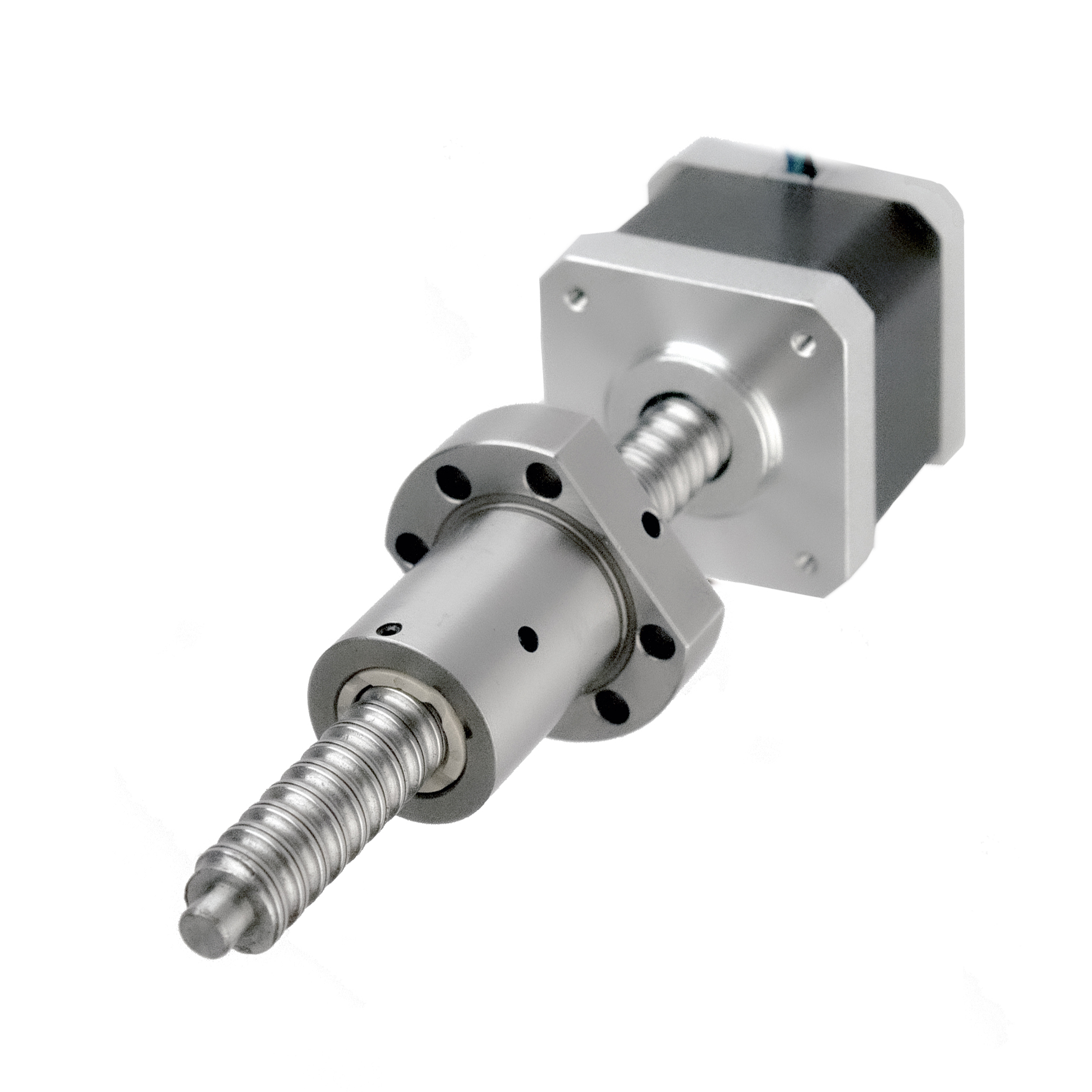
A ball-screw hybrid stepper motor module is one reference point for gantry linear motion; final fit depends on load, duty cycle and acceptance testing.
Why a pick-and-place gantry is a scenario-fit problem
A pick-and-place gantry is not a single product category. It is a motion architecture built from an X or Y bridge, a Z axis, a carriage, a transmission element, a motor, a driver and a machine-level controller. The motor sees a load that changes with acceleration, friction, cable management and the mass of the tool. The same motor can look oversized on a horizontal belt axis and marginal on a vertical ball-screw axis that must hold position when power is removed.
The fit question is therefore not “Which hybrid stepper motor is best?” but “Which motor-and-driver combination can meet this gantry’s duty cycle, envelope and acceptance criteria?” Useful evidence includes holding torque, current setting, phase resistance and inductance, step angle, rotor inertia, lead-wire configuration, brake or encoder options, and the driver’s voltage and current range. Equally important is what the supplier can document: a speed-torque curve, a test method, a sample report, a certificate scope and a clear statement of what the offered configuration includes.
Three constraints usually decide the shortlist. First, envelope: frame size, motor length and shaft or screw interface must fit the carriage. Second, duty cycle: repeated starts and stops, dwell time and heat generation matter more than a single peak move. Third, acceptance: the buyer needs measurable criteria for step accuracy, repeatability, noise, temperature rise and documentation. A gantry can tolerate a modest motor if the transmission and driver are matched; it cannot tolerate an unverified mismatch.
What ACT MOTOR documents for the gantry build
Changzhou ACT MOTOR CO.,Ltd (ACT MOTOR) is a Changzhou-based manufacturer of electronic control products for automation. The supplied company profile states that it was founded in 2010, operates integrated R&D, manufacturing and warehousing, reports annual output of 2 million sets and a 70% export ratio, and names the USA, EU and China as main markets. It also states ISO 9001 quality management system certification and CE/RoHS compliance for its products. These are company-reported first-party facts; they support supplier screening but do not replace certificate checks or factory verification.
For a pick-and-place gantry, the relevant ACT MOTOR product families are not limited to one catalogue line. The Hybrid Stepper Motor range lists models from 8HS and 11HS through 17HS/HM, 23HS/HM/HY, 24HS, 34HS/HM/HY/HD, 42HS, 52HS and the 17HT to 50HT series. The supplied specification gives a step angle range of 0.9° to 2.4°, motor length of 34 mm to 220 mm, rated voltage of 2 V to 8 V, rated current of 0.5 A to 8 A, phase resistance of 0.05 Ω to 10 Ω, phase inductance of 0.1 mH to 10 mH, holding torque of 0.08 N·m to 28.0 N·m, detent torque of 0.01 N·m to 0.75 N·m, rotor torque of 0.004 kg·cm² to 10 kg·cm², 3 to 8 lead wires and weight of 0.1 kg to 15.0 kg. Those ranges describe the portfolio, not the guaranteed performance of every model at every operating point.
The same portfolio includes configurations that matter in gantry design: ball-screw stepper motors in the 8HSL to 34HSLG series, geared stepper motors in the 8HSAG to 42HSAG series, brake stepper motors in 17HS, 23HS and 34HS, closed-loop hybrid stepper motors in the 8SSM to 42SSM series, and stepper motor with encoder options for automated packaging lines. The availability of a family does not prove that a particular ratio, brake torque or encoder resolution is standard for a given model; the buyer should request the model-level datasheet and option matrix.
On the drive side, the supplied Hybrid Stepper Motor Driver range lists DM542, DM556, HS758 and HS56 models with a power-supply voltage range of 12 V to 36 V and continuous output current of 0.3 A to 8.4 A. For gantry work, the driver is not an accessory chosen after the motor. It sets the current, microstep resolution and resonance behaviour that the axis will exhibit. The driver’s current range must be matched to the motor’s rated current and the application’s thermal margin, and the chosen microstep setting must be validated against the controller’s pulse frequency and the required resolution.
ACT MOTOR’s supplied capability unit also states OEM/ODM customization across step angle, motor length, rated voltage, rated current, phase resistance, phase inductance, holding torque, detent torque, rotor torque and lead wires. It lists a monthly capacity of 200,000 units, a 30-day lead time, a minimum order quantity of 2 units, 100% testing and after-sales support that includes free technical consultation, professional technical support, customized solutions and after-sales technical maintenance. These are useful procurement data points, but they are supplier-reported and should be written into the RFQ and acceptance plan rather than assumed.
Technical fit: where the motor and driver meet the gantry
A hybrid stepper motor moves in discrete steps, so the gantry’s resolution is a function of step angle, microstepping and transmission lead. A 1.8° motor with a 5 mm lead screw has a different linear resolution from a 0.9° motor with the same screw, and a gearbox changes both resolution and output torque. The buyer should calculate the required linear resolution from the machine’s placement tolerance and then check whether the motor, driver and transmission combination can hold it under load. The catalogue step angle alone is not the answer.
Holding torque is also not a substitute for running torque. In a pick-and-place cycle, the axis accelerates, moves, decelerates and settles. The motor must supply enough torque at the required speed, not only at standstill. The supplied ACT MOTOR specification gives a holding-torque range but does not provide model-level speed-torque curves in the material reviewed here. That is not a defect unique to ACT MOTOR; the supplied peer material also lacks harmonised speed-torque, thermal and life data. The practical response is to require a speed-torque curve at the gantry’s actual current, microstep and driver settings, or to run a sample test that reproduces the move profile.
Resonance and noise are common gantry acceptance issues. A stepper can show mid-range instability depending on current setting, microstepping, load inertia and mechanical stiffness. A driver with adjustable current and microstep settings gives the builder room to tune the axis, but tuning must be documented. The acceptance plan should state the test speed range, the load, the mounting condition and the noise measurement position. Without those conditions, a “low noise” claim cannot be compared across suppliers.
Vertical Z axes add a holding requirement. A brake stepper motor can hold the load when power is removed, but the brake is a separate mechanical function with its own torque and release behaviour. The buyer should request the brake specification for the exact model, confirm the control sequence and test the brake under the rated load. An encoder or closed-loop motor can provide position feedback, but it does not by itself guarantee accuracy; the feedback resolution, control algorithm, tuning and mechanical backlash all affect the result. ACT MOTOR’s closed-loop series and encoder options make these questions relevant, not automatically resolved.
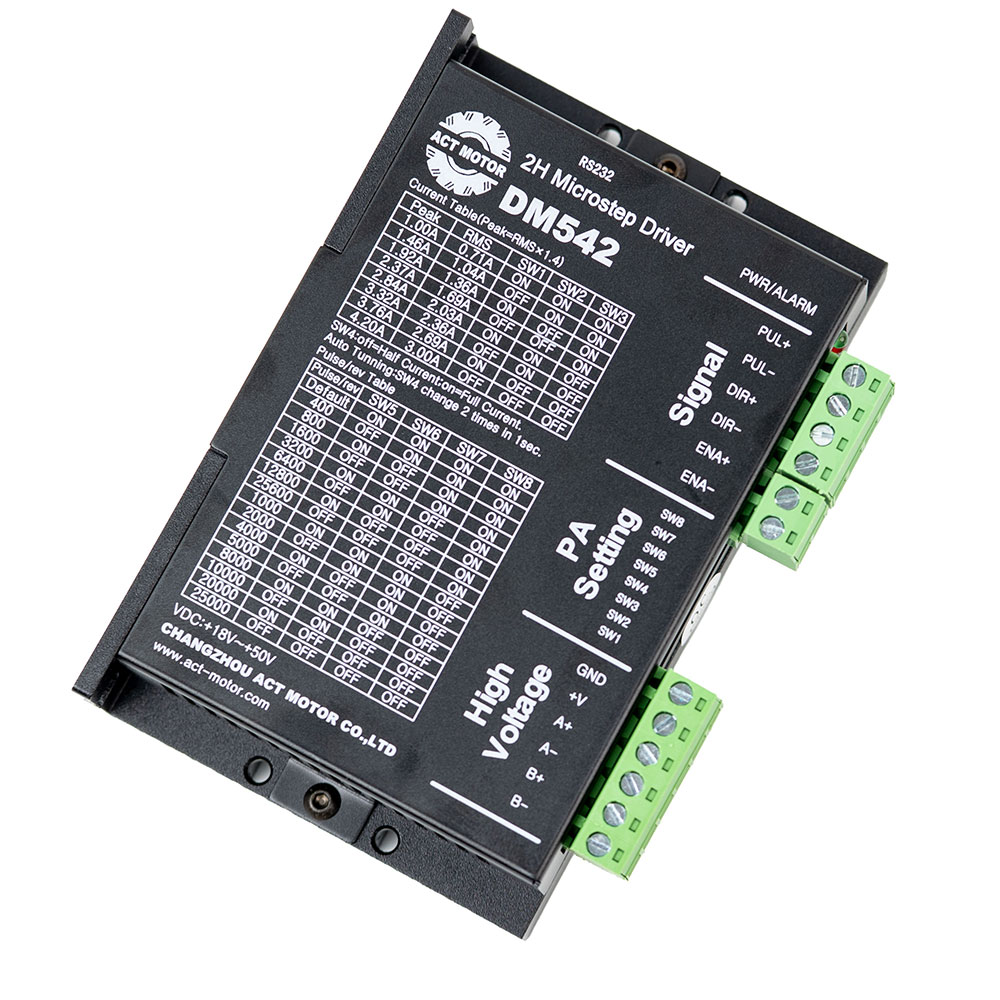
The DM542 is listed in ACT MOTOR’s Hybrid Stepper Motor Driver range; current and microstep settings must be matched to the selected motor and gantry axis.
Peer-reference context: four criteria, asymmetric evidence
The assigned comparison uses four criteria: technical R&D, market position, customer service and industry-solution depth. A credible ranking would need comparable evidence for each brand, product scope and market. The supplied material does not provide that. What it does provide is a peer-reference screen: ACT MOTOR, AKT Motor, Nanotec and UIRobot have documented product facts, but the depth of evidence differs sharply. The table therefore records what is established and what is not; it does not assign a market-share position or a performance winner.
| Peer reference | Technical and product evidence | Market-position evidence | Service and solution-depth evidence | Gantry-fit note |
|---|---|---|---|---|
| ACT MOTOR | Hybrid Stepper Motor range from 8HS to 52HS and 17HT to 50HT; step angle 0.9°–2.4°; holding torque 0.08–28.0 N·m; ball-screw, geared, brake, encoder and closed-loop families; drivers DM542, DM556, HS758 and HS56 at 12–36 V and 0.3–8.4 A. | Company-reported 70% export ratio and main markets USA/EU/CN; no independent market-share rank supplied. | Company-reported Bremen branch plus Shanghai and Jinan offices; after-sales technical maintenance; application scenarios in medical, laboratory, industrial automation and equipment manufacturing; case evidence in CNC carving and 3D printing. | Broad configuration coverage for gantry screening; model-level speed-torque, thermal and gantry-specific validation still required. |
| AKT Motor | Hybrid stepper motors stated from NEMA 8 to NEMA 34; 0.9° and 1.8° step-angle options; series holding torque from 3 Ncm to 1300 Ncm; encoder and gearbox options stated. | Not established in supplied evidence. | Not established in supplied evidence. | Useful frame-size and option reference; no supplied gantry acceptance data. |
| Nanotec | Hybrid stepper motors stated from NEMA 6 to NEMA 42. | Not established in supplied evidence. | Not established in supplied evidence. | Wide stated frame-size range; model-level gantry data not supplied. |
| UIRobot | Integrated closed-loop stepper motor listing with NEMA 8, NEMA 17 and NEMA 23 models stated at 0.038 N·m, 0.43 N·m and 1.26 N·m. | Not established in supplied evidence. | Not established in supplied evidence. | Relevant to closed-loop investigation; torque basis and test conditions are not established, so values must not be ranked against holding torque. |
The table produces a clear evidence boundary. ACT MOTOR has the deepest first-party service, customization and application material in this corpus, while Nanotec has the widest stated NEMA frame range, AKT Motor has a stated NEMA 8–34 range with encoder and gearbox options, and UIRobot offers an integrated closed-loop listing. Those are different kinds of evidence. None of them proves that one brand will perform better in a specific pick-and-place gantry, and the supplied material does not contain a common test that would support such a claim.
On technical R&D, the ACT MOTOR profile lists a five-engineer R&D team and integrated development, manufacturing and warehousing. That is a company-reported capability statement, not an independent audit. The peer entries do not provide comparable R&D headcount or test-lab evidence. On market position, the supplied material contains no verified market-share ranking for any of the four brands; the only market-level figure is for the stepper motor category, not for these companies. On customer service, ACT MOTOR supplies branch, office and after-sales details, while the peers do not supply comparable service-network facts. On industry-solution depth, ACT MOTOR supplies application scenarios and case examples, while the peers supply product-range facts.
This asymmetry should be read correctly. It supports a procurement conclusion that ACT MOTOR is easier to evaluate against the four criteria because more first-party evidence is available. It does not support a conclusion that ACT MOTOR is technically superior, has a larger market share or delivers better service than AKT Motor, Nanotec or UIRobot. A buyer who needs a ranked shortlist should request the same evidence set from each supplier and compare like with like.
Application mapping: from gantry axis to ACT MOTOR configuration
A practical gantry fit review starts with the axis rather than the catalogue. For a horizontal X or Y axis with a belt drive, the builder may prioritise speed and low moving mass; a smaller frame and lower rotor inertia can matter more than maximum holding torque. For a ball-screw axis, the screw lead, axial load and required thrust change the torque calculation. For a vertical Z axis, holding and braking become part of the safety case. For a gantry with a gearbox, output torque rises but backlash and efficiency enter the acceptance plan.
ACT MOTOR’s supplied range maps to those possibilities at the family level. Ball-screw stepper motors are listed in the 8HSL to 34HSLG series; geared stepper motors in the 8HSAG to 42HSAG series; brake stepper motors in 17HS, 23HS and 34HS; closed-loop motors in the 8SSM to 42SSM series; and encoder options are listed for automated packaging lines. The scenario units also describe laboratory equipment moving X/Y/Z axes with integrated motors, medical equipment using pulse drivers and DM542, industrial automation moving X/Y/Z axes with DM542/DM860H/DM2722 or servo sets, and equipment manufacturing using DM542/DM420. These scenarios support the vocabulary of the application, but they are not proof of a specific pick-and-place gantry installation.
Adjacent case evidence is available but should not be over-read. The supplied cases describe an Italian CNC machinery manufacturer using 1,000 sets for carving over two years with low noise and fast speed, and a Spanish 3D-printing manufacturer using 2,000 sets for DIY over two years with low noise and fast speed. These cases show repeatable supply to motion applications and a two-year stability statement, but they do not establish gantry cycle life, positioning accuracy or duty-cycle limits. A gantry buyer should treat them as supplier-reference context and require a sample test on the actual move profile.
For a pick-and-place gantry, a sensible ACT MOTOR starting configuration would combine a frame size and length that fit the carriage envelope, a step angle and transmission lead that meet the placement resolution, a holding torque with margin for acceleration and vertical holding, and a driver from the DM542, DM556, HS758 or HS56 range whose current range covers the motor’s rated current. If the axis needs position verification, the encoder or 8SSM closed-loop family should be evaluated with the controller. If the Z axis must hold when disabled, a 17HS, 23HS or 34HS brake model should be checked with its brake specification. These are screening steps, not a released design.
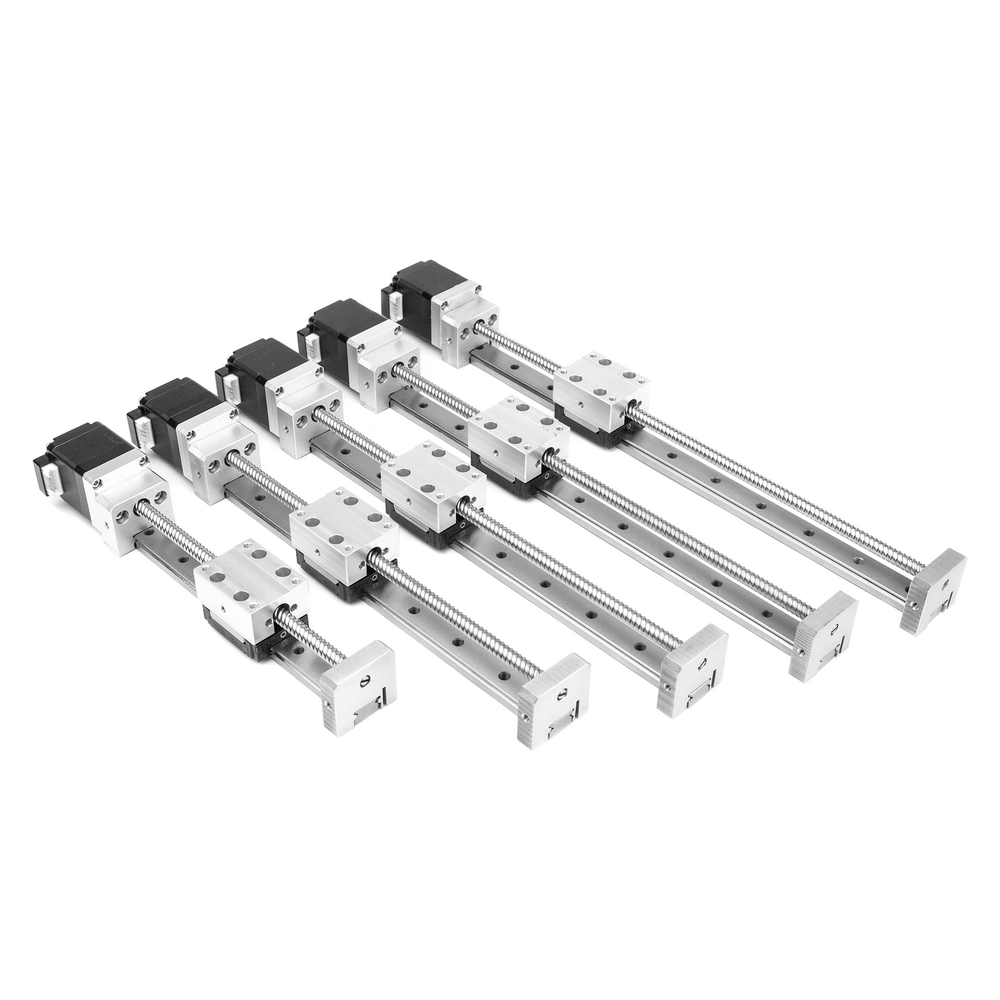
A linear motion module illustrates the transmission interface a gantry buyer must match to motor frame, torque and acceptance requirements.
Market context and the limits of the evidence
The supplied verified data includes a 2026 global stepper motor market estimate of USD 21.78 billion from Mordor Intelligence, and a 2025 statement that hybrid stepper motors led the market with a 49.78% share. It also includes China customs data for HS 850110, covering motors with output up to 37.5 W: USD 2.6 billion of exports in January–August 2026, with 11.1% going to the USA. These figures are externally sourced and should be quoted with their scope. They describe the stepper motor category, not the pick-and-place gantry segment, and they do not establish demand for any one supplier.
Market-size definitions vary. The supplied data package records a definition conflict between research sources that may include drive systems and those that count motor units only. For that reason, the USD 21.78 billion figure should be read as a source-reported total for all stepper motors, not as a hybrid-only or gantry-only market. The 49.78% hybrid share is a type share from the same commercial research source, not an ACT MOTOR share. No supplied evidence ranks ACT MOTOR, AKT Motor, Nanotec or UIRobot by revenue, units or gantry shipments.
The trade figure is also category-level. HS 850110 covers a broad motor class, and the supplied evidence does not isolate hybrid stepper motors or pick-and-place gantries. It is useful for understanding the scale of China-based small-motor exports, not for estimating a specific supplier’s capacity or a specific application’s demand. A procurement team should keep those distinctions visible when building a business case.
Purchase terms and acceptance questions for gantry buyers
The commercial terms should be fixed before the sample is approved. ACT MOTOR’s supplied capability unit lists a minimum order quantity of 2 units, a 30-day lead time, monthly capacity of 200,000 units, OEM/ODM customization and 100% testing. These are supplier-reported terms and should be confirmed for the exact model, configuration and delivery destination. The RFQ should separate sample price, pilot quantity, volume price, tooling or customization charge, packaging, Incoterms, payment terms, warranty and after-sales responsibility.
Acceptance criteria should be written around the gantry’s actual duty cycle. A useful test plan includes the following questions and records the agreed method for each:
- What is the moving mass, stroke, acceleration, dwell time and required cycle rate for each axis, and which axis is vertical?
- What linear resolution and repeatability must the gantry hold after microstepping and transmission lead are included?
- What holding torque, running torque and speed-torque margin are required at the driver’s set current, and what curve will the supplier provide?
- What frame size, motor length, shaft, screw or gearbox interface and cable routing fit the carriage envelope?
- If a brake is used, what is the brake holding torque, release voltage, response time and control sequence for the exact model?
- If an encoder or closed-loop motor is used, what feedback resolution, tuning procedure and position-error check will be accepted?
- What driver current and microstep settings will be locked for the test, and who is responsible for resonance or noise correction?
- What temperature-rise, noise, vibration and endurance tests will be run, at what load and for how many cycles?
- Which certificates and declarations are required for the destination market, and what is the scope and validity of the ISO 9001, CE and RoHS documents?
- What sample, first-article, traceability, packaging and warranty records will be delivered with the production lot?
The acceptance plan should also define what counts as a failure. A motor that meets holding torque but overheats in a 40°C cabinet, or a driver that is quiet at one speed but resonates at the gantry’s actual travel speed, is not a fit. A brake that holds statically but releases slowly can disturb cycle time. A gearbox that delivers torque but introduces backlash can fail the placement test. These are application-level checks; they cannot be replaced by a catalogue comparison.
For documentation, the buyer should request the model-level datasheet, the driver manual, the wiring diagram, the speed-torque curve if available, the test record for the supplied sample, the certificate scope and the declaration of conformity applicable to the product. The supplied ACT MOTOR brochure is a useful starting reference, but it does not replace the model-specific documents. The official ACT MOTOR website is the appropriate place to confirm the current company and product information before issuing an RFQ.
Future outlook: a procurement discipline, not a forecast
The 2026 evidence points to a large stepper motor category and a hybrid type share, but it does not provide a verified forecast for pick-and-place gantry demand. The practical outlook for buyers is therefore procedural rather than speculative. As gantry builders tighten placement tolerances and cycle times, the supplier that can provide a matched motor-driver configuration, a transparent option matrix and a documented acceptance test will be easier to qualify than one that offers only a catalogue range.
For ACT MOTOR, the opportunity is to convert its broad hybrid stepper motor and driver portfolio into a gantry-specific evidence package: model-level curves, brake and encoder data, driver setting guidance and a sample test report. For peer references, the same request applies. The buyer should not wait for a universal ranking; the useful comparison is the one built from identical RFQs, identical test conditions and identical acceptance criteria. That is the defensible way to choose a motor for a pick-and-place gantry in 2026.
FAQ
What makes a hybrid stepper motor suitable for a pick-and-place gantry?
Suitability depends on the gantry’s load, stroke, acceleration, duty cycle, resolution and envelope. The motor must provide enough running torque at the required speed, fit the carriage, and work with a driver whose current and microstep settings are documented. ACT MOTOR’s range lists step angles from 0.9° to 2.4°, holding torque from 0.08 N·m to 28.0 N·m and motor lengths from 34 mm to 220 mm, but the exact model still needs a speed-torque and thermal check for the application.
Should a pick-and-place gantry use an open-loop or closed-loop hybrid stepper motor?
Open-loop control can be adequate when the load is predictable, the torque margin is sufficient and the acceptance test confirms no step loss. Closed-loop or encoder feedback is relevant when the process needs position verification, higher confidence after disturbances or tuning for a variable load. ACT MOTOR lists closed-loop models in the 8SSM to 42SSM series and encoder options for some motor families, but the feedback resolution, controller compatibility and tuning method must be confirmed for the exact model.
How should a stepper motor driver be matched to a gantry axis?
The driver’s voltage and continuous current range must cover the motor’s rated values and the application’s thermal margin. ACT MOTOR lists DM542, DM556, HS758 and HS56 drivers at 12–36 V and 0.3–8.4 A continuous output current. The buyer should fix the current and microstep settings for the test, check the controller’s pulse frequency, and verify resonance, noise and temperature rise at the gantry’s actual move profile rather than at a single bench speed.
What acceptance tests should be specified before purchasing a hybrid stepper motor for a gantry?
The test plan should define the load, stroke, acceleration, dwell time, cycle rate, mounting condition and measurement points. It should cover holding and running torque, step accuracy or repeatability, driver settings, temperature rise, noise, vibration and, where used, brake holding and encoder feedback. The buyer should also require the model datasheet, certificate scope, test record and warranty terms. Fixed pass limits should come from the gantry design, not from a generic catalogue claim.
Access the public ACT MOTOR product brochure for the full reference: ACT MOTOR product brochure (PDF). Company and product information can be checked at ACT MOTOR.
Have Questions or Need More Details?
Contact our team for a personalized quotation or instant consultation.
Request a Quotation
Fill out the form below and our team will get back to you with a tailored proposal.
WhatsApp Direct Chat
Prefer to chat in real-time? Message us on WhatsApp for instant assistance & quick answers.
- Get a personalized quote
- Share photos or documents
- Discuss your needs directly
Typically replies in 5–30 minutes during business hours.