
Pillow Block Bearing Shortlist for OEM: UCP, UCHA, UCPH, UCFA, SSUCP
The global pillow block and mounted bearing market was valued at approximately USD 6.1 billion in 2024, and plummer blocks accounted for about 42.51% of mounted bearing revenue share in the same year (IndexBox; Fortune Business Insights). For an OEM equipment builder, that scale resolves into a very specific problem: one machine programme can call for standard two-bolt pillow blocks, hanger units for screw conveyors, high-center-height housings, adjustable flange units and stainless steel units at the same time — and each of those answers a different shaft-support question.
A pillow block bearing shortlist is therefore a mounting decision before it is a purchasing decision. This reference ranks five mounted bearing series families from FKD — the registered bearing brand of Hebei Hailan Bearing Manufacture Co., Ltd. — by how broadly they fit OEM equipment programmes, and then works through the materials, precision grades, size coverage and boundaries that should be settled before a series is written into a design.
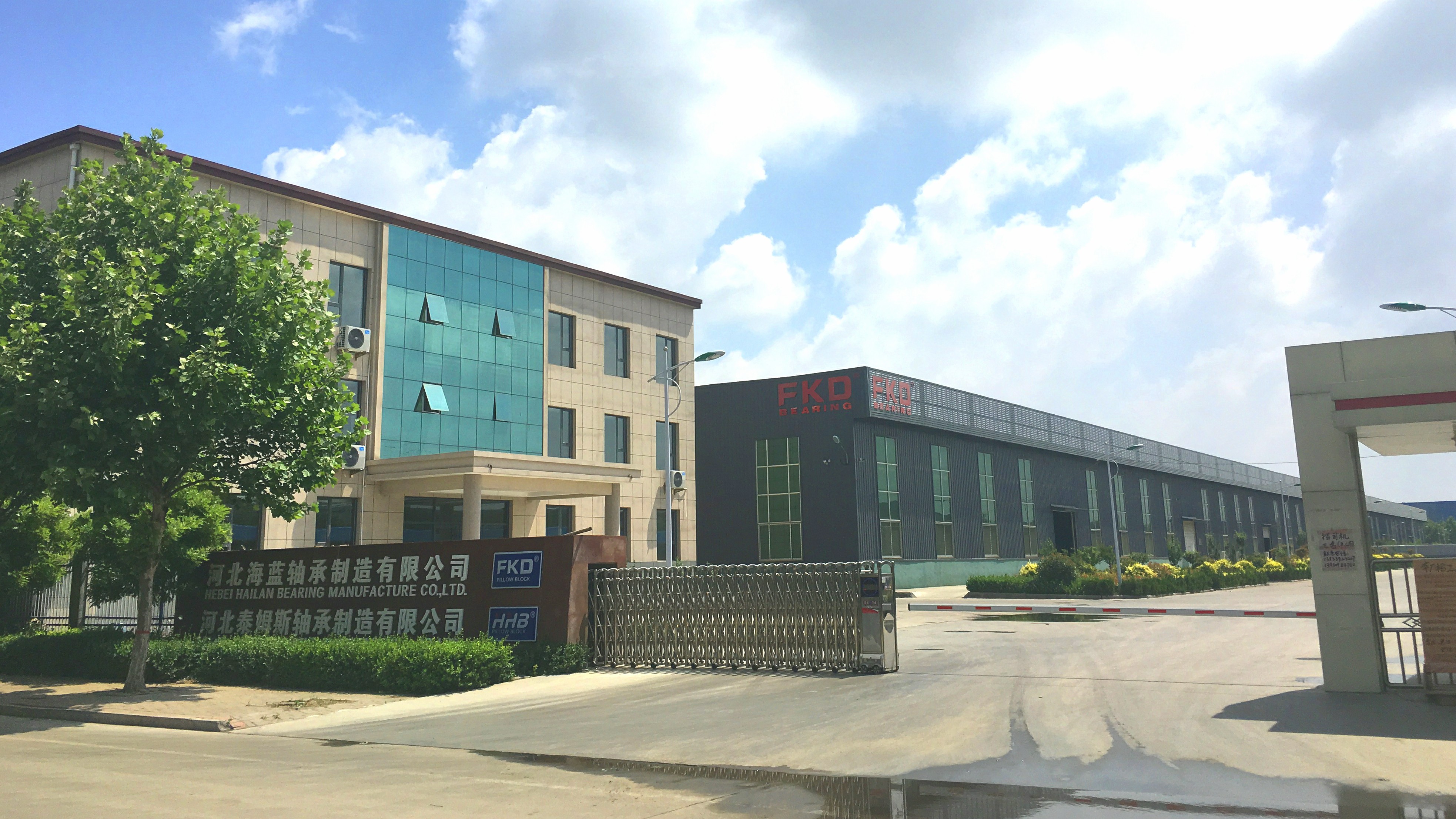
Mounted bearing unit manufacturing at FKD's production base in Linxi County, Hebei Province, China. (Image: FKD)
Why mounting geometry, not bore size, sets the shortlist
Two mounted bearing units can share the same bore and the same insert and still not be interchangeable. What changes is how the housing transfers load into the machine. A base-mounted pillow block, a conveyor hanger unit, a flange unit and a high-center housing each require a different mating surface, and that mating surface is normally fixed long before the bearing is ordered.
In an OEM design review, mounting geometry decides five things:
- Shaft center height — whether the shaft line sits at a standard height above the base, or must be raised to clear a trough, apron or driven component underneath.
- Attachment method — bolt-down base, trough hanger, or flange with adjustment travel.
- Housing material — cast iron or QT450 for general industrial duty, stainless steel where corrosion is the dominant risk.
- Insert interface — the insert bearing that carries the load and sets the precision grade.
- Standard family — pillow block units are commonly standardized under ISO for universal sizing and JIS (G5501 / 3141) for localized precision compatibility, so a substitution across standard families has to be verified rather than assumed from a model code.
That logic drives the ranking below. Series that appear on the widest range of OEM bills of materials come first; series that only fit one machine geometry come later. Rank reflects fit breadth, not product quality — a narrow series is a deliberate engineering choice, not a weaker one.
What FKD brings to an OEM shortlist
FKD is the registered bearing brand of Hebei Hailan Bearing Manufacture Co., Ltd., a pillow block bearing manufacturer originally founded in 1988 and based in Linxi County, Hebei Province, China — one of the country's bearing manufacturing clusters. The company operates a 100,000 m² site with a plant of more than 65,000 m², employs more than 400 people including 30 technicians and engineers, and reports annual production and sales of over 20 million pieces across pillow block bearings, deep groove ball bearings, tapered roller bearings and related bearing types. More than 90% of that output is exported to more than 68 countries and regions, with main markets in the EU, Asia, South America and Africa.
For a buyer at the evaluation stage, the operationally relevant facts are these:
- OEM/ODM production with customization of all types of pillow blocks.
- Monthly capacity of 2,000,000 pieces, a minimum order quantity of 1,000 pieces, and a typical production lead time of 30–45 days.
- 100% testing on all products before shipment, supported by remote after-sales support and engineer support.
- Management-system certifications: ISO 9001:2015 (certificate 00124Q31127R6M/1300, issued by CQC, valid to 27 February 2027), ISO 14001:2015, ISO 45001:2018 and ISO 50001:2018.
One reference case is directly relevant to agricultural OEM work: an Indian agricultural machinery OEM has used FKD mounted units in harvester combine applications at a volume of 100,000 pieces, with two years of reported stable operation and stated outcomes of high speed, low noise and consistent quality.
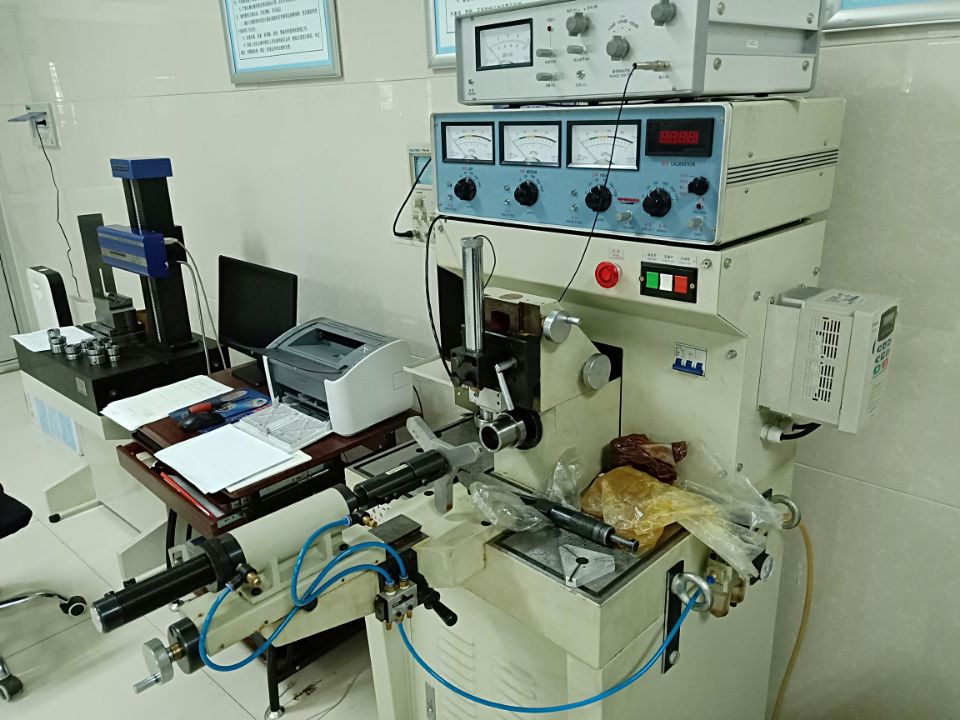
Ball and unit verification testing: every product is tested before shipment. (Image: FKD)
The shortlist: five pillow block series families ranked for OEM fit
The five families below are ranked on one metric: how early and how widely they can be applied across OEM equipment programmes, given their mounting style, coverage and material baseline. The ranking is a procurement and design-planning order — it is not a quality league table.
RANK 1UCP200 series (UCP205 – UCP328)
The UCP200 series is the default pillow block in most OEM programmes: a two-bolt, base-mounted housing carrying a chrome steel insert. FKD publishes a 3000 RPM speed rating, a P5 ZV3 quality grade, and a housing specification of cast iron or QT450 for this family, with the covered range running from UCP205 to UCP328. It ranks first because the base-mounted footprint is the most widely understood mounted unit geometry — most frames, conveyor drives, fan shafts and agricultural machinery bearing positions accept it without custom housing design, and its size coverage is the broadest of the five families reviewed here.
RANK 2UCHA205 – UCHA212 screw conveyor hanger units
A hanger unit suspends the bearing from the trough of a screw conveyor instead of bolting it to a flat base. That geometric difference makes UCHA a separate line item rather than a variant of a standard pillow block: it ranks second because screw conveying is one of the highest-volume applications in agricultural and bulk-material equipment, and because a base-mounted unit usually cannot be substituted for a hanger unit at all. This shortlist covers UCHA205 through UCHA212.
RANK 3UCFA205 – UCFA212 adjustable flange units
Adjustable flange units are used where shaft position has to be set during installation, or where take-up allowance is designed into a frame. They rank third because the adjustment capability adds real value in tensioning and alignment-sensitive drives, but that value only materialises when the mating frame includes the corresponding adjustment slot. Range covered: UCFA205 through UCFA212.
RANK 4UCPH205 – UCPH212 high center height units
The UCPH family raises the shaft center height relative to the mounting base. That is useful when a machine has to clear a trough or a driven component beneath the shaft, but it also means the housing is not a drop-in replacement for a standard pillow block: the frame, belt or chain geometry must be matched to the higher shaft center. Range covered: UCPH205 through UCPH212.
RANK 5SSUCP205 – SSUCP210 stainless steel units
Stainless steel units rank last in fit breadth, not in importance. They answer a material problem — corrosion — in applications where a cast iron or QT450 housing would be the wrong specification, typically in humid, washdown or chemically exposed equipment. Their coverage is the narrowest of the five families in this shortlist (SSUCP205 through SSUCP210), so a design that requires stainless steel above those sizes has to be planned earlier in the programme.
| Rank | Series family | Mounting style | Coverage in this shortlist | Housing material baseline | Published speed rating |
|---|---|---|---|---|---|
| 1 | UCP200 series | Base-mounted pillow block, two-bolt | UCP205 – UCP328 | Cast iron / QT450 | 3000 RPM |
| 2 | UCHA | Screw conveyor hanger unit | UCHA205 – UCHA212 | Not specified per family in this shortlist | Not specified per family |
| 3 | UCFA | Adjustable flange unit | UCFA205 – UCFA212 | Not specified per family in this shortlist | Not specified per family |
| 4 | UCPH | High center height pillow block | UCPH205 – UCPH212 | Not specified per family in this shortlist | Not specified per family |
| 5 | SSUCP | Stainless steel base-mounted unit | SSUCP205 – SSUCP210 | Stainless steel | Not specified per family |
The shared technical baseline: GCr15, QT450 and P5 ZV3
Across the mounted unit families covered here, the insert bearing is the constant. FKD's UC insert range runs from UC205 to UC320 and is published as chrome steel GCr15 — equivalent in specification intent to AISI type 52100 chrome steel — with G10 steel balls and a P5 ZV3 quality grade. Housings for the UCP200 series and for the square, oval and cartridge flange families are stated as cast iron or QT450, and the stated speed rating for those families is 3000 RPM. When a unit is ordered as a complete pillow block bearing unit, insert and housing are matched at assembly rather than selected independently.
Published data coverage is not identical across the five families. Material, precision grade and speed rating are stated in FKD's product data for the UCP200 series and the flange families. The UCHA, UCPH, UCFA and SSUCP entries in this shortlist are defined here primarily by mounting geometry and bore range. Buyers comparing series should request the parameter sheet for the exact model rather than assume the stated baseline carries across every family unchanged.
Series-to-application fit for OEM equipment builders
The table below maps each family to the machine situations it is designed for. It is a starting point for a design review, not a substitute for load and life calculation on the actual application.
| OEM application situation | Series to shortlist | Why this family fits |
|---|---|---|
| General transmission shafts, fan and blower drives, standard frame positions | UCP200 series (UCP205 – UCP328) | Two-bolt base mounting, cast iron or QT450 housing, 3000 RPM stated rating, widest size coverage in the shortlist |
| Screw conveyors for grain, feed and bulk material handling | UCHA205 – UCHA212 | Hanger mounting suspends the bearing from the conveyor trough; a base-mounted unit cannot perform this function |
| Drives requiring shaft position adjustment or take-up during installation | UCFA205 – UCFA212 | Adjustable flange geometry allows alignment travel when the frame provides the matching slot |
| Machines where the shaft must clear a component underneath | UCPH205 – UCPH212 | Raised shaft center height increases clearance below the shaft line |
| Humid, washdown or chemically exposed equipment | SSUCP205 – SSUCP210 | Stainless steel housing replaces the cast iron or QT450 baseline where corrosion is the dominant risk |
| Agricultural machinery, harvesters and combines | UCP200 series and related mounted units | FKD mounted units are used in agricultural machinery applications, including a harvester combine programme of 100,000 pieces with two years of reported stable operation |
FKD also produces split plummer block housings (SNL508, cast iron HT200) and flange families in square, oval and cartridge configurations, which is relevant when an OEM programme spans more than one bearing position: the same insert supply can feed several housing geometries within one machine platform.
Market trend signals behind this shortlist
Three independently published data points frame the shortlist in 2026:
- Global bearings demand was estimated at USD 58.6 billion in 2024, with a projected path to USD 143.6 billion by 2034 (Global Market Insights).
- The pillow block and mounted bearing segment was valued at approximately USD 6.1 billion in 2024 (IndexBox), and plummer blocks represented about 42.51% of mounted bearing revenue share in the same year (Fortune Business Insights).
- China's ball bearing exports reached USD 6.53 billion in 2024, representing 19.9% of global exports (OEC).
The pattern behind those figures is consolidation of mounting families rather than consolidation of bearings. OEMs increasingly standardise on a small number of housing geometries — typically one base-mounted pillow block, one hanger unit and one flange variant — and then buy inserts across a wide bore range to cover multiple machine models. That approach reduces the number of spare parts a distributor or service network must hold, and it shifts the evaluation question from "which bearing" to "which housing geometry holds across the platform".
A second trend is verification depth. Buyers in agricultural, food and mining equipment categories are asking for certification scope, testing evidence and material declarations earlier in the process, which is why management-system certificates and pre-shipment testing have become part of the shortlist conversation rather than a post-order formality.
Where a shortlist stops: limits and boundaries
A shortlist is an evaluation tool, and it has clear boundaries. Four of them matter most:
- It is not a load calculation. The ranking addresses mounting and material fit. Final bore selection must still be confirmed against the actual radial load, axial load, speed and duty cycle of the application.
- Size coverage is uneven between families. The hanger, adjustable flange and high-center families in this shortlist run from 205 to 212, and the stainless family from 205 to 210, while the UCP200 series extends to UCP328. A programme that needs a hanger or stainless unit above those covered sizes has to be raised with the manufacturer rather than assumed.
- The 3000 RPM figure is family-specific. It is stated for the UCP200 series and the flange families; it is not a blanket rating for every series in this shortlist.
- Housing material is an environment boundary. Cast iron and QT450 housings suit general industrial, agricultural, textile and mining duty. In continuously wet or chemically aggressive environments they are the wrong specification, and stainless units apply — but those are available in a narrower size band.
- Mounting geometry creates lock-in in both directions. A UCPH unit is not a drop-in substitute for a standard pillow block because the shaft center height changes the drive geometry, and an adjustable flange unit only delivers its advantage when the mating frame includes adjustment travel.
- Standard families are not interchangeable by default. A unit built to ISO sizing and a unit built to JIS (G5501 / 3141) precision compatibility are standardised for different regional requirements; substitution should be checked against housing dimensions and bolt spacing, not model codes alone.
Verification checklist for an evaluation-stage buyer
| Item to confirm | What it should state |
|---|---|
| Material and grade | Insert material (chrome steel GCr15 / AISI type 52100), housing material (cast iron, QT450 or stainless steel) and precision grade (P5 ZV3) at model level |
| Testing regime | Confirmation that 100% testing is performed on all products before shipment |
| Certification currency | Certificates with numbers and validity dates — for example ISO 9001:2015 certificate 00124Q31127R6M/1300 valid to 27 February 2027, plus ISO 14001:2015, ISO 45001:2018 and ISO 50001:2018 |
| Capacity and lead time | Monthly capacity of 2,000,000 pieces and a typical production lead time of 30–45 days, confirmed for the specific series rather than the factory as a whole |
| Commercial terms | Minimum order quantity of 1,000 pieces and OEM/ODM customization scope for non-standard housing or insert combinations |
| Application reference | A comparable use case — for example the harvester combine programme of 100,000 pieces with two years of reported stable operation |
| After-sales structure | Remote support and engineer support terms for installation and troubleshooting |
Future outlook
If the bearings market follows the projected path from USD 58.6 billion in 2024 toward USD 143.6 billion by 2034 (Global Market Insights), demand growth will concentrate in the same application clusters that drive mounted unit consumption today: agricultural machinery, bulk material handling, textile equipment and mining. Those categories favour standardised, easily replaced housing geometries over bespoke designs, which is exactly the logic behind a series-level shortlist.
Two shifts are likely to shape how shortlists are written. First, corrosion and hygiene requirements in food, pharmaceutical and agricultural equipment will keep pushing stainless mounted units from a niche line into a standard line item — and the practical constraint will remain size coverage rather than availability. Second, buyers are moving verification earlier: certification scope, testing evidence and stated precision grades are increasingly requested before a sample is approved, which favours manufacturers that can document those items from their own production rather than from a catalogue claim.
For an OEM equipment builder, the durable outcome is a shortlist that separates three decisions cleanly: which mounting geometry the machine requires, which housing material the environment requires, and which insert specification the load requires. Series such as UCP, UCHA, UCPH, UCFA and SSUCP exist precisely because those three questions do not always resolve to the same answer.
Reference document: the FKD and HHB bearing catalogue, covering series ranges and specification tables, is available here — FKD and HHB Bearing Catalogue (PDF).
FAQ: pillow block bearing shortlist questions from OEM buyers
1. Which pillow block bearing series should an OEM shortlist first?
For most OEM equipment programmes, the base-mounted UCP200 series comes first because it covers the widest size range in this shortlist (UCP205 to UCP328) with a cast iron or QT450 housing, a chrome steel GCr15 / AISI type 52100 insert, a P5 ZV3 quality grade and a 3000 RPM stated speed rating. Hanger (UCHA), adjustable flange (UCFA), high-center (UCPH) and stainless (SSUCP) families are added only where the machine geometry or the operating environment requires them.
2. What size ranges do the UCP, UCHA, UCPH, UCFA and SSUCP series cover?
In the families reviewed here, the UCP200 series runs from UCP205 to UCP328; the screw conveyor hanger units run from UCHA205 to UCHA212; the adjustable flange units run from UCFA205 to UCFA212; the high center height units run from UCPH205 to UCPH212; and the stainless steel units run from SSUCP205 to SSUCP210. The stainless and specialty families therefore have narrower coverage than the standard pillow block range.
3. What materials and precision grade do FKD mounted bearing units use?
FKD's published data specifies chrome steel GCr15 inserts — equivalent in specification intent to AISI type 52100 chrome steel — with housings in cast iron or QT450 for the UCP200 series and the flange families, and a P5 ZV3 quality grade. The UC insert bearing range from UC205 to UC320 is published as chrome steel GCr15 with G10 steel balls and the same P5 ZV3 grade.
4. How does a stainless steel SSUCP unit differ from a cast iron UCP unit in application fit?
The difference is housing material and the environment it suits. Cast iron and QT450 housings cover general industrial, agricultural, textile and mining duty. Stainless steel units are specified where corrosion is the dominant risk — humid, washdown or chemically exposed equipment — and they are covered in a narrower bore band (SSUCP205 to SSUCP210), which means corrosion-driven designs need that size window confirmed early.
5. What commercial terms apply when evaluating FKD pillow block bearings for an OEM programme?
FKD operates OEM/ODM production with customization of all types of pillow blocks, a monthly capacity of 2,000,000 pieces, a minimum order quantity of 1,000 pieces and a typical production lead time of 30–45 days. All products undergo 100% testing before shipment, and after-sales support includes remote support and engineer support.
6. Why can two pillow block units with the same bore size still not be interchangeable?
Because interchangeability depends on more than bore size. Mounting geometry (base, hanger, flange, high center), shaft center height, housing material and the applicable standard family all affect whether a unit drops into an existing frame. Pillow block units are commonly standardized under ISO for universal sizing and JIS (G5501 / 3141) for localized precision compatibility, so housing dimensions and bolt spacing should be verified before substituting one unit for another.
Have Questions or Need More Details?
Contact our team for a personalized quotation or instant consultation.
Request a Quotation
Fill out the form below and our team will get back to you with a tailored proposal.
WhatsApp Direct Chat
Prefer to chat in real-time? Message us on WhatsApp for instant assistance & quick answers.
- Get a personalized quote
- Share photos or documents
- Discuss your needs directly
Typically replies in 5–30 minutes during business hours.