
Pillow Block Bearings for Disk Harrows: Bore and Sleeve Fit
Pillow Block Bearings for Disk Harrows: Bore and Sleeve Fit
Disk harrow bearing selection begins at the shaft, not at the catalogue page. LDK's Agriculture Bearings disk harrow units are supplied with either a round bore or a square bore, are mounted in two stampings, carry a triple lip seal and are relubricable. The first question a buyer therefore has to answer is which shaft interface the harrow actually presents. Adapter sleeves follow a third logic — a tapered-bore insert drawn onto a plain shaft — and appear in LDK's mounted bearing range through the UKP2 series, which is listed for shaft diameters from 20 mm to 80 mm and from 3/4 inch to 2-2/3 inch. A bore choice that does not match the gang shaft cannot be corrected by any later step in the specification.
Why the harrow gang is a fit problem before it is a load problem
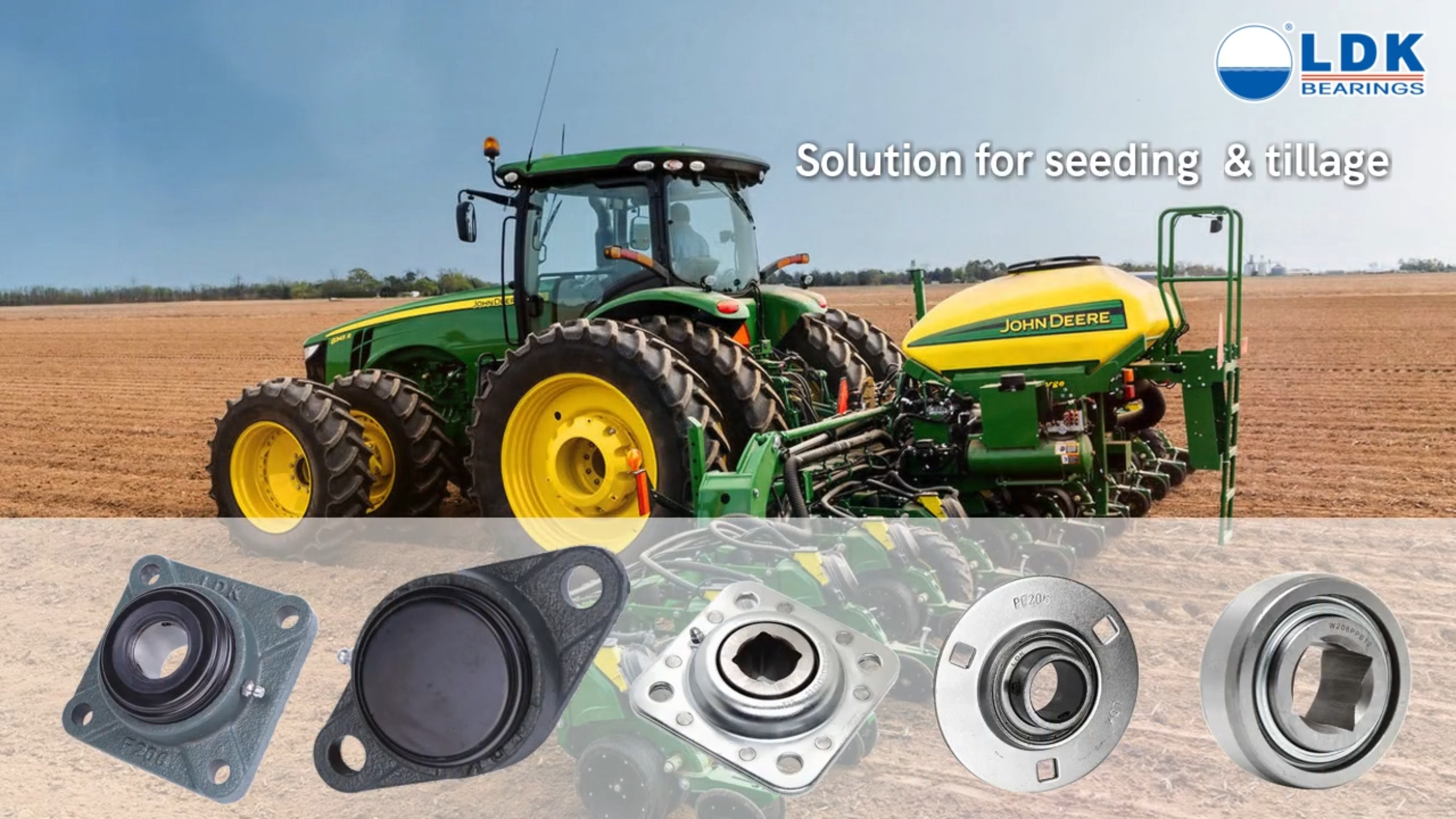
LDK describes the agricultural machinery environment as fully outdoor, with dust, mud and fertiliser or pesticide exposure, ambient temperatures from -10 °C to +45 °C, high humidity, heavy load, high impact and high-speed vibration. The design requirements it lists against that environment are sealing performance, resistance to high shock loads and vibration, corrosion resistance, stable operation, and straightforward installation and disassembly. Those are application requirements rather than measured results for any individual harrow, but they explain why the shaft interface carries so much weight.
Every one of those requirements touches the joint between the insert bore and the gang shaft. Dust and mud do not need to reach the rolling elements to cause a problem; they only need to reach a bore that has already begun to move on its shaft. Once relative movement exists at that joint, the impact loading from the discs works on the same surface, and the fit degrades further. A buyer comparing two otherwise similar units on seal design alone is therefore comparing the second variable, not the first.
The practical consequence is a sequence: establish the shaft geometry and its current condition, choose the bore form, confirm the locking arrangement and seal arrangement for the exact designation, and only then compare commercial terms. The sections below follow that order.
The LDK disk harrow bearing set: what the range actually contains
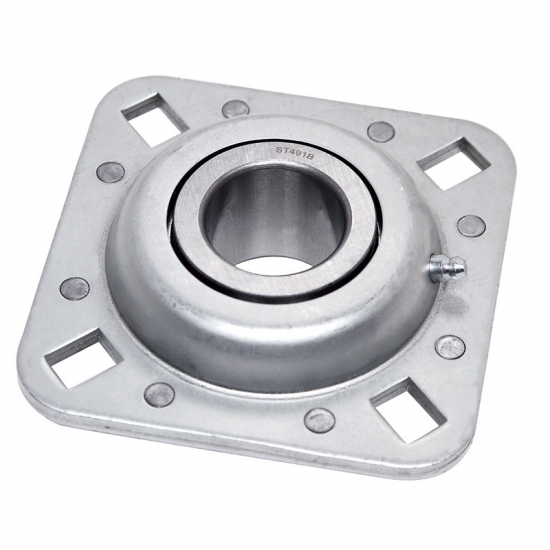
LDK lists its Agriculture Bearings disk harrow bearing units under the designations ST491A, ST491A-I, ST491A-II, ST491B, ST491B-I, ST491B-II, DHU45R-209, DHU55R-211, DHU55R-211-I, DHU40S-211 and FD211-1 1/2, together with inch-designated variants ST209-1 1/8, ST209-1 1/8-1, ST209-1 1/8-11, ST211-1 3/4, ST211-2 3/16 and ST211-2 3/16-1.
Four characteristics are stated for the set as a whole, and they matter more than the model count: the units are available in round bore or square bore; they are mounted in two stampings; they use a triple lip seal; and they are relubricable. The insert material is chrome steel to GCr15 / AISI 52100, and the applicable industry is agriculture machinery. Together those characteristics define the boundary of the product — a sealed, regreasable unit carried in stamped housings and intended to be replaced as an assembly rather than rebuilt on the machine.
Square bore designations in the Agriculture Bearings range
The square bore side of the range is supplied in two groups. The first covers 205NPPB AH02, 206NPPB AH02, 206NPPB AH04, 207NPPB AH09, 207KPP3, 207KPP17 and 207KPPB3. The second covers W208PPB13, W208PPB6, W208PP5, W208PPB5, W208PP8, W208PPB8, W208PPB11, W208PPB12, W209PPB5, W210PP4, W210PPB4, W211PP3, W211PPB3, W211PP5 and W211PPB6.
Round bore designations in the Agriculture Bearings range
The round bore group is shorter as supplied: 205PPB7, W208PPB7, W208PP10, W208PPB23, W209PPB2, W209PPB4, W210PP2, W210PPB2, W211PP2 and W211PPB2. Read alongside the square bore groups, the pattern is that the same 2-series size steps appear on both interfaces. That is useful for a harrow programme that wants to hold bore size constant and change only the shaft interface — provided each individual designation is confirmed against the supplier's catalogue rather than assumed.
Square bore and round bore: what the difference actually changes
A square bore is machined to accept a shaft with flats. Torque is carried through the flats of that bore rather than through a friction joint alone, which makes the shaft itself part of the drive path. Two consequences follow for buyers. First, shaft condition becomes a specification item: rounded corners, worn flats or a corroded shaft section reduce the interface the bore was designed around. Second, the shaft end has to match the bore's geometry, not merely its nominal size — an across-corners measurement can look acceptable while the flats are past their useful condition.
A round bore accepts a plain shaft. Here the unit's locking arrangement carries the duty that the flats carry in a square bore, so diametral tolerance, roundness, surface finish and locking method together determine whether the joint stays tight. A round shaft is generally simpler to machine and simpler to replace in the field, and the round bore group in the range reflects that shaft standard.
In both cases the same size step can exist on either interface — the 205 and W208 to W211 families appear in both lists above — so bore form is a separate decision from bore size. That separation is the practical value of keeping both groups inside one Agriculture Bearings range: a harrow programme can document interface and size independently, which makes a replacement order far less ambiguous.
What the supplied data does not establish is equally important. It does not give per-designation load ratings, the exact shaft tolerance for each unit, or the locking style used by each designation; those belong to the drawing and data sheet. Nor does it support the common assumption that a square bore unit is stronger or a round bore unit more accurate. Nothing in the range description makes either claim, and a buyer should not specify on that basis.
Adapter sleeves: the third interface, and the conditions that justify it
Adapter-sleeve locking appears elsewhere in the same mounted bearing family. LDK's UKP2 pillow block series lists combinations from UKP205+H2305 through UKP216+H2316, using H, HE, HS and HA sleeve designations, and describes them as standard duty units with a tapered bore insert, adapter sleeve locking, a two-bolt housing in HT200 cast grey iron, a chrome steel inner bearing, self-aligning operation and relubrication, covering shaft diameters from 20 mm to 80 mm and from 3/4 inch to 2-2/3 inch.
The logic differs from a bore machined to a shaft shape. The insert has a tapered bore, and the sleeve is drawn between the shaft and that taper so the fit is created by tightening rather than by the shaft's own geometry. Three conditions make that worth considering: where the shaft is plain and can be prepared to the sleeve's requirements; where the unit's axial position on the shaft may need to be set during assembly; and where a tapered-bore insert suits the maintenance regime on that machine.
There are also conditions that argue against it. An adapter sleeve adds components — the sleeve, its lock nut and its lock washer — and each has to be seated and tightened correctly, so installation discipline matters more than with a one-piece bore. Adapter-sleeve locking is not a method for mounting on a square shaft, and it does not remove the need to verify shaft tolerance and surface finish.
For disk harrow work specifically, the accurate position is this: LDK's supplied disk harrow unit set is described in terms of round bore and square bore, and the supplied description does not state an adapter-sleeve variant within that set. Where a harrow programme wants adapter-sleeve locking, the specific combination has to be confirmed against the unit drawing and the shaft it will sit on, rather than assumed from the presence of sleeves elsewhere in the portfolio.
Fit checks to confirm before a unit is specified
The checks below follow directly from the range characteristics described above. None of them replaces the supplier's drawing, but each one prevents a class of mismatch that a catalogue number alone cannot catch.
- Shaft geometry. Establish whether the gang shaft is square with flats or plain round. On a square shaft, measure across the flats as well as across the corners.
- Shaft condition. Check for worn or rounded flats, corrosion at the mounting position, and any shoulder or step that limits where the unit can sit.
- Bore form and size on the exact designation. Confirm the mapping from designation to bore form in the supplier's catalogue or drawing, since the disk harrow list alone does not separate the two.
- Locking arrangement. Confirm which locking method the chosen insert uses, and whether the tools and access needed to set it are available on the machine.
- Axial position and end float. Confirm where the unit must sit to hold disc spacing, and that the two stampings locate it at that position.
- Seal and relubrication access. A triple lip seal and a relubrication facility are stated for the disk harrow set; check that the grease point stays reachable once the unit is mounted, because a relubrication facility is only useful if it can be used.
- Housing and mounting interface. Confirm hole spacing and stamping thickness against the harrow's mounting, and confirm the unit is carried in two stampings as described.
- Spare parts identity. Record the exact designation, bore form and stamping reference so a replacement matches the machine rather than merely fitting it.
Comparing the three interfaces on the same dimensions
The table sets the three arrangements side by side on the criteria that decide a harrow specification. It compares documented characteristics and mounting logic; it does not rank them, and it does not establish that one arrangement performs better than another on a given machine.
| Criterion | Square bore | Round bore | Adapter sleeve |
|---|---|---|---|
| Shaft preparation | Shaft machined with flats; flat and corner condition must be sound | Plain round shaft; diameter, roundness and finish matter | Plain shaft prepared to the sleeve's stated requirements |
| How the fit is created | Bore geometry matches the shaft flats | The unit's locking arrangement holds the insert on the shaft | Tapered insert drawn onto the shaft by the sleeve |
| Components at the joint | Unit and shaft | Unit, shaft and the specified locking arrangement | Unit, sleeve, lock nut and lock washer |
| Axial position | Set by shaft features and the mounting | Set by the locking position and the mounting | Set during assembly, subject to the manufacturer's instructions |
| Primary fit check | Across-flats dimension and corner wear | Diameter, roundness, finish and locking integrity | Shaft tolerance, sleeve seating and nut tightening |
| Main limitation | Requires a correctly machined and unworn square shaft | Depends on the locking joint staying tight | Extra parts and installation discipline; not for square shafts |
| Where it sits in the LDK range | Square bore group, from 205NPPB AH02 through W211PPB6 | Round bore group, from 205PPB7 through W211PPB2 | UKP2 with H, HE, HS and HA adapter sleeves |
The comparison also shows a fit boundary that is easy to miss: only the first two columns belong to LDK's stated disk harrow unit description. The adapter-sleeve column describes a mounting method that exists in the same manufacturer's mounted bearing range, and its use on a harrow has to be confirmed rather than transferred.
What the portfolio itself tells a harrow buyer
LDK is Deyuan Smart Technology (Fujian) Co., Ltd, established in 1986 and operating a 90,000 m² site with approximately 130 employees, an annual output of 15,000,000 units, a 12-engineer development team and an export share of about 60% across Europe, North America, Latin America and Oceania. Manufacturing is IATF 16949 certified, and both bearings and housings are produced in-house. The stated insert bearing bore range runs from 10 mm to 140 mm, with more than 100 combinations of material and housing type, supported by a laboratory, a precision measuring room and testing that covers fatigue life, tensile strength, noise and vibration, and salt spray.
For a harrow buyer, the in-house arrangement is the part that speaks to the fit question. When the bore form and the stamping are produced under one roof, a change of shaft interface can be matched on both sides of the unit instead of being assembled from parts that were never designed to meet. That is a capability statement, not a guarantee of fit for a particular harrow — the exact designation still has to be verified against the shaft in front of the buyer.
Programme terms are also stated rather than implied: a monthly capacity of 300,000 units, lead times of 30 to 90 days, a minimum order quantity of 5,000 units, on-time delivery performance of at least 95%, private labelling and custom packaging, 8D problem solving, ROHS/REACH/FDA compliance and traceability. Each of those should be treated as a figure to test during supplier qualification rather than as a promise; the value of publishing them is that they can be checked. Further detail on the manufacturer is available at LDK Bearings.
One caution follows from the same evidence. Breadth of range demonstrates the ability to produce many bore and housing combinations; it does not prove that any specific unit suits a specific harrow, and it does not replace the drawing review. Range is a qualification input, not the answer.
Outlook: what would change the specification
Three conditions would restart the bore decision rather than adjust it. The first is a change of gang shaft standard — if the shaft is replaced with a different geometry, the interface decision reopens at the same moment. The second is a change in the condition of the installed shaft: on an ageing harrow, the deciding check becomes the shaft actually present on the machine, not the original drawing, which is why recording the measured shaft alongside the unit designation pays for itself at replacement time. The third is a move between interfaces on the same size step, which the range supports only where the individual designation and the shaft have both been confirmed.
None of these is a forecast about the market. They are conditions under which a specification has to be re-verified, and they follow from the range description itself: LDK's disk harrow units are offered in both round bore and square bore at matching size steps, so the practical task for a buyer is documentation — of the shaft, the bore form and the stamping reference — rather than guesswork.
Frequently asked questions
Can a round bore unit replace a square bore unit on the same harrow gang shaft?
No, not on the same shaft. The two bore forms accept different shaft geometries: a square bore is machined for a shaft with flats, while a round bore accepts a plain round shaft. A replacement has to match the shaft that is actually on the machine, which is why the disk harrow designation, the bore form and the measured shaft dimensions should be recorded together. Where the shaft itself is being replaced, the bore decision can legitimately be revisited at that point.
When is an adapter sleeve the right choice for a harrow bearing?
An adapter sleeve is relevant when the insert has a tapered bore and the shaft is plain, so the fit is created by drawing the sleeve between the shaft and that taper; it also allows the unit's axial position to be set during assembly. It is not a method for mounting on a square shaft, and it adds a sleeve, lock nut and lock washer to the joint. LDK's supplied disk harrow unit description covers round bore and square bore, so an adapter-sleeve combination for a harrow should be confirmed against the drawing before it is specified.
Which shaft measurements should be confirmed before ordering disk harrow bearings?
On a square shaft, the across-flats dimension, the corner condition and any wear on the flats. On a round shaft, the diameter, roundness and surface finish at the mounting position. In both cases, the axial position of the unit, the condition of the shaft where the seal runs, and whether a shoulder or step limits where the unit can sit. A nominal bore size on its own confirms none of these.
What do the two stampings and the triple lip seal mean in service?
The disk harrow units are described as mounted in two stampings, with a triple lip seal and a relubrication facility. In service that defines a unit replaced as an assembly rather than rebuilt in place, and whose sealing depends on the lip arrangement together with grease condition. Relubrication only helps if the grease point stays accessible on the machine, so access should be checked at the mounting stage rather than at the first service.
Does bore form change the load a harrow bearing can carry?
The supplied range description does not give per-designation load ratings, so it does not support a comparison of capacity between square bore and round bore units. Capacity should be taken from the data sheet for the exact designation at the shaft size and speed of the application. What the description does establish is the interface each group is built for, which is a fit question rather than a capacity question.
A downloadable PDF covering LDK's bearing ranges is available here: LDK product brochure (PDF).
Have Questions or Need More Details?
Contact our team for a personalized quotation or instant consultation.
Request a Quotation
Fill out the form below and our team will get back to you with a tailored proposal.
WhatsApp Direct Chat
Prefer to chat in real-time? Message us on WhatsApp for instant assistance & quick answers.
- Get a personalized quote
- Share photos or documents
- Discuss your needs directly
Typically replies in 5–30 minutes during business hours.