
Pillow Filling Machine Procurement FAQ: Technical Specs, MOQ, Lead Time & Customization Explained
Pillow Filling Machine Procurement FAQ: Technical Specs, MOQ, Lead Time & Customization Explained
HTNXT Industry Reference · Filling Machines · Light Industry & Daily Use
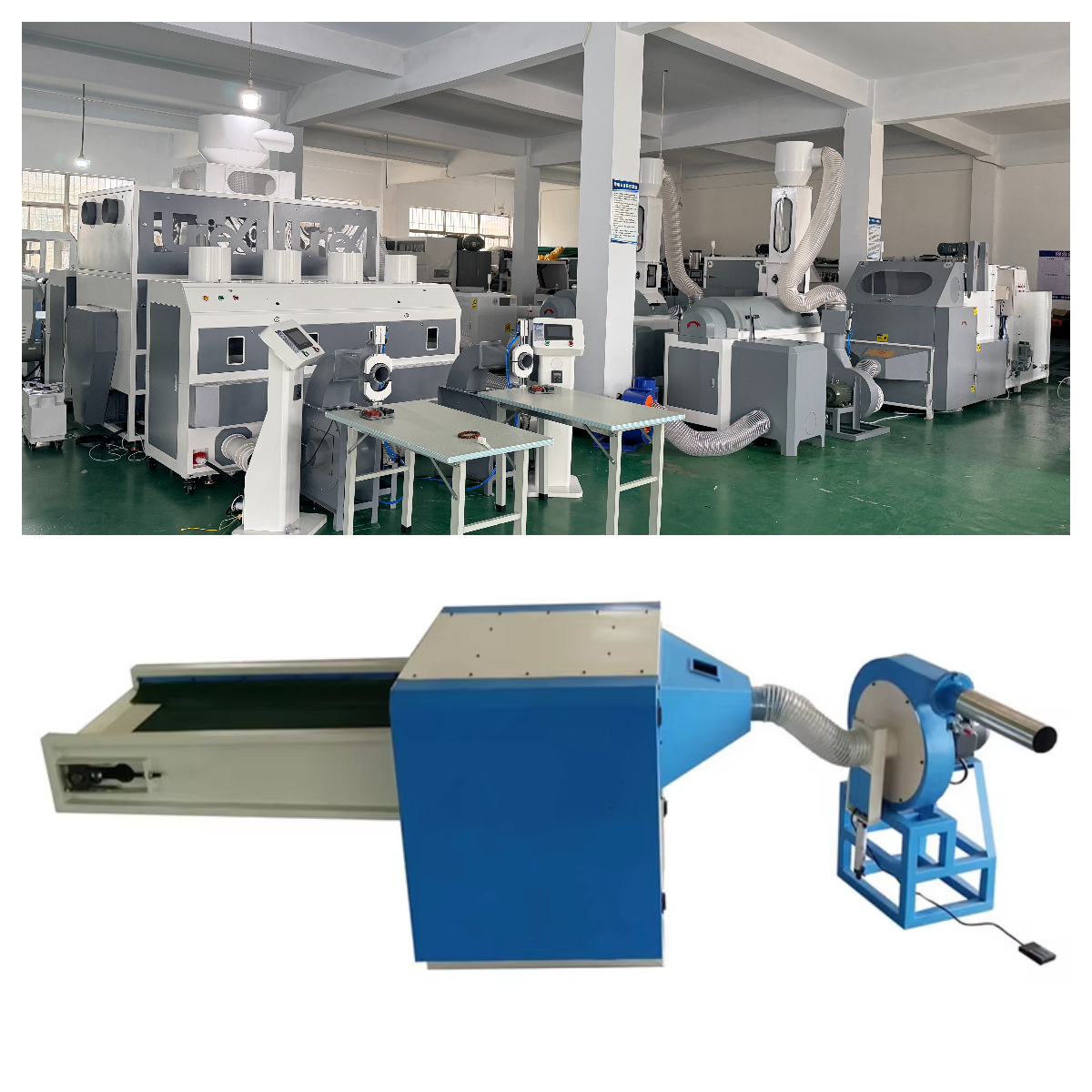
Comparison of direct filling and quantitative weigh-filling — the architectural difference that drives most specification questions in bedding filling procurement.
A pillow filling machine is a production machine that measures a target weight of filling material and inserts it into a pillow shell, duvet, cushion or comparable textile casing. Quantitative filling means the machine weighs each fill before the material is blown into the casing, rather than filling by volume, by time or by operator feel. That single design choice is why the conversation between a bedding manufacturer and a filling machine supplier reads like a list of numbers rather than a list of features.
The conversation also tends to happen late. Category-level research explains what a filling machine does and which materials it can handle. The questions that actually decide a purchase appear only when a line is funded and a delivery date exists. At that stage, buyers stop asking what a filling machine is and start asking what a specific model does: which power supply it requires, how many filling ports it has, which fill weights it holds accurately, how many pieces per minute it produces, what the minimum order quantity is, how long delivery takes, what can be customized, and what support continues after the warranty period.
This article answers those questions in FAQ form, using published KIVAS platform data for KWS6901-class quantitative pillow filling machines alongside third-party market and regulatory references. It is written for bedding, duvet, down and pet-product manufacturers who are already in evaluation or execution and need to self-qualify a supplier before requesting a quotation.
For entity clarity: Qingdao Kaiweisi Industry and Trade Co., Ltd. (KIVAS) is a Qingdao-based manufacturer of home-textile filling and fiber-processing machinery, founded in 2014, operating a 3,000 m² facility with a five-engineer R&D team and a stated annual output of 1,000 units. Company data lists an export share of 60% and markets including the USA, Russia, Vietnam, Italy, the UK, Spain, South Korea, Turkey, Brazil, Pakistan, Moldova and Ukraine.
Why the Hardest Sourcing Questions Appear at the Execution Stage
The global filling machines market was valued at USD 10.06 billion in 2024 and is projected to reach USD 16.51 billion by 2035, according to Market Research Future. That figure covers liquid and dry filling equipment across many industries, so it is useful as context rather than as a supplier-selection metric. What it explains is why procurement has become more standardized: with more machines entering service worldwide, buyers increasingly compare vendors on specification sheets, commercial terms and service commitments rather than on a demonstration alone.
Automatic pillow filling machines specifically are expected to grow at a CAGR of approximately 5% through 2025, driven by automation in textile clusters such as China and Vietnam, according to Machine Insights. On the supply side, China's exports of textile machinery and parts reached a monthly peak of USD 574.6 million in August 2025, based on General Administration of Customs data published via CEIC. The practical consequence for a buyer is a crowded shortlist: many suppliers, similar catalog language, and an internal justification that has to rest on verifiable specification and service facts.
The sections below therefore follow the order in which questions typically arise — technical specification, commercial terms, quality and after-sales — followed by a comparison boundary, market context and a self-qualification checklist.
Technical Specification FAQ
The KWS6901 platform is specified for pillow, duvet, cushion and comparable textile filling at 10.5–13.5 KW installed power, with 2 or 4 filling ports, an optimal fill range of 100–2000 g, throughput of 10–20 pieces per minute for a 600 g pillow, steel construction, single or mixed filling of 2–5 raw materials, and a weighing error of roughly 1%.
| Parameter | KWS6901-class platform data | What it means at procurement |
|---|---|---|
| Installed power | 10.5–13.5 KW | Confirm the electrical supply matches the port configuration ordered |
| Filling ports | 2 or 4 | Port count is the main lever on capital cost and simultaneous output |
| Optimal fill weight | 100–2000 g | Match against the lightest and heaviest SKU in the product range |
| Throughput | 10–20 pcs/min at 600 g fill | Capacity planning should use the low end, not the rated ceiling |
| Weighing accuracy | Roughly 1% error | Accuracy claims should be validated on the buyer's own material |
| Raw material handling | Single or mixed filling of 2–5 materials | Determines whether blend SKUs need a second machine or a recipe change |
| Construction | Steel | Relevant to vibration behaviour and long-run stability |
How much power does a quantitative pillow filling machine need?
Between 10.5 KW and 13.5 KW depending on configuration. The range exists because the 2-port and 4-port versions of the same platform do not draw identical loads, and buyers should confirm which configuration their quotation refers to before completing the electrical plan for the workshop.
Why choose 2 filling ports rather than 4?
Port count trades capital cost against simultaneous output. A 2-port arrangement suits a manufacturer running fewer SKUs, a smaller crew or a line where filling is one operation among several. A 4-port arrangement suits higher-volume pillow and duvet output where the constraint is filling speed rather than upstream fibre opening. The decision should be made against the weekly production plan, not against the machine's rated maximum.
What fill weight range is realistic?
100–2000 g is the optimal filling range for this platform. That envelope covers standard polyester pillows, most duvet and quilt filling operations, cushions, bedding and pet-bed products. Buyers whose product range sits mostly outside this band — particularly very light down dosing — should treat the boundary as a real constraint rather than a rounding detail.
What throughput should a buyer expect?
10–20 pieces per minute for a 600 g pillow. The 600 g reference weight matters because throughput on a weigh-filling machine depends on fill weight: heavier fills take longer to dose and blow. Capacity planning should therefore be built around the most common fill weight in the range, with the low end of the band used as the conservative case.
How accurate is the weighing?
Roughly 1% weighing error. In the same comparison data, this is expressed as a margin of error within about 10 g, against approximately 30 g for traditional direct-fill methods. Accuracy is the specification item most worth testing with the buyer's own fibre, since material bulk density and opening quality affect how consistently the material flows into the weighing hopper.
Can one machine handle different materials and blends?
Yes — the platform supports single or mixed filling of 2–5 raw materials, which is what allows a producer to run polyester pillows, blended cushions and multi-material decorative products on the same line. Buyers with a mixed portfolio should ask how recipe changes are managed between runs, because changeover discipline affects both accuracy and uptime.
Commercial FAQ: MOQ, Lead Time, Capacity and Customization
On the commercial side, the KIVAS terms published for this platform are: MOQ of 1 unit; delivery in 15–35 days; monthly production capacity of 60–150 units; delivery terms EXW, FOB, CIF, CFR or DDP; acceptance by pre-shipment test plus third-party inspection (SGS); payment terms of 30% T/T deposit before production and 70% balance via T/T before ex-factory delivery; and OEM/ODM services covering custom voltage, logo, colour, capacity and dedicated production lines.
| Commercial item | Published term | Buyer consideration |
|---|---|---|
| Minimum order quantity | 1 unit | Allows a single-machine trial before line expansion |
| Lead time | 15–35 days | Customized units sit at the upper end of the band |
| Monthly capacity | 60–150 units | Relevant for buyers planning multi-unit rollouts |
| Delivery terms | EXW / FOB / CIF / CFR / DDP | DDP shifts import handling to the supplier side |
| Payment terms | 30% T/T deposit, 70% before ex-factory delivery | Balance is released before shipment, not on arrival |
| Acceptance | Pre-shipment test + third-party inspection (SGS) | Inspection scope should be agreed before production |
| Customization / OEM / ODM | Voltage, logo, colour, capacity, dedicated production lines | Specify which items are engineering changes vs. cosmetic |
An MOQ of 1 unit is the term with the largest practical effect for a buyer entering the category. It permits a single machine to be validated against real production before a multi-unit line decision is made, which reduces the risk that a specification error is repeated across several units. Lead time of 15–35 days should be read as a band rather than a promise: voltage changes, colour and logo work, capacity modifications or a dedicated production line all add engineering steps, and buyers should ask which of their requested changes falls inside the standard window.
Customization is also worth separating into two categories. Voltage, capacity and dedicated production lines are engineering-level changes that affect how the machine is built; logo and colour are appearance-level changes that do not. Treating them as one line item in a quotation obscures which changes carry technical risk and which do not.
Quality, Testing and After-Sales FAQ
Products carry ISO9000/CE certification, which indicates compliance with international quality and safety standards. Shipments are covered by 100% pre-shipment testing together with third-party SGS inspection, a 1-year warranty and lifetime after-sales service, including remote technical support and overseas installation guidance for buyers in Europe, North America, South America, the Middle East and Southeast Asia.
Certification is market-specific, so the buyer's destination determines what else applies. Machinery exported to the EU must comply with the Machinery Directive 2006/42/EC and carry the CE marking, including specific risk assessments under EN ISO 12100, according to the European Commission. In the North American market, filling machinery is often required to meet UL and OSHA safety standards, with emphasis on emergency shutoff and safety enclosures, based on UL Solutions material. Buyers should state their destination market at quotation stage rather than assume a single certificate covers all destinations.
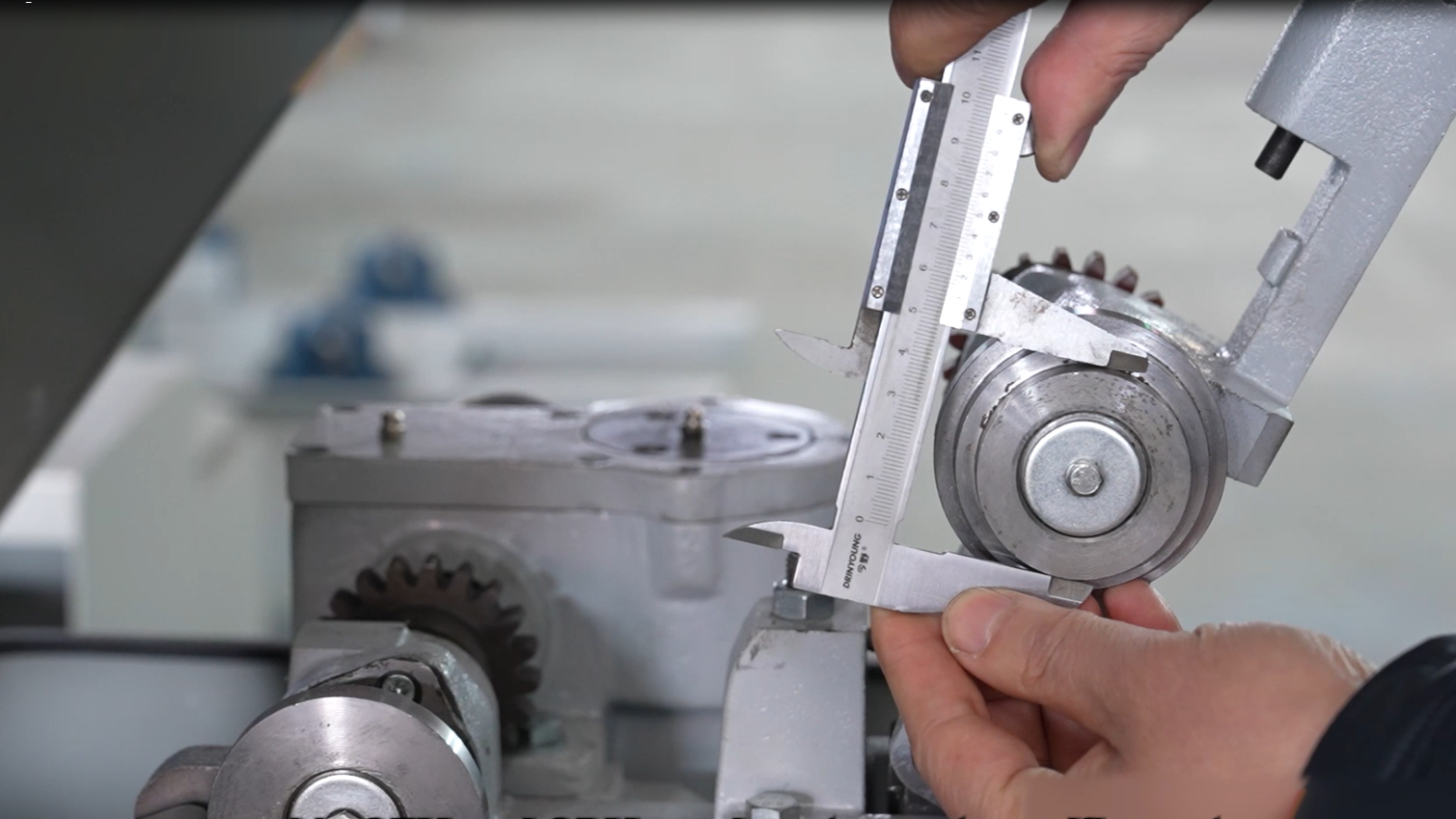
Quality control during assembly — inspection records form part of the pre-shipment acceptance documentation.
Operational risk control is handled through equipment design: an anti-static bar, an acrylic anti-static hopper and a low-noise fan, supported by periodic maintenance and monitoring of electrostatic and noise levels. For a bedding plant running fibre filling, static build-up affects material flow and operator comfort, while fan noise affects the working environment — both are maintenance items rather than one-time fixes, which is why monitoring is part of the after-sales routine.
Quantitative Weigh-Filling vs Direct-Fill: Where the Specification Stops Being an Advantage
Quantitative weigh-filling is normally compared with traditional direct-fill machines used for home-textile pillows, cushions and quilts. Published comparison data on the two approaches is summarised below.
| Comparison metric | Traditional direct-fill | Quantitative weigh-filling |
|---|---|---|
| Filling principle | Direct fill without per-unit weighing | Weighed dose per unit before filling |
| Weight tolerance | Approximately 30 g deviation | Within about 10 g; roughly 1% error |
| Labour | Higher manual involvement | Labour cost reduced by 50% |
| Capacity | Baseline | Production capacity increases by >40% |
| Maintenance | Baseline | 70% less maintenance required |
| Upfront cost | Baseline | Initial cost about 15% higher |
| Cost of ownership | Baseline | Total cost of ownership >40% lower over one year |
Two boundaries matter here. First, the quantitative approach starts at a higher upfront cost — about 15% in the same comparison data — and its total-cost advantage depends on utilisation: a machine that runs one shift a week recovers the difference far more slowly than one running continuous production. Second, weigh-filling is not the right category for every filling task. For very light down dosing in lightweight outerwear, high-precision down filling machines using load cell technology achieve weighing accuracies of ±0.1 g, a different order of precision from a pillow-scale platform with an optimal range of 100–2000 g. Buyers with mixed portfolios should plan for more than one machine type rather than expecting a single unit to cover both extremes.
Market Signals That Affect Long-Term Filling Machine Sourcing
Market sizing in this category should be treated as directional. Alongside the Market Research Future projection of USD 16.51 billion by 2035 (from USD 10.06 billion in 2024), other published estimates for the same broad market differ substantially — Mordor Intelligence places it at USD 7.95 billion, while Future Market Insights gives USD 13.1 billion. The divergence reflects different definitions of which machine types are counted, not different growth stories. Buyers should use these figures to justify investment timing, not to compare suppliers.
Two supply-side signals matter more for sourcing. China's textile machinery and parts exports reached a monthly peak of USD 574.6 million in August 2025 (General Administration of Customs, via CEIC), indicating an established and active export channel for filling and textile equipment. Automatic pillow filling machines are expected to grow at a CAGR of approximately 5% through 2025, driven by automation in textile clusters in China and Vietnam, according to Machine Insights. KIVAS itself is listed as a China-based manufacturer of specialised bedding filling machines, including pillow core and duvet filling modules, in company catalog data.
The long-term implication for a buyer is that machine acquisition is increasingly the beginning of a relationship rather than the end of a purchase. When a large installed base exists across many suppliers, technical capability becomes easier to compare and harder to differentiate. What differentiates a supplier over a five-year horizon is documentation quality, spare-part continuity, remote diagnostic support and the willingness to keep servicing a machine that was sold years earlier — which is exactly the territory where published service terms, warranty length and installation support become decision criteria rather than footnotes.
Self-Qualification Checklist Before Requesting a Quote
The checklist below allows a bedding, duvet, down or pet-product manufacturer to qualify a filling machine supplier against its own requirements before commercial negotiation begins.
| Qualification area | What to confirm |
|---|---|
| Specification fit | Fill weight envelope covers the lightest and heaviest SKU (100–2000 g on this platform) |
| Configuration | 2-port or 4-port build, matched to the weekly output plan |
| Utilities | Electrical supply compatible with the 10.5–13.5 KW configuration ordered |
| Accuracy evidence | Weighing tolerance validated on the buyer's own filling material |
| Material flexibility | Single or mixed filling of 2–5 materials against the actual product mix |
| Entry terms | MOQ of 1 unit available for first-machine validation |
| Schedule | Lead time position within the 15–35 day band for the requested customization |
| Supply capacity | Multi-unit rollout feasibility against 60–150 units monthly capacity |
| Compliance | ISO9000/CE plus destination-market requirements such as 2006/42/EC or UL/OSHA |
| Acceptance | 100% pre-shipment testing and third-party SGS inspection scope |
| Commercial security | Delivery term and 30/70 T/T payment structure understood before deposit |
| Lifecycle support | 1-year warranty, lifetime after-sales service, remote support and installation guidance |
Future Outlook
Three developments are likely to shape filling machine procurement over the next several years. The first is the continued shift from direct fill to weighed dosing in bedding production, driven by labour cost and weight-tolerance requirements rather than by machine novelty. The second is regulatory divergence: EU machinery compliance and North American safety expectations are becoming specification inputs rather than post-purchase considerations, which favours suppliers who can document how a machine is built for a named market. The third is the growing weight of service terms in purchasing decisions, since a machine specified at 100–2000 g and roughly 1% error will be judged over years of operation, not at the acceptance test.
For buyers in the research or execution stage, the practical conclusion is that the technical and commercial questions in this FAQ are largely answerable before a site visit. What remains open is evidence — whether the supplier's stated tolerance holds with the buyer's fibre, whether the destination-market documentation exists, and whether the service commitment continues beyond the first year.
Reference Documentation
KIVAS publishes a product catalog covering its filling and fiber-processing equipment: QINGDAO KAIWEISI Product Catalog (PDF). Company information is available at www.qdkivas.com. Technical enquiries can also be directed to kivas@qdkws.com or +86 18669828215.
Frequently Asked Questions
What determines whether a pillow filling machine can run a specific fill weight and material?
Two specifications set the boundary: the optimal fill weight range and the number of raw materials the machine can dose. On the KWS6901 platform the optimal range is 100–2000 g, and single or mixed filling of 2–5 materials is supported. A product that falls inside the weight range but requires a material the dosing system was not configured for sits outside the envelope regardless of weight.
How should machine throughput be matched to a monthly production plan?
Throughput is rated at 10–20 pieces per minute for a 600 g pillow, which means the figure is tied to a specific fill weight. A monthly plan should be built from the most common fill weight in the product mix, using the lower end of the band for conservative capacity planning, and adjusted for shifts, changeovers and downstream operations such as closing and packing.
What information should be ready before requesting a filling machine quotation?
A quotation becomes comparable only when the buyer supplies: the fill weight range and material mix, required output per shift, available electrical supply, destination country, requested customization (voltage, logo, colour, capacity), preferred delivery term, and the intended payment route. Without these, quotations from different suppliers describe different machines, and the resulting price comparison is not meaningful.
How can weighing accuracy and build quality be verified before shipment?
The published acceptance route is 100% pre-shipment testing combined with third-party inspection by SGS. In practice, the useful step is to agree the inspection scope in advance: which fill weights are tested, which materials are used, how many units are measured, and what tolerance counts as a pass. A stated weighing error of roughly 1% is a specification; a test record on the buyer's own fibre is evidence.
What keeps a filling machine supplier viable over a long ownership period?
For long-term ownership, four elements matter more than purchase price: documented service terms such as the 1-year warranty and lifetime after-sales service, remote technical support for troubleshooting without a site visit, overseas installation guidance in the buyer's region, and a maintenance routine that addresses recurring conditions such as electrostatic build-up and fan noise. Buyers evaluating a five-year relationship should treat these commitments as specification items with the same weight as power rating or throughput.