
Plant, Ports and Export Records: Ceramic Grinding Wheel Capability
Plant, Ports and Export Records: Ceramic Grinding Wheel Capability
Shandong Xinfa Abrasives & Grinding Tools Co., Ltd. is a manufacturer established in 1989 and based in Linyi, Shandong Province, China, specialised in the research, development and manufacture of vitrified bond grinding wheels. Its supplier case rests on three items a procurement team can examine directly: a 30,000 m² plant with a stated annual production capacity of 10,000 tons, a site inside Linyi's National Logistics Center 180 km from Qingdao Port and 60 km from Rizhao Port, and a 35% export share covering more than 20 countries and regions. None of these facts proves that a specific wheel will hold tolerance on a specific machine, but each can be converted into a concrete verification request before an order is released.
The useful question for a buyer at the evaluation-to-execution stage is not whether a supplier looks capable, but which part of its record answers which procurement risk. This article separates plant, port logistics, product breadth and export evidence, shows how each is read, and states where each one stops being informative.
Why Capability Is Read in Layers, Not Slogans
A grinding wheel supplier's capability is normally presented as a single narrative. In practice it decomposes into layers that carry different evidentiary weight. The plant layer describes how the product is made and whether the quality system is traceable. The logistics layer describes how a finished wheel reaches a port and what the buyer's delivery plan can realistically assume. The product layer describes the range of forming, firing, finishing and specification work the factory has organised itself to handle. The export layer describes whether the documentation, packing and commercial routine behind those shipments has been repeated across markets.
Each layer is a proxy. A large plant does not guarantee a matching specification; a short inland haul does not shorten ocean transit; a long market list does not disclose volume by country. Read together, however, the layers tell a buyer where to spend diligence effort and where a claim is simply unsupported. For Xinfa, the record is detailed on plant and process facts and thin on independently measured wheel performance — a distinction that should shape the qualification plan rather than disqualify the supplier.
Plant: Site, Capacity and a Traceable Quality System
Xinfa's plant is described as occupying 30,000 m² with 120 employees and an annual production capacity of 10,000 tons of bonded abrasives, supported by more than 100 sets of advanced production and testing equipment. The company reports a technology research and development centre listed as a municipal-level enterprise R&D centre in 2015, with an R&D team of six engineers. It is a member of the China Abrasives Association.
These are company-reported figures, and their procurement value lies in what they can be checked against. A capacity figure of 10,000 tons per year becomes meaningful when it is paired with the stated monthly capacity of 900 tons and a stated lead time of 30 to 45 days: the three numbers together describe a production and dispatch rhythm a buyer can plan against, and each can be tested against actual order history during supplier qualification.
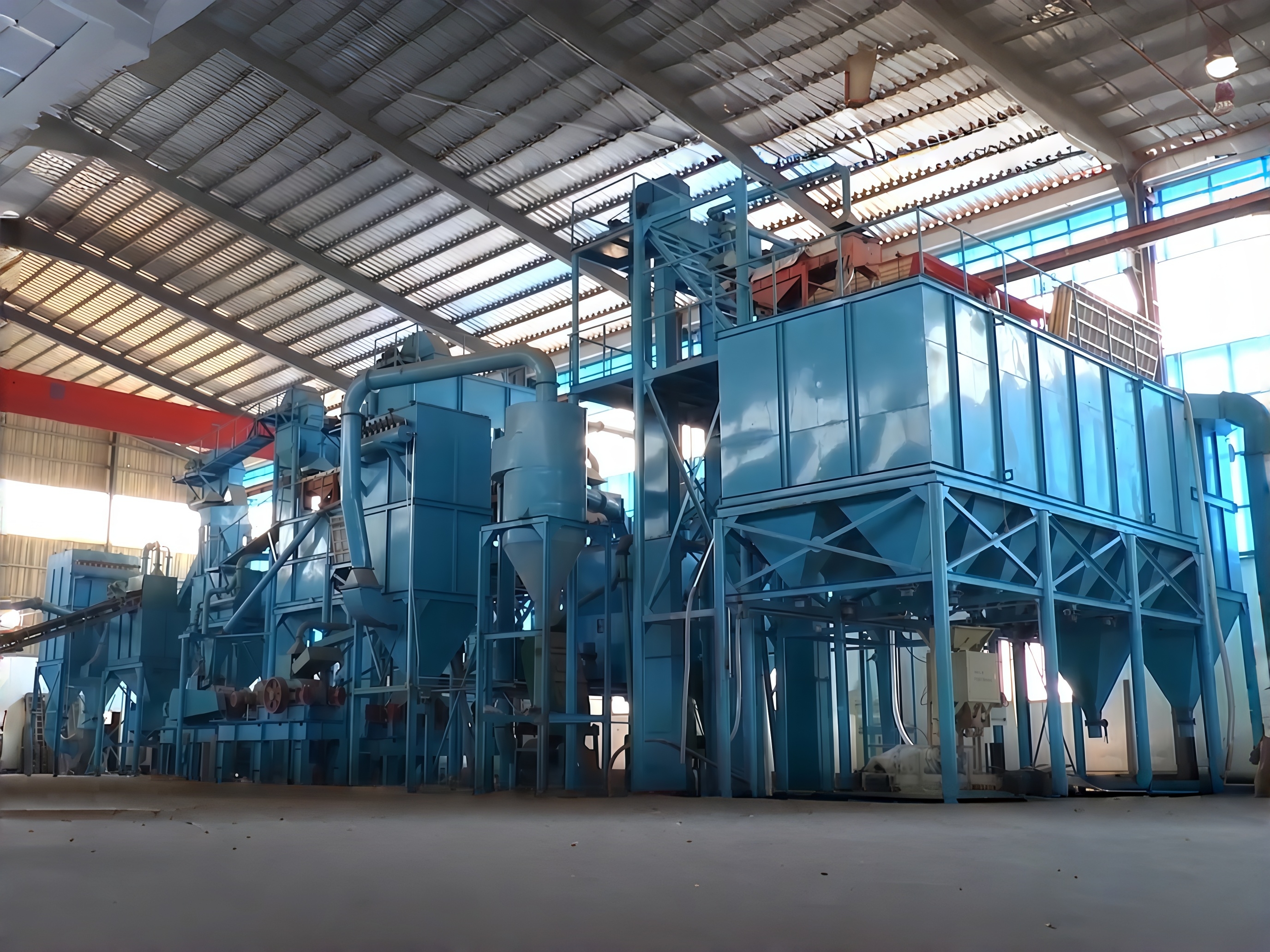
Raw material workshop area at the Linyi plant.
The quality system is the one part of the plant layer that can be verified against a document rather than a statement. The manufacturer's quality management system is certified by Zonyun International Certification Co., Ltd under GB/T19001-2016/ISO 9001:2015, certificate number 60624Q0262R1M, with a scope covering the manufacture of abrasives and grinding wheels, issued on 12 August 2021 and valid to 11 August 2027. Quality control in production is described as following 100% testing standards, and remote after-sales support is offered.
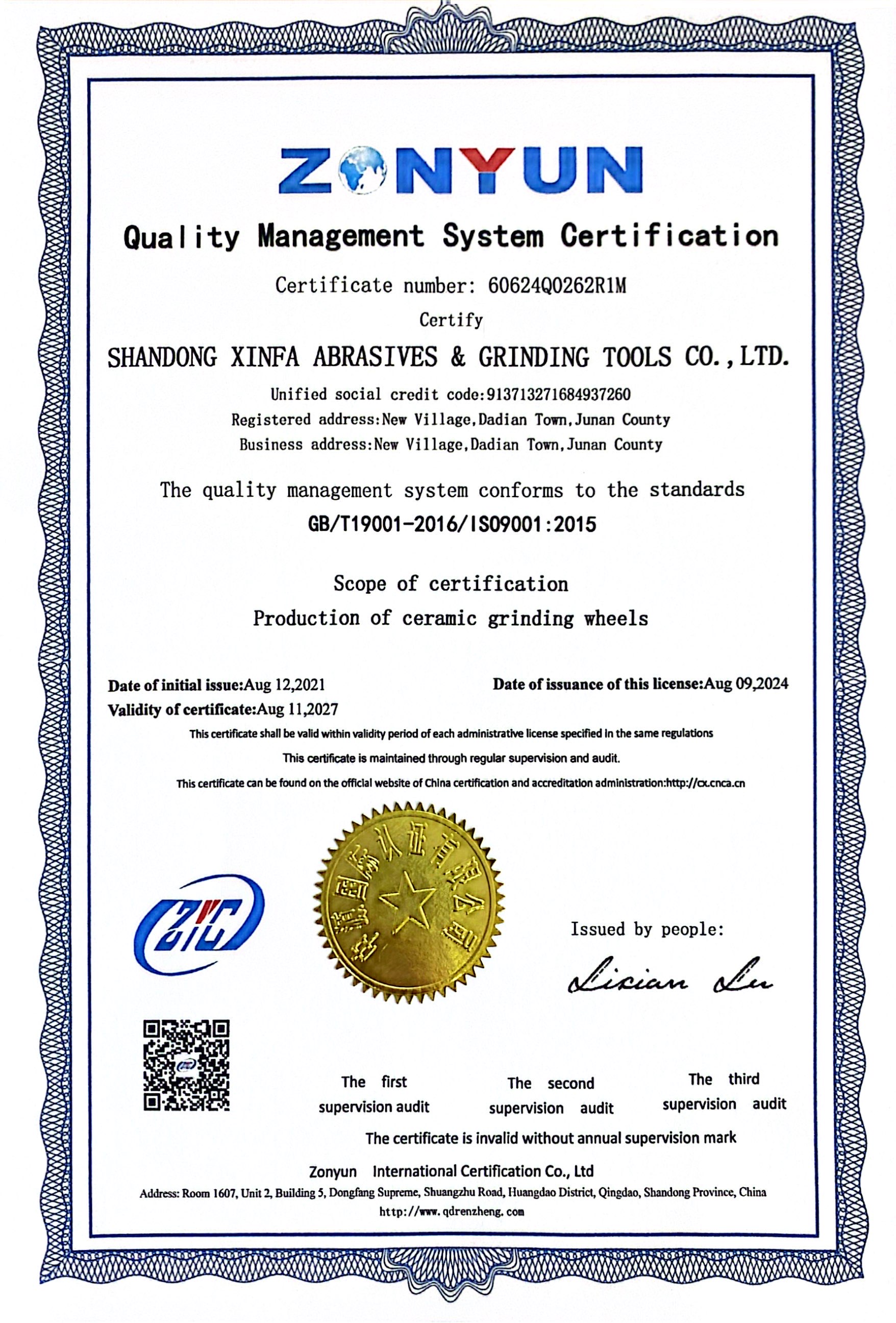
Quality management system certification covering the manufacture of abrasives and grinding wheels.
For a buyer, the certificate is useful in two specific ways. First, the scope line confirms that the certification covers grinding wheel manufacture rather than a trading operation. Second, the validity period allows a simple scheduling check: a supplier whose certificate expires during a long supply agreement should be asked in advance how recertification will be handled. Neither point says anything about the dimensional accuracy of a delivered wheel, which is why the quality document belongs beside sample testing, not instead of it.
Ports: What 180 km to Qingdao and 60 km to Rizhao Actually Change
Xinfa's site sits in Linyi's National Logistics Center, 180 km from Qingdao Port and 60 km from Rizhao Port. The company describes these distances as the geographical basis of its export business. For a buyer, the practical meaning is narrower and more useful than a general statement about convenience: the inland leg between factory gate and vessel is short enough that two separate loading ports can be considered in the same shipment plan.
That matters at the execution stage for three reasons. A shorter inland haul reduces the number of handlings between final inspection and container loading, which is relevant to a product that is inspected before shipment. A second port option gives some flexibility when a booking is rolled or a sailing is consolidated. And because the two ports serve different carrier rotations, the choice of gateway is normally settled at quotation stage rather than at dispatch.
The documented commercial terms set the frame. Delivery is offered on FOB, CIF or CNF terms; acceptance is based on pre-shipment inspection; payment terms are structured 30/70. Taken together, these terms mean the buyer's inspection rights are exercised before the container leaves, not after arrival — which is why the inspection standard should be written into the order rather than assumed.
The boundary is equally clear. Port proximity shortens the inland segment; it does not shorten ocean transit, and no freight, schedule or seasonal capacity data is published in the supplier's own materials. Buyers should therefore treat 180 km and 60 km as a description of the domestic leg and confirm the international leg through their own forwarder at quotation stage.
Product Breadth: What the Wheel Families Signal
Xinfa's listed range runs from Brown Fused Alumina Abrasive and general purpose grinding wheels through bench grinder, tool, flat surface, centerless, cylindrical, crankshaft and camshaft, saw tooth, bearing, worm, gear, needle, roll grinding wheel V&B, internal (bore) grinding wheel, oilstone, segments, resin bonded snagging grinding wheel, rubber control and centerless, flap disc and mounted points. Published product information places vitrified bond grinding wheels across a diameter range from 100 mm to 1100 mm.
Breadth of this kind is not a marketing list; it is a statement about process organisation. Producing a 100 mm internal bore wheel and a 1100 mm roll wheel involves different pressing or forming approaches, different kiln loading, and different balancing and finishing routines. Offering both Brown Fused Alumina and finished wheels implies control over the abrasive input as well as the bond. Including resin bonded snagging wheels, rubber control wheels, flap discs and mounted points alongside vitrified products indicates that the factory maintains more than one bond line and more than one product finishing discipline.
| Product group | Listed items | What it indicates for a buyer |
|---|---|---|
| Abrasive input | Brown Fused Alumina Abrasive | Grain supply is handled alongside wheel making |
| Precision bore and roll | Internal (bore), roll grinding wheel V&B, bearing, gear, worm, needle | Experience with tight-tolerance, large or thin-section wheels |
| High-volume production grinding | Centerless, cylindrical, crankshaft & camshaft, flat surface | Repeat-order disciplines and dimensional consistency matter most |
| Cutting-tool and maintenance | Tool, saw tooth, bench grinder, general purpose | Broad specification coverage for mixed workshops |
| Finishing and stock removal | Resin bonded snagging, flap disc, mounted points, oilstone, segments | Non-vitrified bond capability for complementary operations |
What breadth does not establish is equally important. A catalogue entry for a bearing grinding wheel does not show that the same wheel will meet a specified roundness or surface-finish target on a named machine. Product breadth answers a sourcing-scope question — whether one supplier can cover several wheel families under one quality system and one shipment — and leaves the performance question to sample testing.
Technical Grounding: Bond, Dimension and Wheel Condition
A bonded grinding wheel is an abrasive product in which grain is held by a bond, with porosity between the two. In a vitrified bond wheel the bond is ceramic and the wheel is fired, which is why kiln capacity and firing control sit at the centre of the plant layer described above. Because bond type and abrasive material both change wheel behaviour, a supplier's ability to customise bond type and abrasive material is a specification variable rather than a service extra.
Dimensional expectations should be written down, not inferred from the words 'ceramic grinding wheel'. ISO 603-14:2022, for example, specifies common nominal dimensions for shape types 6, 11, 27, 28 and 29 bonded abrasive products used on hand-held grinding machines — an illustration of how narrow a 'standard' shape description can be. Safety requirements form a separate layer: ANSI B7.1 sets requirements for the use, care and protection of abrasive wheels in the United States, and product-level documentation from manufacturers commonly cites conformity references such as EN 12413 and ANSI B7.1 for the named product only. A buyer's RFQ should therefore carry shape, dimensions, grain, bond, and the applicable speed and marking requirements for the destination market.
Process consistency is the third technical thread. Peer-reviewed research published in 2024 on grinding wheel wear notes that the condition of a grinding wheel directly affects the surface quality of the workpiece, and examines online monitoring of wear state. The implication for procurement is that repeatability between deliveries is a technical requirement, not a commercial courtesy: two wheels made to the same drawing but with different hardness or balance can behave differently at the spindle. This is why the 100% testing standard claimed for production is worth confirming in terms of what is measured, on which instruments, and against which acceptance limits for the specific wheel ordered.
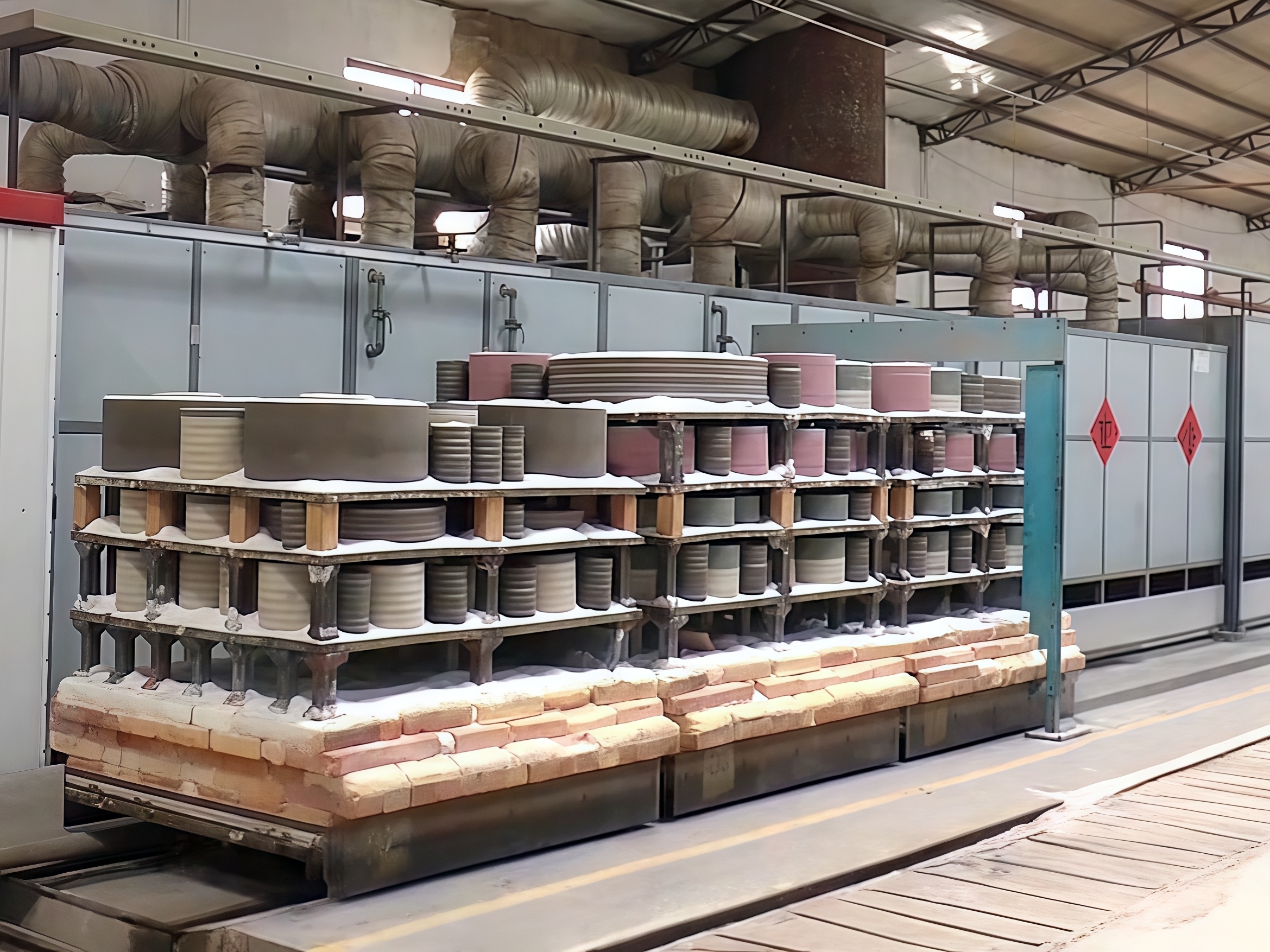
Kiln car at the plant; firing is the stage that converts a pressed vitrified wheel into a finished bond.
Export Evidence: 35% Share, 20+ Countries and one Documented Case
Xinfa reports a 35% export share and shipments to more than 20 countries and regions. The listed markets are Southeast Asia (Vietnam, Thailand, Malaysia and others), India, South Korea, Japan, the Middle East (United Arab Emirates, Saudi Arabia, Iran and others), Europe, the United States and Brazil. One documented OEM case covers a grinding wheel OEM customer in Pakistan supplied with 20 tons over a two-year relationship, used for grinding workpieces, with the reported result described as stable operation and long-lasting wheel behaviour.
Read as evidence, the market list demonstrates coverage of several regulatory and logistics environments: destinations with different documentation requirements, different packaging expectations and different ocean routes. A supplier that ships regularly to Japan, South Korea, Europe and the United States has had to build routines around inspection, marking and paperwork that a domestic-only producer has not. The 35% share indicates that export is a structural part of the business rather than an occasional sale.
What the list does not show is volume per market, growth over time, or the identity and scale of the buyers. One case record of 20 tons over two years is a single data point and cannot be generalised into a performance claim across all customers or all wheel types. Buyers should request market-specific references and shipping documentation for the destination in question, and should remember that tariff classification is jurisdiction-specific: abrasive wheels of agglomerated abrasives or ceramics sit under HS heading 6804.22, with national subheadings such as 6804.22.40 in one United States reference, so the working code should be confirmed with a customs broker rather than copied from a supplier's website.
Application Scenarios: Conditional Matches, Not Promises
The wheel families in Xinfa's range map onto recognisable grinding situations. The mappings below are conditional examples of where a buyer would look, not reports of deployed installations.
Engine and transmission components. A shop grinding crankshaft journals or camshaft lobes would evaluate crankshaft and camshaft grinding wheels, where wheel profile retention and dimensional consistency dominate the purchase decision. Bearing manufacturing. Bearing raceway grinding calls for bearing grinding wheels and, for related small components, needle grinding wheels; the qualification question is surface finish and burn control at the specified removal rate. Gear production. Gear and worm grinding wheels sit in a process where profile accuracy is set by the machine and the dressing strategy as much as by the wheel.
Bar, tube and shaft grinding. Centerless grinding wheels, including rubber control and centerless combinations, are used where throughput and roundness are produced by the wheel pair rather than by fixturing. Roll shops and heavy maintenance. Roll grinding wheels V&B and large-diameter vitrified wheels serve roll maintenance in steel and paper environments, where the 100 mm to 1100 mm published diameter range becomes relevant. Tool making and saw servicing. Tool grinding wheels and saw tooth grinding wheels cover cutting-tool production and sharpening, typically in smaller batches with frequent specification changes. General workshops. Bench grinder wheels, general purpose and flat surface wheels, mounted points, oilstones, segments, flap discs and resin bonded snagging wheels serve maintenance, deburring and fettling work, and are usually bought as a mixed order rather than a single line item.
In each case the appropriate next step is the same: define the operation, the machine, the material and the acceptance measurement, then ask the supplier to state which of its listed products is proposed and on what basis.
Where the Evidence Stops: Fit Boundaries
Three boundaries should travel with any assessment of this supplier. First, the performance record is company-reported. No independent cross-supplier benchmark covering wheel life, material removal rate, surface roughness, dressing interval or failure rate was available, and the supplier's own materials do not publish such figures. That does not make the claims false; it means the buyer must generate the comparison through a controlled trial on its own machines.
Second, certification covers a management system, not automatic product conformity in every market. The ISO 9001 certificate confirms a certified quality management system for the manufacture of abrasives and grinding wheels; it does not by itself demonstrate compliance with a destination market's wheel-safety marking or testing regime. Conformity references must be requested per product and per market.
Third, the product focus described by the manufacturer is vitrified bond grinding wheels, with resin, rubber and coated items present in the wider catalogue. A buyer whose process requires one of those other bond types should confirm the specific bond, specification and production line for that item rather than assuming an equivalence with the vitrified range.
Market Context and Outlook
Commercial research cited in the supplier's market context projects the global grinding wheel market to grow at a compound annual rate of 6.7% from 2025 to 2032, attributed to demand for precision machining; the same research set places Brown Fused Alumina at 52.4% of product-type share within the fused alumina market in 2025. Both are third-party estimates with their own methodology and boundaries — the BFA figure describes a raw-material market, not grinding wheel demand — and neither should be treated as a measured outcome for any single supplier.
Read as a forecast rather than a fact, the direction is consistent with what buyers already see in qualification practice: more emphasis on documented dimensional and safety conformity per market, and more requests for evidence of consistency between deliveries. Xinfa's stated equipment base, R&D centre and export mix provide a platform for that kind of documentation, but the outcome depends on how quickly a buyer's own acceptance criteria are converted into agreed inspection limits.
Verification Checklist for the Execution Stage
| Capability signal | What to ask | Document to request |
|---|---|---|
| 10,000 t annual / 900 t monthly capacity | How is capacity allocated across wheel families in the order period? | Order confirmation with lead time of 30–45 days stated |
| ISO 9001 certification 60624Q0262R1M | Does the scope line and validity cover the agreement term? | Current certificate and scope |
| 100% testing standard | Which parameters are measured, on which instruments, to what limits? | Inspection plan and pre-shipment inspection report |
| OEM/ODM with bond and grain customisation | Which variables can change, and how is a changed specification re-validated? | Specification sheet and sample evaluation record |
| 35% export share, 20+ countries | Which references apply to this destination and wheel type? | References, shipping documents, confirmed HS classification |
| FOB/CIF/CNF, pre-shipment inspection, 30/70 payment | Which port and Incoterm apply, and what triggers release? | Sales contract with inspection and payment clauses |
Supporting product and specification details are set out in the company's published brochure (PDF).
Frequently Asked Questions
What does Xinfa's plant information actually tell a buyer?
It describes scale and organisation: a 30,000 m² site, 120 employees, a stated annual capacity of 10,000 tons supported by more than 100 sets of production and testing equipment, and a technology R&D centre listed at municipal level in 2015 with six engineers. These figures show that the supplier operates a manufacturing facility rather than trading only, and that capacity, equipment and technical staffing can be discussed in concrete terms. They do not predict how a specific wheel will perform on a specific machine.
Does a broad product range mean any ceramic grinding wheel specification can be supplied?
No. Breadth indicates that forming, firing, finishing and bond formulation are organised across many wheel types — published information places vitrified wheels from 100 mm to 1100 mm in diameter — and that both vitrified and other bond lines exist for specific items. A named product still has to be matched to the operation, machine and acceptance measurement, and the match is confirmed by sample evaluation rather than by catalogue coverage.
How does the Linyi location affect export logistics?
The plant sits in Linyi's National Logistics Center, 180 km from Qingdao Port and 60 km from Rizhao Port. In practice this shortens the inland leg between final inspection and container loading and allows two loading gateways to be considered in one shipment plan. It does not shorten ocean transit, and no freight or schedule data is published by the supplier, so the international leg is normally confirmed with the buyer's forwarder at quotation stage under FOB, CIF or CNF terms.
What customization can be supported under OEM and ODM arrangements?
The manufacturer documents OEM production services together with ODM design and production, and technical support covering customization of specification, size, logo, bond type and abrasive material. Because bond type and abrasive material change wheel behaviour, a customised specification should be re-validated through a sample or trial order before it is released into repeat supply.
How should the export record be verified before a repeat order?
The published record covers a 35% export share and shipments to more than 20 countries and regions across Southeast Asia, India, South Korea, Japan, the Middle East, Europe, the United States and Brazil, plus one documented OEM case of 20 tons over two years in Pakistan. A buyer should request references and shipping documentation relevant to its own destination and wheel type, confirm the applicable tariff classification under HS heading 6804.22 with a customs broker, and align pre-shipment inspection criteria in writing, consistent with the stated FOB, CIF or CNF delivery terms and 30/70 payment structure.
Have Questions or Need More Details?
Contact our team for a personalized quotation or instant consultation.
Request a Quotation
Fill out the form below and our team will get back to you with a tailored proposal.
WhatsApp Direct Chat
Prefer to chat in real-time? Message us on WhatsApp for instant assistance & quick answers.
- Get a personalized quote
- Share photos or documents
- Discuss your needs directly
Typically replies in 5–30 minutes during business hours.