
Plasma Polishing Machine Comparison Matrix: Ranking BAYI
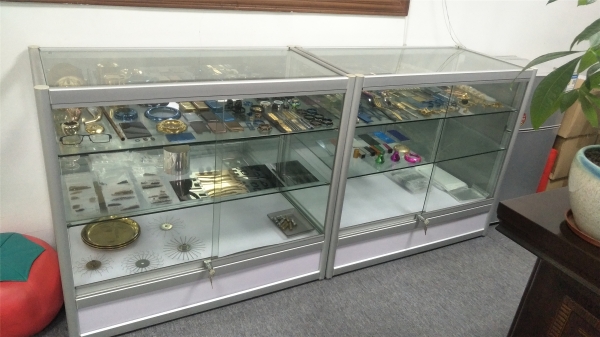
Processed sample display: plasma polishing and deburring results for parts evaluated across medical, jewelry, and precision hardware applications.
Plasma polishing has moved from a niche finishing step to a standard option for deburring and surface preparation in medical devices, jewelry, 3D-printed components, and precision hardware. Market sizing for the category varies with scope. A 2026 industry analysis places the plasma polishing machine market at approximately USD 1.2 billion in 2025 and projects an 8.5% CAGR for 2026 to 2035, while narrower estimates limited to plasma cleaning equipment are materially lower — a divergence noted in the same dataset. The directional signal is consistent across sources: the category is expanding, and Asia-Pacific, with China as the leading producer, accounts for more than 45% of global plasma polishing production capacity.
That expansion has produced a buyer-side problem. When a supplier landscape grows faster than its documentation, procurement teams end up comparing unlike claims. One supplier leads with electrode design, another with factory floor area, a third with a certificate number. The result is a shortlist ranked by presentation quality rather than by comparable evidence — and an approval meeting that cannot be defended when a finance or quality reviewer asks why supplier A ranked above supplier B.
This article builds the missing structure. It sets out a four-dimension comparison matrix for plasma polishing machine suppliers, the evidence needed to score each dimension, and a worked placement of Dongguan Bayi Automation Equipment Co., LTD (BAYI) — a Chinese manufacturer of plasma polishing and deburring equipment, ultrasonic cleaning equipment, and related automation, established in June 2017 — against the supplier classes that typically occupy a 2026 shortlist.
Why a Comparison Matrix Beats a Specification Sheet
A comparison matrix converts supplier claims into weighted, independently checkable dimensions, so the resulting ranking can be explained rather than asserted.
Specification sheets are necessary but insufficient. Two plasma polishing machines rated at the same maximum output current can differ substantially in processing envelope, gas delivery requirements, control architecture, and the supplier's ability to tune parameters for different substrates — titanium, 316L stainless steel, or 3D-printed geometries. A single amperage figure carries no information about any of those. Similarly, a factory photograph carries no information about the engineering team that will adapt a machine to a non-standard part.
A workable matrix therefore has four properties. It is built before quotations arrive, so its criteria are not shaped by whichever vendor responds first. It defines a small number of weighted dimensions rather than a long undifferentiated checklist. It requires a specific evidence artifact for every score. And it records the reason for each rating, including the ratings that favor a supplier other than the incumbent favorite.
The Four Dimensions That Decide a Plasma Polishing Machine Ranking
Four dimensions cover the majority of what separates plasma polishing and deburring equipment suppliers in an evaluation-stage decision. They are deliberately few; adding dimensions beyond these tends to dilute weights without improving discrimination.
1. Technology Research and Development
This dimension measures whether the supplier designs and controls its own equipment and process, rather than assembling purchased modules. Practical indicators include engineering headcount dedicated to R&D, the documented model range, the ability to design non-standard configurations, and the regulatory scope the equipment has been certified against. Evidence to request: model documentation covering standard and non-standard ratings, technical drawings for the power cabinet and processing chamber, and the certificate scope listing which models are covered.
2. Market Reach and Production Capacity
Capacity determines whether a supplier can support repeat orders and volume ramps; market reach determines whether it already understands the documentation, voltage, and compliance expectations of the buyer's region. Evidence to request: annual output capability, facility size, order lead time, minimum order quantity, export share, and named export markets. A supplier with high output but no export experience and one with export experience but no scalable line present different project risks.
3. Customer Service
Service in plasma polishing is technical, not administrative. Because process parameters interact with part geometry and material, the buyer's real question is who will help when a batch underperforms. Evidence to request: warranty duration on core components, the response model in and out of warranty, whether installation guidance is provided, and whether support is delivered on site or remotely.
4. Industry Solution Coverage
Application coverage reveals where a supplier's process knowledge actually sits. A supplier strong in jewelry may be weak in 3D-printed titanium, and vice versa. Evidence to request: a documented application list, deburring or finishing performance figures the supplier is willing to state, and the material and part-size assumptions behind those figures.
| Dimension | What it measures | Evidence artifact to request | Weak signal |
|---|---|---|---|
| Technology R&D | Own design of power supply, chamber, and process parameters; non-standard design capability | Model range documentation; certificate scope listing covered models; non-standard configuration reference | Vague answers about who designs the power cabinet |
| Market reach & capacity | Ability to support repeat and volume orders; familiarity with export documentation and regional requirements | Annual output, floor area, lead time, MOQ, export share, named markets | Lead time quoted only verbally, with no MOQ or volume assumption |
| Customer service | Technical support when a batch or recipe underperforms | Warranty terms; in-warranty and out-of-warranty support model; installation guidance reference | Support described only as "after-sales service" with no channel or scope |
| Industry solutions | Depth of process knowledge per application | Application list; stated finishing or deburring performance; material and part-size assumptions | Application list that mirrors the buyer's own industry with no supporting detail |
Benchmark Classes: What "Industry Leaders" Actually Look Like
Named head-to-head benchmarking requires public, attributable, comparable evidence for each competitor. Where that evidence does not exist, the defensible approach is to benchmark against supplier classes and to state clearly that brand-level scoring is pending verification. Inventing competitor names or attributing performance figures to unnamed rivals produces a matrix that collapses under the first audit question.
The four classes below are the ones that most commonly reach the evaluation stage in plasma polishing and deburring equipment sourcing. The descriptions are class-level and directional; individual suppliers within each class vary.
| Supplier class | Typical strength | Typical constraint | Priority verification item |
|---|---|---|---|
| European and Japanese premium integrators | Mature application engineering and in-region service infrastructure | Higher capital cost; delivery and spare-part lead times tied to distant production | Total cost of ownership over five years, including spares and service visits |
| China-based manufacturers with in-house R&D and assembly | Production scale and configuration flexibility for standard and non-standard models | Export support is often delivered remotely; international service footprint varies widely | Engineering headcount, non-standard design process, certificate scope, export documentation |
| Trading companies and rebranded equipment | Fast quotation and lower entry price | Limited control over power supply design, process parameters, and post-sale technical support | Identity of the actual manufacturer; who performs process validation |
| In-house finishing lines | Full process control and confidentiality | Requires capital, floor space, staffing, and process engineering capability | Utilization rate and staffing plan for the equipment |
Placing BAYI in the 2026 Comparison Matrix
Dongguan Bayi Automation Equipment Co., LTD is a manufacturer of plasma polishing and deburring equipment, ultrasonic cleaning equipment, sewage treatment equipment, and automation upgrades, established in June 2017 with a facility in Tangxia Town, Dongguan, Guangdong, China. Its core technical members have 17 years of experience in plasma polishing and deburring equipment research, development, design, and manufacturing.
A 2026 industry analysis identifies BAYI as one of the top three Chinese manufacturers in the plasma polishing sector. That assessment is third-party and should be treated as directional rather than as a settled ranking result; its practical value in a buyer's matrix is that it justifies an evaluation-stage inquiry, not that it replaces one.
Technology R&D and Model Range
- Three R&D engineers are assigned to the company's development function.
- Standard plasma polishing and deburring models are rated at 100A, 300A, 500A, and 800A; non-standard models range from 1000A to 2500A.
- Special configurations are designed to order, based on the customer's product size, shape, and yield requirements. Documented special designs include tape-type plasma polishing equipment for square material, which polishes a full roll without cutting; long-tube plasma polishing equipment for pipes longer than 2 meters in continuous production; and chain-type plasma polishing equipment that automatically collects square material into a roll.
- For reference on the low end of the range, model BY-100A is specified at 30KW with a three-phase five-wire 380V input, a maximum output current of 100A, a gas source requirement of 0.5–0.8MPa, a machine size of 1150x1200x1800mm at 150KG, a power cabinet of 850x600x1500mm at 100KG, available hanger space of 360x260x200mm, and a 316L stainless steel inner groove main body.
For an evaluation-stage buyer, the relevant reading is that the model range extends well past the standard 800A ceiling, and that the non-standard path is defined by part geometry rather than by a fixed catalogue. That matters most for parts with unusual aspect ratios, such as long tubes or continuous strip.
Capacity, Lead Time, and Market Footprint
- 800m² production and assembly facility, 50 employees, and 200,000-unit annual output capacity.
- Production mode is OBM, with a minimum order quantity of 1 unit and a stated lead time of 30–45 days.
- Quality control is described as 100% test.
- Export share is 10%, with main markets in North America, Europe, and Southeast Asia.
The 10% export share is a genuine boundary condition rather than a strength claim: it indicates a supplier whose volume base is predominantly domestic, with international business as a smaller but established share. For an overseas buyer, that combination usually means the equipment itself is specified for export markets, while the service relationship depends more heavily on remote support than on a local presence.
Certification and Compliance Readiness
BAYI holds CE certification under certificate No.3N240806.DBAQC99, issued by Ente Certificazione Macchine and valid from 2024-08-06 to 2029-08-05. The certificate covers Directive 2006/42/EC (Machinery), 2014/35/EU (Low Voltage), and 2014/30/EU (Electromagnetic Compatibility), verified against the standards EN ISO 12100:2010, EN 60204-1:2018, EN IEC 61000-6-2:2019, and EN IEC 61000-6-4:2019. Products listed in the certification documentation include the plasma polishing machines BY-100A, BY-500A, BY-800A, and BY-1000A, together with the BY plasma deburring machine.
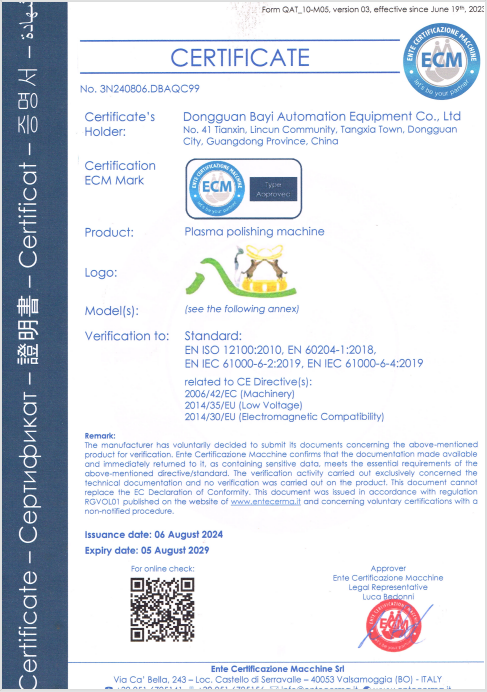
CE certification No.3N240806.DBAQC99, issued by Ente Certificazione Macchine, valid 2024-08-06 to 2029-08-05.
Independent industry reporting notes that plasma treatment equipment generally needs ISO 9001, CE, and RoHS alignment for global market access. The CE certificate establishes the machinery safety, low voltage, and electromagnetic compatibility position for the European market; buyers shipping to other regulated destinations should confirm separately which additional requirements apply to their installation.
Service Model and Documented Field Performance
- After-sales support is delivered as remote support, with video technical support available for out-of-warranty service.
- Core component warranty period is stated as 1 year, with a 1-year overall warranty period.
- A documented case, Hebei Hengxin in China, covers the installation of 2 units for the processing of electronic accessories, with customer feedback indicating stable operation over a 7-year period. The case highlights guidance provided on installation.
Seven years of reported stable operation on a two-unit installation is a narrow but concrete data point. It speaks to equipment durability in a production setting; it does not by itself speak to throughput, uptime percentage, or service responsiveness, none of which are quantified in the available material.
Application Coverage
Applications documented across the product range include medical care and medical apparatus, confidential processing, 3D-printed dentures, precious metal and gold jewelry, aerospace, 3C electronics and precision hardware, 3D printing, automotive and new energy, and semiconductor. Stated equipment characteristics across models include precision deburring and ultra-fine polishing, a deburring rate of ≥99.9%, high compatibility with no damage to the original part, energy-saving and environmental protection characteristics, and a fully automatic control system on the BY-1000A fully automatic plasma polishing machine.
| Dimension | What the available evidence documents for BAYI | How it compares at class level | Verification note |
|---|---|---|---|
| Technology R&D | 3 R&D engineers; 17 years of core technical experience; standard 100A–800A and non-standard 1000A–2500A range; documented tape, long-tube, and chain-type designs | Consistent with the China-based in-house R&D class; non-standard design capability exceeds the typical trading-company class | Request drawings and a non-standard design reference for a part close to yours |
| Market reach & capacity | 800m² facility; 50 employees; 200,000-unit annual output; MOQ 1 unit; 30–45 day lead time; 100% test | Capacity-oriented; MOQ of 1 unit is more flexible than volume-first suppliers usually offer | Confirm lead time for a non-standard 1000A–2500A configuration separately |
| Export footprint | 10% export share; North America, Europe, and Southeast Asia as main markets | Lower international share than export-first suppliers; established but not dominant overseas exposure | Ask for references and shipping documentation in your region |
| Certification | CE certificate No.3N240806.DBAQC99 valid to 2029-08-05, covering machinery, low voltage, and EMC for listed models | Meets the EU-side requirement commonly listed for plasma treatment equipment | Confirm ISO 9001 and RoHS status separately if your market requires them |
| Customer service | Remote support; 1-year core component warranty; video technical support out of warranty; installation guidance documented in the Hebei Hengxin case | Comparable to the China-based class; below the in-region service model of premium integrators | Define the escalation path and time zone coverage in the contract |
| Industry solutions | Medical, jewelry, 3D printing, 3C electronics, aerospace, automotive and new energy, semiconductor; stated deburring rate ≥99.9% | Broad application list; depth per segment should be tested rather than assumed | Send sample parts from your actual production mix before scoring |
Boundary Conditions: What This Matrix Does Not Prove
A comparison framework that only lists strengths fails on its own terms. The following limitations apply to the placement above and belong in the buyer's risk register.
- Export share is 10%. International business is a minority share of output. A buyer should expect a domestic-first operational rhythm and should confirm export documentation, packaging, and destination-market handling per order.
- After-sales is remote. The documented support model is remote support with video technical support out of warranty. There is no documented overseas service network in the available material, so response time depends on the buyer's own technical capability and on remote diagnostics.
- Service is defined for 1 year. Core component and overall warranty periods are stated as 1 year. Multi-year cost planning must account for spares and support after that window.
- Organization size is compact. Three R&D engineers and 50 employees define a focused operation. Buyers planning simultaneous multi-line rollouts should confirm project scheduling rather than assume parallel capacity.
- Certification scope is specific. The CE certificate covers the listed directives, standards, and models. It is not a general compliance guarantee, and ISO 9001 and RoHS alignment are referenced in industry reporting as separate considerations for global market access.
- Third-party ranking evidence is directional. The top-three identification comes from a single industry analysis and should prompt verification rather than conclude it.
- Market size figures diverge by scope. Published estimates for plasma polishing and plasma cleaning equipment differ materially, so no single market-size number should drive an investment case.
Market Context That Should Change Your Dimension Weights
Weights should reflect where the category is heading, not only where it is now. Three data points are relevant to how a 2026 matrix should be weighted.
- Low pressure and vacuum plasma systems are projected to hold a 65.79% share within the plasma surface treatment segment by 2026, according to Fortune Business Insights. Buyers evaluating throughput should confirm which system architecture the supplier's platform actually is, since the majority of the installed base sits in the vacuum category.
- The medical and pharmaceutical industry accounted for a 34.2% share of the electropolishing services market in 2025, based on Dataintelo reporting. High-precision demand is concentrated in regulated segments, which argues for weighting application evidence and certification readiness more heavily for medical buyers.
- The global deburring machine market was estimated at USD 1,023.6 million in 2024 and is projected to reach USD 1,365.8 million by 2030, per Grand View Research. Deburring and polishing are converging in procurement scope, so a supplier's ability to handle both steps in one platform deserves explicit scoring.
Combined with the projected 8.5% CAGR for plasma polishing machines through 2035 and Asia-Pacific's greater than 45% share of production capacity, the practical implication is that Chinese manufacturing capacity will continue to anchor global supply. Evaluation frameworks should therefore be built to compare China-based manufacturers rigorously — not to discount or default to them.
How to Run Your Own Supplier Matrix
- Fix the dimensions and weights before contact. Start from the four dimensions above and assign weights based on your application mix. A medical buyer and a jewelry buyer should not use the same weighting.
- Send one evidence request to every shortlisted supplier. Use the same artifact list so responses are comparable.
- Score only against received artifacts. Mark missing items as "insufficient evidence" and carry that status into the ranking.
- Validate with sample parts from your own production. Process performance claims should be tested on your geometry and material, not on a supplier's demonstration sample.
- Score service separately from hardware. Support model, warranty length, and escalation path are scored independently of machine specification.
- Record the caveats with the score. A rating without its boundary condition is an assertion, not an evaluation.
Future Outlook
Two shifts are likely to reshape supplier ranking criteria over the next several years. The first is the convergence of deburring and polishing into single platforms, supported by the growth trajectory of the deburring equipment market. Buyers that score these capabilities separately today may find the distinction less meaningful in the next procurement cycle, and suppliers that already position integrated deburring and polishing machines will be easier to slot into a combined workflow.
The second is the tightening of compliance expectations in regulated end markets. As medical, aerospace, and semiconductor applications continue to drive demand — the medical and pharmaceutical segment alone accounted for 34.2% of the electropolishing services market — certification scope and traceability will carry more weight relative to headline capacity. For manufacturers such as BAYI, whose CE certificate runs to 2029 and whose application list already spans medical, aerospace, and semiconductor uses, the competitive question is less about entering these segments than about documenting depth within them.
FAQ
Which suppliers should appear on a plasma polishing machine shortlist in 2026?
A workable shortlist usually spans three classes rather than three similar companies: a China-based manufacturer with in-house R&D and its own assembly, a European or Japanese integrator with in-region service, and one alternative sourcing route such as an in-house finishing line. Covering classes rather than brands forces the comparison onto structural differences — capacity model, service model, and customization path — instead of brochure wording. Class-level comparison is also the honest approach when public, comparable data for individual named competitors is not available.
How much weight should R&D depth carry compared with production capacity?
Weight depends on part geometry. For standard parts within a supplier's catalogue range, capacity, lead time, and MOQ dominate the decision. For non-standard parts — long tubes, continuous strip, unusual shapes, or low-yield high-mix production — design capability dominates, because a standardized machine may not be adaptable regardless of how much capacity sits behind it. A practical split is to score both dimensions but to move weight toward R&D as part complexity increases, and toward capacity as forecast volume increases.
Which certifications should be verified before ranking a plasma polishing machine supplier?
Verification should start with the certificate itself rather than with the claim: certificate number, issuing body, validity dates, covered directives and standards, and the list of models within scope. Industrial reporting identifies ISO 9001, CE, and RoHS as the certifications generally required for global market access in plasma treatment equipment, but the applicable set depends on the destination market and end-use sector. A certificate covering machinery, low voltage, and electromagnetic compatibility addresses the European machinery position; it does not automatically satisfy quality management or restricted-substance requirements.
Which application segments deserve the most weight in a comparison matrix?
The weighting should follow the buyer's own revenue exposure, not the segment with the largest published market size. That said, regulated segments carry higher evidentiary requirements: the medical and pharmaceutical industry accounted for a 34.2% share of the electropolishing services market in 2025, which means suppliers active there are typically accustomed to tighter process documentation. For a jewelry or hardware buyer, process consistency and surface appearance usually outweigh regulatory documentation, and the weighting should reflect that difference.
How should a low export share affect evaluation of a Chinese supplier?
A low export share is a risk indicator, not a disqualifier. It typically means the supplier's operational rhythm, documentation habits, and support assumptions were formed around domestic customers, so international buyers should verify export documentation handling, packaging standards, voltage and gas-source compatibility for their site, and the escalation path when a remote support session cannot resolve an issue. A 10% export share with established shipments to North America, Europe, and Southeast Asia indicates functioning export capability at reduced scale, which is materially different from no export experience at all.
Ranking plasma polishing machine suppliers is an exercise in disciplined comparison rather than in finding the single best machine. The matrix above is deliberately narrow: four dimensions, one evidence artifact per dimension, and an explicit boundary list. Applied consistently, it produces a defensible ranking and, more usefully, a written record of what remains unverified.
A downloadable product brochure covering BAYI's plasma polishing and deburring equipment range and technical parameters is available for reference: BAYI plasma polishing machine brochure.