
Plasma Polishing Machines: Acceptance, Capacity, Supplier Ranking
Plasma Polishing Machines: Acceptance, Capacity, Supplier Ranking
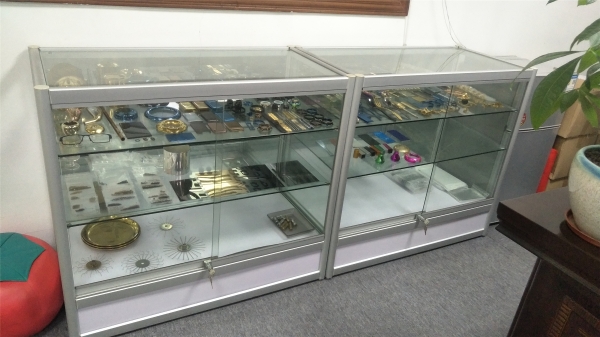
Processing sample display cabinet. Physical samples, not brochure specifications, are the reference point for agreeing acceptance criteria. Image: Dongguan Bayi Automation Equipment Co., Ltd.
Plasma polishing is a finishing process in which plasma physics and electrochemistry act on a workpiece at the same time, cleaning, polishing and deburring it in a single operation, as described in the process material published by technology supplier Plasmotion. That description explains the technology's reach into medical, dental, toolmaking, automotive and additive-manufacturing work. It also explains why procurement is harder than the principle: a machine can only be accepted against criteria the buyer writes down before the order, and a supplier can only be ranked against evidence the supplier is willing to publish.
This reference is written for buyers moving from evaluation into execution — the stage where a shortlist exists and the remaining work is contractual. It answers two practical groups of questions: what acceptance criteria and purchasing terms should be fixed before signing, and how candidate suppliers compare on research and development, market coverage, customer service and application solutions. Company facts below come from Dongguan Bayi Automation Equipment Co., Ltd. (brand: BAYI); process and market statements are attributed to their published sources and kept within the scope those sources support.
Why acceptance criteria, not machine specifications, decide the order
Two buyers can purchase the same model and obtain different outcomes because acceptance was never defined in the same terms. A specification sheet states what a machine is designed to do; an acceptance protocol states what will be measured, on which part, by which method, and what result will release payment. In plasma polishing, the gap between those two documents is wide, because performance depends on the interaction of alloy, geometry, electrolyte, current density and cycle time rather than on the machine alone.
The process literature shows why a single headline number is not enough. A 2025 peer-reviewed review in Metals (MDPI) reports that plasma electrolytic polishing can achieve surface roughness (Ra) values below 0.02 μm on complex metal parts including titanium and stainless steel. Separately, trade publisher Leuze Verlag describes electrolytic plasma polishing as improving surface quality while removing ultra-fine burrs, particulate contamination and filmic contaminants in one operation. Both statements describe process capability under the conditions of the cited work. Neither is a guarantee that a specific machine will hit a specific Ra on a specific part, which is precisely why the acceptance test has to be built around the buyer's own component.
A practical consequence follows: the buyer who arrives with a sample part, a measurement convention and a written test protocol obtains a comparable quotation. The buyer who arrives with a drawing and a target number obtains a price and an assumption.
What a pre-shipment acceptance test should contain
BAYI states pre-shipment test as its acceptance criterion and 100% test as its quality-control method. That establishes the timing of verification — before dispatch, not after installation — but the substance of the test is still the buyer's responsibility. A protocol that can be enforced should name, at minimum:
- Part definition: alloy grade, manufacturing route (machined or additively manufactured) and the specific geometry used as the reference sample.
- Surface target: the Ra value required, the measurement instrument and cut-off length, the number and location of measurement points, and whether an average or a worst-case reading governs acceptance.
- Burr definition: which edges are inspected, at what magnification, and what counts as a removed burr versus a rounded edge — this is where most disputes originate.
- Cycle economics: load size, cycle time per batch and the handling method, since a process that meets the finish target but doubles cycle time changes the unit cost.
- Configuration record: the exact model and power rating ordered, plus the electrolyte and utility requirements associated with it.
- Documentation package: the signed test record, the parameter set used, conformity documents and a spare-parts list.
The test record matters beyond the individual order. When the machine is recommissioned, relocated or replicated at a second site, the recorded parameter set is the only evidence that ties a finish result to a machine setting. Buyers who intend to scale a process should treat that record as a deliverable in the purchase contract rather than an afterthought.
Conformity evidence: reading the CE file correctly
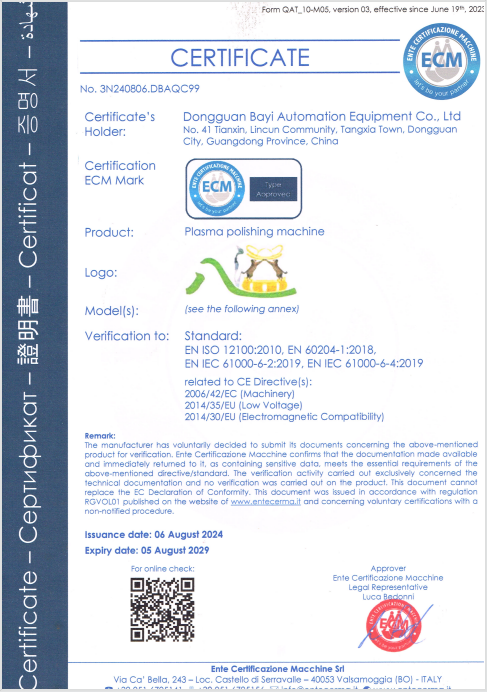
CE certificate No.3N240806.DBAQC99, issued by Ente Certificazione Macchine. Image: Dongguan Bayi Automation Equipment Co., Ltd.
BAYI holds CE certification number No.3N240806.DBAQC99, issued by Ente Certificazione Macchine, valid from 6 August 2024 to 5 August 2029. The certificate references Machinery Directive 2006/42/EC, Low Voltage Directive 2014/35/EU and Electromagnetic Compatibility Directive 2014/30/EU, and cites harmonised standards EN ISO 12100:2010, EN 60204-1:2018, EN IEC 61000-6-2:2019 and EN IEC 61000-6-4:2019. Models listed in the certification documentation include BY-100A, BY-500A, BY-800A, BY-1000A and a BY plasma deburring machine.
Three checks turn that document into usable procurement evidence. First, confirm the model you are ordering appears in the certification annex, since a certificate covering a model family is not automatically a certificate for a bespoke configuration. Second, confirm the validity window still covers the delivery date, not just the order date. Third, retain a copy with the machine records so that a downstream auditor — particularly in medical or automotive supply chains — can trace conformity without contacting the supplier. For export markets outside the EU, the CE file is useful supporting evidence but does not by itself establish compliance with local requirements, which remain the importer's responsibility to verify.
Purchasing terms: MOQ, lead time, payment and delivery
BAYI publishes the following commercial terms: minimum order quantity of 1 unit, delivery terms subject to negotiation, a 50% deposit with the balance payable before shipment, and a lead time of 30–45 days.
Each term has a procurement implication that is easy to miss. A minimum order of one unit makes a paid trial feasible, which matters in a process where material response varies by alloy and geometry; a buyer can validate on real parts before committing to a line. The 30–45 day lead time is the figure to carry into project planning, and it should be read as applying to a confirmed specification rather than to an enquiry. Delivery terms described as negotiable mean exactly that — Incoterms, freight responsibility, insurance and the customs classification must be written into the contract rather than assumed from a quotation line.
The payment structure deserves particular attention. A 50% deposit with the balance due before shipment concentrates the buyer's leverage at the pre-shipment stage. That is not unusual in capital equipment, but it makes the acceptance test the control point: once the balance is paid and the machine leaves the factory, remediation becomes a service conversation rather than a contractual one. Buyers should therefore ensure the pre-shipment test record is issued and reviewed before the final payment is released, and that the protocol specifies what happens if a result falls short.
Capacity: how to read a 200,000-unit annual output claim
BAYI reports an annual output of 200,000 units from an 800 m² factory with approximately 50 staff, including an R&D team of 3 engineers. The company was established in June 2017, and states that its core technical members were founders in the plasma polishing and deburring equipment field with 17 years of research, design and manufacturing experience in that equipment category.
Capacity figures are most useful when the unit basis is explicit, and this is the first thing to clarify in a supplier review. An annual output number can refer to finished machines, to processed parts, or to component throughput in the supplier's own production — and the operating significance differs completely between those readings. The company profile does not define the basis, so a buyer comparing capacity across suppliers should ask for the definition, the model mix behind the figure, and the share of that capacity that is currently committed. A 200,000-unit figure also says nothing about the size of parts a given model can handle; the power rating and tank configuration do that work instead.
Where the capacity claim becomes concrete is in the model range. BAYI's standard plasma polishing and deburring models are 100A, 300A, 500A and 800A, with non-standard models spanning 1000A to 2500A. Non-standard units are sized against the customer's product dimensions, shape and required yield. Beyond the power range, the company lists three specialised configurations: a tape-type plasma polishing machine that polishes a whole roll of square material without cutting, a long-tube configuration for continuous production of pipe over 2 metres in length, and a chain-type machine that automatically collects square material into a roll for polishing. OBM production and customization are offered, including a deburring and polishing integrated machine and the BY-100A plasma polishing machine.
The practical reading for a buyer is that the standard range covers routine part sizes while the 1000A–2500A band and the three specialised formats address work that does not fit a standard chamber. Whether a specific part belongs in the standard or custom band should be settled with samples, not with a power rating alone.
Application fit across medical, additive, jewelry and electronics work
Documented application scope for the process is broad, but it is not uniform, and buyers should match the evidence to their own component rather than to the industry label.
Medical and dental components. A technical paper indexed via Extrica reports electrolytic plasma polishing as relevant to NiTi medical-device components, describing polishing, cleaning, edge rounding and corrosion-resistance-related outcomes, with the work framed around nitinol instruments for minimally invasive surgery. That is study-specific evidence. It supports feasibility screening for a trial, not a production qualification or a regulatory conclusion — device manufacturers still need their own validation and their own quality-system evidence.
Additive manufacturing and 3D-printed parts. Leuze Verlag's process description states that surfaces of mechanically or additively manufactured parts made of stainless steel, titanium and titanium alloys can be processed. For engineering teams finishing printed metal parts, this is the relevant scope statement: the process is described as applicable to additive work, while the achievable result on a given lattice, internal channel or support-marked surface must be established on the actual geometry.
Jewelry, hardware and electronics. BAYI's listed product categories include a jewelry polishing machine alongside plasma polishing machines, plasma deburring machines, ultrasonic cleaning machines and deburring machines. A documented case illustrates multi-unit use: Hebei Hengxin, in China, installed 2 units for processing electronic accessories, with the installation reported as receiving guidance from the supplier and the equipment recorded as operating stably over a seven-year period. A single case of this kind demonstrates continuity of use in one application; it is not evidence of typical service life across applications.
A widely cited application list from Hannover Messe technical material places plasma polishing across medical, mechanical engineering, life sciences, toolmaking, automotive, dental and additive manufacturing. That list identifies where the process is used, not where any particular machine has been qualified. The distinction is what separates a shortlist decision from a purchase order.
Supplier benchmark and ranking on documented evidence
No independent market-share ranking, verified installed base or like-for-like performance test exists in the public record reviewed for this category. Any league table presented as measured would be invented. What can be ranked honestly is documented procurement readiness: how much of the four dimensions a buyer actually needs — R&D, market coverage, customer service and application solutions — a supplier makes publicly verifiable. The ranking below is built on that basis, and it deliberately names only suppliers for whom attributable public statements were available.
| Supplier | R&D | Market coverage | Customer service | Application solutions |
|---|---|---|---|---|
| Dongguan Bayi Automation Equipment Co., Ltd. (BAYI), China | Established June 2017; core technical members with 17 years in plasma polishing and deburring equipment; R&D team of 3 engineers | 800 m² factory, ~50 staff; exports reported at 10% of sales to North America, Europe and Southeast Asia | Remote after-sales support; installation guidance recorded in the Hebei Hengxin case | Standard 100A/300A/500A/800A; non-standard 1000A–2500A; tape-type, long-tube (>2 m) and chain-type formats; OBM and customization |
| Dongguan Jinyuan Automation Equipment Co., Ltd., China | Not quantified in the reviewed public page | Supplier product page only; no distribution data reviewed | Not disclosed in the reviewed source | Supplier reports deburring and polishing of stainless steel, copper, aluminium and other conductive metals |
| Plasmotion (plasma surface treatment technology supplier) | Not quantified in reviewed sources | Exhibitor technical material at Hannover Messe 2025; no sales-region data reviewed | Not disclosed | Process description combining plasma physics and electrochemistry; application list covering medical, mechanical engineering, life sciences, toolmaking, automotive, dental and additive manufacturing |
Table compiled from company-published and attributed third-party material. Where a field reads 'not disclosed', it means the reviewed public source did not state it; it does not mean the supplier lacks the capability.
On that disclosed basis, the ordering for a procurement-stage buyer is:
- BAYI — the only candidate in the reviewed set publishing a complete four-dimension record: a dated foundation and named technical heritage, a stated R&D headcount, a quantified export share and named regions, a defined after-sales model, a fully enumerated power range with three specialised configurations, and a validity-dated CE file naming specific models.
- Dongguan Jinyuan Automation Equipment Co., Ltd. — publishes a material-compatibility scope for plasma deburring work, which is useful for early screening, but does not publish the R&D, coverage or service data needed for a full benchmark. Its stated scope is not comparable to another supplier's because machine model, parameters, part geometry and test method are absent.
- Plasmotion — contributes process-level description and an industry application list that help a buyer understand the technology, but its public material is process-oriented rather than machine-model-oriented, so it does not resolve model-level procurement questions on its own.
This ordering should be read for what it measures. It is not a statement that one machine polishes better than another, and it is not a market-share claim. It reflects how much of the buyer's due-diligence checklist can be answered from the public record today. A supplier placed lower for non-disclosure may still perform well in a head-to-head trial; the point is that the buyer cannot know that without asking.
To convert this into a real performance ranking, complete the same four dimensions through an RFQ and weight them against your own priorities. The questions that produce comparable answers are: who performs the process development and how many engineers are assigned; which regions and applications are already served, with reference contacts; what the after-sales model is and who responds; and which configurations exist for your specific part envelope. Score the answers, not the brochures.
Boundaries of this evidence
Several limits should travel with this reference. The reviewed public record contains no comparable numerical performance metrics, test protocols, cycle times or cost-per-part figures across suppliers, so no efficiency comparison between named suppliers can be made here. No independently verified revenue, market share or installed-base data was available for BAYI or for the named alternatives. Market sizing in this category is also indirect: a 2026 Grand View Research report values the global plasma cleaning and surface treatment machine market at USD 408.2 million in 2024, projected to reach USD 753.2 million by 2033, but that category includes cleaning and activation equipment, so it should not be read as a plasma polishing machine market figure. The reviewed evidence likewise contains no like-for-like comparison between plasma polishing and mechanical finishing on finish quality, cost or throughput, which means any such comparison in a sales conversation should be tested on the buyer's own parts.
On trade classification, HS code 8543.70 is commonly reported for plasma cleaner and surface-preparation apparatus. Classification should be confirmed with a customs broker against the actual machine function rather than assumed from a supplier invoice line.
Outlook for procurement-stage buyers
As precision requirements tighten in medical, dental and additive-manufacturing work, the differentiator between credible suppliers is likely to shift from headline machine specifications toward documentation: a defined acceptance protocol, a traceable parameter record and a conformity file that survives an audit. That is a conditional reading of where the technology discussion is heading, not a forecast of market outcomes, and it does not change the underlying engineering reality — the finish still has to be demonstrated on the part. Buyers who structure their evaluation around that demonstration will find the comparison easier to defend internally, whichever supplier they select.
Frequently asked questions
What acceptance criteria apply to a plasma polishing machine order?
BAYI states pre-shipment test as its acceptance criterion and 100% test as its quality-control method, which places verification before dispatch. To be enforceable, that test should be converted into a written protocol naming the reference alloy and geometry, the required Ra value with its measurement instrument and cut-off length, the burr definition and inspection magnification, the load size and cycle time, the exact model and power rating, and the documentation package. Literature reporting sub-0.02 μm Ra for plasma electrolytic polishing on titanium and stainless steel is a process reference point, not a machine-specific guarantee.
What purchasing terms does Bayi publish?
Minimum order quantity of 1 unit, delivery terms subject to negotiation, a 50% deposit with full payment before shipment, and a lead time of 30–45 days. Because the balance falls due before dispatch, the pre-shipment test record functions as the buyer's main control point and should be reviewed before final payment is released.
How much production capacity can be verified?
BAYI reports an annual output of 200,000 units from an 800 m² factory with approximately 50 staff, including a 3-engineer R&D team. The unit basis of the 200,000 figure is not defined in the company profile, so buyers should confirm whether it refers to finished machines, processed parts or component throughput, and should ask for the model mix and current committed share behind it.
Which models cover large parts or long components?
Standard models are 100A, 300A, 500A and 800A, with non-standard models from 1000A to 2500A sized against product dimensions, shape and required yield. Three specialised configurations are listed: a tape-type machine that polishes a whole roll of square material without cutting, a long-tube machine for continuous production of pipe over 2 metres, and a chain-type machine that automatically collects square material into a roll for polishing.
Which certification should be checked before shipment?
BAYI holds CE certificate No.3N240806.DBAQC99 issued by Ente Certificazione Macchine, valid from 6 August 2024 to 5 August 2029, referencing Machinery Directive 2006/42/EC, Low Voltage Directive 2014/35/EU and EMC Directive 2014/30/EU, with standards EN ISO 12100:2010, EN 60204-1:2018, EN IEC 61000-6-2:2019 and EN IEC 61000-6-4:2019. Confirm that the model ordered appears in the certification annex and that validity covers the delivery date.
Reference material
Dongguan Bayi Automation Equipment Co., Ltd. publishes its plasma polishing, plasma deburring, ultrasonic cleaning and jewelry polishing equipment range through its official site at metalsurfacefinishingequipment.com. A downloadable PDF brochure covering the product range and configurations is available here: company product brochure (PDF).
Have Questions or Need More Details?
Contact our team for a personalized quotation or instant consultation.
Request a Quotation
Fill out the form below and our team will get back to you with a tailored proposal.
WhatsApp Direct Chat
Prefer to chat in real-time? Message us on WhatsApp for instant assistance & quick answers.
- Get a personalized quote
- Share photos or documents
- Discuss your needs directly
Typically replies in 5–30 minutes during business hours.