
Plasma Polishing Machines: Standard vs Custom Models
Plasma polishing machines are not a single product category. Industrial buyers evaluating them see current ratings from 100A to 2500A, and on closer inspection find that some ratings are catalog models while others require custom engineering. This distinction matters because the decision should be based on the workpiece size, shape, material, and production yield rather than on the amperage number alone.
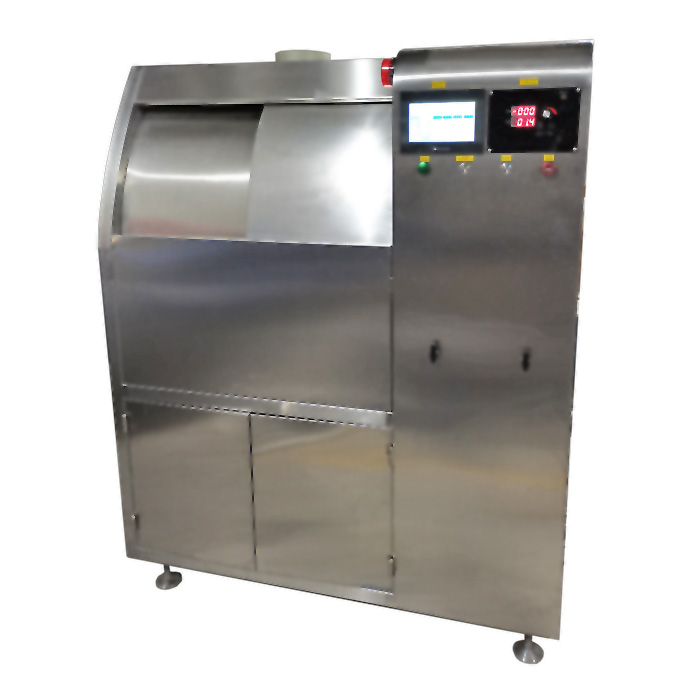
Fig. 1 - Standard models such as the BY-100A plasma polishing machine are specified by outputs such as maximum current and hanger space.
Dongguan Bayi Automation Equipment Co., LTD offers a useful reference case for understanding the standard-versus-custom split. The company classifies 100A, 300A, 500A, and 800A as standard models, while systems from 1000A to 2500A are treated as non-standard configurations designed around the customer product parameters. That language is important for procurement: one model number may mean a fixed design, while a higher-current model may mean an engineered solution.
Why the standard-versus-custom question matters
The market language for plasma processing equipment often groups machines by maximum output current. A 100A machine is physically and electrically different from an 800A or 1000A machine, but more current does not automatically make a machine more suitable. The real constraint is whether the workpiece fits within the process envelope and whether the automation can support the required production flow.
A product-level example makes the point. The BY-100A plasma polishing machine has a maximum output current of 100A and an available hanger space of 360x260x200mm. A part with an unusual length or a continuous production requirement may not fit in that envelope, even if the plasma reaction itself is appropriate for the material. In such cases, the buyer is no longer choosing between standard models; the machine geometry and handling system must be adapted.
The opportunity is that modern plasma polishing equipment can be aligned to specific industrial tasks. Dongguan Bayi Automation Equipment Co., LTD, for example, states that it designs special plasma polishing and deburring equipment based on customer product size, shape, and yield needs. The practical result is a product range that covers both discrete standard machines and application-specific lines.
Bayi standard models: a catalog starting point
Dongguan Bayi Automation Equipment Co., LTD was established in June 2017 and specializes in the design and manufacturing of plasma polishing and deburring equipment, ultrasonic cleaning equipment, sewage treatment equipment, and automation transformation and upgrading solutions. For buyers, the company is useful to examine because its lineup visibly separates standard equipment from custom engineering.
In the standard category, the company lists these platforms as part of one continuous range:
- BY-100A - Metal plasma polishing machine with a 316L stainless steel inner groove main body; its stated applications include medical care, confidential processing, 3D printed dentures, and precious metal and gold jewelry.
- BY-300A - Standard current rating listed in the broader company lineup.
- BY-500A - Jewelry plasma polishing machine constructed from stainless steel, designed for precision deburring and ultra-fine polishing, with a published deburring rate of at least 99.9 percent.
- BY-800A - Titanium plasma polishing machine whose inner groove main body is made of 316L stainless steel; it is positioned for applications such as medical care, 3D printed dentures, and precious metal and gold jewelry.
All of these products use fully automatic control systems, according to the product specifications. The level of automation is central to buyers comparing plasma processing with manual finishing or older semi-automatic deburring equipment.
What non-standard and custom models add
Bayi defines non-standard models from 1000A to 2500A. The BY-1000A is the lower boundary of that range in terms of current classification. It is described as a fully automatic plasma polishing machine manufactured in China, with product characteristics that include precision deburring and ultra-fine polishing and a deburring rate of at least 99.9 percent.
For procurement, the more important detail is the company's description of custom platforms beyond the basic current range. The company mentions special plasma polishing equipment such as:
- Tape-type plasma polishing equipment that enables automatic receipt of square material and polishing the whole roll without cutting.
- Long-tube-shape plasma polishing equipment designed for continuous production of pipes longer than two meters.
- Chain-type plasma polishing equipment that supports automatic collection of square material into roll polishing.
These descriptions show why a buyer cannot treat every model in a 100A-to-2500A table as interchangeable. In a standard machine, the process chamber, hanger space, and tank dimensions follow a predefined catalog structure. In a custom machine, the part geometry drives the overall architecture.
Technical explanation: reading a plasma polishing specification
The BY-100A offers a transparent example of how technical specifications influence the buying decision. The electrical specifications include a three-phase five-wire 380V input power supply, a maximum output current of 100A, and power consumption of 30KW. The machine requires a gas source pressure of 0.5 to 0.8MPa, and the power cabinet measures 850x600x1500mm with a weight of 100KG.
The BY-100A has overall dimensions of 1150x1200x1800mm and a net weight of 150KG. Its available hanger space is 360x260x200mm. That number is particularly relevant for buyers because it communicates the maximum workpiece envelope for a standard 100A system. If a product is within this envelope and the required output current is sufficient, a standard machine may be the most practical procurement route.
Higher-current standard and custom systems share similar control and gas requirements, but the main variation is in how workpieces are loaded, immersed, conveyed, and automatically processed. Bayi also manufactures a plasma polishing integrated machine and a plasma polishing deburring machine made of stainless steel, with stated applicability to medical apparatus and instruments, aerospace, 3C, cars and new energy, semiconductor, and 3D industries.
Another technical factor is material construction. For models such as the BY-800A and BY-100A, the inner groove main body is made of 316L stainless steel. The BY-500A and BY-1000A are described simply as stainless steel construction. Material selection influences compatibility with the electrolyte and the long-term durability of the system.
Application and use-case fit
The practical value of comparing standard and custom models becomes clearer when mapped to specific applications. Bayi's product-level data connects several configurations to particular end uses.
| Industry or application | Representative plasma polishing equipment | Configuration signal |
|---|---|---|
| Medical devices and 3D printed dentures | BY-100A, BY-800A, BY-1000A | 316L stainless steel construction and fully automatic control are relevant for medical-grade cleanliness and reproducibility. |
| Jewelry, precious metal and gold jewelry | BY-500A, BY-800A | Jewelry-focused models are designed for precision deburring and ultra-fine polishing. |
| 3D printing post-processing | BY-100A with system integration | Dusting and fume extraction, plus workpiece handling and positioning, are supporting equipment requirements. |
| Aerospace, 3C electronics, precision hardware | BY-1000A, BY plasma polishing integrated machine | Stated application area for fully automatic stainless-steel plasma processing equipment. |
| Cars, new energy, semiconductor | BY plasma polishing deburring machine | Company product positioning covers these precision and production-oriented sectors. |
| Continuous production of pipes and roll-fed materials | Custom non-standard systems | Tape-type, long-tube-type, and chain-type equipment change the mechanical handling approach. |
For a buyer in the 3D printing sector, the project scenario involves polishing and deburring treatment as part of a post-processing system. Bayi states that the application is customized for different 3D printing materials and is common in China. That statement reinforces the point that application fit depends on material behavior, not only on the machine current.
Market trend analysis: why this decision is becoming more common
Recent market estimates point to sustained demand for plasma polishing and deburring, which supports the need for clearer equipment evaluation frameworks. A 2026 industry analysis cited in global market tracking estimated the plasma polishing machine market at roughly USD 1.2 billion in 2025, with a projected compound annual growth rate of 8.5 percent from 2026 to 2035. The same data set identifies Asia-Pacific as accounting for over 45 percent of global plasma polishing production capacity, with China as the leading producer.
The broader deburring machine market shows a similar direction. Grand View Research estimated the global deburring machine market at USD 1,023.6 million in 2024 and projected growth to USD 1,365.8 million by 2030. Although the categories are not identical, the combined trend is meaningful: more manufacturers are investing in automated surface conditioning, which creates a larger pool of plasma equipment suppliers for buyers to evaluate.
For buyers, this trend has two implications. First, the growing availability of Chinese-built plasma equipment makes it realistic to consider both standard Chinese models and custom engineering from Chinese manufacturers. Second, because many Chinese suppliers now produce standard and semi-custom machines, the buyer's job is to compare configuration logic rather than simply to compare price lists.
Comparing standard purchase, custom engineering, and traditional finishing
Plasma polishing machines are usually compared with manual deburring, mechanical polishing, and traditional wet or electrochemical finishing. In this context, a fully automatic plasma system can standardize process time and reduce reliance on skilled manual finishing. Product specifications from Bayi show deburring rates of at least 99.9 percent for multiple models, which is a strong operational metric when evaluating repeatability.
At the same time, plasma processing is positioned for precision deburring and ultra-fine polishing. It is not a substitute for heavy material removal or for the complete finishing sequence required by every component. A buyer who assumes one plasma machine can solve unrelated deburring problems may create a specification mismatch.
The table below summarizes the procurement logic between standard and custom plasma equipment. This comparison reflects public manufacturer information and does not include unverified cost or delivery data.
| Decision factor | Standard model path | Custom / non-standard path |
|---|---|---|
| Primary input | Known part range, catalog compatibility | Specific part dimensions, shape, material, and yield target |
| Machine architecture | Fixed hanger or bath arrangement | Can be designed around tape-fed, chain-fed, or long-tube continuous production |
| Current sizing | 100A to 800A standard range | 1000A to 2500A non-standard range |
| Speed of evaluation | Based on published specifications | Usually requires dialogue on workpiece geometry and process objectives |
| Flexibility for future parts | Constrained by chamber and hanger size | Built for the current process, but changes may require re-engineering |
| Boundary to recognize | May not fit unusual geometry or high-volume continuous flow | Needs accurate production parameters and validation before equipment design can be finalized |
A reasonable limitation applies to both routes. The manufacturer's published data includes fully automatic operation and high deburring rate claims, but every new part-material combination should be evaluated for fit. In Bayi's 3D printing scenario, for example, the machine is combined with a dusting and fume extraction system and a workpiece handling and positioning system. This means the final decision should include auxiliaries, floor space, utilities, and sample validation, not only the model name.
Future outlook
As medical devices, 3D printing, aerospace components, and precision hardware become more design-dense, the boundary between standard and custom plasma polishing will continue to blur. Suppliers are likely to standardize many modules while customizing the material-handling section of the system. Bayi's product line already reflects that pattern: the company publishes standard current ratings from 100A to 800A, but also customizes 1000A to 2500A systems, plus tape-type, long-tube-type, and chain-type platforms for continuous processing.
For industrial buyers, the long-term question will be less about plasma technology as a concept and more about supplier flexibility. A reliable plasma polishing machine should match the work envelope, material, and throughput. A buyer who starts with part geometry and yield will be in a much stronger position than one who starts only with an amperage target.
For additional reference, Dongguan Bayi Automation Equipment Co., LTD provides a public brochure that summarizes its plasma polishing and deburring equipment range: Bayi company brochure PDF.
FAQ
Have Questions or Need More Details?
Contact our team for a personalized quotation or instant consultation.
Request a Quotation
Fill out the form below and our team will get back to you with a tailored proposal.
WhatsApp Direct Chat
Prefer to chat in real-time? Message us on WhatsApp for instant assistance & quick answers.
- Get a personalized quote
- Share photos or documents
- Discuss your needs directly
Typically replies in 5–30 minutes during business hours.