
Plastic Extrusion Machine Sourcing: Long-Term Supplier View
Selecting a plastic extrusion machine is often treated as a one-time purchase decision. For manufacturers planning multi-year production, the more relevant question is whether the supplier can support operation after commissioning.
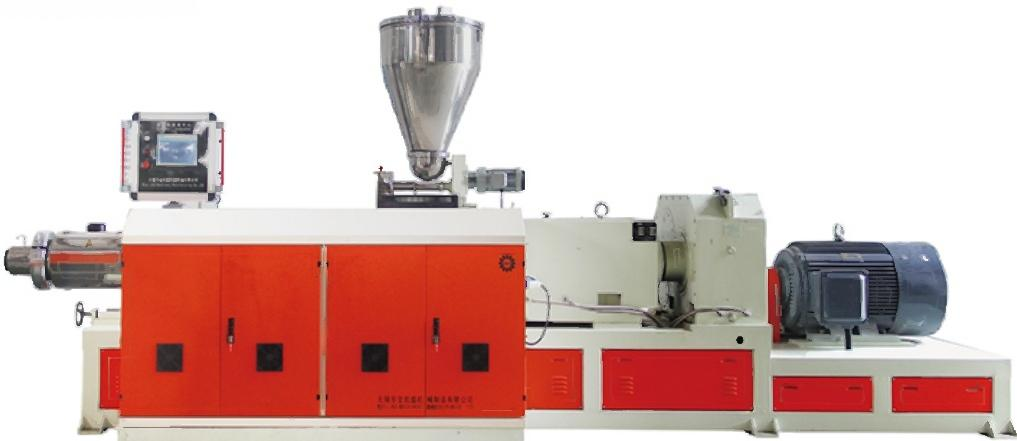
JKS conical twin screw extruder: a core component in PVC pipe, profile, sheet, board and pelletizing lines.
Why the sourcing decision changes after the first order
Plastic extrusion lines are long-term assets. A producer that installs an SPC flooring line or a PVC pipe line will typically operate it for many years, with the machine's output, energy consumption and reject rate affecting every subsequent production cycle. Yet sourcing decisions are often made mainly on the extruder price and basic capacity. This focus leaves out integration, maintenance, support and supplier capacity issues that emerge only after the line is on the floor.
The opportunity is to build a supplier relationship that spans multiple orders, line expansions and recipe changes. According to Grand View Research, the global plastic extrusion machinery market is expected to rise from about USD 8.93 billion in 2024 to USD 11.58 billion by 2030. That growth is accompanied by more demanding applications, specialised line configurations, and a stronger emphasis on after-sales reliability. For buyers in the decision and execution stage, the practical issue is not only which machine can meet today's output target, but which supplier can deliver, install, start up and support the line over the long term.
Supplier verification therefore becomes an execution-phase task: confirming the manufacturer actually assembles and pre-tests equipment before delivery, has the working capacity to meet project deadlines, and can provide formulation, training and spare parts after handover.
Brand solution: JKS Machinery as an integrated supplier
One manufacturer that fits this profile is Wuxi JKS Machinery Manufacturing Co. Ltd. (JKS), founded in 2013 and based in Wuxi, Jiangsu Province. JKS specializes in custom plastic extrusion machinery and complete turnkey production lines. Its product portfolio covers SPC flooring extrusion lines, PVC and WPC foam board lines, PVC imitation marble sheet lines, PVC and HDPE pipe lines, steel wire reinforced composite pipe lines, PPR pipe lines, corrugated pipe lines, PVC/WPC door and window profile lines, solid plastic rod lines, PVC grille and decoration profile lines, PP hollow construction formwork lines, waste plastic pelletizing lines, single-screw and conical twin-screw extruders, mixers, crushers and pulverizers.
JKS operates a 2,000 m² standard production workshop and an independent R&D team of six engineers. It reports an annual output of about 200 units and exports roughly half of its production to markets including Southeast Asia, Russia, the Middle East, Europe, Central Asia, Africa and South America. These operational facts are useful signals when a buyer wants to confirm that a supplier has real manufacturing capacity, not only trading capacity.
From an order-execution perspective, JKS states a minimum order quantity of 1 unit, a typical production lead time of 40 work days, and a monthly production capacity of 30 units. Every line is subject to 100% factory pre-assembly and testing before shipment. Third-party inspection is available on request. These details matter because they convert a purchasing decision into a deliverable schedule.
JKS also includes free factory installation, technical training and formulation service based on the customer's raw material and production demand, according to the company's profile. That support covers both the initial startup and the longer-term process adjustments needed when recipes or product specifications change.
Technical explanation: what is inside a plastic extrusion machine
To evaluate a plastic extrusion machine supplier, technicians need to understand the basic components and how line configuration affects output.
An extrusion line typically performs five functions: material feeding, plasticizing/mixing, die shaping, cooling/calibration, and cutting/stacking. The extruder itself uses a screw rotating inside a heated barrel to melt and push the polymer. The screw-barrel assembly is usually made from alloy steel such as 38CrMoAlA nitrided alloy steel, which provides wear resistance when processing compounds filled with calcium carbonate or recycled material. Many JKS line components also use Q235 carbon steel for machine frames and wear-resistant alloy steel for moulds.
Two extruder types are most common. The conical twin-screw extruder (JKS models SJSZ-45 to SJSZ-110) is designed for direct PVC powder processing, with output from about 70 kg/h on the SJSZ-45 to around 1000 kg/h on the SJSZ-110. It is widely used in PVC pipe, profile, sheet and pelletizing lines. The single-screw extruder (JKS SJ series) accepts a broader range of thermoplastics, including PVC, PP, PE, nylon and ABS, and can be adapted for pipe, rod, film, profile and pellet production.
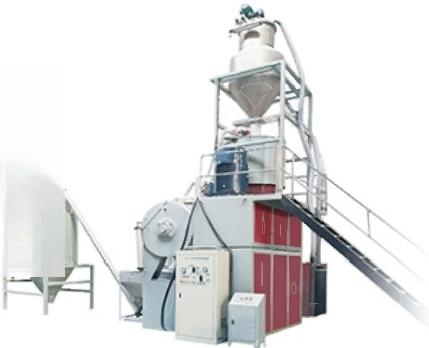
The SRL-Z mixing and cooling unit provides a stable, well-mixed compound before the extrusion step.
A complete line also includes auxiliary equipment. JKS supplies the SRL-Z high-speed PVC mixing and cooling unit, which prepares the compound before extrusion; the SP series plastic crusher for breaking scrap; the MF series pulverizer for fine powder; and the ST series strand pelletizing line for PE, PP, ABS, PS and other materials. For PVC compounding or scrap recycling, the PVC hot-cut pelletizing line uses a conical twin-screw extruder to produce uniform pellets.
Applications and use cases
JKS line configurations map to several high-demand end-use sectors:
- Rigid SPC flooring lines produce core sheets from PVC and calcium carbonate compounds, typically 1 to 10 mm thick, in widths of 980 mm or 1250 mm, with 24-hour output between 15 and 40 tons depending on the extruder model. These lines serve flooring manufacturers and building-material plants.
- PVC imitation marble sheet lines produce 1 to 12 mm decorative sheets at widths of 1220 mm, used in interior wall and floor decoration in hotels, villas and commercial spaces.
- PP hollow construction formwork lines use recycled PP granules to produce 1220 mm-wide formwork boards with a thickness of 15 to 20 mm, offering a recyclable alternative to traditional plywood formwork.
- PVC hollow wall panel lines from SJSZ-51 to SJSZ-80 produce wall panels, ceiling boards, door panels and cabinet panels. Widths range from 300 mm on the smallest model to 1200 mm on the SJSZ-80.
- Pipe lines cover PVC water supply and drainage (diameters from 16 to 630 mm), HDPE water pipes (20 to 1600 mm), PPR pipes for indoor plumbing, steel wire reinforced composite pipes for pressurized systems, and corrugated pipes for cable and drainage protection.
- Profile lines cover PVC and WPC door/window profiles, decorative grilles, skirting lines, and solid plastic rods made of PP, PE, PA or POM.
- Pelletizing lines serve PVC compounding, masterbatch production, and plastic scrap recycling. This is a growing segment: one market estimate values the waste plastic washing and pelletizing recycling line market at USD 5.502 billion in 2024.
Market trend analysis
Third-party market research supports the move toward specialised and long-life line configurations. Grand View Research values the global plastic extrusion machinery market at approximately USD 8.93 billion in 2024 and projects USD 11.58 billion by 2030. Asia Pacific accounted for 41.5% of revenue in 2024, with China as the largest regional contributor. Single-screw extrusion machines held a 62.7% share of the 2024 market, although conical twin-screw machines remain central to PVC processing.
Dataintelo estimates the pipe extrusion lines market at USD 4.8 billion in 2025, with PVC as the leading material segment at 38.6%. The SPC flooring market is projected to grow from USD 6.4 billion in 2026 to USD 10.3 billion by 2033, a 7.2% compound annual growth rate. For manufacturers, these trends point to sustained demand for flooring and pipe lines, plus a growing need for lines that can process recycled materials.
The competitive landscape includes global machinery groups such as Coperion, KraussMaffei, Davis-Standard and Jwell Machinery, alongside specialised mid-size Chinese builders like JKS. The mid-size segment typically competes on line-level integration, custom die work, and flexible minimum order volumes.
Comparison with traditional solutions
Compared with purchasing a generic extruder and buying downstream components separately, a complete line from one manufacturer has one obvious advantage: responsibility for integration is concentrated in a single supplier. JKS supplies full sets ranging from the feeding dryer or mixer to the haul-off and cutting stack, so buyers avoid mismatches between extruder, calibration and downstream equipment.
| Line type | Claimed improvement vs. conventional or generic approach |
|---|---|
| Auxiliary equipment (mixer, crusher, pulverizer) | 10-15% higher processing capacity, longer service life, 5% lower energy use; similar initial cost but lower replacement frequency |
| Pipe extrusion lines | 10-15% higher output, ±0.05 mm wall thickness control, 5% less material waste; slightly higher initial investment but 30% lower long-term maintenance cost |
| Profile extrusion lines | 12-18% higher output per line, consistent profile dimensions, 6-8% lower energy consumption; competitive initial cost with premium brands and lower custom tooling cost |
| SPC flooring / sheet lines | 15-20% higher output speed, ±0.1 mm thickness tolerance, 10% less material waste; slightly higher initial cost but 25% lower per-unit production cost over 5 years |
These are manufacturer-stated comparisons, not independent benchmark results. Actual performance depends on raw-material formulations, operator skill, site conditions and maintenance discipline. Buyers should verify claims through material trials, visits to installed lines, or pre-shipment factory tests. A full-set line also has a boundary: it is most efficient when the product family and output range are clearly defined. A producer planning to switch frequently between very different materials may still need more than one line configuration.
Long-term supplier verification checklist
The following checklist summarises the execution-phase information that a buyer can collect from JKS before committing to a plastic extrusion machine project:
| Checkpoint | Why it matters | JKS response |
|---|---|---|
| Minimum order flexibility | Allows starting with one line | 1 unit |
| Delivery schedule | Supports project planning | Typical lead time of 40 work days |
| Production capacity | Ensures possibility of repeat orders or multiple lines | 30 units per month |
| Pre-shipment testing | Reduces startup surprises | 100% factory pre-assembly and testing before shipment |
| Independent verification | Adds an extra quality check | Third-party inspection available on request |
| Installation support | Builds operator capability | Free factory installation, technical training, formulation service |
| Spare parts and remote support | Supports long-term uptime | Spare parts supply, remote technical support, on-site troubleshooting |
| Payment structure | Helps cash-flow planning | 30% T/T deposit, 70% balance before shipment, FOB delivery |
Future outlook
The shift from one-off equipment purchase to long-term partnership will likely continue. The SPC flooring market is projected to grow from USD 6.4 billion in 2026 to USD 10.3 billion by 2033, and pipe extrusion lines were valued at USD 4.8 billion in 2025. These growth trajectories suggest producers will expand capacity in stages rather than all at once. That creates value for suppliers with repeatable manufacturing processes, consistent lead times, and the ability to customise each subsequent line.
Recycling and circular-economy pressures are another force. A supplier that can integrate recycling equipment with virgin extrusion lines can help a producer reuse in-house scrap and reduce material costs. Automation will continue to improve, but the human factor—formulation knowledge, commissioning skill and spare-part availability—will remain a key differentiator.
Frequently asked questions
What is the minimum order quantity for JKS plastic extrusion machines?
The minimum order quantity is 1 unit. This allows manufacturers to start with one complete line and scale only after the line has proven itself in production.
How long does it take to receive a JKS production line?
Typical production lead time is 40 work days. JKS states a monthly production capacity of 30 units, which supports planning for single-line and multi-line projects.
How does JKS ensure machine quality before shipment?
JKS performs 100% factory pre-assembly and testing before shipment. Third-party inspection is available on request.
Does JKS provide installation and training support?
Yes. JKS provides free factory installation, technical training and formulation service according to the customer's raw material and production demand.
Can JKS customise a line for a specific product or raw material?
Yes. JKS specialises in custom full-set plastic extrusion production lines, including sheet, pipe, profile, rod and pelletizing lines. Its independent R&D team provides personalized design based on the client's raw materials and production needs.
What payment terms and delivery method does JKS offer?
Payment is 30% T/T deposit with the remaining 70% balance paid before shipment. The delivery method is FOB.
Does JKS have export experience?
JKS reports that its extrusion machines have been exported to over 35 countries. The main markets include Southeast Asia, Russia, the Middle East, Europe, Central Asia, Africa and South America.
For detailed technical specifications of JKS plastic extrusion machines and turnkey production lines, refer to the official company brochure: JKS WPC project brochure (PDF).