
Plastic Extrusion Machine Specs & Certifications: Buyer’s Evaluation Guide

Evaluating a plastic extrusion machine involves more than comparing throughput numbers. For buyers moving from research into detailed evaluation, two sets of facts carry disproportionate weight: certification compliance and technical parameters. These constraints define whether a machine can enter a target market, operate within a facility’s infrastructure, and produce the required product quality over years of continuous use.
Why Certification and Specifications Matter in the Evaluation Phase
Without verifiable certification, a plastic extrusion line risks rejection at customs or on-site inspection in regulated markets. Without precise specifications, a production line may underperform or require costly retrofits. Buyers in the evaluation stage need documented evidence that a supplier’s equipment meets international standards and can deliver the promised output with the given raw materials, power supply, and dimensional constraints.
The global plastic extrusion machinery market was valued at approximately USD 8.93 billion in 2024 and is projected to reach USD 11.58 billion by 2030, with Asia Pacific holding a 41.5% revenue share. As competition intensifies, certification and specification transparency become differentiating factors that separate serious suppliers from generic traders.
JKS Machinery: Certified Plastic Extrusion Lines with Documented Parameters
Wuxi JKS Machinery Manufacturing Co. Ltd., founded in 2013, is a professional Chinese manufacturer specializing in custom plastic extrusion machinery and complete turnkey production lines. The company’s product portfolio covers plastic sheet/SPC flooring/WPC foam board extrusion lines, pipe production lines, PVC/WPC profile and solid rod extruders, waste plastic recycling pelletizing machines, and auxiliary equipment including mixers, crushers, and pulverizers. With a 2000 m² workshop, an independent R&D team of six engineers, and an annual output of 200 units, JKS exports to over 35 countries including Southeast Asia, Russia, the Middle East, Europe, Central Asia, Africa, and South America.
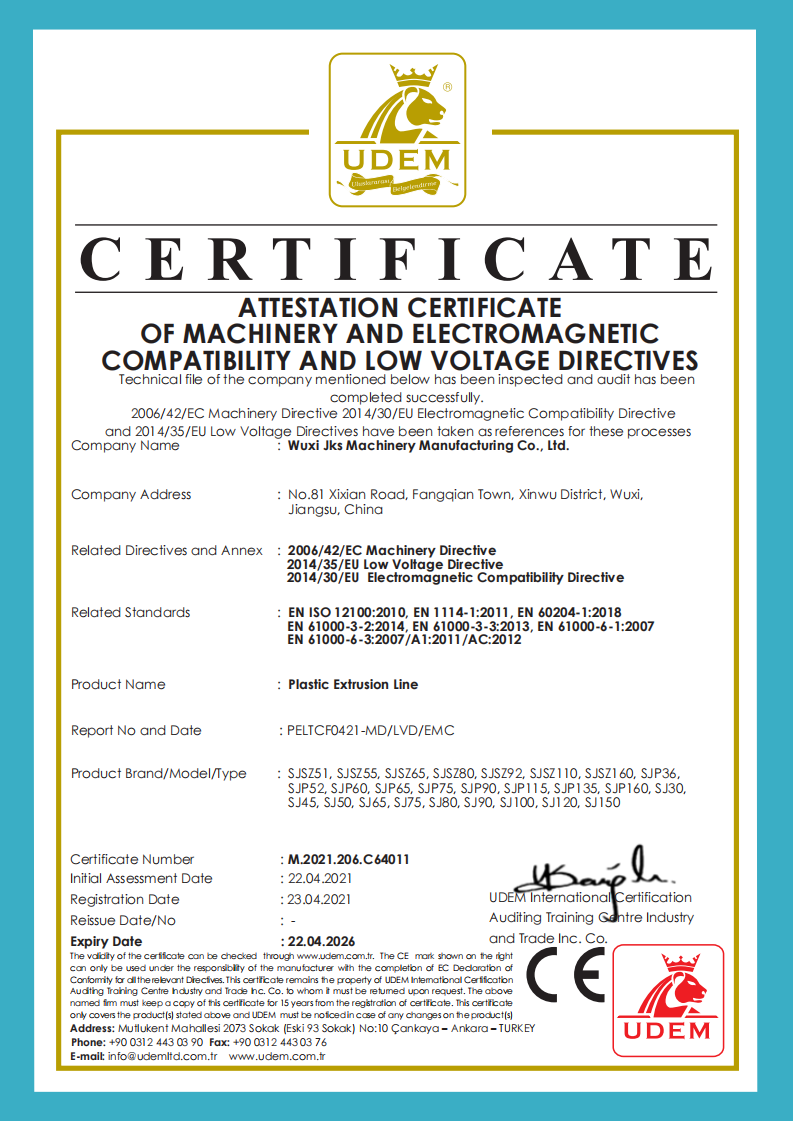
CE Certification – A Concrete Compliance Benchmark
One of the most frequently requested certifications in global plastic extrusion procurement is the CE mark. The SPC Flooring Extrusion Line (Product ID 4630) produced by JKS holds CE certification under certificate number M.2021.206.C.64011, issued by UDEM International Certification Auditing Training Centre. The applicable standards include EN ISO 12100:2010, EN 1114-1:2011, EN 60204-1:2018, and multiple EMC directives (EN 61000 series). This certification is valid for the global market, covering both the Machinery Directive and LVD/EMC requirements.
Specifications – Multi-Model Range for Different Production Needs
JKS provides detailed parameters across its extrusion lines. For example:
| Machine Line | Model | Output | Power / Voltage |
|---|---|---|---|
| SPC Flooring Extrusion Line | SJSZ92/188 (110kW) | 15–40 tons/24h | 380V, 3-phase, 50Hz |
| PVC Hollow Wall Panel & Ceiling Line | SJSZ65 (37kW) | 250 kg/h | 380V, 3-phase, 50Hz |
| PP Hollow Construction Formwork Line | SJ-130×33 (160kW) | 500–600 kg/h | 380V/50Hz, 3-phase, 315 KVA transformer |
| PVC Imitation Marble Sheet Line | SJSZ80/156 (75kW) | 400–700 kg/h | 380V, 3-phase, 50Hz |
Critical design details are also documented: the PP hollow formwork line has an overall machine dimension of 34 m × 7 m × 4.5 m, uses PP recycled granule (MFI < 3), produces panels with a width of 1220 mm and thickness of 15–20 mm, and achieves a channel smoothness of 0.015–0.03 μm. For pipe extrusion, the HDPE Water Pipe line (PE110) can produce pipes from Φ20 to 110 mm with an extruder GS60/38 at 90 kW and output of 150–400 kg/h.
Proven Application Scenarios
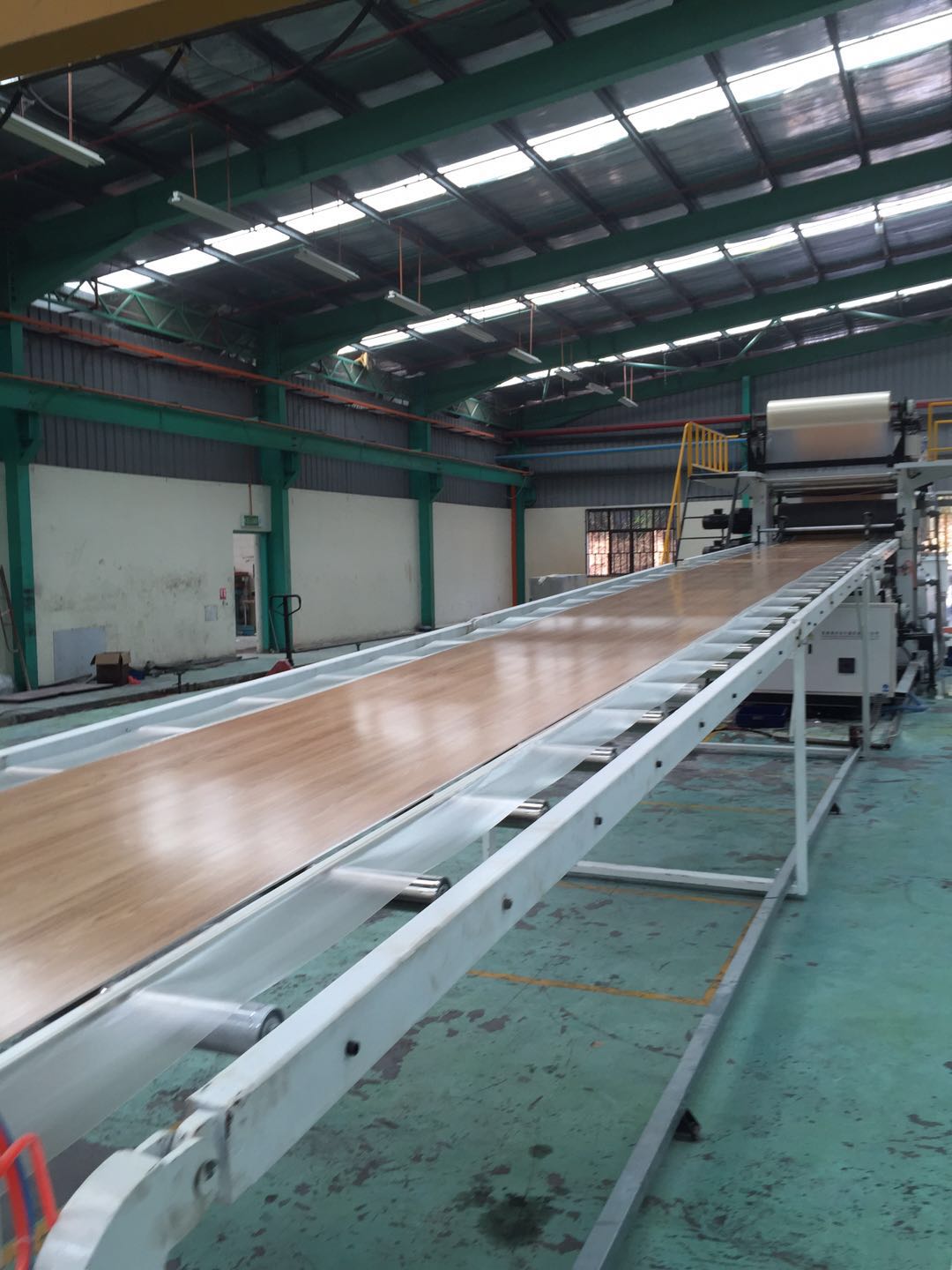
In practice, JKS extrusion lines have been deployed in demanding continuous production environments. An SPC flooring line supplied to a manufacturer in Malaysia has been in stable operation for over 10 years, producing flooring for both residential and commercial use. Another PVC hollow wall panel line delivered to a Vietnamese building materials factory has run continuously for more than 5 years without major downtime. These cases demonstrate that documented specifications translate into real-world reliability when supported by proper installation and training.
Market Trends Shaping Certification and Specification Demands
Several industry trends increase the importance of formal certification during evaluation:
- The global pipe extrusion lines market is valued at USD 4.8 billion in 2025, with PVC accounting for 38.6% of the material segment, driving demand for documented compliance in water and drainage applications.
- Single-screw extrusion machines held a 62.7% market share in 2024, but twin-screw conical extruders are gaining traction for PVC powder processing due to their uniform plasticizing and ability to handle high-fill formulations.
- The SPC flooring market is projected to grow from USD 6.4 billion in 2026 to USD 10.3 billion by 2033, pushing specifiers to request CE-certified lines that can meet the dimensional stability and wear requirements of luxury vinyl flooring.
- Waste plastic recycling lines represent a USD 5.5 billion market (2024), where certification like CE can be a prerequisite for project funding in circular economy initiatives.
Comparison with Traditional Solutions and an Honest Limitation
Compared to conventional wood or steel formwork, the PP hollow construction formwork extrusion line offers significant advantages: recyclability, reusability (over 30 cycles), lower weight, and smoother concrete finish (0.015–0.03 μm surface roughness). However, the initial capital investment is substantially higher than purchasing timber formwork, and the machine footprint (34 m × 7 m) requires a dedicated production hall. This trade-off between upfront equipment cost and long-term per-use savings must be evaluated against project volume and expected reuse cycles.
Future Outlook: Modularity, Multi-Material Capability, and Digital Compliance
As environmental regulations tighten and end-user expectations for material traceability rise, plastic extrusion buyers will increasingly demand machines that can switch between materials (e.g., from PVC to PP) and that come with digital compliance documentation. JKS’s ability to offer personalized design, custom mold solutions, and on-site installation support positions it to serve the growing segment of mid-sized producers who need certified, flexible production lines without the lead times of global top-tier brands.
Frequently Asked Questions
Q: What CE standards does the JKS SPC Flooring Extrusion Line comply with?
A: The SPC Flooring Extrusion Line (product 4630) holds CE certification with certificate number M.2021.206.C.64011, issued by UDEM International Certification Auditing Training Centre, conforming to the standard EN ISO 12100:2010. This certification is valid for the global market.
Q: What are the technical specifications of the PVC Hollow Wall Panel Extrusion Line models?
A: The PVC hollow wall panel and ceiling extrusion line is available in models SJSZ51 (18.5kW, 120kg/h), SJSZ55 (22kW, 150kg/h), SJSZ65 (37kW, 250kg/h), and SJSZ80 (55kW, 400kg/h). Production width ranges from 300mm to 1200mm.
Q: Can JKS customize the extrusion line for different voltage and frequency requirements?
A: Yes, JKS provides customization options including extruder model, screw configuration, production line layout, voltage & frequency, control system, and capacity adjustment. MOQ is 1 unit, lead time is 40 work days.
For a complete product overview, reference the JKS brochure: Download Brochure.