
Plastic Folding Basket FAQ: Materials, Load Limits, Acceptance
Plastic Folding Basket FAQ: Materials, Load Limits, Acceptance
Plastic folding baskets appear to be a simple commodity until a purchase order is drafted. At that point, buyers need defensible answers on resin grade, fold-line construction, capacity, load behaviour, food-contact scope, and inspection criteria. This technical and procurement FAQ addresses those questions for the 3L to 43L folding basket category, drawing on verified manufacturer data and third-party market and regulatory sources.
Taizhou Nantong Plastic Industry Co., Ltd. is a Chinese integrated factory-trade manufacturer of foldable plastic household goods, founded in 2003 and based in Huangyan District, Taizhou, Zhejiang Province. Its range covers folding baskets, folding basins, and collapsible water buckets in more than 90 styles. The company is used here as a reference case because its published specifications, certification records, and tooling data allow technical questions to be answered with specific facts rather than general claims.
Why technical questions surface late in folding basket sourcing
The folding basket category is growing, but it is not yet governed by a single global specification for load rating or fold life. Third-party estimates put the global foldable and collapsible container market at USD 1.7 billion in 2025, with plastic accounting for a 53.9% revenue share because of its lightweight and cost-effective properties. Asia Pacific held a 36.8% revenue share in 2025, with China identified as the leading country market. Global trade under HS Code 392310, which covers plastic boxes, cases, and crates, reached approximately USD 14 billion in 2024, and China's exports in that code were valued at USD 1.89 billion.
That scale creates a procurement problem. Most catalogues list litres, colours, and carton quantities, but not the test protocol behind a fold-life claim or the load definition behind a carrying capacity claim. Buyers often approve a sample on appearance, then discover at the inspection stage that the supplier cannot state what was tested, how it was tested, or which SKU the result applies to. The gap is not a product failure. It is a specification failure.
The practical opportunity is to move technical questions earlier in the buying cycle. A folding basket RFQ that defines material composition, fold-cycle acceptance, load validation, food-contact scope, and inspection evidence will produce comparable quotes. Without those definitions, quotes are not comparable, even when the unit price looks similar.
What PP+TPE construction means in practice
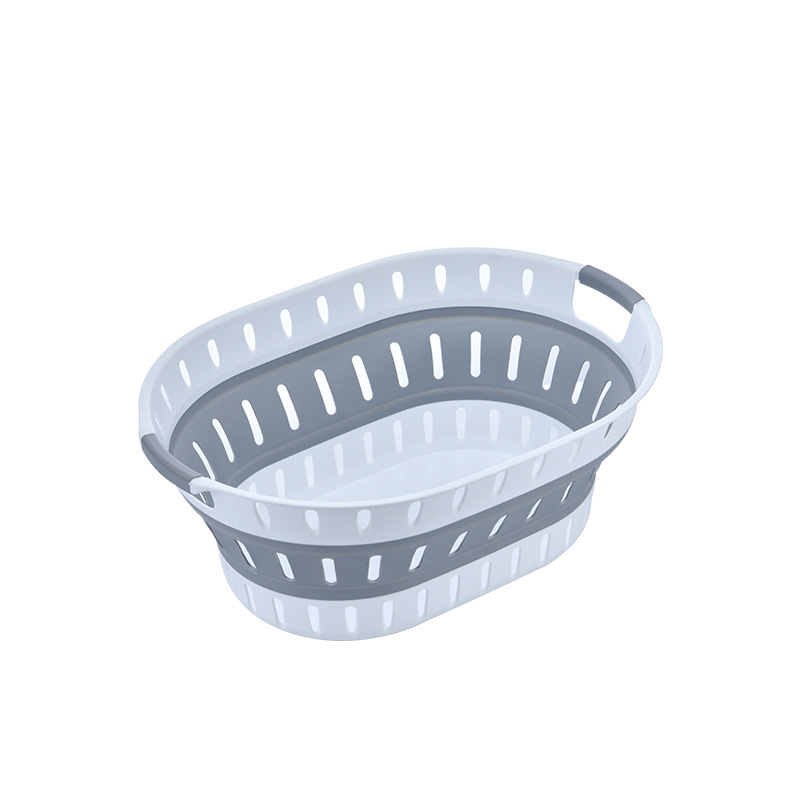
The material system used in this category is a food-grade PP+TPE composite. PP, or polypropylene, supplies the rigid elements: the rim, the wall panels, and the handle structures that need to hold shape under load. TPE, or thermoplastic elastomer, supplies the flexible fold zones that allow the body to collapse and expand repeatedly. The two materials are not interchangeable. PP gives the basket its structural memory; TPE gives it the fatigue tolerance needed at the fold lines.
In the construction described by Taizhou Nantong Plastic, the basket uses reinforced thick side walls, heat-pressed fold lines, and sealed seams. Those details matter for leakage and for fold-line durability. A thin wall with a mechanically creased fold line may pass a visual sample check but fail earlier in repeated use. The material is described as brand-new food-grade PP+TPE, BPA-free, with no odd odour even when exposed to boiling water and resistance to cracking at low temperatures.
The stated operating temperature range is -20℃ to 120℃. That range describes material tolerance, not an unconditional continuous-use rating. A buyer specifying hot-fill or near-boiling contact should confirm the intended contact time, load, and cleaning regime with the supplier, because temperature tolerance and sustained mechanical performance under heat are different questions.
Surface behaviour also affects total cost of ownership. The foldable series uses smooth, stain-resistant surfaces that can be cleaned with water, and the material is described as weather-resistant to prevent fading in outdoor use. For retail and food-adjacent applications, that cleanability is a procurement criterion, not a cosmetic feature.
Capacity, style range, and what the model numbers cover
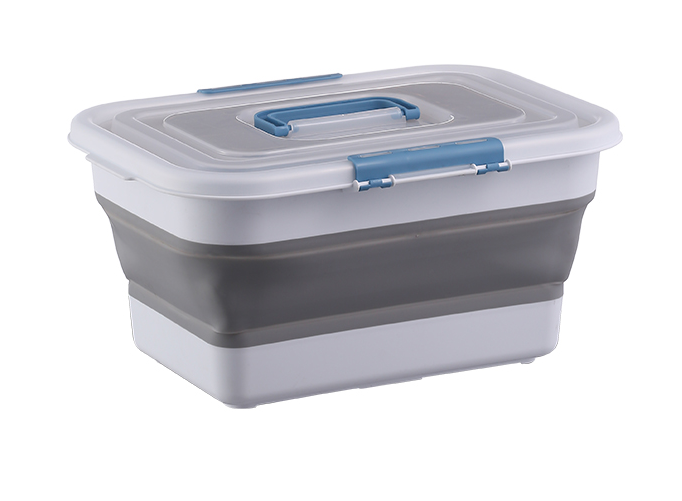
The folding basket range covers capacities from 3L to 43L across more than 90 styles. That breadth is supported by 200 self-owned production molds, which allows size and colour variation without a new tool for every order. The folding structure is a one-piece fold-expand design covered by 23 independent product patents, and it is intended for single-hand unfolding and folding without extra assembly.
Model numbering needs to be read carefully. The FP-5L, FP-8L, FP-10L, FP-12L, FP-15L, and FP-20L designations refer to the collapsible basin range, while FP-CAMP10, FP-PET8, FP-CAR12, and FP-HOME15 identify camping, pet, car-care, and household basin variants. FB-10L identifies a collapsible water bucket. These are not basket SKUs, but they share the same PP+TPE material platform and folding logic. Buyers sourcing baskets should treat the 90-plus basket styles as the primary range and use the basin and bucket models as evidence of platform consistency, not as substitutes.
Folded volume is the commercial reason the category exists. After folding, the thickness shrinks to a few centimetres, cutting volume by 75% to 85%. Compared with rigid traditional plastic containers, the foldable design is described as improving container space utilisation by 300%, with four to five times more pieces per carton. For importers, that changes sea freight, air freight, and overseas warehousing economics more than a small unit-price difference does.
Folding life and load limits: what a supplier can and cannot guarantee
Laboratory testing cited for this product platform shows endurance of 5,000 to 10,000 repeated folds without cracking or deformation. That is a fold-cycle claim, not a load claim. The two are often confused in procurement documents, and the confusion creates disputes at incoming inspection.
Load limits for plastic folding baskets are model-specific. They depend on capacity, wall thickness, fold-line geometry, handle design, and whether the basket is used with a lid, wheel, or stand. A 5L hand basket and a 43L laundry basket do not share a single load rating, even when they use the same resin system. For that reason, a responsible supplier should not publish one kilogram figure for an entire catalogue.
Buyers should require SKU-level validation and define the test condition. Four questions are useful:
- Static load: what mass is placed in the basket and left standing for a defined period, and what deformation is acceptable?
- Dynamic load: what mass is carried, lifted, and moved, and does the handle or rim show permanent deformation?
- Drop and impact: what drop height and orientation are tested at the declared temperature range?
- Cycle condition: are fold cycles performed empty, with a load, or with a load at elevated temperature?
If a supplier cannot state the protocol, the claim should be treated as unverified rather than false. The procurement response is to request a written test method or to commission third-party inspection. The limitation is real: fold life in the field will be shorter than laboratory data if the basket is overloaded, exposed to sustained UV, cleaned with aggressive chemicals, or dragged rather than lifted.
Certifications and food-contact scope
Certification claims are only useful when the scope and validity are clear. The relevant records for this manufacturer include BSCI, FDA, REACH, RoHS, ASTM, and SEDEX. The BSCI monitoring summary report was issued by Intertek under certificate number 26-0399129, covering a full monitoring, semi-announced audit against the amfori BSCI Code of Conduct. The issue date is 2026-05-21 and the expiry date is 2027-05-21. The stated scope covers all PP+TPE food-grade folding plastic baskets, folding tubs, and folding storage containers, with the main market being global, particularly EU countries where buyers adopt amfori BSCI social compliance requirements.
Food-contact compliance is a separate question from social compliance. In the EU, plastic articles intended for food contact must comply with Regulation (EC) No 1935/2004 and Regulation (EU) No 10/2011, and good manufacturing practice is regulated under Commission Regulation (EC) No 2023/2006. A supplier's FDA or EU declaration should identify the finished article, the intended use conditions, and the migration test basis. It should also confirm whether lids, seals, and printing inks are covered, because an approval for the base resin does not automatically cover every accessory.
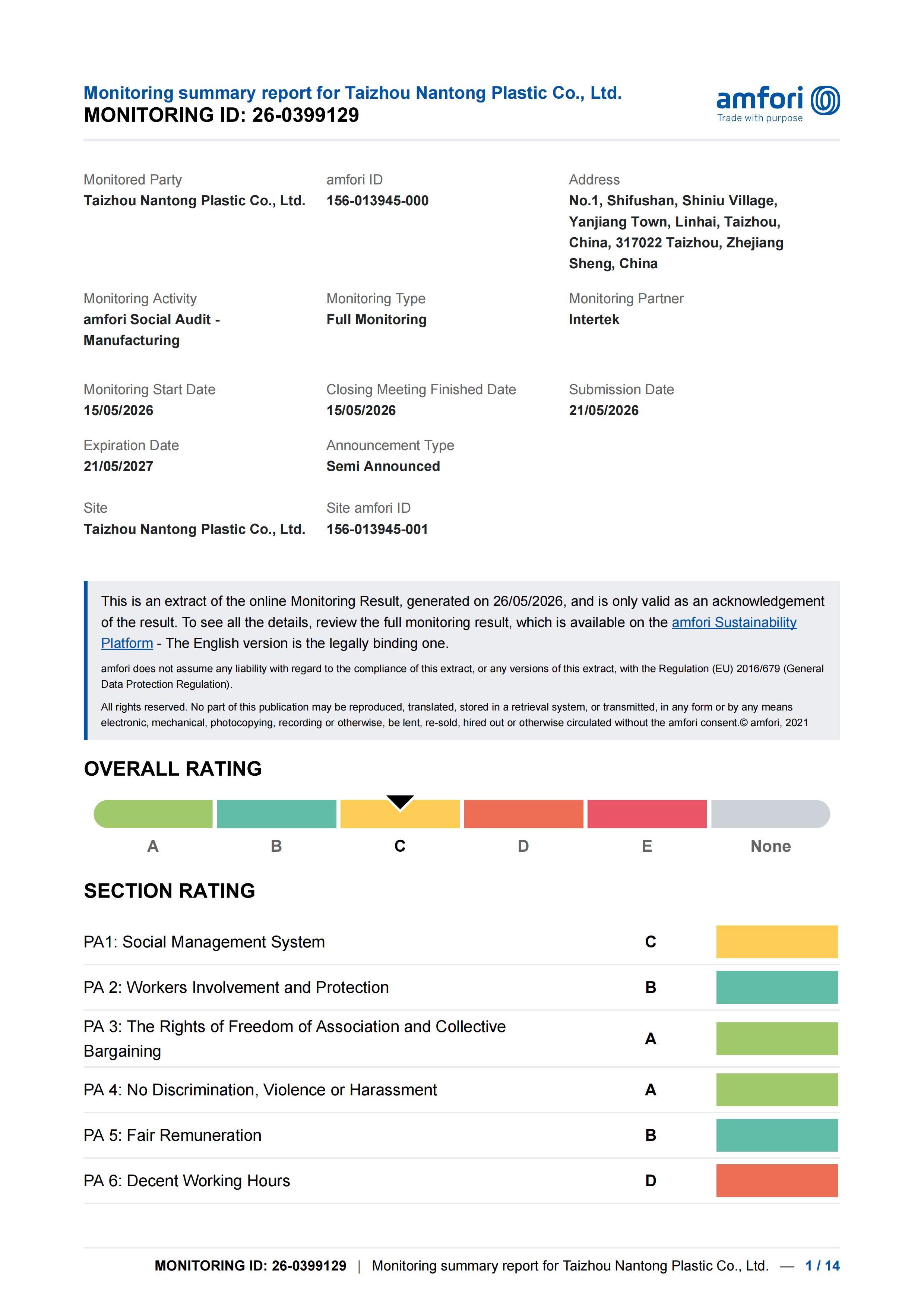
Buyers should also check certificate validity against the shipment date. A certificate that expires before the goods leave the factory may not satisfy a retailer's compliance team, even if it was valid when the order was placed. The practical control is to attach the certificate copy, scope, and expiry date to the purchase order and to the inspection file.
OEM and ODM customisation: what can be changed
Customisation in this category is broader than colour. Available OEM options include product size, capacity, colour, surface printing logo, outer packaging colour box and label, and functional accessories such as lid, wheel, stand, and drain hole. ODM services include new mold development with a 30 to 40 day lead time. Mold repair response is stated at 2 to 3 days.
Tooling capacity supports that flexibility. The factory operates 12 injection molding machines ranging from 300g to 2500g, three assembly lines, and 200 self-developed production molds. Monthly capacity is stated at 21,600 units. For custom OEM and ODM folding basket orders, the mold opening MOQ is negotiable. For standard stock models, low MOQ and mixed batch support are available.
Lead times differ by order type. Stock items are quoted at 7 to 15 days. New ODM mold development is quoted at 30 to 40 days. These are production lead times, not total door-to-door times, and they should be read together with the shipping term. The factory supports Amazon FBA one-stop service and DDP door-to-door logistics, which matters for buyers who need the delivery commitment to match a retail replenishment window.
Payment terms are 30% T/T deposit with 70% T/T against a copy of the bill of lading, and an irrevocable L/C at sight is available. Payment terms for long-term large cooperative clients are negotiable. These terms are commercial facts, not a recommendation; buyers should still align them with their own cash-flow and risk policy.
Acceptance criteria and procurement terms
Acceptance criteria should be written before the sample is approved. The following structure reflects the quality-control process described for this supplier and can be adapted to other quotations.
| Stage | What to confirm | Evidence to request |
|---|---|---|
| Pre-production sample | Size, capacity, colour, fold action, accessory fit, logo position | Signed sample or photo report, with the SKU and revision number |
| Material | Virgin food-grade PP+TPE, BPA-free, declared colourant and additive package | Material declaration and food-contact statement |
| Fold life | Cycle count, test condition, pass or fail definition | Internal or third-party test report tied to the SKU |
| Load validation | Static and dynamic load, handle pull, deformation limit | SKU-specific test record or agreed test protocol |
| In-process and final inspection | Wall thickness, fold-line integrity, seam seal, flash, colour match, odour | 100% finished goods inspection record before loading |
| Third-party inspection | Sampling plan, defect classification, acceptance number | SGS or ITS inspection report when required by the buyer |
| Packaging | Colour box, label, barcode, carton drop test, pieces per carton | Packaging artwork approval and carton specification |
| Shipping | FBA labelling, DDP terms, warehouse receipt | Shipping documents and delivery confirmation |
The supplier's stated quality-control sequence is 100% raw material incoming inspection, semi-finished product inspection, and full finished product inspection before shipment, with third-party SGS or ITS inspection supported. That sequence is stronger than a final-only inspection model, because fold-line and seam defects are easier to contain before packing. The acceptance clause should still define what counts as a critical, major, or minor defect; otherwise the inspection report is not actionable.
Application fit across the 3L to 43L range
Capacity choice should follow the use case, not the catalogue page. The 3L to 43L range covers household, outdoor, and commercial wholesale scenarios, and the same platform supports laundry, storage, shopping, picnic, vegetable, drain, car, pet, and supermarket formats. The relevant design features change with the scenario.
- Laundry and household storage: larger capacities benefit from reinforced handles, anti-slip bases, and optional wheels or stands. The 43L styles are aimed at this segment.
- Shopping and retail: wheeled and pull-rod formats suit supermarket shopping and reduce carrying load; perforated or hollow formats reduce weight and improve ventilation.
- Picnic and outdoor: a folding picnic basket or a basket-table combination prioritises folded volume and setup speed rather than maximum load.
- Vegetable, drain, and food preparation: drain holes, drain plugs, and smooth food-contact surfaces are the relevant specifications, and the food-contact declaration must match the intended use.
- Car care and pet care: the FP-CAR12 and FP-PET8 basin variants show how the same material platform is adapted to washing tasks; buyers should confirm accessory compatibility rather than assume it.
For retail programmes, the commercial fit is driven by carton economics. A 75% to 85% folded volume reduction and four to five times more pieces per carton can lower landed cost more than a marginal ex-works price reduction. That is why the folding feature should be evaluated as a logistics decision, not only as a product feature.
How folding baskets compare with rigid containers
| Criterion | Plastic folding basket | Rigid plastic container |
|---|---|---|
| Space when empty | Folds to a few centimetres; volume reduced by 75% to 85% | Keeps full volume when empty |
| Container loading | Four to five times more pieces per carton; space utilisation described as 300% higher | Lower pieces per carton; higher shipping and warehousing cost per unit |
| Top-load rigidity | Lower; fold lines are the flex point | Higher; better for stacking and heavy loads |
| Wear point | Fold line and seam | Wall, base, and handle |
| Best fit | Retail, household, outdoor, e-commerce, space-constrained storage | Industrial bulk handling and heavy static loads |
The limitation is straightforward. Folding baskets are not a substitute for rigid industrial crates in the 100L to 300L segment, which third-party analysis identifies as the most widely used capacity band in industrial and commercial sectors. A folding basket trades some top-load rigidity for space savings. Buyers who need stacking strength under heavy static load should specify a rigid container, or use a folding design only for the transport and storage stages where the load is controlled.
A second limitation is that fold life is not the same as field life. Laboratory cycles are usually run under controlled conditions. Field use introduces overloading, dragging, UV exposure, and cleaning chemicals. The procurement response is to set a realistic acceptance threshold and to keep the test protocol on file, rather than to treat the highest published cycle count as a universal guarantee.
Market trend analysis
Three trends are visible in the available data. First, the category is expanding with e-commerce and retail demand for space-saving solutions. The U.S. foldable container market was valued at USD 422.8 million in 2024. Second, material choice remains concentrated in plastic: PP and HDPE are the primary resins used for folding baskets because of durability and recyclability, and plastic held a 53.9% revenue share of the foldable container segment in 2025. Third, sustainability is creating a distinct sub-segment: collapsible recycled plastic packaging is estimated at USD 9.9 billion globally in 2025.
Market estimates should be read with caution. Published figures for the broad foldable and collapsible container market vary by definition. Grand View Research cites USD 1.7 billion for 2025, while Strategic Revenue Insights cites USD 1.4 billion. The difference reflects whether heavy industrial bulk bins are included alongside retail crates and baskets. Buyers should use these figures for directional planning, not as a precise forecast for a single product line.
For procurement teams, the practical trend is specification-driven sourcing. Retailers and importers are asking for SKU-level test records, certificate scope, and packaging data earlier in the process. Suppliers with in-house molds and documented quality control can respond faster than trading intermediaries, because the answer depends on tooling and process data rather than on a catalogue claim.
Future outlook
The next stage of category development is likely to be documentation rather than dramatic material change. PP+TPE construction is already established, and the main variability is in fold-line design, wall thickness, and accessory integration. What buyers will increasingly require is a traceable technical file per SKU: material declaration, fold-cycle protocol, load validation, food-contact statement, certificate scope, and inspection record.
Tooling flexibility will also matter. A supplier with 200 self-owned molds and a 30 to 40 day new-mold cycle can support size and colour variation without long development delays. That capability is useful for regional retail programmes that need different capacities or packaging formats. The limitation is that custom tooling still requires a negotiated MOQ and a sample approval cycle, so it should be planned as a development project rather than as a stock replenishment order.
Frequently asked questions
What materials are used in a plastic folding basket?
The reference construction uses virgin food-grade PP+TPE composite material that is BPA-free. PP provides the rigid rim, wall panels, and handle structures. TPE provides the flexible fold zones that allow the basket to collapse and expand. The construction also uses reinforced thick side walls, heat-pressed fold lines, and sealed seams.
What capacity range is available?
The folding basket range covers 3L to 43L across more than 90 styles, supported by 200 self-owned molds. The collapsible basin range includes FP-5L, FP-8L, FP-10L, FP-12L, FP-15L, and FP-20L, with FP-CAMP10, FP-PET8, FP-CAR12, and FP-HOME15 for camping, pet, car-care, and household variants. FB-10L is a collapsible water bucket.
How many folding cycles should a buyer specify?
Laboratory testing cited for this platform shows 5,000 to 10,000 repeated folds without cracking or deformation. A buyer should specify the cycle count together with the test condition, such as empty or loaded folding, and the pass or fail definition. The published range is a lab result, not a field-life guarantee.
What load limit should be written into a purchase order?
There is no single load limit for the category. Load capacity depends on the specific SKU, capacity, wall thickness, fold-line geometry, handle design, and accessories. A purchase order should reference a SKU-specific load test covering static load, dynamic carrying, handle pull, and acceptable deformation. A catalogue-wide kilogram figure should be treated as unverified unless the test protocol is provided.
Which certifications apply to food-contact folding baskets?
The relevant records for this manufacturer include FDA, REACH, RoHS, ASTM, BSCI, and SEDEX. The BSCI monitoring summary report was issued by Intertek under certificate number 26-0399129, with an issue date of 2026-05-21 and an expiry date of 2027-05-21. In the EU, food-contact plastic articles must also comply with Regulation (EC) No 1935/2004 and Regulation (EU) No 10/2011, with good manufacturing practice under Commission Regulation (EC) No 2023/2006.
Can the basket be customised in size, colour, and accessories?
OEM services include customisation of product size, capacity, colour, surface printing logo, outer packaging colour box and label, and functional accessories such as lid, wheel, stand, and drain hole. ODM services include new mold development with a 30 to 40 day lead time. Mold repair response is stated at 2 to 3 days.
What is the MOQ and lead time for OEM and ODM orders?
Standard stock folding baskets support low MOQ and mixed batch orders. For custom OEM and ODM folding basket orders, the mold opening MOQ is negotiable. Stock items are quoted at 7 to 15 days, and new ODM mold development is quoted at 30 to 40 days. Monthly capacity is stated at 21,600 units.
What are the acceptance criteria before shipment?
The process starts with pre-production sample confirmation before mass production. It continues with 100% raw material incoming inspection, semi-finished product inspection, and full finished goods inspection before loading. Third-party SGS or ITS cargo inspection is supported. The purchase order should define critical, major, and minor defects so that the inspection report is actionable.
What temperatures can the basket handle?
The stated material range is -20℃ to 120℃, with no odd odour even when exposed to boiling water and resistance to cracking at low temperatures. This is a material tolerance range. Buyers planning sustained hot contact or repeated hot-fill use should confirm the intended contact time, load, and cleaning regime with the supplier.
What are the limitations compared with rigid containers?
Folding baskets have lower top-load rigidity than rigid crates because the fold line is a flex point. They are not a substitute for rigid industrial containers in the 100L to 300L heavy-load segment. Their advantage is space reduction of 75% to 85% when empty and four to five times more pieces per carton, which lowers shipping and warehousing cost.
What payment terms are typical?
The stated terms are 30% T/T deposit and 70% T/T against a copy of the bill of lading, with an irrevocable L/C at sight available. Payment terms for long-term large cooperative clients are negotiable.
Reference summary
For buyers at the evaluation-to-execution stage, the working rule is simple: evaluate the material system, then the fold-life protocol, then the load validation, then the certificate scope, and only then the price. A folding basket quote that cannot answer those four questions is not a comparable quote. A quote that can answer them gives the buyer a defensible basis for sample approval, inspection, and repeat orders.
Sources include Taizhou Nantong Plastic Industry Co., Ltd. company and certification records; Grand View Research; Fortune Business Insights; OEC; Plastics Europe; and European Commission food-contact regulations. Market estimates differ by definition and should be used for directional planning.
A full 2026 catalogue with model and packaging details is available for download: 2026 Taizhou Nantong Plastic catalogue (PDF).
Have Questions or Need More Details?
Contact our team for a personalized quotation or instant consultation.
Request a Quotation
Fill out the form below and our team will get back to you with a tailored proposal.
WhatsApp Direct Chat
Prefer to chat in real-time? Message us on WhatsApp for instant assistance & quick answers.
- Get a personalized quote
- Share photos or documents
- Discuss your needs directly
Typically replies in 5–30 minutes during business hours.