
Plastic Folding Basket Supplier Viability: Molds, Capacity, Compliance
HTNXT Industry Reference · Sourcing and Supply Continuity
The global foldable and collapsible container market was valued at USD 1.7 billion in 2025, and plastic accounted for a 53.9% revenue share of that segment (Grand View Research). Asia Pacific held a 36.8% revenue share in the same year, with China identified as the largest single country market (Grand View Research). Those figures explain why folding basket lines keep appearing in retail and e-commerce programs. They do not answer the harder sourcing question: will the supplier behind that line still be able to produce the same specification in year three.
Supplier sustainability for plastic folding baskets is not the same question as first-order price. It rests on three things a buyer can inspect before committing: who owns the molds, how wide the production range genuinely is, and whether food-contact and factory documentation survives repeat orders. This reference examines all three using verifiable capability evidence rather than catalog claims.
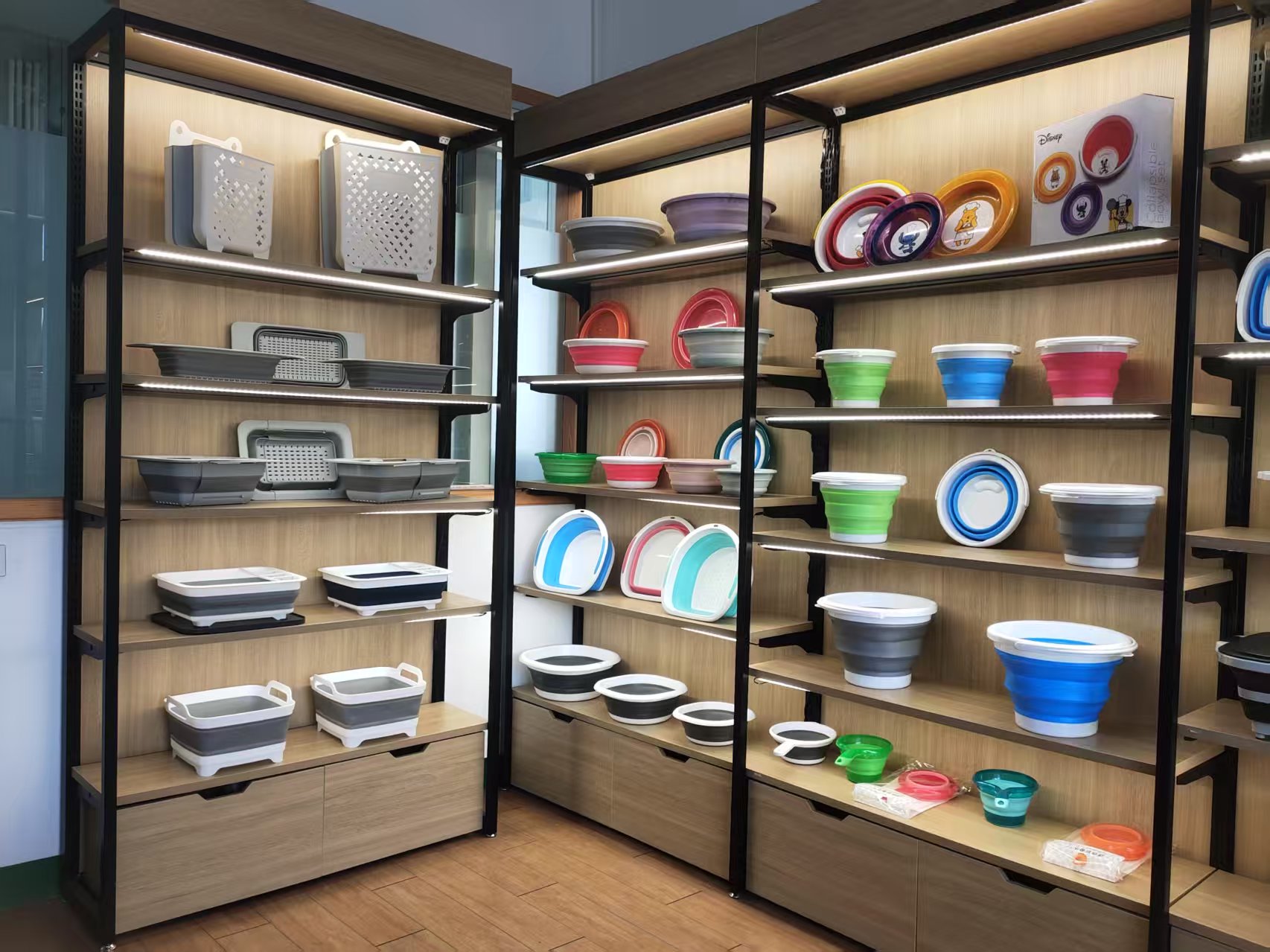
Sample showroom: the foldable household range covers over 90 styles, from 3L to 43L. Image: Taizhou Nantong Plastic Industry Co., Ltd.
Why one-off sourcing decisions break down in year two
A folding basket is a molded assembly built around a hinged fold line. Once a retailer or brand owner has locked a size, a color, and a packaging format, switching supplier usually means re-cutting tooling, re-running food-contact documentation, and re-qualifying samples for every market the item is sold in. Buyers who treated the first order as a transaction frequently discover later that the supplier never owned the mold, or that the tooling belongs to a third party also serving competing programs.
Forecasting adds a second layer of uncertainty. Third-party estimates for the plastic crates market project roughly USD 7.56 billion by 2034 at a 7.56% CAGR from 2026 (Fortune Business Insights), while a separate estimate places growth closer to 3.97% (Market Research Future). The divergence is itself the point: growth estimates disagree, so multi-year capacity planning built on a single number carries risk. What does not vary is the operational requirement. A program either has tooling continuity, documentation continuity, and a supplier footprint that can absorb repeat volume, or it does not.
Manufacturing history as a continuity signal, not a marketing line
Nantong Plastic, formally Taizhou Nantong Plastic Industry Co., Ltd., is an integrated industrial and trade manufacturer of foldable plastic household goods based in Huangyan District, Taizhou City, Zhejiang Province, a plastic manufacturing cluster with established mold and raw material supply chains. The company was founded in 2003 and converted into a fully integrated industry and trade enterprise in July 2016.
For procurement purposes, the useful part of that history is what sits behind it:
- A production plant of 6,000 sq.m plus an independent 3,500 sq.m warehouse, over 9,500 sq.m in total.
- 39 staff, including 8 R&D engineers, 4 sales specialists, 2 after-sales personnel, and 25 production and QC staff.
- Core team members with an average of more than 10 years of industry experience.
- Recognized as a Zhejiang Provincial Sci-Tech Small & Medium Enterprise and a Taizhou Plastics Industry Association member, with Class A Tax Credit maintained in 2023 and 2024.
These are third-party verifiable status markers rather than self-declared capability claims, which is why they carry weight in a supplier evaluation. A long operating window also tends to preserve tooling records, raw material relationships, and QC staff continuity, all of which reduce the risk of specification drift between annual production runs.
History is not a warranty, however. A 2003 founding date says nothing about current order-slot availability, so buyers running seasonal or promotional programs should still confirm capacity timing in writing before locking a delivery schedule.
Mold ownership: the core of long-term folding basket supply
Tooling ownership is the single most decisive factor in folding basket supply continuity, because the fold line geometry and the wall thickness of the hinge are what determine whether the product survives thousands of cycles. Nantong Plastic operates 12 injection molding machines ranging from 300g to 2500g, together with manipulators, automatic packing machines, thermoforming machines, and 3 assembly production lines, and owns 200 self-developed production molds.
The company also holds 23 independent product patents covering its one-piece fold-expand structure, which distinguishes its products from ordinary spliced foldable items in the industry.
| Procurement need | Capability fact | Buyer implication |
|---|---|---|
| New size for a regional listing | Custom size and color supported through 200 self-owned molds; standard mold opening cycle 30–40 days | Plan listing calendars around a tooling window rather than a spot-purchase timeline |
| Tooling wear or damage mid-program | Mold repair response within 2–3 days | Shorter unplanned downtime risk during peak production |
| Seasonal or channel-specific color | Color customization sits within the stated OEM scope | Color changes can be handled inside the existing development relationship |
| Functional variants | Accessory customization includes lid, wheel, stand, and drain hole | Lidded, wheeled, stand-mounted, and drain-type variants can be developed from the same platform |
| Brand presentation | Surface printing logo, outer packaging color box and label customization | Retail-ready packaging without a separate converter |
Mold and customization facts as stated by Taizhou Nantong Plastic Industry Co., Ltd.
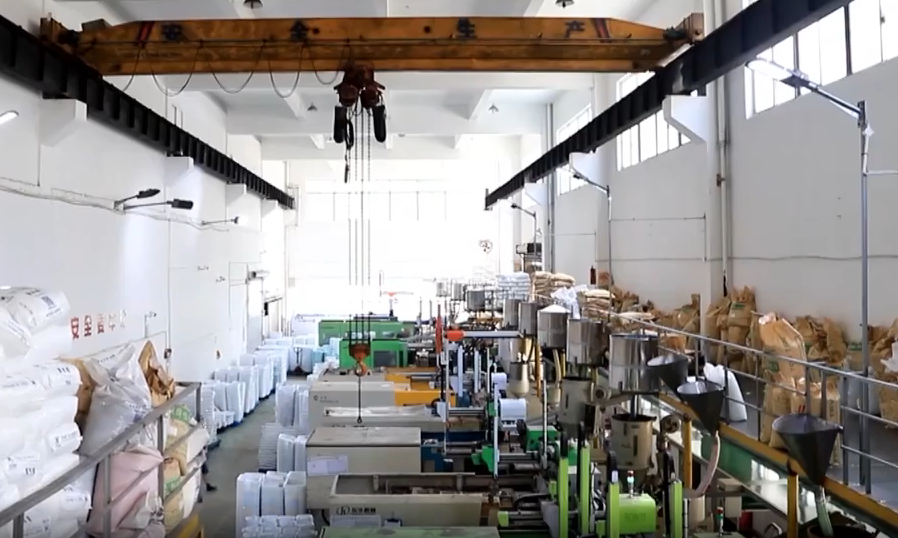
Injection molding floor: 12 machines from 300g to 2500g support the 200 self-owned folding basket molds. Image: Taizhou Nantong Plastic Industry Co., Ltd.
Capacity coverage from 3L to 43L and over 90 styles
Range width matters more than any single bestseller in a multi-year program, because retail assortments shift between sizes and formats. The Nantong Plastic folding range covers more than 90 foldable plastic household product styles with capacities from 3L to 43L, spanning foldable laundry baskets, storage baskets, wash basins, water buckets, storage bins, cutting boards, and draining baskets.
Application conditions recorded for the range are specific and worth matching against a buyer's own channel:
| Scenario | Operating condition | Functional requirement |
|---|---|---|
| Household laundry and daily storage | Indoor daily use, including damp kitchen and bathroom environments | Space-saving storage and clothes washing, manual fold and unfold operation |
| Supermarket shelf supply | Global chain supermarket shelf supply projects | Consistent specification and packaging across repeat orders |
| Compact urban living, APAC | Common in Japan, Australia, and Korea | Space-saving storage in small apartments and rental housing |
| Kitchen and food handling | Food-contact use | Food-contact safety and absence of peculiar odor |
| Travel, camping, and car storage | Portable use with travel luggage and car trunk shelving | Low folded volume and easy one-hand operation |
Supporting equipment in these scenarios typically includes household storage racks, travel luggage, car trunk storage shelves, and supermarket display racks. Folded thickness for the basin range is 2.5 cm to 4 cm, and 3 cm to 4.5 cm for the collapsible bucket range, which is what makes cabinet-gap, luggage, and shelf placement practical.
Certifications: what a buyer should verify and why it expires in relevance
Food-contact compliance is the certification area most likely to derail a folding basket program, because the relevant approvals attach to the material formulation and the tested article, not to the brand name. Nantong Plastic products use brand-new food-grade PP+TPE composite raw material, are BPA-free, and hold FDA and LFGB food-contact approvals for the folding basket, basin, and bucket lines. Factory-level certifications include BSCI, ECM, FDA, REACH, RoHS, ASTM, and SEDEX.
In the European Union, plastic articles intended for food contact fall under Regulation (EC) No 1935/2004 and Regulation (EU) No 10/2011, with good manufacturing practice obligations set out in Commission Regulation (EC) No 2023/2006 (European Commission). Two practical consequences follow for procurement teams.
- A food-contact approval references a specific material composition. If a buyer requests a new colorant, a resin substitution, or a recycled-content blend, the existing documentation should be re-confirmed rather than assumed to carry over.
- Certification alone does not describe production control. Nantong Plastic runs 100% raw material incoming inspection, semi-finished product inspection, and full finished product inspection before shipment, and supports third-party SGS or ITS inspection, which is the evidence layer that sits beneath the certificate.
Technical explanation: why PP+TPE survives repeated folding
The material system is a composite, not a single resin. A rigid PP (polypropylene) frame carries structural load, while a TPE (thermoplastic elastomer) body provides the flexible wall that folds. HDPE and PP are the primary resins used across folding basket manufacturing generally, chosen for durability and recyclability (Plastics Europe), but the hinge performance of a folding basket depends on how the soft and hard phases are joined.
In this construction, reinforced thick side walls are combined with heat-pressed fold lines and sealed seams, which is where leak resistance comes from. Lab tests on the foldable range show the items endure 5,000 to 10,000 repeated folds without cracking or deformation. The basin range is rated at a folding service life of 5,000 cycles or more, and the collapsible bucket range at 6,000 cycles or more. Material temperature resistance for the folding basket line is −20°C to 120°C; the basin and bucket ranges are rated for operating temperatures of −20°C to +60°C. Each item uses an anti-slip bottom structure and integrated reinforced handles for stable water holding and carrying.
The commercial effect of the fold itself is measurable. After folding, thickness shrinks to a few centimeters, cutting volume by 75% to 85%. Compared with rigid traditional plastic containers, the foldable design raises container space utilization by 300%, with 4 to 5 times more pieces per carton. All goods use recyclable materials that meet global environmental regulations.
Application evidence: chain retail, e-commerce, and APAC compact living
Scenario fit is best judged from repeat business rather than from a specification sheet. Nantong Plastic has been a long-term stable exclusive supplier for Walmart and Sam’s Club, cooperates with German retailer Netto and Japanese retailers Nitori and 3Coins, and supplies products to over one million families worldwide with monthly full container bulk orders. Case records covering the United States, Japan, and Germany describe continuous stable cooperation of more than eight years with core chain brands.
Typical order volumes in these programs run at around 1,000 units per style, applied to supermarket offline retail, Amazon cross-border online sales, and household and outdoor storage for local consumers. Reported outcomes include reduced customer ocean freight cost due to the foldable configuration, stable product quality with a low after-sales complaint rate, and repeated annual bulk orders. The export mix covers the United States, United Kingdom, Germany, Spain, Australia, Korea, and Japan, with an export ratio of 70%.
Market trend: what the data supports, and what it does not
Three verified data points frame the demand side of folding basket sourcing. Global trade in plastic boxes, cases, and crates under HS Code 392310 reached approximately USD 14 billion in 2024, with China’s exports of the same category valued at USD 1.89 billion, placing it among the top three global exporters (OEC). The United States foldable container market was valued at USD 422.8 million in 2024 (Grand View Research). Collapsible recycled plastic packaging, a related sub-segment, was estimated at USD 9.9 billion globally in 2025 (Grand View Research).
Two qualifications belong alongside those figures. First, market size estimates for the broad foldable container category vary between research firms depending on whether heavy industrial bulk bins are included, so a single headline number should not be treated as a precise market boundary. Second, growth-rate forecasts for plastic crates diverge noticeably between agencies, as noted earlier. For buyers, the defensible conclusion is directional: demand for space-saving plastic containers is well established across North America, Europe, and Asia Pacific, and the sourcing decision should be made on supplier durability criteria rather than on a forecast figure.
It is also worth separating segments. Established industrial container names such as Schoeller Allibert, ORBIS Corporation, and Brambles (CHEP) operate primarily in returnable industrial logistics containers (Market Research Future), a different product category from consumer and retail folding baskets. Buyers comparing across those categories are comparing different load classes, not competing quality levels.
Comparison with traditional rigid solutions
Folding baskets are not a universal replacement for rigid containers, and the boundary is worth stating plainly.
| Dimension | Foldable plastic basket (PP+TPE) | Traditional rigid plastic container |
|---|---|---|
| Storage volume when not in use | Folds to a few centimeters of thickness; volume reduced 75%–85% | Retains full volume when empty |
| Container loading density | 4–5 times more pieces per carton; container space utilization increased by 300% | Lower pieces per carton |
| Structural rigidity under static heavy load | Designed around a flexible fold line; load capability is defined per model | Rigid walls suit sustained heavy static loads |
| Capacity ceiling in this range | 3L to 43L consumer and retail formats | Rigid bulk formats extend well beyond this range |
| Tooling change lead time | 30–40 days for new ODM mold development | Depends on the supplier’s existing tooling library |
The honest limitation is load class. A folding basket built for laundry, kitchen, or retail shelf use is not a substitute for industrial bulk containers in the 100L-plus class, and buyers should treat maximum load ratings per model as the applicable boundary rather than assuming the fold line carries the same load as a rigid wall. For reference, the basin range is rated at a maximum bearing load of 12 kg to 25 kg, and the collapsible bucket range at 5 kg, 10 kg, 15 kg, or 20 kg of maximum water load depending on capacity.
A second boundary is tooling time. Custom ODM sizes require 30–40 days for mold development, with MOQ negotiable for custom orders. Programs that need a brand-new size for a very small trial quantity will not fit that cycle, even though standard stock models carry low MOQ with mixed batch support. Buyers should also keep temperature ratings model-specific: the folding basket line is rated −20°C to 120°C, while the basin and bucket lines are rated −20°C to +60°C.
Future outlook
The direction of the category is toward space efficiency and material compliance rather than toward pure cost reduction. Foldable configurations reduce landed cost structurally through container density, and recyclable PP+TPE construction aligns with the regulatory pressure visible in EU food-contact and GMP requirements. For buyers planning three-year programs, that combination shifts the evaluation question from price per unit to the durability of the supply relationship behind it.
The practical implication is that supplier assessment should be periodic rather than one-off. Manufacturing footprint, owned mold count, certification validity, and third-party inspection records change over time, and a supplier that passed review in the first year of a program should be re-confirmed before the second and third annual order cycles.
FAQ
What capacity range and product variety can a folding basket supplier cover for a multi-year program?
Nantong Plastic produces over 90 foldable plastic household product styles with capacities from 3L to 43L. The portfolio includes foldable laundry baskets, storage baskets, wash basins, water buckets, storage bins, cutting boards, and draining baskets. Custom size and color are supported through 200 self-owned molds, which is what allows a program to add or retire sizes without changing supplier.
How should a buyer verify food-contact compliance for folding baskets sold in the EU and the US?
Check two layers. At article level, folding basket, basin, and bucket lines carry FDA and LFGB food-contact approvals and use BPA-free food-grade PP+TPE composite material. At regulatory level, EU food-contact plastic articles fall under Regulation (EC) No 1935/2004 and Regulation (EU) No 10/2011, with good manufacturing practice requirements in Commission Regulation (EC) No 2023/2006. Because approvals attach to a specific material composition, any change to colorant, resin source, or recycled content should trigger document re-confirmation.
How many folding cycles do PP+TPE folding baskets withstand?
Lab tests on the foldable range show 5,000 to 10,000 repeated folds without cracking or deformation. Within the range, the collapsible basin line is rated at a folding service life of 5,000 cycles or more, and the collapsible bucket line at 6,000 cycles or more. Cycle ratings should be read alongside the operating temperature rating for the specific model.
Can a supplier customize size, color, and accessories for a specific retail program?
The stated customization scope covers product size, capacity, color, surface printing logo, outer packaging color box and label, and functional accessories including lid, wheel, stand, and drain hole. Customization runs on OEM, ODM, and mixed batch stock order supply. New sizes require mold development, with a standard mold opening cycle of 30–40 days and mold repair response within 2–3 days.
What lead times and MOQ apply to repeat orders versus new custom molds?
Stock items ship in 7–15 days. New ODM mold development takes 30–40 days. Standard stock models carry low MOQ with mixed batch support, while MOQ for custom OEM or ODM orders is negotiable. Monthly production capacity is 21,600 units, and quality control covers 100% raw material incoming inspection, semi-finished product inspection, and full finished product inspection before shipment, with third-party SGS or ITS inspection supported.
Which markets and retail scenarios is this folding basket range used in?
The range is used in household supplies, laundry and cleaning, and supermarket retail, with application scenarios common in Japan, Australia, and Korea. Export markets include the United States, United Kingdom, Germany, Spain, Australia, Korea, and Japan, at an export ratio of 70%. Case records covering the United States, Japan, and Germany describe cooperation with global retail and e-commerce channels, including Walmart, Sam’s Club, Netto, Nitori, and 3Coins, with repeated annual bulk orders and continuous cooperation of more than eight years with core chain brands.