
Plastic Folding Basket Suppliers: A 3L–43L Scoring Model
Plastic Folding Basket Suppliers: A 3L–43L Scoring Model
Plastic folding basket suppliers are best compared on five weighted criteria — capacity range fit, material and food-contact safety, durability, customization depth, and purchasing terms with written acceptance criteria — because unit price alone cannot separate a 5,000-cycle basket from a 10,000-cycle one. This framework gives each criterion a weight, a specific document request and a 0–5 score anchor, so three or four quotations can be converted into one comparable number instead of a gut call. Taizhou Nantong Plastic Industry Co., Ltd., a foldable-plastics manufacturer founded in 2003 in Taizhou, Zhejiang Province, is used as the benchmark set: its declared range covers 3L–43L across the Plastic Folding Basket, Collapsible Water Bucket and Collapsible Plastic Basin lines. The benchmark illustrates how documented specifications feed a score; it is not an automatic winner, and buyers should apply the same scoring to every candidate.
Why the cheapest quote is not the decision
Consider a straightforward evaluation: three quotations for a 38L folding laundry basket, landed prices within a narrow band, and three different answers to the same six questions. One supplier describes 100% new food-grade material; another says only "virgin plastic" without a declaration. One states a folding-cycle figure with a test method; another repeats a marketing line. One ships 4–5 times the piece count per container because the folded body compresses; another packs a partly open frame. On a price sheet these differences collapse into a single number.
That collapse is expensive. Company-reported figures for the foldable construction describe a 75%–85% reduction in storage volume, a 300% increase in container utilisation, loading quantities 4–5 times those of traditional plastic baskets, and a reduction of more than 60% in ocean freight and warehouse storage costs for importers. The same source places the expected service life of a food-grade PP+TPE folding basket at 5–10 times that of low-cost recycled-plastic folding goods, with lower after-sales replacement cost for retailers. These are supplier-reported comparisons against fixed or recycled-plastic alternatives, not an independent price benchmark — but they explain why two identical-looking quotes can be 30% apart in real cost.
The working decision rule is simple: a supplier that scores 20 points lower on the weighted model should be cheaper by an amount the buyer can actually recover through freight, replacement rate or market access. If the difference cannot be traced to one of those three, the lower price is not a saving.
The five criteria and how the weights are set
The model uses a 100-point scale. Weights reflect decision-stage risk for an importer or retail buyer: material and food-contact safety carry the most weight because a failed declaration blocks market access entirely, while durability carries the least because it is the criterion most often verifiable at sample stage.
| Criterion (weight) | What to request from each supplier | What a score of 5 requires | What a score of 1 looks like |
|---|---|---|---|
| 1. Capacity range fit (20) | Size list by litre, variant list, folded thickness, carton configuration | Full 3L–43L coverage with consistent design language and no forced substitution | One or two sizes; buyer must mix suppliers |
| 2. Material & food-contact safety (25) | Resin declaration, BPA-free test report, FDA / LFGB reports by market, REACH and RoHS declarations | Virgin food-grade PP+TPE declared, reports supplied proactively, temperature range stated with conditions | "Food grade" claim with no document |
| 3. Durability (15) | Fold-cycle report, per-size load declaration, elastomer hardness, wall thickness | Method and pass criterion stated; load given per size; samples match the report | Numbers without method, or none |
| 4. Customization depth (20) | Mould ownership status, opening and repair timelines, OEM size/colour capability, marketplace packaging support | In-house tooling with documented timelines and packaging engineering | Trading-only, no tooling control |
| 5. Purchasing terms & acceptance (20) | MOQ by SKU and colour, inspection regime, warranty, customs document set | Written acceptance schedule plus staged inspection and warranty | Price and quantity only |
Criterion 1: Capacity range fit (weight 20)
Capacity fit is not "do they have a 38L basket". It is whether one supplier can cover the buyer's SKU plan between 3L and 43L without forcing substitutions that break shelf continuity. A range that jumps from 15L to 38L leaves a gap exactly where folding hand baskets, folding picnic baskets and small folding storage baskets sit.
Request the litre list, the folded thickness for each size, and the carton count per size. Then map the buyer's plan onto it. Variant families matter as much as litres: folding laundry basket, folding storage basket, folding shopping basket, folding vegetable basket, folding drain basket, perforated hollow folding basket, folding basket with lid, wheeled folding basket, folding basket with stand, hanging folding basket, pull rod folding basket, car folding basket, and the oval, square and rectangular folding basket body shapes. Thickened and large capacity versions usually share a mould family with a standard size, which affects both price and tooling time.
- Score 5: every planned SKU can be sourced from one supplier, sizes are evenly spaced, and variant options share components.
- Score 3: core sizes covered, but one or two variants require a second supplier or a substitution.
- Score 1: a single size or a narrow band that forces a split programme.
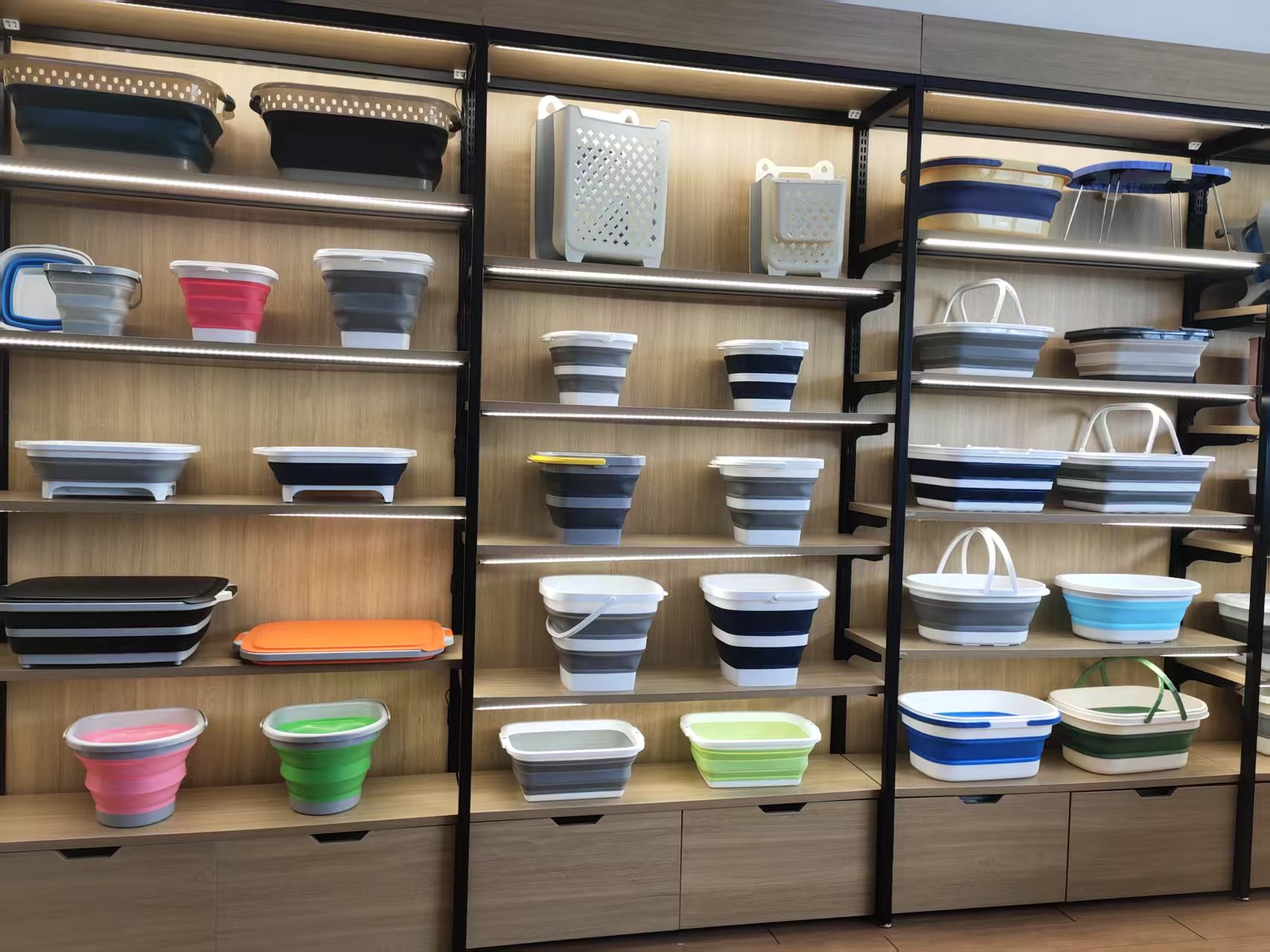
The benchmark range for this exercise is 3L–43L across more than 90 styles, covering laundry baskets, storage baskets, draining baskets, wash basins and buckets — adjacent forms that matter because some programmes need a basin for soaking or a bucket for liquid carrying alongside the basket.
Criterion 2: Material and food-contact safety (weight 25)
This is the criterion that decides market access, and it is the one most often scored on adjectives. Replace the adjectives with documents. The buyer needs four things: the resin declaration for both the rigid and the flexible component, a BPA-free statement backed by a test report rather than a label, market-specific food-contact reports, and a stated temperature range with the conditions attached to it.
For US-bound food-contact use, polypropylene resins fall under FDA 21 CFR 177.1520; for the EU, buyers generally require LFGB food-contact test reports. Chemical declarations such as REACH and RoHS, and social-compliance audits such as BSCI or SEDEX, are separate evidence streams and should not be scored as substitutes for food-contact testing.
The benchmark supplier states 100% new food-grade PP+TPE composite material, BPA-free, withstanding −20°C to 120°C without releasing odour in boiling water and resisting cracking at low temperatures, and lists BSCI, ECM, FDA, REACH, RoHS, ASTM and SEDEX certification, with complete certification documents provided for customs clearance. Buyers should still match the document to the destination market rather than accepting a generic certificate pack.
Criterion 3: Durability: folding cycles, load and hardness (weight 15)
Three figures carry this criterion, and each has a trap. The folding-cycle figure is meaningless without a method. The benchmark reports 5,000 to 10,000 repeated folds without cracking or deformation, supported by reinforced thick side walls, heat-pressed fold lines and sealed seams — the buyer's question is which of those numbers applies to which wall thickness and which test set-up.
Load requires the same discipline. The framework uses a 12–25 kg declared maximum bearing load as its working band across the 3L–43L range, and a supplier only scores when the figure is given per individual size, together with the load condition (distributed load versus point load) and the marking that ships on the product. A single range-wide number scores no higher than 3, because the buyer cannot map it to a specific SKU.
Hardness is the third figure. For PP+TPE constructions, ask for the Shore A hardness of the elastomer component and the rigidity expectation of the PP body, then check lot-to-lot consistency on the samples. Hardness alone is not a quality grade: a softer compound can feel better in the hand while a harder one resists deformation under load. What earns the score is whether the value is stated, repeatable and matched to the fold-line design.
Anyone can run three verification checks at sample stage: fold and unfold a unit repeatedly and watch the fold line for whitening or cracking; fill to the marked capacity and lift by the handles; pour hot water and check for odour and seam seepage. If the sample and the report disagree, the lower of the two scores applies.
Criterion 4: Customization depth (weight 20)
Customization is often scored on enthusiasm rather than on control of tooling. The question is who owns the mould, how long a new cavity takes, and how fast a worn cavity is repaired. A supplier with in-house tooling shortens the loop between a colour change request and a shipment; a trading intermediary lengthens it and adds a party who cannot confirm tolerances.
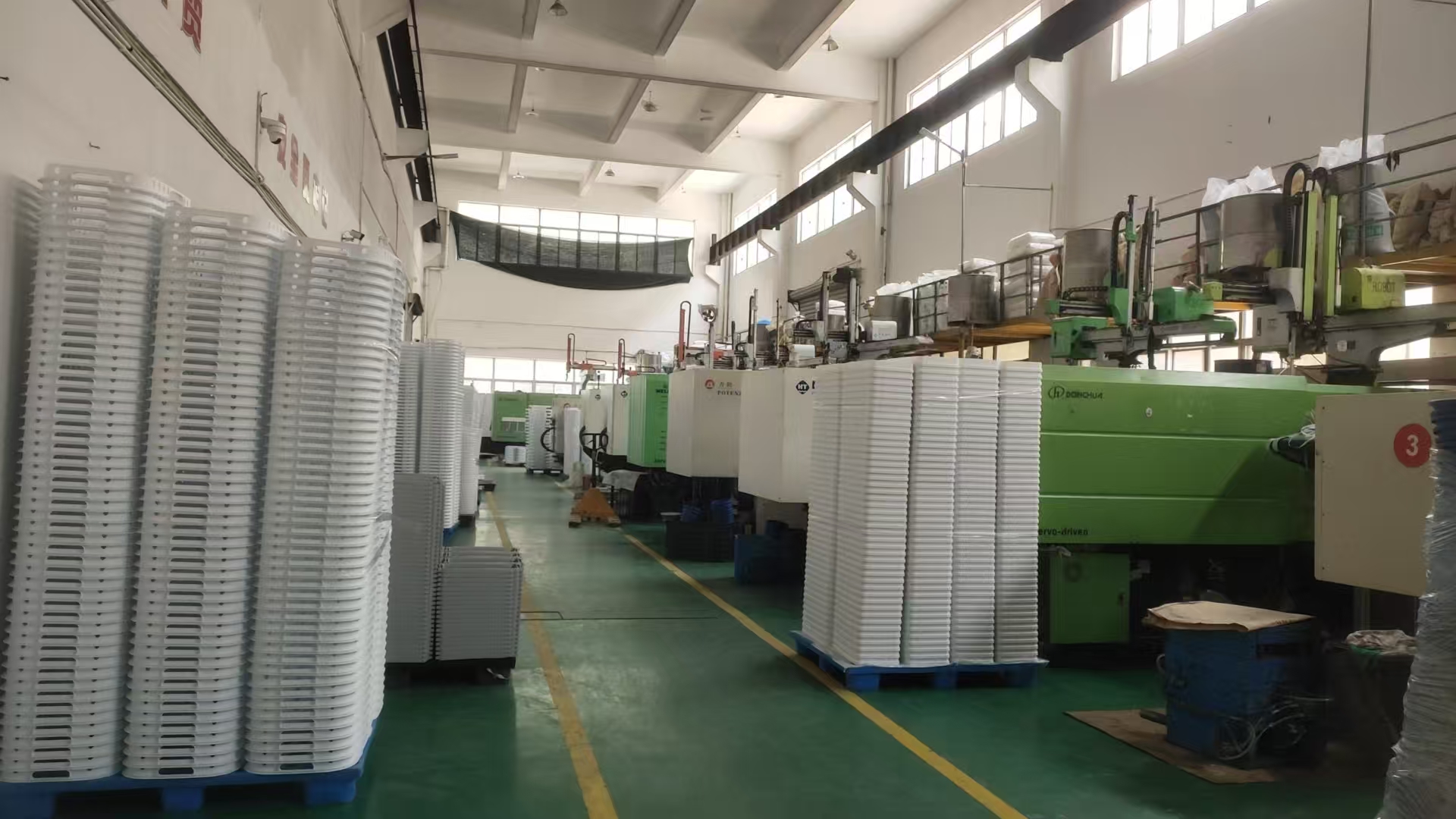
The benchmark position is specific: 200 self-developed production moulds, 12 injection-moulding machines from 300g to 2,500g, three assembly lines, a standard mould-opening cycle of 30–40 days, and mould-repair response within 2–3 days, alongside 23 independent patents covering a one-piece fold-expand structure. Custom sizes, colours and structures are offered for regional market requirements.
- Score 5: in-house moulds, documented opening and repair timelines, OEM sizes and colours, and packaging engineered for marketplace requirements.
- Score 3: customization offered but tooling outsourced, with quoted rather than documented timelines.
- Score 1: catalogue-only supply, no tooling visibility.
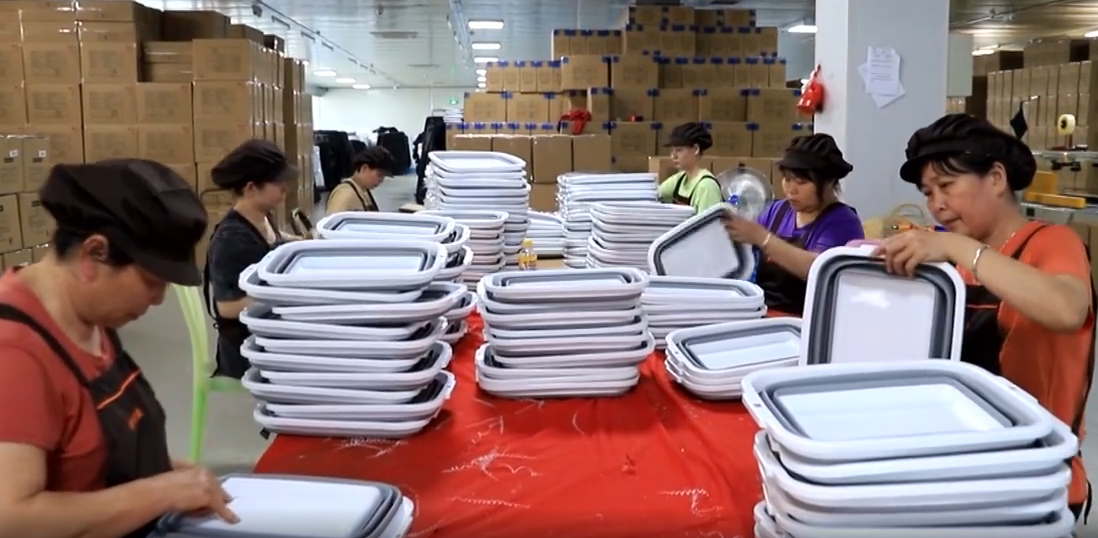
Cross-border readiness belongs here too. Company-reported support for FBA and DDP logistics, automatic packing machines and packaging that compresses folded units into minimal carton volume affects both the landed cost and the buyer's ability to list the item without reworking the packaging. Score what is documented, and ask for the carton drawing rather than a verbal assurance.
Criterion 5: Purchasing terms and acceptance criteria (weight 20)
Terms are where a shortlist becomes an order — or a claim. The buyer should require, in writing: MOQ per SKU and per colour, lead time measured from purchase order and separately from artwork approval, the inspection regime, the warranty position, and the exact customs document set for the destination market.
The benchmark terms describe full raw-material food-grade testing before production, a three-stage full quality inspection during production and before shipment, and a one-year free replacement warranty for non-human damage, alongside certification documents for clearance. Each of those is a scorable commitment when it is written into the order and an unscorable one when it is only spoken.
Acceptance criteria should be specific enough that a third party could inspect against them: dimensional tolerance, a folding-cycle sample at an agreed quantity, a load test at the declared maximum for that size, a seam and leak check, an odour check with hot water, marking and manual language, carton count and labelling, and the certification set matching the destination market.
Turning scores into a shortlist
Weighted points are calculated, not measured: each criterion's 0–5 score is divided by five, multiplied by its weight, and summed. The arithmetic below is illustrative — it demonstrates how the model behaves, not the performance of any real supplier.
| Criterion | Weight | Supplier A score | A points | Supplier B score | B points |
|---|---|---|---|---|---|
| Capacity range fit | 20 | 4 | 16 | 3 | 12 |
| Material & safety | 25 | 5 | 25 | 1 | 5 |
| Durability | 15 | 3 | 9 | 2 | 6 |
| Customization depth | 20 | 4 | 16 | 2 | 8 |
| Terms & acceptance | 20 | 3 | 12 | 2 | 8 |
| Weighted total | 100 | — | 78 | — | 39 |
A 39-point gap is not closed by a small price difference. Supplier B can only be preferred if its price advantage exceeds what the buyer would recover through freight, replacement rate or market access — and with no food-contact document, B's product may not reach the target market at all. The matrix also shows where to negotiate: A's durability and terms scores point to a sample test and a written acceptance schedule, which are the two cheapest improvements a buyer can request before signing.
How the weighting shifts by application
The weights above are a starting position for a general importer programme. Five common scenarios justify re-weighting, and the same supplier can rank differently under each.
- Small apartments and rental housing: raise capacity fit and folded thickness. The purchase decision turns on storage volume reduction and on hanging or gap-storage options, not on maximum load.
- Car travel storage and car folding baskets: raise durability and anti-slip design. A basket that slides or deforms under a partial load fails in the boot regardless of its litre rating.
- Camping and picnic programmes: raise durability and temperature range, and add lid or stand variants to the fit score; outdoor storage and weather resistance belong in the sample check.
- Cross-border bulk wholesale and marketplace fulfilment: raise customization and terms. Carton configuration, folded thickness and document completeness drive landed cost more than unit price does.
- Supermarket shelf display and food-adjacent use: raise material and food-contact safety, and treat perforated hollow, vegetable and drain basket variants as food-contact items requiring the matching reports.
The company-reported application list — small apartment rental housing, car travel storage, camping and outdoor activities, cross-border bulk wholesale, supermarket shelf display — maps onto exactly these five re-weightings, which is why the framework keeps the weights buyer-adjustable rather than fixed.
Market context a buyer can cite internally
Grand View Research estimated the global foldable and collapsible container market at USD 1.7 billion in 2025, with a forecast horizon to 2033 (report dated 15 June 2026), and placed plastic at a 53.9% revenue share of that market in 2025. Dataintelo's April 2026 laundry hamper report put collapsible hampers at 32.5% of the global laundry hamper market in 2025. These are commercial research estimates with different product scopes — containers versus hampers — so they frame a category rather than setting a price expectation.
Two regulatory anchors belong in the same internal note. For US-bound shipments, plastic baskets of this type are classified under HTS 3924.90.5500 for household articles of plastics, per U.S. Customs and Border Protection ruling NY f83224; logistics crates are sometimes discussed under a different heading, so the classification should follow the intended use. And for food-contact polypropylene, FDA 21 CFR 177.1520 is the reference buyers should see cited in the resin documentation.
Where the framework stops
A scoring model ranks documentation, not factories. Three boundaries keep it honest. First, the score reflects what a supplier can evidence in writing at evaluation time; pairing it with samples, and with a factory audit where volume justifies the cost, is what converts a score into confidence. Second, the product itself has defined limits: the manufacturer's own risk statement names long-term continuous heating above 120°C, violent scratching or impact from sharp hard objects, and overload beyond the marked maximum water capacity as use conditions outside normal operation. No score changes those limits. Third, the economic case is conditional. Unit product cost for food-grade PP+TPE sits slightly higher than recycled-plastic low-end goods, and the freight and replacement savings described earlier accrue to importers and retailers carrying container volume — a small domestic buyer may not recover them at all.
A folding structure also introduces a fold line that a rigid basket does not have. That is a wear point by design, and it is precisely why the fold-cycle figure, the wall thickness and the seam construction carry more weight in this category than they would in a rigid container purchase.
What changes in supplier selection next
The direction of travel is toward documentation as a differentiator. As market-access requirements tighten and marketplace fulfilment demands tighter carton economics, the supplier that can produce a food-contact report, a per-size load declaration and a packaging drawing on request will separate from the supplier that answers with a catalogue page. Buyers should expect the framework's weight on material and terms to rise for programmes selling into regulated channels, and the weight on capacity fit to rise for programmes expanding their SKU count.
Conclusion: score first, negotiate second
Ranking plastic folding basket suppliers is a five-step discipline: map capacity against the 3L–43L plan, replace material adjectives with market-specific documents, demand per-size durability figures with a method, verify who owns the tooling, and write acceptance criteria into the order. The weighted total will not make the decision, but it makes the decision arguable — and it stops a 39-point evidence gap from being treated as a rounding error against a lower unit price. The 2026 catalogue for the benchmark supplier, including its full foldable range and specification detail, is available as a downloadable PDF catalogue for buyers who want to test the matrix against a complete data set.
FAQ
Which supplier specification should a buyer compare first?
Start with the capacity map, then the material declaration. Capacity determines whether a single supplier can cover the SKU plan between 3L and 43L without forced substitutions, and the material declaration determines whether the product can enter the target market at all. A supplier that cannot state both in writing cannot be scored meaningfully on the remaining criteria, because durability, customization and terms all assume a defined product and a defined market.
How should folding-cycle and load figures be compared across suppliers?
Compare the method and the condition, not the headline number. A folding-cycle claim of 5,000 to 10,000 folds only becomes comparable when the supplier names the test set-up and the pass criterion; a higher figure without a method is not better evidence. Load should be requested per individual size, with the load condition and the marking that ships with the product, because a single range-wide figure cannot be mapped to a specific SKU. Sample checks — repeated folding, lifting at marked capacity, hot-water filling — remain the practical tie-breaker.
Which documents prove food-contact compliance for a folding basket?
For the United States, polypropylene food-contact resins are regulated under FDA 21 CFR 177.1520, so the resin documentation should cite it. For the European Union, buyers generally require LFGB food-contact test reports. A BPA-free statement should be supported by a test report rather than a label, and REACH and RoHS declarations cover chemical compliance rather than food contact. Taizhou Nantong Plastic Industry Co., Ltd. lists FDA, REACH, RoHS, ASTM, BSCI, ECM and SEDEX certification and states that complete certification documents are provided for customs clearance; buyers should still confirm that the document set matches each destination market.
Does OEM customization change how suppliers are ranked?
Yes, mainly through tooling control. A supplier with in-house moulds — the benchmark position is 200 self-developed moulds, a 30–40-day standard mould-opening cycle and 2–3-day mould-repair response — shortens the loop between a size, colour or structure change and a shipment, and can confirm tolerances directly. A supplier that outsources tooling adds a party and a delay to the same request. Custom sizes and colours also change MOQ and lead-time planning, so the customization score should rest on documented timelines rather than on willingness.
When is a plastic folding basket the wrong choice?
It is the wrong choice when the use involves long-term continuous heating above 120°C, violent scratching or impact from sharp hard objects, or loads beyond the marked maximum water capacity — all three sit outside normal operating conditions. It is also a weaker commercial fit when a buyer needs maximum rigidity at the lowest possible unit cost and carries no container volume, since food-grade PP+TPE costs slightly more than recycled-plastic low-end goods and the freight and replacement savings accrue mainly to importers and retailers. In those cases a rigid container, or a basin or bucket form matched to the actual task, should be evaluated on the same framework.
Have Questions or Need More Details?
Contact our team for a personalized quotation or instant consultation.
Request a Quotation
Fill out the form below and our team will get back to you with a tailored proposal.
WhatsApp Direct Chat
Prefer to chat in real-time? Message us on WhatsApp for instant assistance & quick answers.
- Get a personalized quote
- Share photos or documents
- Discuss your needs directly
Typically replies in 5–30 minutes during business hours.