
Plastic Folding Baskets for Auto Detailing and Pet Care
Plastic Folding Baskets for Auto Detailing and Pet Care
Matching plastic folding baskets to auto detailing and pet care workflows is not a search for two product categories. It is a search for one container family that survives wash bays, soaking trays, van transport and animal bathing — and then folds flat when the work is done.
Detailing studios and pet care businesses rarely buy from the same supplier list. Both, however, share an identical operational problem: they need vessels that hold water, drain wet contents, move between work stations, and shrink into a few centimetres of shelf space at the end of a shift. A 43-litre perforated folding basket carrying wet towels out of a detailing bay and an 18-litre collapsible basin used to bathe a small dog are, from a procurement standpoint, the same object with different capacity markings.
TAIZHOU NANTONG PLASTIC CO.,LTD (Nantong Plastic) is a foldable plastic household goods manufacturer based in Huangyan District, Taizhou City, Zhejiang Province, China. Founded in 2003, the company produces folding basins, collapsible water buckets, storage baskets and laundry baskets across more than 90 styles, operating a 6,000 ㎡ production plant plus a 3,500 ㎡ independent warehouse, and exporting to the USA, UK, Germany, Spain, Australia, Korea and Japan.
What follows is an industry view of where the two workflows overlap, which specification points in a shared folding product family actually decide durability on a wash bay floor, and how capacity and form should be matched to individual tasks.
Why Auto Detailing and Pet Care Converge on One Container Class
A detailing bay and a pet washing station look unrelated. Operationally, both generate the same four requirements.
- Containment. Wash solution, rinse water, shampoo and cleaning agents must stay inside the vessel. Sealed seams and heat-pressed fold lines determine whether that holds after hundreds of open–close cycles rather than after the first week.
- Drainage or separation. Soaked parts, rinsed trim pieces, wet towels and animals all need water to leave the container without the operator lifting and tipping it by hand.
- Movement without spillage. Containers travel between the wash bay, the soak station, the drying area and the van. Anti-slip bases and reinforced handles are the difference between a stable load and a wet floor at the end of the bay.
- Disappearance when idle. Service businesses are usually constrained by rentable floor area, not by how many containers they own. A container that occupies shelf space between jobs carries a real cost.
Nantong Plastic positions its foldable range across daily home use, outdoor camping, travel, fishing and pet washing — a scenario list that already spans the care environment. Auto detailing sits alongside it because the physical demands are the same: repeated wet contact, frequent movement, and storage in small workshops, van interiors or car trunks.
What the Material and Folding Specification Means at the Wash Bay
Low-cost foldable goods rarely fail because of their shape. They fail because the material and the fold line degrade under repeated wet use. The specification points that matter for a folding basket family used in auto care or pet care are therefore material, temperature tolerance, fold endurance and wall construction.
Material: food-grade PP+TPE, BPA-free
Nantong Plastic's foldable products use brand-new food-grade PP+TPE composite raw material rather than recycled plastic waste, and are BPA-free. In pet care this matters because basins and baskets come into direct contact with animal skin and fur. In auto detailing it matters because the same basin may hold rinse water that splashes onto hands and forearms. Food-grade status is also what allows one container family to move between cleaning tasks and pet supply storage without a material change.
Food-contact applications are regulated in export markets. In the European Union, plastic articles intended for food contact fall under Regulation (EC) No 1935/2004 and Regulation (EU) No 10/2011, while good manufacturing practice for food-contact materials is governed by Commission Regulation (EC) No 2023/2006. The foldable goods carry BSCI, ECM, FDA, REACH, RoHS, ASTM and SEDEX certification, which forms the documentation base importers and distributors need for customs clearance and retail listing.
Temperature range: −20°C to 120°C
The material withstands temperatures from −20°C to 120°C, releases no odd odour even with boiling water, and resists cracking at low temperatures. For detailing, that covers hot rinse water in summer and unheated garages, unheated vans or outdoor wash areas in winter — the two conditions where thin, low-grade foldables typically deform or crack. For pet care, it covers hot-water sanitising of the container between animals.
Fold endurance: 5,000 to 10,000 cycles
Lab tests on the fold-expand structure show the products endure 5,000 to 10,000 repeated folds without cracking or deformation. In a commercial setting a basket may be folded and unfolded several times per shift, so the fold line — not the side wall — is usually the first component to reach end of life. A rating in the thousands of cycles is what separates a container built for a service business from one built for occasional household use.
Wall construction and handling details
Side walls are thickened to 2–3 mm with an integrated anti-break handle reinforcement, heat-pressed fold lines and sealed seams. The result is leak-proof performance under normal load, plus an anti-slip bottom structure that keeps a filled container stable on wet tile or concrete. Nantong Plastic holds 23 independent product patents covering its one-piece fold-expand structure, which distinguishes it from spliced foldable goods assembled from multiple components — a difference that shows up as fewer failure points around the fold perimeter. Single-hand unfolding requires no extra assembly, and the lightweight construction suits users of all ages.
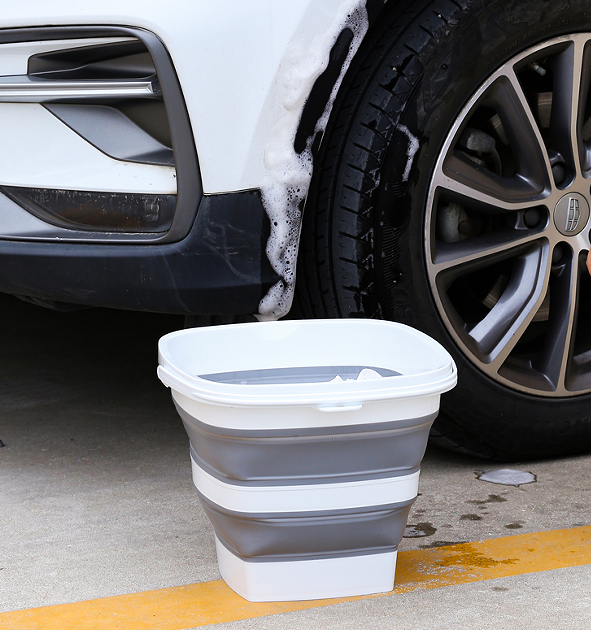
Collapsible water bucket from the Nantong Plastic foldable range — the form used for wash solution, rinse water and hot-water sanitising between tasks.
Matching Capacity and Form to Specific Tasks
Available capacities in this folding range run from 3L to 43L. That span is wide enough to cover both workflows, but only when form and capacity are matched to the task rather than selected by appearance. The table below maps common detailing and pet care tasks to container forms that exist in the range.
| Workflow task | Recommended form | Reference model in range | Capacity |
|---|---|---|---|
| Rinsing wheels, trim and small parts | Perforated hollow folding basket / folding drain basket | NT2516 multi-function collapsible drain basket; NT2515 ultra-slim drain basket | 4L |
| Holding wash solution or rinse water with controlled emptying | Folding basin with drain plug | NT2510 folding washing basin with drain plug | 8L |
| Carrying brushes, applicators and small interior parts | Folding hand basket | NT1899 folding hand-held basket; NT1898 folding hand basket | 10L – 15L |
| Storing towels, chemical bottles and drying cloths in the van | Folding storage basket / folding basket with lid | NT2101 folding storage box with transparent visible lid; NT2103 folding hand-carry basket | 18L – 23L |
| Moving wet loads between bays | Wheeled folding basket | NT2105 wheeled shopping basket; NT2507 wheeled perforated folding storage basket | 38L – 43L |
| Bathing small to medium animals | Oval or large-capacity perforated folding basket | NT1905 oval perforated folding basket; NT2506 perforated folding laundry basket | 36L – 43L |
| Storing pet supplies, toys and grooming accessories | Folding storage basket with stand | NT2508 folding stand laundry basket; NT2101 folding storage box | 18L – 43L |
The logic behind the mapping is straightforward. Small perforated forms such as the 4L drain basket work for parts that need to be rinsed and drained repeatedly, because lifting a perforated shell is faster than tipping a solid basin. An 8L basin with a drain plug covers the middle ground — it holds a working volume of wash solution, then empties through the plug rather than over the rim. Hand baskets in the 10L to 15L band are sized for one operator carrying tools or trim pieces between a vehicle and a bench.
Capacity becomes an operational decision rather than a storage decision once loads get heavy. A 38L or 43L wheeled folding basket lets one person move wet towels, soaked mats or a full batch of parts across a bay without a second trip, and the wheeled configuration removes the need to carry the load at all. For pet bathing, the 36L oval perforated basket and the 43L perforated folding basket provide enough volume for small to medium animals while still allowing water to drain away during the wash.
Where floor space is the binding constraint — mobile detailers, small grooming salons, van-based setups — hanging and stand formats change how the same capacity behaves in the room. An 8L folding over-cabinet hanging unit keeps the floor clear by mounting on a cabinet or wall, and the stand format positions a large basket at working height without a separate frame.
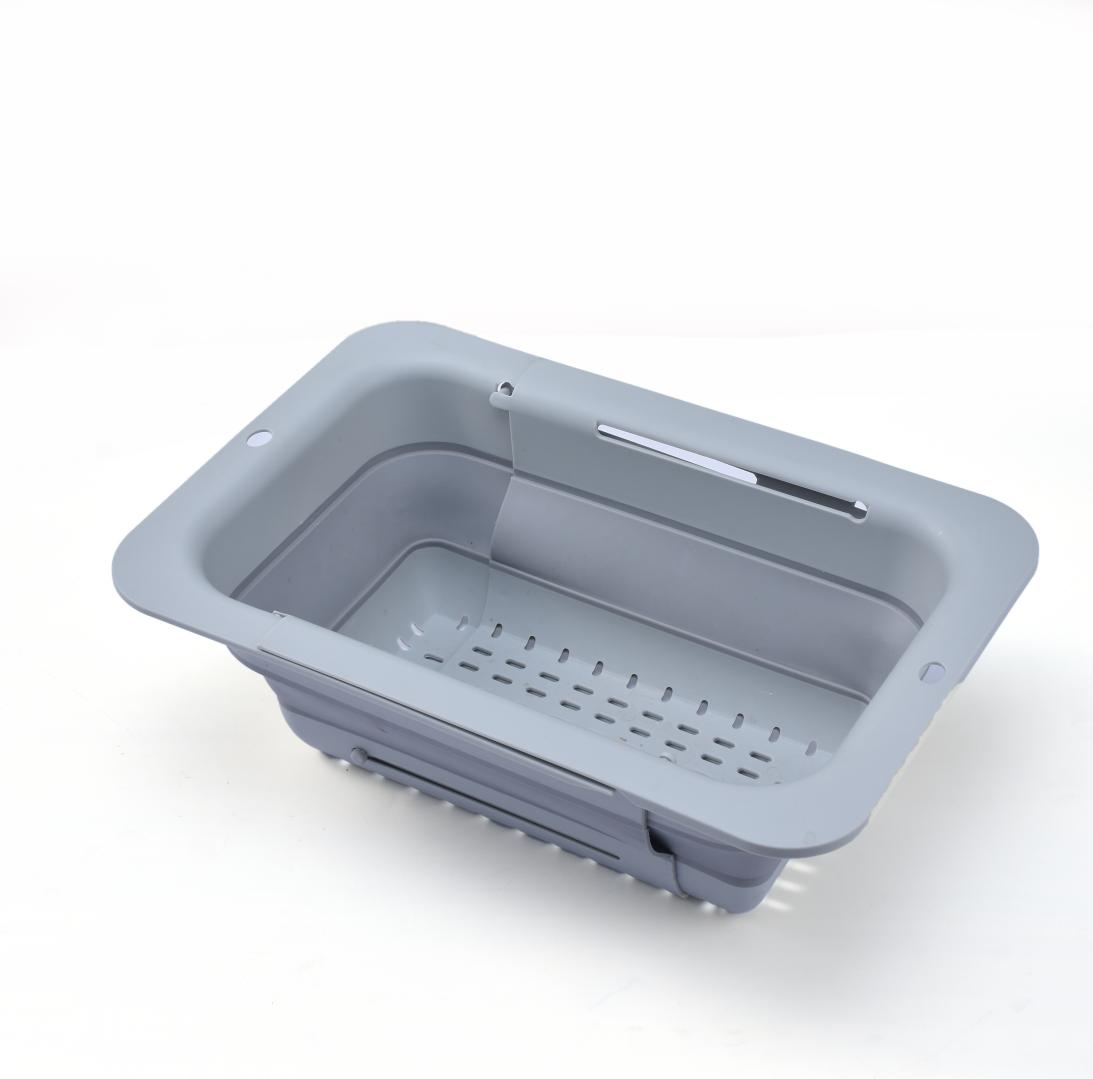
NT2516 multi-function collapsible drain basket — a perforated form suited to soaking and draining auto parts or washing accessories.
Design Details That Decide Daily Usability
Specifications set durability; handling details decide whether staff actually use the container the way it was intended. Several details in this range are relevant to both workflows.
- Anti-slip bottom structure. Wet tile and coated concrete floors are standard in wash bays. An anti-slip base reduces tipping when a container is filled close to its marked capacity.
- Integrated reinforced handles. Loaded baskets are lifted dozens of times per shift; a reinforced handle is a structural component, not a styling feature.
- Smooth, stain-resistant surfaces. The products can be cleaned simply with water, which shortens turn-around between a chemical-heavy detailing task and a pet contact task.
- Weather-resistant material. Outdoor wash areas, open vans and unheated storage do not fade the material, and the low-temperature tolerance prevents cracking in cold conditions.
- Folded thickness of a few centimetres. After folding, volume drops by 75%–85%. Units can be hung on walls, stored in cabinet gaps, luggage or car trunks, and stacked together to save warehouse and retail shelf space.
Market Signals Behind the Space-Saving Requirement
The space-saving argument is not only a workshop preference. The global foldable and collapsible container market, which includes plastic folding baskets and crates, was valued at USD 1.7 billion in 2025 according to Grand View Research. Within that segment, plastic is the dominant material, accounting for a 53.9% revenue share in 2025 on the strength of its lightweight and cost-effective properties.
Demand is geographically concentrated. Asia Pacific held a 36.8% revenue share of the foldable container market in 2025, with China identified as the leading country market. In North America, the U.S. foldable container market was valued at USD 422.8 million in 2024, driven by e-commerce and retail demand for space-saving solutions — the same demand pattern that pushes small service businesses toward fold-flat equipment.
Trade data points in the same direction. Global trade for plastic boxes, cases and crates under HS Code 392310 reached approximately USD 14 billion in 2024, with China's exports in that category valued at USD 1.89 billion, placing it among the top three global exporters. Independent research also puts the space reduction achievable with foldable crates at up to 75% compared with rigid alternatives — a figure consistent with the 75%–85% volume reduction achieved by the one-piece fold-expand structure used in this product family.
Folding Baskets Compared with Fixed Containers and Low-Cost Foldables
For a buyer standardising on one container type across a detailing and pet care operation, the meaningful comparison is not folding versus non-folding. It is folding goods built from virgin food-grade material versus folding goods built from recycled waste, with fixed rigid containers as the baseline.
| Consideration | Fixed rigid plastic container | Low-cost recycled-plastic foldable | PP+TPE folding family (Nantong Plastic) |
|---|---|---|---|
| Storage space when empty | Occupies full footprint permanently | Folds flat | Folds to a few centimetres; volume down 75%–85% |
| Material | Varies | Recycled plastic waste | 100% new food-grade PP+TPE, BPA-free |
| Fold / service life | Not applicable | Short; cracking and leaking are common | 5,000–10,000 folds without cracking or deformation; service life 5–10 times longer than cheap recycled foldables |
| Container loading efficiency | Baseline | Improved | Container utilisation up 300%; 4–5 times more pieces per carton |
| Unit cost | Low | Lowest | Slightly higher than recycled low-end goods |
| Importer logistics cost | Highest per unit shipped | Reduced | Ocean freight and warehouse storage cost reduced by over 60% for importers |
| Best fit | Fixed industrial stations | Price-driven, low-intensity use | Small workshops, mobile services, cross-border bulk wholesale, retail shelf display |
The comparison also defines the limits of the folding format, and buyers should treat those limits as selection criteria rather than as caveats.
- Temperature ceiling. Continuous heating above 120°C is outside the intended working range. Detailing tasks that involve direct contact with open flame, hot metal surfaces or sustained high-temperature exposure are not suitable applications.
- Mechanical damage. Violent scratching or impact from sharp, hard objects can damage the wall. Baskets used to hold loose metal parts or sharp tools should be loaded with that risk in mind.
- Load limit. Each product carries a marked maximum water capacity. Overloading beyond that marking is the most common cause of handle and wall failure, and it is outside the warranty terms.
- Not a heavy industrial bulk bin. The folding range serves household, outdoor and commercial wholesale scenarios. It does not replace 100–300 L industrial collapsible crates used in heavy logistics.
- Entry price. Unit cost sits above recycled-plastic low-end goods. Buyers whose procurement decision is driven purely by the lowest possible unit price will find cheaper alternatives — with the corresponding fold-life and leakage consequences.
What Buyers Should Verify Before Standardising on One Product Family
Standardising a detailing or pet care operation on a single folding family is a long-term supply decision rather than a one-off purchase, so verification should cover production capability, documentation and continuity — not only samples.
- Capacity and form coverage. Confirm the supplier covers the full working range required, from small drain baskets through to 43L container formats, so a single supplier can serve both workflows.
- Certification file. BSCI, ECM, FDA, REACH, RoHS, ASTM and SEDEX documentation should be complete and current, since customs clearance and retail listing depend on it.
- Sample and acceptance criteria. Pre-production sample confirmation before mass production, full finished goods inspection before loading, and the option of third-party SGS or ITS cargo inspection are the standard acceptance sequence.
- Tooling capability. Nantong Plastic operates 200 self-developed production molds, 12 injection molding machines from 300g to 2500g, and 3 assembly production lines, with a standard mold opening cycle of 30–40 days and mold repair response within 2–3 days.
- Warranty and after-sales. A one-year free replacement warranty for non-human damage, with complete certification documents supplied for customs clearance, reduces after-sales replacement cost for retailers and distributors.
- Order flexibility and delivery. Standard stock folding baskets support low MOQ and mixed batch orders, with negotiable MOQ for custom OEM/ODM tooling. Sea freight is the main channel, with air freight and international express for small trial orders, plus Amazon FBA one-stop service, DDP door-to-door logistics, and domestic or overseas warehouse bulk shipment.
- Supply continuity. The company has served over one million families worldwide and acts as a long-term exclusive supplier for Walmart and Sam's Club, alongside cooperation with German Netto and Japanese Nitori and 3Coins — retailer relationships that require consistent certification and delivery schedules.
For buyers already running both a detailing and a pet care line, the practical outcome is a single container family with one certification file and one logistics profile, rather than two parallel supply chains that differ only in colour and capacity markings.
Outlook
The direction of travel for both workflows points toward fewer, more versatile containers. Service businesses continue to operate in smaller rented units and mobile setups, which makes fold-flat equipment a space decision before it becomes a cost decision. At the same time, the requirement for food-grade, BPA-free materials is extending from kitchen goods into adjacent categories such as pet care, where contact with skin and fur drives the same material standard.
For manufacturers, the constraint is no longer the ability to fold a basket but the ability to hold a fold rating in the thousands of cycles across a 3L to 43L capacity span while keeping the material food-grade and recyclable. Buyers evaluating suppliers for a multi-year programme should weigh fold endurance, certification completeness and tooling capacity together, because those three factors determine whether a container family can actually be standardised across two different service environments.
Product reference: the 2026 catalogue covering the folding basin, collapsible water bucket, storage basket and laundry basket ranges is available for download at TAIZHOU NANTONG PLASTIC CO.,LTD 2026 catalogue.
FAQ
Can one folding basket family really serve both auto detailing and pet care?
Yes, when the selection is driven by material and form rather than by category labelling. The shared requirements are water containment, drainage, movement between stations and fold-flat storage. A food-grade, BPA-free PP+TPE construction is suitable for contact with both vehicle cleaning tasks and animal skin, and capacities spanning 3L to 43L cover small parts soaking through to bathing small to medium animals. The practical condition is that containers used for chemical-heavy detailing tasks are cleaned with water before being reused for pet contact tasks, which the smooth, stain-resistant surfaces are designed to allow.
What capacity should be selected for a wash bay versus a pet bath?
Capacity should follow the load, not the shelf. For small parts, trim and wheel rinsing, perforated forms in the 4L range — such as the NT2516 multi-function collapsible drain basket or the NT2515 ultra-slim drain basket — allow water to drain without tipping. An 8L basin with a drain plug covers wash solution and rinse water. Hand baskets in the 10L to 15L band suit one operator carrying tools or parts. For moving wet loads between bays, 38L to 43L wheeled forms remove the need to carry the container. For animal bathing, 36L to 43L perforated forms provide enough working volume for small to medium animals while allowing water to drain during the wash.
Are these baskets safe for direct contact with animal skin and food?
The foldable products use brand-new food-grade PP+TPE composite raw material and are BPA-free, with no odd odour released even when boiling water is used. The material resists cracking at low temperatures and withstands a range from −20°C to 120°C. In the European Union, plastic articles intended for food contact are regulated under Regulation (EC) No 1935/2004 and Regulation (EU) No 10/2011, with good manufacturing practice under Commission Regulation (EC) No 2023/2006. The company's foldable goods hold BSCI, ECM, FDA, REACH, RoHS, ASTM and SEDEX certification. Buyers with specific regulatory requirements should confirm the certification documents match their destination market before ordering.
How long does the folding mechanism last under daily commercial use?
Lab tests show the one-piece fold-expand structure enduring 5,000 to 10,000 repeated folds without cracking or deformation. Because the fold line typically reaches end of life before the side wall does, this rating is the key durability figure for a service environment where a container may be folded and unfolded several times per shift. Construction details that support the rating include heat-pressed fold lines, sealed seams, reinforced 2–3 mm side walls and integrated anti-break handle reinforcement. Users should note that performance under normal load does not extend to overload beyond the marked maximum water capacity or to impacts from sharp, hard objects.
What are the purchasing terms and acceptance criteria for long-term supply?
Standard stock folding baskets support low MOQ and mixed batch orders, while custom OEM/ODM tooling MOQ is negotiable. Delivery is mainly by sea freight, with air freight and international express available for small trial orders, alongside Amazon FBA one-stop service, DDP door-to-door logistics, and domestic or overseas warehouse bulk shipment. Acceptance follows pre-production sample confirmation before mass production and full finished goods inspection before loading, with third-party SGS or ITS cargo inspection available on request. Payment terms are 30% T/T deposit with 70% T/T against copy of B/L, or an irrevocable L/C at sight, with flexible terms for long-term large cooperative clients. The company provides a one-year free replacement warranty for non-human damage and supplies complete certification documents for customs clearance.
How does supply continuity work for a buyer standardising on this product family?
Continuity depends on production capacity, tooling ownership and certification consistency. TAIZHOU NANTONG PLASTIC CO.,LTD was founded in 2003 and operates a 6,000 ㎡ production plant with a 3,500 ㎡ independent warehouse, 12 injection molding machines, 3 assembly production lines and 200 self-developed production molds, with a standard mold opening cycle of 30–40 days and mold repair response within 2–3 days. The company holds 23 independent product patents for its one-piece fold-expand structure and reports over one million families served worldwide, with long-term supply relationships including Walmart and Sam's Club as an exclusive supplier, plus German Netto and Japanese Nitori and 3Coins. Buyers should still validate delivery scheduling and certification currency against their own market requirements during supplier qualification.