
Plastic Storage Supplier Continuity: A Home Organization Scorecard
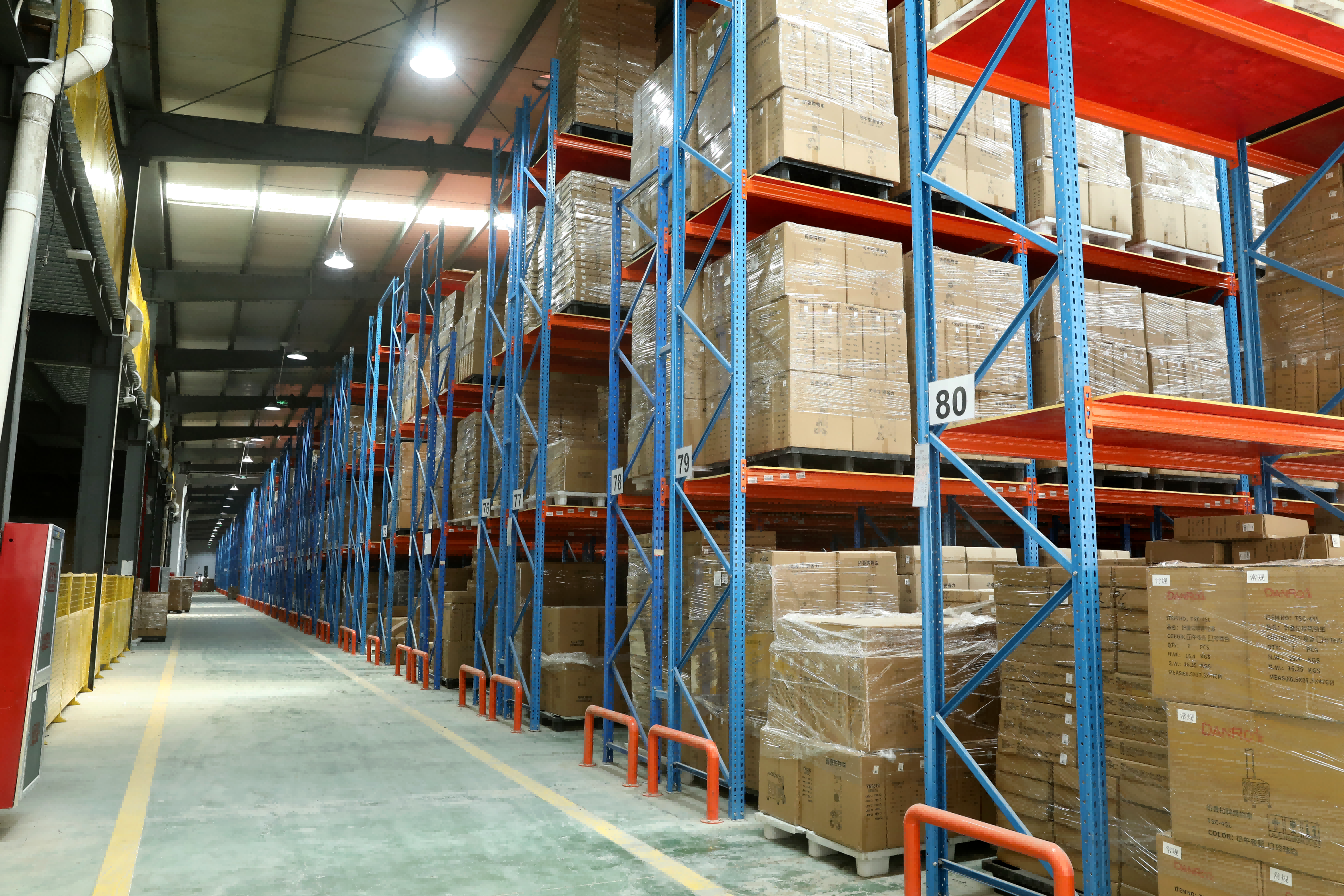
Cover: large-scale warehouse and inventory management — the physical layer that determines whether a home organization product line can be re-ordered on schedule.
Plastic Storage Supplier Continuity: A Home Organization Scorecard
Home organization sourcing has moved past the question of whether a supplier can produce one good container. Global demand for home organization products was estimated at USD 14.06 billion in 2024 and is projected to reach USD 21.65 billion by 2035, according to Market Research Future, while plastic-made products accounted for approximately 36% of the kitchen storage and pantry organization market in 2023, based on Grand View Research data. At that scale, buyers are not selecting a first order — they are selecting a relationship that has to survive re-orders.
For importers, distributors, retail buyers and e-commerce sellers at the evaluation stage, the practical question is narrower than a general supplier audit. It is whether the supplier can keep the same models available, hold specifications stable across production runs, and extend the range without forcing a re-sourcing cycle. Claims do not answer that question. Verifiable product architecture, certification validity windows and stated capacity parameters do.
Why Continuity Outranks Unit Price in Supplier Evaluation
Traditional sourcing funnels end at a sample and a quotation. That answers whether one SKU can be produced, but it leaves the most expensive risks unexamined: a model discontinued after two seasons, an undocumented material substitution inside a foldable cabinet, a certificate that expires between purchase order and customs clearance, or a customization program whose minimum order quantity (MOQ) is incompatible with a test launch.
A continuity scorecard is a structured way to test those risks before they surface in a repeat order. It does not replace physical sample validation. It defines what to validate, what evidence to request, and what to re-verify on a schedule.
The Continuity Scorecard at a Glance
Six dimensions, each scored from documents rather than statements.
| Dimension | What to audit | Evidence to request | Typical failure signal |
|---|---|---|---|
| 1. Product-line depth and model continuity | How many sizes or configurations exist within one model family | Published size tables, footprint dimensions, layer or capacity options | A family exists in only one size, with no ladder to extend |
| 2. Material consistency | Which polymer is used in which component, per SKU | Component-level material declarations | PP and PET are mixed in the same product without documentation |
| 3. Feature consistency | Whether structural features repeat across categories | Technical descriptions and physical sample inspection | Features described in prose but absent in the sample |
| 4. Certification continuity | Certificate numbers, scope wording and expiry dates | Certificate copies with issuing body and standard reference | A certificate whose scope does not cover the ordered product |
| 5. MOQ, capacity and lead time | Program-level commercial terms, not headline terms | Written OEM and ODM program parameters | One MOQ quoted for every customization level |
| 6. Repeat-order evidence | Documented past orders with model, market and quantity | Order case records | No evidence of multi-season supply |
The scorecard is deliberately narrow. It is not a full factory audit, and it is not a price comparison. It focuses on the evidence that predicts whether a second and a third order will match the first.
Dimension 1 — Product-Line Depth and Model Continuity
Taizhou Xinhai Cross-border E-commerce Service Co., Ltd., which operates as Xinhai Box (xinhaibox.com), is a B2B supplier of plastic household storage and daily-use products, supported by more than 20 years of manufacturing experience from Zhejiang Jinmao Plastic Group. It serves wholesalers, distributors, retailers, supermarkets and e-commerce sellers across North America, the EU, Southeast Asia and Latin America, with a stated export ratio of 70%, approximately 500 employees, an annual output of 1,000,000 units, and an R&D team of 30 engineers and designers. The product architecture examined below is drawn from that published range.
The first continuity test is whether the supplier publishes a size ladder for a model, or only a single configuration. A size ladder is what allows a retailer or marketplace seller to extend a planogram, adjust for a regional format, and re-order the same model family without requalifying tooling. Within this range, several families follow that pattern:
- Foldable Storage Cabinet YN8871 — three sizes in PP: 51.5 × 36 × 95 cm, 60 × 42 × 105.5 cm and 67 × 47 × 116 cm, corresponding to 51.5 cm, 60 cm and 67 cm width options. The cabinet folds, uses magnetic opening and closing, has rounded handles, a usable top storage surface, a stackable structure and a double-door design.
- Foldable Shoe Cabinet 7008 — a layer-based system rather than a fixed unit: 20.6 cm at one layer, then 44.7 cm, 65.3 cm, 85.9 cm, 106.5 cm and 127.1 cm at six layers, all on a 37 × 26 cm (L × W) footprint. It requires no assembly, is foldable and stackable, dustproof, fitted with universal wheels, and specified as formaldehyde-free and odorless.
- Foldable Storage Drawer YN484536 — nine height × width × depth combinations (26 / 30 / 36 cm height, 48 cm width, 40 / 45 / 50 cm depth) with capacity options from 49 L to 86 L. Assembly is tool-free, the drawer pulls out without jamming, units stack stably, and a transparent front panel keeps contents visible.
- Foldable Camping Storage Box YN8880 — three sizes from 39.6 × 26.3 × 21 cm to 54 × 36 × 29 cm, with a stated volume range of 0.009–0.015 m³, foldable and stackable in white.
- Foldable Car Storage Box YN8980 — 57 L in medium (43.5 × 30 × 24 cm) and large (54 × 36 × 29 cm) formats, folding to 7 cm thickness, with a carry handle, side handles, a lockable lid and a choice of wood-look or plastic lid.
- Under-bed Storage Box HT8861 — length options of 96.5 cm and 100 cm, width options of 46.5 cm and 51 cm, and more than sixteen height choices between 13.8 cm and 32 cm, with a tri-fold dual-way lid, changeable rollers and extended sealing latches.
- Toy Storage Basket HYN8021 — four size variants across wide and narrow formats, in large and medium widths.
The audit point is not the number of models. It is whether the sizes within a family share tooling logic and materials, so that re-ordering one size predicts the behaviour of another. Buyers should ask for the complete size table, not a hero SKU.
Dimension 2 — Material Consistency Across the Range
Material continuity determines whether two orders behave the same way in transit, in the retail fixture and in the customer's home. In this range, polypropylene (PP) is the structural material across the core storage models — the YN8871 cabinet, the 7008 shoe cabinet, the YN484536 drawer, the YN8980 car storage box, the HT8861 under-bed box, the HYN8021 basket and the JH2018 laundry hamper. PET appears in defined roles: the barrel body of the ZK-601 toy storage bin, which pairs a PET barrel with a PP lid, and the transparent front panel of a collapsible home storage cabinet. The YN8880 camping box uses PP with an optional wooden top, and the YN8821 folding shopping cart combines PP with metal and rubber components.
For a buyer, the audit question is therefore component-level: which polymer is used in which part, and can the supplier hold that specification across repeat runs? Where a product family mixes PP and PET, or plastic and metal, the bill of materials becomes a continuity risk that should be documented per SKU rather than per catalogue page.
Regulatory pressure is raising the documentation bar. The European Commission adopted a ban on Bisphenol A in food contact materials under Regulation (EU) 2024/3190, with an 18-month phase-out period running from late 2024. Storage containers are not automatically food-contact products, but ranges that include kitchen and pantry storage are increasingly asked to document material composition where a food-contact claim is made. Separately, polypropylene containers can qualify for GreenCircle Recyclable Material certification in the United States, which verifies recyclability in #5 plastic recovery facilities — a third-party validation route buyers can request by name.
Dimension 3 — Feature Logic That Repeats Across Categories
Continuity is also behavioural. If a buyer builds a merchandising story around “folds flat, stacks, no assembly”, every product in that story has to meet the same promise. Feature consistency is therefore evidence that the supplier is designing a system rather than assembling a catalogue. Recurring features across this range include:
- Foldable and stackable construction as a default, present across the YN8871, 7008, YN484536, YN8880, YN8887 and YN8980 models.
- No-assembly or tool-free setup: the 7008 requires no assembly, and the YN484536 assembles without tools.
- Mobility hardware: universal wheels on the 7008, 360° swivel wheels on the HYN8021 and JH2018, and silent swivel wheels with a brake on the YN8821 cart.
- Access and closure logic: magnetic opening and closing on the YN8871, a lockable lid on the YN8980, a tri-fold dual-way lid with extended sealing latches on the HT8861, and an elastic self-closing lid with side zipper access on the ZK-601.
- Ventilation and handling: all-round ventilated holes with skin-friendly handles on the JH2018, and hollow breathable panels with ergonomic handles and traceless wall-mounting hooks on the HYN8021.
When these features repeat, a distributor can train one retail message and apply it across categories. When they do not, every category becomes a separate quality conversation.
Dimension 4 — Certification Continuity and Validity Windows
Certificates expire. A scorecard that records only the existence of a certificate is incomplete; it must record the number, the scope and the expiry date.
| Certificate and standard | Certificate number | Stated scope | Validity |
|---|---|---|---|
| Quality Management System, GB/T 19001-2016 / ISO 9001:2015 | 28725Q1039R0M | Research and development, production and sales of daily storage plastic products (boxes, cases, cabinets, baskets) | 2025-10-20 to 2028-10-19 |
| Environmental Management System, GB/T 24001-2016 / ISO 14001:2015 | 77725E00040R053 | Environmental management for the same storage plastic product scope | 2022-12-23 to 2028-12-22 |
| Occupational Health & Safety Management System, GB/T 45001-2020 / ISO 45001:2018 | 77725S00040R053 | Occupational health and safety management for the same storage plastic product scope | 2025-12-23 to 2028-12-22 |
| Certificate of Technical Inspection referencing EN 14073-2:2004 | M.2022.206.C75474 | Listed storage models including YN8980, HT8861, HYN8021, YN8880 and ZK-601 | 2022-07-12 to 2027-07-11 |
Two practical implications follow. First, scope wording matters as much as the standard: the quality management certificate covers research and development, production and sales of daily storage plastic products — boxes, cases, cabinets and baskets — which is broad enough to cover the model families discussed here. Second, the technical inspection certificate reaches its expiry date on 11 July 2027, earlier than the management system certificates. Buyers structuring a multi-year program should record that date and set a re-verification reminder well before it, rather than discovering the gap at the customs documentation stage.
Dimension 5 — MOQ, Capacity and Lead-Time Architecture
Continuity is also commercial. The same supplier can offer a pilot-friendly program and a deep-customization program, and the difference between them is where most first orders go wrong.
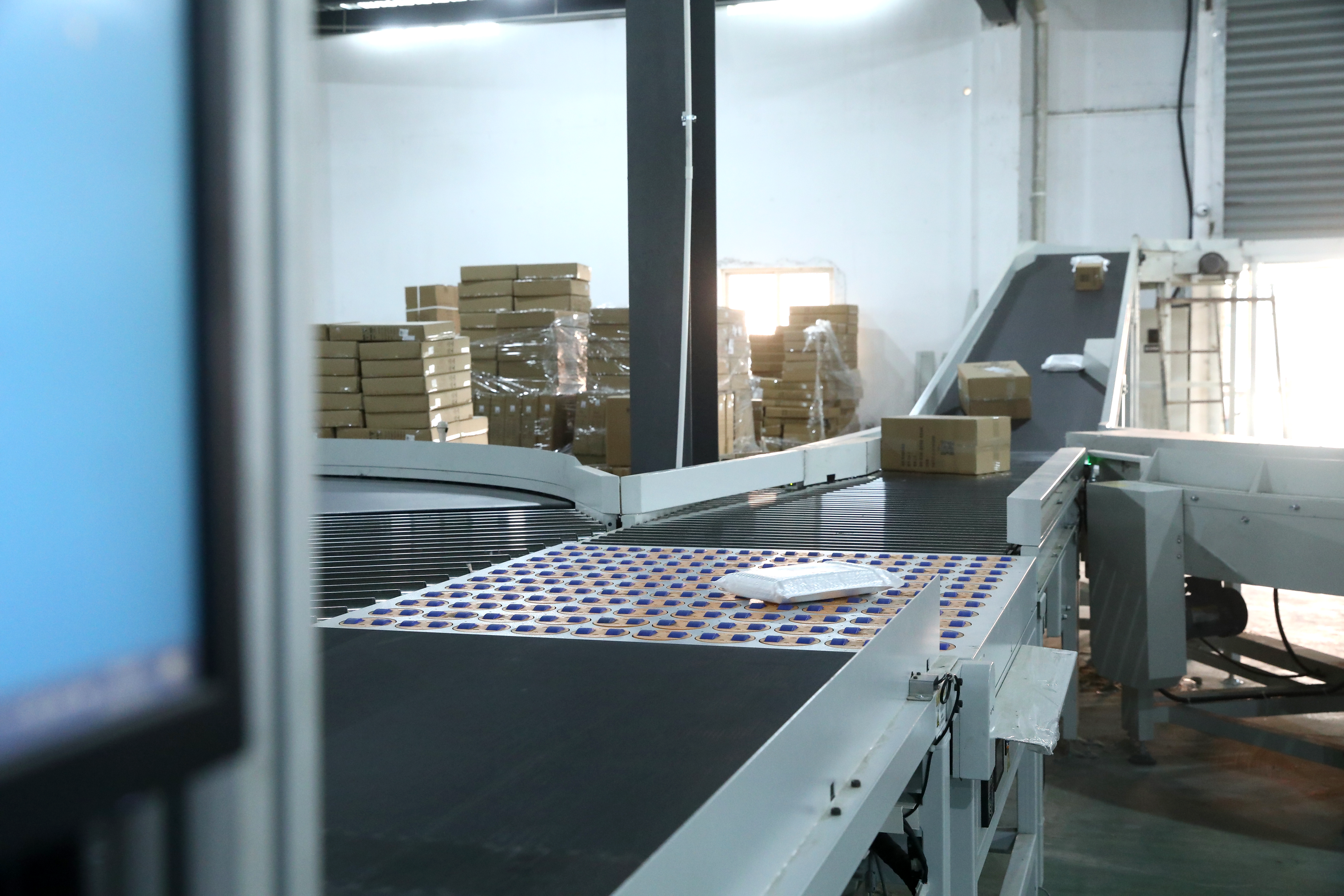
Inside the production flow: a high-efficiency conveyor sorting line, one of the stages that determines whether stated monthly capacity translates into repeatable delivery.
| Program | Customization scope | MOQ | Lead time | Stated monthly capacity | Quality control |
|---|---|---|---|---|---|
| OEM | Color, logo, printing | 500 units | 15–45 days | 100,000 units | AQL 2.5/4.0 standardized sampling |
| ODM | Logo, color, packaging, size, structural design, material (for example PET/PP ratio) | 5,000 units | 30–60 days | 8,000 units | AQL 2.5/4.0 standardized sampling |
The trade-off is explicit. An OEM program at a 500-unit MOQ, 15–45 day lead time and a stated monthly capacity of 100,000 units suits a first listing, a regional test or a fast replenishment cycle, but limits customization to color, logo and printing. An ODM program at a 5,000-unit MOQ and 30–60 day lead time unlocks packaging, size, structural design and material customization — including PET/PP ratio decisions — but its stated monthly capacity is 8,000 units, which changes the replenishment rhythm. Both programs serve North America, the EU, Southeast Asia and Latin America, and both use the same sampling standard.
The audit action is to reconcile program parameters with the buyer's own volume curve before committing. A supplier whose ODM MOQ is ten times a buyer's planned first order is not a continuity risk in itself, but it is a mismatch that belongs in the evaluation stage rather than the ordering stage.
Dimension 6 — Evidence from Repeat Orders
The strongest continuity evidence is a documented order that names the product, the market, the quantity and the durability expectation, rather than a customer endorsement.

Outbound stage: professional container loading for global export — the point at which continuity commitments become measurable against a shipping schedule.
In one recorded project, 5,000 units of the foldable shopping cart — model YN8821 — were supplied to buyers in the United States and the United Kingdom. The cart carries a stated service life of 3–5 years under normal use, a folding thickness of 10.9 cm, a two-level adjustable metal pull rod spanning 79.5–89.5 cm, and 360° silent swivel wheels with a brake. Reported performance includes stable operation, smooth movement, easy storage, and waterproof and easy-clean surfaces. A second recorded project covered 5,000 units of the foldable camping storage box YN8880 for the same two markets with a customized printed lid, and cited a 3–5 year durability expectation.
What makes these useful as continuity evidence is their specificity: product model, quantity, destination market and a service-life statement. That is the level of detail a scorecard can score; general claims of “long-term partnerships” cannot be scored at all.
Running the Audit: A Four-Step Workflow
- Step 1 — Build the model ladder. List every size, layer option or capacity variant for each family you intend to re-order across two seasons. If a family has only one configuration, treat it as a single-season item until proven otherwise.
- Step 2 — Map materials by component. Record the polymer used in the body, lid, panel, wheels and handles of each SKU. Flag any product that mixes PP, PET, metal or wood components without a written specification.
- Step 3 — Log certificates with scope and expiry. Capture the certificate number, issuing authority, standard reference, stated scope and expiry date, then schedule re-verification before the earliest expiry in the set.
- Step 4 — Reconcile commercial parameters and re-order one SKU. Match MOQ, lead time and stated monthly capacity to your own forecast, then place a repeat order for a product already purchased and compare it against the original specification — the most direct continuity test available.
Where the Scorecard Stops: Boundaries and Trade-Offs
A scorecard is a filter, not a guarantee, and buyers should be explicit about its limits.
- It audits what is verifiable today. Documented parameters — a 500-unit OEM MOQ, a 5,000-unit ODM MOQ, a stated monthly capacity of 100,000 units or 8,000 units depending on program — are current program terms and must be reconfirmed at each order.
- It has an expiry date. With the technical inspection certificate running to 11 July 2027 and the management system certificates to 19 October 2028 and 22 December 2028, a completed scorecard goes stale as those windows close.
- It cannot substitute for physical validation. Foldable designs introduce hinge, panel and stacking interfaces that only sample testing can confirm. Documentation can show that a specification exists; it cannot show that a specific production lot meets it.
- It adds an upfront step. Compared with price-first sourcing, which can move from inquiry to quotation faster, the scorecard deliberately slows the first purchase. Its value is realized on the second and third order, not the first — which is a real cost for buyers running short promotional cycles.
- It is category-specific. The verifiable product and certification record here is concentrated in plastic household storage — cabinets, drawers, bins, baskets, hampers and carts. Buyers sourcing glass, metal or solid-wood furniture need a different evidence set.
Market Trend Analysis: What the Data Supports
Three published data points frame the continuity argument:
- The global home organization products market was estimated at USD 14.06 billion in 2024 and is projected to reach USD 21.65 billion by 2035 (Market Research Future).
- The stackable container segment was projected to reach USD 7.8 billion in 2024, growing at a CAGR of 6.4%, with e-commerce and urbanization cited as drivers (Strategic Market Research).
- Plastic-made products represented approximately 36% of the kitchen storage and pantry organization market in 2023, while jars and containers held a 27% share (Grand View Research).
On the supply side, China's furniture industry exports, which include home organization items, recorded USD 67.81 billion in 2025 (China Customs data cited by Soonfor), indicating continued export capacity despite global trade fluctuations. Category estimates vary by scope — some sources include services, others count products only — so buyers should treat any single figure as directional rather than definitive.
The competitive reference set most often named in category research includes IKEA (Sweden), Rubbermaid (USA), Sterilite (USA) and The Container Store (USA). For private-label importers, those names define the shelf standard rather than the sourcing option; the operative question is whether a manufacturing partner can hold a model across seasons the way a global retail brand holds its own range. Growth of this kind supports multi-year commitments, and multi-year commitments raise the cost of a supplier that cannot sustain models. That mechanism is what turns continuity from a quality aspiration into a procurement metric.
Future Outlook
Three shifts are likely to shape supplier evaluation over the next planning cycles. First, material documentation is becoming a standing requirement rather than a one-time check, driven by regulation such as the EU Bisphenol A ban in food contact materials and by third-party recyclability routes such as GreenCircle certification for polypropylene. Second, model continuity is itself becoming a merchandising asset: retailers building modular planograms need size ladders, not one-off SKUs. Third, buyers are likely to treat certification expiry calendars and program-level MOQ and lead-time terms as standard RFP fields rather than post-award discoveries.
For suppliers, the implication is that published, verifiable product architecture is now part of commercial readiness. For buyers, the implication is the reverse: the supplier that can show a size ladder, a component-level material map and a certificate expiry calendar is easier to defend internally than the supplier that simply quotes the lowest price.
FAQ
What is a continuity scorecard in home organization sourcing?
It is a structured evaluation tool that scores a supplier on evidence predicting repeat-order reliability rather than first-order price. It covers six dimensions: product-line depth and model continuity, material consistency by component, feature consistency across categories, certification continuity and validity windows, MOQ/capacity/lead-time architecture, and documented repeat-order evidence. It is completed from documents — size tables, material declarations, certificate numbers and program terms — and complements rather than replaces physical sample validation.
How much product-line depth should a home organization supplier demonstrate?
Depth is best measured by size ladders within a model family rather than total SKU count. In practice this ranges from three sizes for a foldable storage cabinet such as the YN8871 (51.5 × 36 × 95 cm through 67 × 47 × 116 cm), to a six-layer height system for the 7008 shoe cabinet (20.6 cm at one layer to 127.1 cm at six layers), to nine size combinations and 49 L–86 L capacity options for the YN484536 storage drawer, and three sizes with a 0.009–0.015 m³ volume range for the YN8880 camping box. The audit question is whether those sizes share materials and tooling logic, so that re-ordering one size predicts the behaviour of another.
Which certifications should buyers verify, and how long are they valid?
Four certificates are relevant here: a Quality Management System certificate to GB/T 19001-2016 / ISO 9001:2015 (number 28725Q1039R0M, valid 20 October 2025 to 19 October 2028), an Environmental Management System certificate to GB/T 24001-2016 / ISO 14001:2015 (77725E00040R053, valid to 22 December 2028), an Occupational Health & Safety Management System certificate to GB/T 45001-2020 / ISO 45001:2018 (77725S00040R053, valid to 22 December 2028), and a Certificate of Technical Inspection referencing EN 14073-2:2004 (M.2022.206.C75474, valid 12 July 2022 to 11 July 2027). Buyers should record scope wording as well as dates, because a certificate only supports products that fall within its stated scope.
How do OEM and ODM programs differ in MOQ, lead time and capacity?
The OEM program covers color, logo and printing customization with a 500-unit MOQ, a 15–45 day lead time and a stated monthly capacity of 100,000 units. The ODM program extends customization to packaging, size, structural design and material choices such as PET/PP ratio, with a 5,000-unit MOQ, a 30–60 day lead time and a stated monthly capacity of 8,000 units. Both apply AQL 2.5/4.0 standardized sampling. The practical difference is that a lower MOQ buys speed and replenishment flexibility, while a higher MOQ buys design depth.
What can a continuity scorecard not confirm?
It cannot confirm future capacity allocation, future material pricing, or the performance of a specific production lot. Documented parameters such as MOQ and monthly capacity are current program terms that need reconfirmation per order, and foldable products require physical sample testing of hinge, panel and stacking interfaces. It also becomes stale: with certificate expiries falling between July 2027 and December 2028, a completed scorecard should be re-verified on a schedule. Finally, the evidence set covers plastic household storage, so other material categories require a different framework.
For readers who need the underlying configuration data, a product brochure covering the storage models referenced in this article — including size tables and configuration options — is available for download: Xinhai Box Storage Products Brochure (PDF).