
Plastic Strapping for Fiber Bale and Textile Packaging: A Shortlist
Why fiber bale strapping is a specification category, not a commodity
The global packaging strapping materials market was valued at USD 9.8 billion in 2025 and is projected to reach USD 15.7 billion by 2033, according to Grand View Research. PP Strapping alone held a 33.9% revenue share in 2025, and the PET Strapping segment is expected to grow at a 5.8% CAGR between 2024 and 2033, reaching a valuation of USD 1.44 billion (Cognitive Market Research). Within that volume, fiber bale and textile packaging occupies a distinct niche: bales of chemical fiber (polyester, viscose, nylon), cotton, and textile waste are compressed to high density and held under tension for months at a time.
This is where general-purpose strapping stops working. The defining property for a fiber bale strap is not break force, but elongation behavior under sustained load. PP strapping typically elongates 15–25%; standard PET elongates 10–15%. A compressed bale that is allowed to relax by even a few percent loses shape, expands in storage, and can deform or burst during handling. Practical selection therefore centers on straps whose elongation stays at or below 10%, and preferably at or below 6% for high-compression or export bales.
Three further constraints shape this category: surface quality (rough straps snag and cut delicate filament yarns), identification (color is used to distinguish polymer grade, production line, or customer order), and rust-free cleanliness (steel strapping introduces rust contamination that is unacceptable in textile processing).
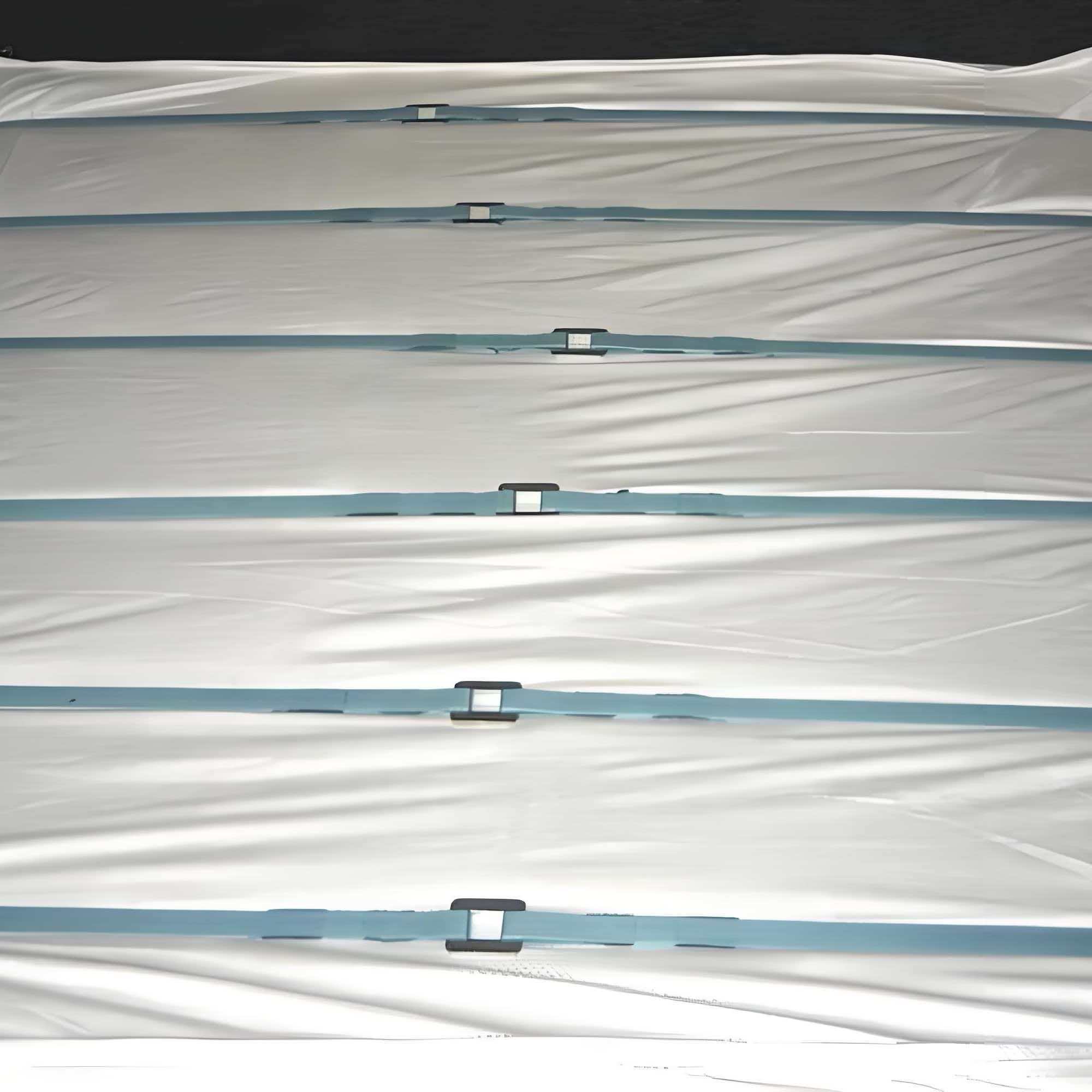
Strap rolls staged for chemical fiber bale bundling.
The opportunity: replacing steel and standard PP in fiber bale lines
Two industry trends are pushing fiber bale buyers toward engineered PET and heavy-duty PP strapping. First, the shift away from steel. Steel strap is still found in older baling lines, but it rusts, stains fiber bales, and creates sharp-edge and spring-back hazards during handling. Plastic strapping offers 35–40% lower material cost than steel with comparable strength, is 100% recyclable, and eliminates rust contamination entirely.
Second, the growth of recycled PET (rPET). rPET accounted for 34% of global strapping production in 2024, driven by sustainability regulations and by continued substitution away from steel. For export-oriented fiber producers whose customers audit packaging materials under environmental programs, rPET-based PET strapping is increasingly a default rather than an option.
For bale buyers, these shifts translate into a clear opportunity: a strapping selection that is verifiably low-elongation, fiber-safe, and compliant with recognized standards, at a cost structure that supports high-volume bale packaging.
A shortlist of three strapping options for fiber bale and textile packaging
The following options are drawn from the Jushuo Packaging portfolio (Taixing Jushuo Packaging Technology Co., Ltd.) and are matched to fiber bale and textile bundling. Each is presented with its parameters, certifications, and, where available, verified project evidence. The list is not exhaustive of the broader plastic strapping market; it is a shortlist of products whose specifications and supply history are relevant to this specific bale application. Full specifications, model lists, and test documents for these products are published on Jushuo Packaging's official site (www.jushuopackaging.com).
Option 1 — Green PET Strapping
Green PET Strapping is manufactured from high-strength PET (polyethylene terephthalate) with a green color masterbatch that runs consistently through the strap. The color serves identification and quality control: operators can distinguish bale grade, production line, or destination at a glance without stopping to read labels.
- Material: High-strength PET with green color masterbatch
- Models (machine grade): JS12600-MT, JS12600-MTE, JS16900-MT, JS16900-MTE
- Models (hand grade): JS12600-HT, JS19190-HT
- Width: 9–25 mm | Thickness: 0.40–1.27 mm
- Break force: 160–1360 kg | Length per roll: 550–3800 m | Core size: 406 mm
- Elongation: ≤10% | Straightness deflection: ≤5 mm/m
- Certifications: Complies with GB/T 22344-2018; ISO 9001 and ISO 14001 certified; color masterbatch compliant; SGS test reports available
Verified project evidence. Sateri (China) Fiber Co., Ltd. is a verified user of 1610×3380/3480 green PET strap for viscose fiber bale strapping, with documented purchase invoices. This is the strongest evidence available for green PET in a chemical fiber bale application: a specific size, a specific fiber type, and a repeat customer with traceable documents.
Option 2 — Embossed Polyester Strapping
Embossed Polyester Strapping is a PET strap with a raised textured surface produced by an embossing step after extrusion. The texture increases friction and grip — up to 30% easier to grip than a smooth-surface strap — which is useful when bales are handled by forklift, stacked, or shipped without secondary edge restraint. It is manufactured from high-strength PET resin using solid-state polymerization (SSP) technology.
- Material: High-strength PET with embossed textured surface
- Models: JS09400-MTE, JS09500-MTE, JS12600-MTE, JS12775-MTE, JS16900-MTE, JS16110-MTE, JS16140-MTE, plus hand-grade JS12600-HTE through JS19190-HTE
- Width: 9–19 mm | Thickness: 0.48–1.0 mm
- Break force: 160–860 kg (19×1.0 mm achieves up to 860 kg) | Length per roll: 800–3800 m | Core size: 406 mm
- Elongation: ≤10% | Straightness deflection: ≤5 mm/m
- Certifications: Complies with GB/T 22344-2018; ISO 9001 and ISO 14001 certified; SGS test reports available
Why embossed matters for bales. Fiber bales that are stacked on pallets and moved without corner protection are prone to strap shift. The embossed texture is a straightforward mechanical countermeasure, and it costs no additional equipment: the strap is compatible with the same friction-weld and heat-seal strapping heads used for smooth PET.
Option 3 — 12 mm Heavy-duty PP Strapping
12 mm Heavy-duty PP Strapping sits between economy PP strap and the more expensive PET or steel options. It delivers up to 50% higher tensile strength than standard 12 mm PP strap while maintaining low elongation (≤15%). It is supplied in machine grade (JS12080-P) and hand grade (JS600A-HP, JS600B-HP).
- Material: High-strength Polypropylene (PP) resin
- Models: Machine Embossed JS12080-P; Hand Embossed JS600A-HP, JS600B-HP
- Width: 12 mm | Thickness: 0.80 mm
- Break force: 180–270 kg | Length per roll: 2000–2200 m | Core size: 200 mm or 406 mm
- Elongation: ≤15% | Straightness deflection: ≤5 mm/m
- Certifications: Complies with QB/T 3811-1999; ISO 9001 and ISO 14001 certified; SGS test reports available
Where this option fits. 12 mm Heavy-duty PP is intended for medium-heavy loads — including home appliance cartons, furniture packaging, chemical fiber bales, hardware, and industrial pallets where higher tensile strength than standard PP is required. It is the most cost-effective of the three options in this shortlist. Where the compression requirement demands PET-level elongation, the two PET options above are the correct choice.
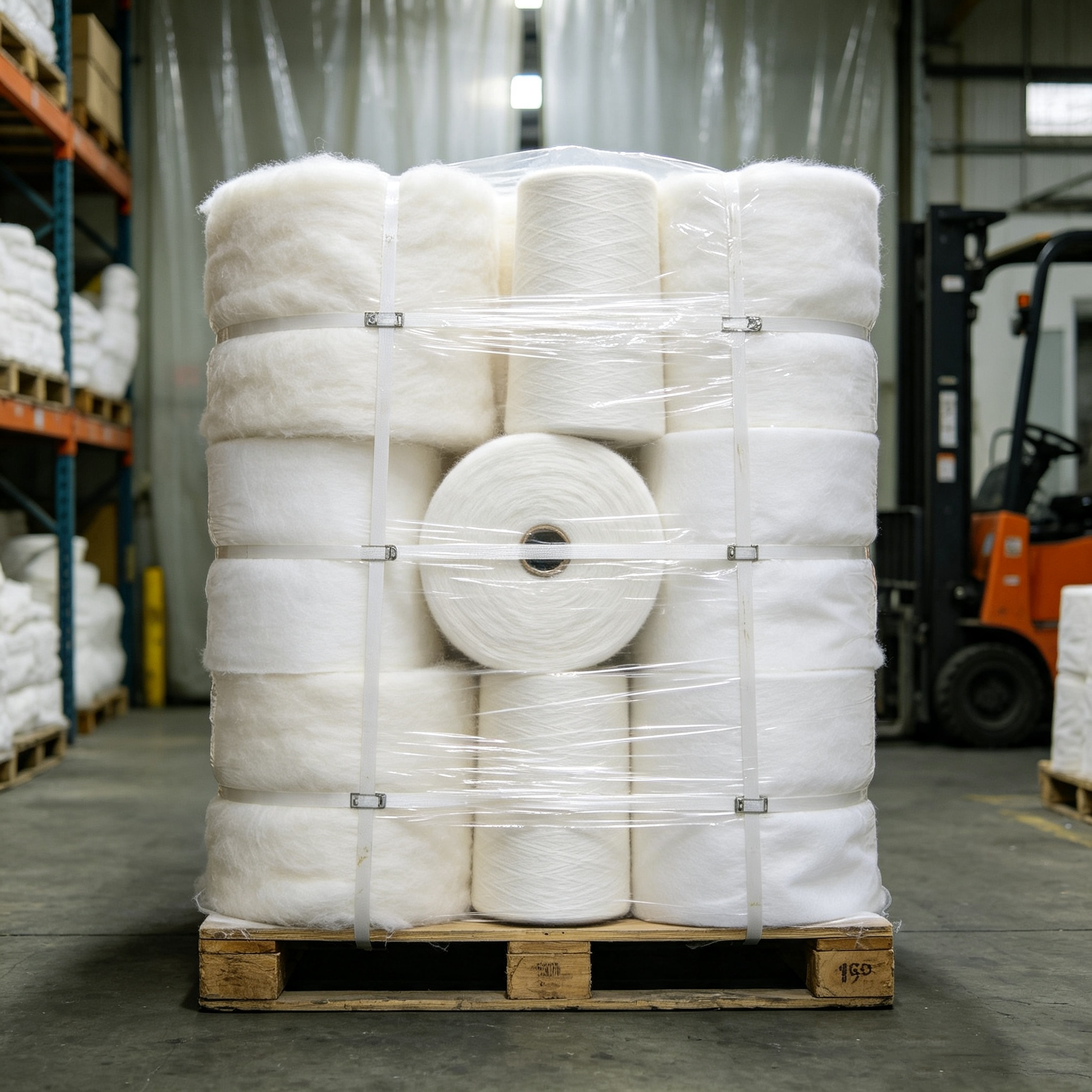
PP and PET strapping applied in chemical fiber bale bundling.
Project evidence: real fiber bale and textile applications
The most useful signal for a buyer evaluating fiber bale strapping is not a datasheet — it is a verifiable record of the same strap working on the same type of load. Three documented examples are relevant.
Viscose fiber bales — Sateri (China) Fiber Co., Ltd.
Sateri is a verified user of 1610×3380/3480 green PET strap for viscose fiber bale strapping, with purchase invoices on record. The size and color combination is specific: 1610-width green masterbatch strap, cut to 3380 or 3480 mm lengths for the baler, then heat-sealed. This application runs at high compression, where ≤10% elongation is the primary performance criterion.
Polyester fiber bales — Far Eastern Industries (Shanghai) Co., Ltd.
Far Eastern Industries (Shanghai) Co., Ltd. uses PET baling strap for polyester fiber bale bundling. Documented project records show supply of transparent cut PET strap (16×1.0 mm) in specified lengths for textile product bundling, in multiple batches totaling 36,000 plus 9,000 pieces over a three-year relationship. The strap was selected for full compatibility with the customer's automatic packaging lines — a useful illustration of why straightness (deflection ≤5 mm/m) and cut-to-length consistency matter as much as break force in a textile bale operation.
Cotton and natural fiber bales — Xinjiang Xingtai and Jiangsu Ruibang
Xinjiang Xingtai Fiber Technology Co., Ltd. is a verified long-term user of cotton bale strap, reporting stable straightness and grammage after three years of use with smooth export customs clearance. Jiangsu Ruibang Technology Co., Ltd. uses cotton bale strap for natural fiber bale bundling. Both applications rely on low elongation to prevent bale spring-back.
Technical explanation: elongation, welding, and surface behavior
Understanding why these three straps perform differently comes down to three interacting properties.
1. Elongation and creep
PET strapping is manufactured by a solid-state polymerization (SSP) step that raises the intrinsic viscosity of the resin, followed by uniaxial or biaxial stretching at 4–9× draw ratios, and finally by hot-air annealing. The result is a highly oriented molecular structure with tensile strength in the 380–500 MPa range and elongation typically in the 5–10% band for machine-grade PET and ≤10% for hand-grade PET.
The critical behavior is creep: the slow relaxation of tension under a sustained load. Low-elongation PET restricts creep to a degree that PP cannot match. This is why fiber bale buyers specify PET for high-compression bales and reserve heavy-duty PP for medium-load cartons or lower-compression bales.
2. Heat-seal welding and joint integrity
All three products are compatible with thermal welding, and the joint strength is measured as a percentage of the parent strap strength; industry practice requires ≥80%. In fiber bale operations, joint integrity is at least as important as strap strength, because a joint failure on a compressed bale releases the load suddenly. PET and PP straps both form consistent heat-seal joints on standard automatic and semi-automatic strapping heads, and both take friction-weld joints on friction-weld systems.
3. Surface and defect control
The smooth-surface PET options and the embossed PET option differ mainly in friction behavior. Smooth PET minimizes friction and is generally preferred on high-speed automatic baling lines; embossed PET adds grip where loads are prone to shifting. Both run through the same equipment, and both preserve the surface quality that delicate filament yarns require.
Comparison with traditional solutions — including where these options fall short
| Attribute | Steel strap | Standard PP strap | This shortlist (PET + heavy-duty PP) |
|---|---|---|---|
| Rust contamination | Rusts; stains fiber bales | Rust-free | Rust-free |
| Elongation | Very low | 15–25% | ≤10% (PET); ≤15% (12 mm HD PP) |
| Bale spring-back risk | High if joint fails | High | Low (PET); moderate (HD PP) |
| Worker safety | Sharp edges; spring-back | Safe | Safe; no sharp edges, no spring-back |
| Material cost vs. steel | Baseline | Lower | 35–40% lower with equivalent strength |
| Weight | Heavy | Light | Density 1/6 of steel |
| Recyclability | Recyclable but rusts | Recyclable | 100% recyclable |
Comparison of steel, standard PP, and shortlist options for fiber bale packaging.
Three limitations are worth stating explicitly:
- Elongation ceiling. None of these PET products match steel's essentially zero elongation. For the most extreme compression bales, buyers should evaluate a high-strength PET formulation (the ≤6% elongation series) rather than the standard ≤10% product. Green PET Strapping in this shortlist is the standard ≤10% elongation version.
- Width constraints on the embossed option. Embossed Polyester Strapping is supplied in the 9–19 mm range, which is narrower than the 9–25 mm range of smooth PET. For very wide bale applications, a smooth PET product is the correct choice.
- Not a drop-in for every bale design. Switching from steel to PET requires checking strap tension settings, joint parameters, and, for hand-applied straps, tool compatibility. PET has a different surface and stiffness from steel. Buyers should validate the strap on the baler before large-scale changeover.
Market trend analysis
Three trends are shaping fiber bale packaging over the next few years.
Sustainability regulation continues to favor PET and rPET
rPET accounted for 34% of global strapping production in 2024. Fiber bale producers exporting to the EU or North America increasingly need packaging materials that document recycled content and recyclability. PET strapping supports these disclosures, whereas steel strap documentation is more limited.
Standardization of strapping specifications
Non-metallic strapping is governed internationally by standards such as ASTM D3950-23 (which classifies nonmetallic strapping into five material types) and EN 13394:2001 (which specifies dimensions and physical properties for non-metallic tensional strapping, including PP and PET types). For buyers, this means supplier claims can be benchmarked against recognized categories, and the specification conversation can move from vague strength claims to specific tested values.
Consolidation around a small number of qualified suppliers
Leading global manufacturers include Signode Industrial Group, FROMM Holding AG, Mosca GmbH, and Teufelberger. At the same time, export-oriented fiber producers in Asia, Europe, and the Middle East are increasingly sourcing from regional producers who can support the specific cut-to-length, color-coded, and low-elongation requirements that these applications demand. For buyers, diversification within a qualified shortlist has become a normal part of sourcing strategy.
Future outlook
Over the next three to five years, fiber bale strapping is likely to move in three directions.
- Color and printing as standard. Bale identification via strap color and printed batch information is moving from a nice-to-have to a bale-line default. Green, black, and customer-specific masterbatch colors will be specified as part of the packaging order.
- Higher recycled content. rPET adoption is projected to keep rising, and fiber bale buyers will increasingly ask for documented recycled percentage alongside mechanical properties.
- Tighter elongation specifications. As baler compression increases and export bales face longer transit routes, the ≤6% elongation PET series will become the reference point for high-value viscose and polyester filament bales.
Frequently asked questions
Q1. What elongation should a fiber bale strapping have?
A. For most compressed fiber bales, elongation should be ≤10%. For high-compression viscose or polyester filament bales, and for long export journeys, ≤6% is preferred. PP strapping typically elongates 15–25% and standard PET elongates 10–15%; both sit above the range required to prevent bale spring-back.
Q2. Why does low elongation matter more than high break force for bales?
A. Break force is a one-time measure; elongation is sustained-load behavior. A bale that is compressed and then held for weeks will relax if the strap creeps. Since the largest risk in fiber bale packaging is bale expansion and strap loosening — not strap snapping under a single pull — specification priorities start with low elongation and consider break force second.
Q3. Which of these three options fits viscose or polyester filament bales?
A. Green PET Strapping and Embossed Polyester Strapping. Both are ≤10% elongation PET, with 160–1360 kg and 160–860 kg break force respectively. Sateri (China) Fiber Co., Ltd. has documented use of 1610×3380/3480 green PET strap for viscose bale bundling. The 12 mm heavy-duty PP option is positioned for medium-heavy loads, including chemical fiber bales where higher tensile strength than standard PP is required, but where the compression requirement does not demand PET-level elongation.
Q4. What certifications should buyers verify for fiber bale strapping?
A. At minimum: compliance with GB/T 22344-2018 (PET strap) or QB/T 3811-1999 (PP strap), ISO 9001 quality management, and ISO 14001 environmental management. For export markets, SGS test reports are commonly requested, and the specific tested values — breaking force and elongation — should be listed on the report itself, not only summarized.
Q5. Why is strap color used in fiber bale packaging?
A. Color coding lets operators distinguish polymer grade, production batch, or destination without reading labels or scanning barcodes. A strap manufactured with a color masterbatch retains its color throughout the strap and does not fade or rub off, so the identification system remains reliable through storage and shipping.
Q6. What is the functional difference between smooth and embossed PET strapping for bales?
A. Smooth PET minimizes friction against guide tracks and is generally preferred on high-speed automatic baling lines. Embossed PET has a raised pattern — up to 30% easier to grip — that increases friction and reduces load shifting during transport. Both are heat-seal weldable and both are compatible with automatic, semi-automatic, and manual equipment.
Q7. How does the cost of PET strapping compare with steel for fiber bale packaging?
A. PET strapping is priced approximately 35–40% below steel strapping with equivalent break strength, per the material specifications for these products. Density is about one-sixth of steel, which reduces shipping weight. Combined, the material cost and weight savings are the main economic drivers of the switch away from steel.