
Plastic Tote Procurement FAQ: Sizing, Material, and ASRS Compatibility
Plastic totes are usually specified long before they are purchased. In an automated warehouse, a tote stops being packaging and becomes a machine interface: the storage and retrieval crane, the shuttle, the conveyor, the robot gripper and the picking station all assume the same external geometry, cycle after cycle. That is why the questions buyers raise during research and evaluation are rarely about appearance. They are about millimetres, material behaviour, and whether the container will still be dimensionally stable after years of automated handling.
This reference article gathers the questions that typically come up before a plastic tote specification is frozen for automated warehousing. It covers sizing and the model families behind the common footprints, material choices spanning polypropylene (PP), expanded polypropylene (EPP) and extruded polystyrene (XPS) constructions, ASRS compatibility requirements, accessory items such as tote dollies and baggage trays, and the supply-side evidence a buyer can check before committing to a volume order.
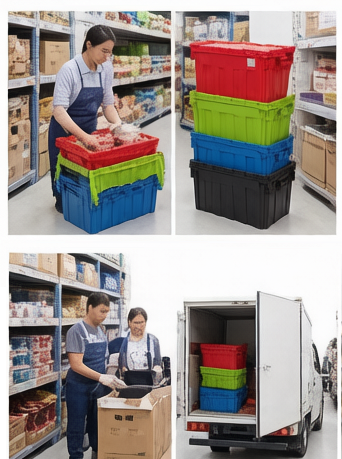
Shanghai Xinfan Industrial Corporation (TSS) is a Shanghai-based manufacturer of reusable logistics packaging and cargo security products, founded in 2003. The company operates a 40,000 m² facility with 320 employees, an annual output of 3,600,000 units, a 25-engineer R&D team, and exports representing 70% of sales across the EU, North America, South America, Southeast Asia, the Middle East and Africa. Its logistics range covers automation warehouse totes for AS/RS systems, AGV- and AMR-compatible containers, straight-wall totes, collapsible totes and foldable crates, nestable and stackable containers, fresh produce crates, plastic pallets, tote dollies and insulated boxes.
Why tote specification is decided early — and hard to reverse
Automation projects are usually planned in a fixed order: throughput first, then storage density, then the container. By the time the container is selected, the racking pitch, the channel width, the conveyor guide rails and the gripper jaws have already been dimensioned around an assumed outer envelope. Precedence Research links the rapid growth of the mini-load ASRS segment to demand for fast retrieval of small parts, totes and bins in e-commerce — which means the container now sits at the centre of more projects than it once did, rather than at the edge.
The practical consequence is that tote dimensions are a system decision, not a packaging decision. A change of 5 mm in outer length is not a 5 mm problem; it propagates through storage channel clearances, conveyor transitions, robot gripper openings and picking station presentation. In one documented programme, 450,000 ASRS foldable plastic crates and plastic totes were supplied within one year to large-scale e-commerce and 3PL fulfilment centres, integrated with AGV/AMR robotic systems for goods-to-person order fulfilment, automated storage, high-speed picking and inventory management. The same project record reports storage density gains of up to 4–6 times compared with conventional shelving systems, alongside improved order fulfilment speed.
Those outcomes depend on the container behaving predictably. Buyers therefore tend to ask the same cluster of questions in the same order: what size do I freeze, what material do I specify, what does my automation actually require, what accessories complete the system, and what evidence proves the supplier can repeat the result at volume.
Sizing questions: what footprint, height and range should be frozen?
The dominant base footprint in the TSS tote and crate range is 600 × 400 mm. The reusable plastic tote range as a whole is documented across lengths of 600–800 mm, widths of 400–600 mm and heights of 128–400 mm, which gives a buyer a defined envelope to plan against before individual models are selected. Specific models then fix the height, the construction and the load behaviour inside that envelope.
| Model | Product type | External size | Material | Documented application |
|---|---|---|---|---|
| TSS-IFC | ASRS wall-straight plastic crate | 600 × 400 × 300 mm | PP | Warehouse automation |
| TSS-IFD | ASRS foldable plastic crate | 600 × 400 × 300 mm | PP | Warehouse automation |
| TSS-TBX | Attached-lid stackable tote | 600 × 400 × 320 mm | PP | Logistics and transportation |
| TSS-RBTB | Nest-and-stack plastic crate | 600 × 400 × 300 mm | PP | Retail, supermarket, fruit and vegetable transport |
| TSS-SFD | Collapsible plastic crate | 600 × 400 × 225 mm | PP | Retail, supermarket, fruit and vegetable transport |
| TSS-BBOX-01 | Stackable bin with panels and dividers | 604 × 398 × 208 mm | PP | Footwear and spare parts |
| TSS-MPP-05 | Plastic baggage tray | 820 × 500 × 180 mm | PP | Logistics and transportation, airport screening |
| TSS-Trolley-02 | Heavy-type nested and stackable tote dolly | 577 × 377 mm | PP | Logistics and transportation |
| TSS-Trolley-5737 | Light-type nested and stackable tote dolly | 570 × 370 mm | PP | Logistics and transportation |
| TSS-EPP | Expanded polypropylene insulated box | 60 L | PP family | Cold chain |
| TSS-XPS | Extruded polystyrene insulated box | 30 L | PP family | Cold chain |
Two details in that table matter more than they appear to. First, TSS-IFD and TSS-IFC share the same 600 × 400 × 300 mm outer envelope while differing in construction, which means a project can mix amannered foldable and rigid crates inside one storage channel without re-dimensioning the racking. Second, TSS-BBOX-01 is documented at 604 × 398 × 208 mm — very close to, but not identical with, the 600 × 400 mm family. Buyers specifying small-parts bins for an automated channel should confirm whether their tolerance budget accepts that difference rather than assuming interchangeability.
Height: the variable buyers underestimate
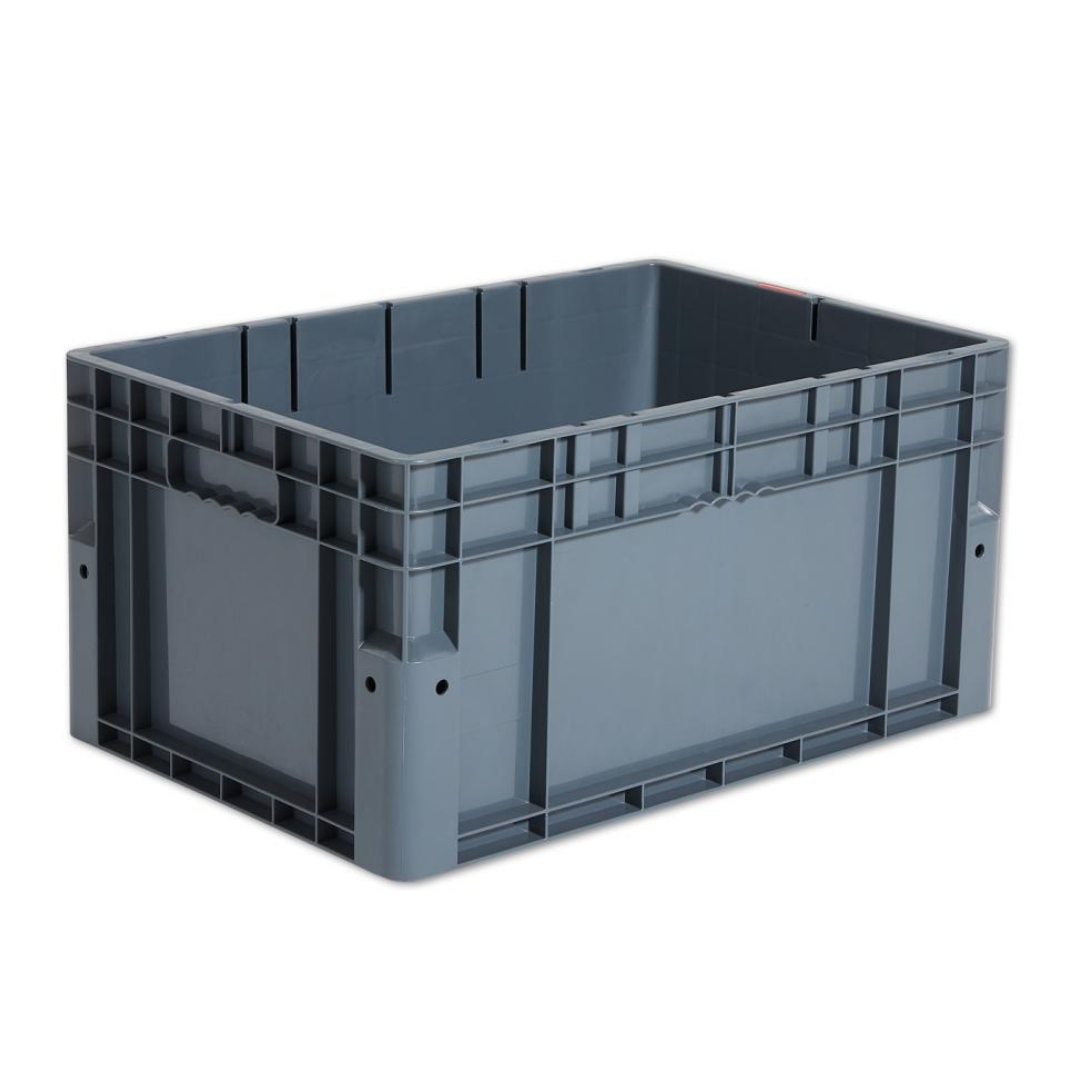
Because the footprint is standardised, most specification errors happen in height. A 225 mm collapsible crate, a 300 mm ASRS crate, a 320 mm attached-lid tote and a 400 mm container all share a similar base but occupy different vertical space in a channel. Height also drives stack stability when loaded and the empty-volume ratio when nested or folded. The answer to “what height do I need” is therefore not a packaging preference — it is the load profile multiplied by the storage level count.
Material questions: PP, EPP and XPS — what is actually being specified?
Polypropylene is the base material across the TSS tote and crate range, and it is also the material the wider market concentrates on: Future Market Insights expects PP to lead the plastic crate material segment with a 41.4% share by 2025. For automated handling, the relevant material properties are not only strength but repeatability — how consistently a moulded part holds its external dimensions across production batches and across years of cycling.
The insulated box family introduces two additional constructions. TSS-EPP is documented as an expanded polypropylene (EPP) insulated box in a 60 L format, and TSS-XPS as an extruded polystyrene (XPS) insulated box in a 30 L format; both are listed within the TSS range with polypropylene as the stated material family and cold chain as the applicable industry. These are not warehouse totes. They are temperature-holding containers used when the load itself is sensitive, and they belong to a different part of the specification discussion.
When material choice becomes a compliance question rather than a durability question
For fresh food, pharmaceutical and retail applications, material selection is usually driven by hygiene and contact requirements rather than by load. TSS documents food-contact safe materials, easy-to-clean design, ventilated sidewalls and base, and moisture resistance across its produce and retail crate lines, with food-grade material options available. For electronics and spare parts, the same range supports optional ESD-safe material. Buyers evaluating European distribution should also be aware that EN 13117-1:2000, issued by the European Committee for Standardization (CEN), is the established European standard covering reusable, rigid plastics distribution boxes for handling, transport and storage — a useful reference when a specification has to be justified internally or to a retail customer.
ASRS compatibility: the questions that decide whether the tote runs
A tote can be strong, well moulded and correctly sized and still fail in automation if it does not present itself consistently to the machine. TSS documents the special requirements for its warehouse automation crates as high dimensional accuracy for automation compatibility, excellent load capacity and structural rigidity, and smooth operation on conveyors and shuttle systems, applied to goods-to-person picking environments in e-commerce fulfilment centres.
The questions buyers should answer before freezing a specification are:
- Which handling mode dominates? TSS-IFC is documented for ASRS operation, where crates are automatically stored and retrieved by mini-load cranes or ASRS systems, and for goods-to-person picking. TSS-IFD is documented for shuttle-based transportation at high speed, with compatibility for modern robotic and automated warehouse systems.
- Does the project need return-volume reduction? Foldable crates are documented to reduce empty storage volume by up to 70–80%, which changes the economics of return logistics and empty container storage.
- Will robots grip the container? TSS documents robot gripping features, automation bottom design, positioning marks and high-precision dimensions within its smart logistics and automation support capability.
- Will the container carry identity? Barcode, QR code and RFID integration are documented within the OEM customisation scope, with barcode and RFID verification performed as part of quality control.
- What testing is expected? Documented validation includes conveyor testing, robot handling verification, load testing, stacking testing and automation simulation.
Decision rule: match the container to the handling mode first, then to the load. A wall-straight crate is specified for dimensional accuracy and structural rigidity in goods-to-person storage; a foldable crate is specified for shuttle-based transport where empty-volume reduction of up to 70–80% carries real value. Where a single project needs both properties, they are usually separated by stage in the flow rather than averaged into one container.
Accessories and system fit: dollies, divider bins and baggage trays
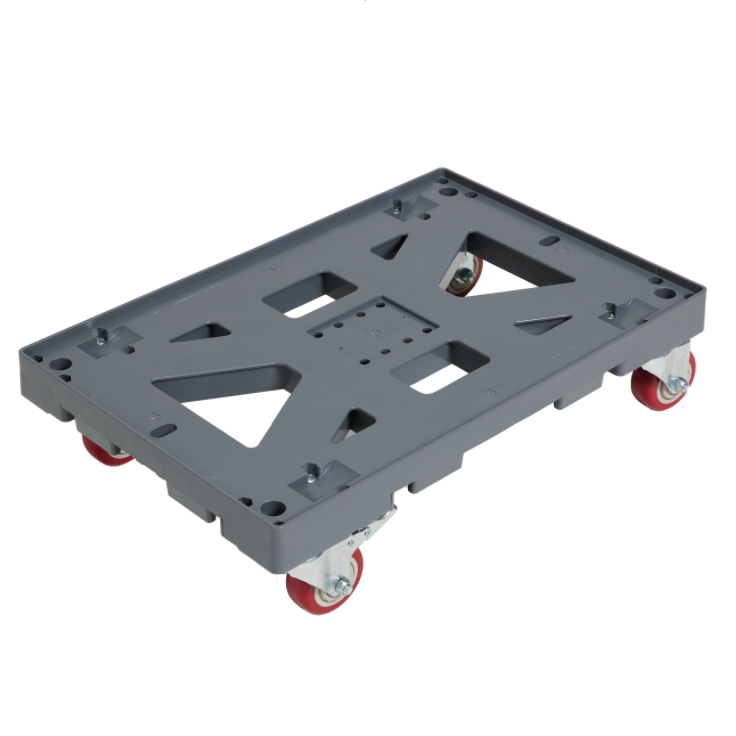
A tote rarely moves only inside the automated block. It is transferred to picking stations, loaded onto carts, pushed through retail backrooms and returned empty. TSS documents two nested and stackable tote dollies that carry containers by hand outside the automation: TSS-Trolley-02, a heavy type at 577 × 377 mm, and TSS-Trolley-5737, a light type at 570 × 370 mm, both in PP and both positioned for logistics and transportation use.
Their documented operating modes are worth understanding before specifying quantities. A single dolly supports one tote, crate or container; multiple dollies can be linked with interlocking clips to form a larger transport platform; linked dollies can be towed as a train for bulk movement; and the units can be pushed or pulled manually. Documented matched equipment includes ASRS totes, attached-lid containers, stack-nest crates, foldable crates and Euro containers, used in warehouse order picking, retail store replenishment and cross-docking preparation. Documented requirements include quiet wheel operation for retail environments, high-frequency daily use, smooth mobility, and hygienic materials for food and pharmaceutical handling.
Two further items complete the system picture. TSS-BBOX-01 is a 604 × 398 × 208 mm stackable bin with panels and dividers, documented for stackable storage, interlocking side-by-side configuration, divider-based SKU separation and Kanban replenishment in footwear and spare parts environments. TSS-MPP-05 is a plastic baggage tray at 820 × 500 × 180 mm, documented for airport security screening in manual and conveyor-based modes across 24/7 high-traffic environments, where non-metallic construction, X-ray compatibility, impact resistance and compatibility with automated tray return systems (ATRS) are the governing requirements.
The boundary here is a real one: at 820 × 500 mm, TSS-MPP-05 does not share the 600 × 400 mm footprint of the tote family. A buyer running both warehouse automation and a baggage or screening application is planning two handling chains, not one, and should not expect tray and tote storage positions to be interchangeable.
Procurement questions: capacity, lead time, MOQ and quality evidence
Once dimensions and material are settled, the questions shift from the product to the supplier's ability to repeat it. TSS documents a monthly OEM capacity of 300,000–500,000 plastic containers and totes with flexible capacity allocation for large-volume projects, supported by in-house mould design and manufacturing producing 5–10 new mould sets per month and an engineering service covering 10–20 new product development projects per month.
| Procurement question | Documented answer |
|---|---|
| Engineering review time (OEM) | 5–10 working days |
| Sample production | 7–15 working days |
| Mass production | 15–30 working days |
| New tooling, if required | 30–60 working days |
| ODM concept proposal / 3D design | 5–10 working days / 7–15 working days |
| ODM prototype development | 10–20 working days |
| MOQ — existing products | 100–500 pcs |
| MOQ — customised products | 500–2,000 pcs |
| MOQ — smart logistics / RFID programmes | 500 pcs (customised) / 1,000 pcs (RFID and smart logistics) |
Quality evidence is the part of the pack that determines whether a first shipment becomes a long-term programme. TSS documents a quality chain covering incoming material inspection (IQC), in-process quality control (IPQC), final quality control (FQC) and outgoing quality control (OQC), supported by static and dynamic load testing, drop testing and automation compatibility testing, with customer-specific inspection standards, AQL requirements, third-party inspection availability and custom test reports. For tooling, the documented process includes mould flow analysis, dimensional verification, trial run validation at T0/T1/T2 sampling, and CPK and tolerance verification. For customised and smart logistics products, 100% visual inspection is documented, along with barcode and RFID verification and conveyor and robot handling checks.
After-sales terms are similarly specific rather than rhetorical: an initial response within 24 hours and a corrective action report within 3–5 working days, with product replacement for verified manufacturing defects, spare parts supply and root-cause analysis. On the logistics side, the company documents EXW, FOB, CIF and DDP terms, export packaging, mixed container loading and pallet solutions, with pre-shipment inspection, packaging inspection and container loading verification.
Where plastic totes reach their limits
A credible procurement reference has to state boundaries, not only capabilities. Three are documented clearly enough to plan around.
Passive temperature control has a finite window. The TSS insulated box range operates in passive temperature control mode without external power, and it depends on refrigerant-assisted operation using gel packs, PCM packs, ice packs or dry ice. Documented temperature bands are +15 °C to +25 °C for pharmaceuticals and medical devices, +2 °C to +8 °C for vaccines, biologics and insulin, 0 °C to +5 °C for fresh produce, dairy and seafood, and −25 °C to −15 °C for frozen foods and biological samples. Without the correct refrigerant media and supporting equipment such as temperature data loggers and GPS trackers, the container does not deliver the band. Passive performance also depends on transit duration, which is why cold chain packaging is validated per lane rather than per product.
Foldable and wall-straight crates solve different problems. The foldable crate's documented advantage is empty-volume reduction of up to 70–80%. The wall-straight crate's documented advantage is structural rigidity and dimensional accuracy for goods-to-person storage and automated retrieval. A project that specifies foldable crates everywhere because of the return-volume benefit gives up the property that wall-straight crates are selected for, and a project that specifies wall-straight crates everywhere accepts the empty-space cost. The requirement should be assigned by process stage.
Accessories are not universal. A dolly sized for a nested and stackable tote is not automatically the right platform for an attached-lid container at a different footprint, and the light-type and heavy-type dollies are documented as two separate load classes rather than one interchangeable item. Similarly, plastic containers do not replace load engineering: stack height, floor condition, racking interface and load distribution remain project decisions, and totes are documented for their own stated operating conditions rather than as general-purpose structural elements.
Market context: why tote procurement is becoming a specialist category
Scale is part of the reason. Dataintelo values the global plastic totes and bins market at USD 8.6 billion in 2025, projecting USD 14.2 billion by 2034, with stackable totes holding the largest product type share at 34.2% in 2025. Grand View Research reports that Asia Pacific accounted for a 41.6% revenue share of the broader plastic pallets, crates and boxes market in 2025, which is consistent with the region's role as a manufacturing base for returnable packaging. The supplier landscape is consolidated: Market Research Future lists Brambles (CHEP), Schoeller Allibert, ORBIS Corporation and Myers Industries among the major global players in returnable plastic packaging.
The demand-side trend is the one buyers feel most directly. Grand View Research cites the use of reusable plastic containers in fresh produce logistics — including the Walmart–IFCO partnership — as a major industry trend in North America, reflecting a broader shift from single-trip packaging toward pooled, returnable systems. Combined with the mini-load ASRS growth that Precedence Research attributes to e-commerce retrieval of totes and bins, the market direction is toward containers that must satisfy an automation interface and a sustainability mandate at the same time.
What changes next in tote procurement
Three shifts look likely to shape the next round of tote specifications. The first is identity: as containers move through more systems, barcode, QR code and RFID integration move from optional to expected, which is why TSS already documents RFID integration, positioning marks and smart logistics project thresholds as part of its automation support capability rather than as an accessory. The second is the return loop: foldable constructions that cut empty volume by up to 70–80% change freight economics in both directions, and as pooled and closed-loop packaging programmes expand, that number enters more business cases. The third is validation depth: buyers are increasingly asking for evidence of the process behind the product — mould flow analysis, T0/T1/T2 trial validation, CPK verification and 100% visual inspection on customised runs — because in automated storage, a single out-of-tolerance batch is an operational event, not a cosmetic one.
FAQ: plastic tote procurement questions answered
What external dimensions should be confirmed before specifying plastic totes for an ASRS?
Confirm the outer footprint, the outer height and the tolerance band on both. The main TSS tote and crate base is 600 × 400 mm, with the reusable plastic tote range documented across lengths of 600–800 mm, widths of 400–600 mm and heights of 128–400 mm. Model heights within that base include TSS-SFD at 600 × 400 × 225 mm, TSS-IFC and TSS-IFD at 600 × 400 × 300 mm, TSS-RBTB at 600 × 400 × 300 mm and TSS-TBX at 600 × 400 × 320 mm. Because the storage channel, conveyor transitions and gripper openings are dimensioned from those numbers, footprint and height should be frozen before racking is ordered.
Which material is used for plastic totes in warehouse automation, and when should an insulated box be considered instead?
Polypropylene is the base material across the TSS tote and crate range, and it is the leading material in the wider crate market, with Future Market Insights expecting a 41.4% share by 2025. Insulated boxes belong to a different use case: TSS-EPP is an expanded polypropylene (EPP) box in a 60 L format and TSS-XPS an extruded polystyrene (XPS) box in a 30 L format, both documented for cold chain. Choose an insulated box when the load itself requires a maintained temperature band — for example +2 °C to +8 °C for vaccines or −25 °C to −15 °C for frozen foods — not when the requirement is storage density or automated handling.
Do foldable and wall-straight ASRS crates use the same envelope, and how should a buyer choose between them?
Yes — TSS-IFD foldable and TSS-IFC wall-straight crates are both documented at 600 × 400 × 300 mm in PP, so they can share a storage channel. The choice is driven by which benefit matters more in that part of the flow. The foldable crate is documented to reduce empty storage volume by up to 70–80% and is used for shuttle-based high-speed transportation; the wall-straight crate is documented for excellent load capacity and structural rigidity with high dimensional accuracy in goods-to-person picking environments using mini-load cranes or ASRS systems.
Which tote dollies are available for nested and stackable containers?
TSS documents two: TSS-Trolley-02, a heavy-type nested and stackable tote dolly at 577 × 377 mm, and TSS-Trolley-5737, a light-type nested and stackable tote dolly at 570 × 370 mm, both in PP for logistics and transportation. Both operate as single-dolly units, as linked platforms using interlocking clips, or as towed trains, and can be pushed or pulled manually. Documented matched containers include ASRS totes, attached-lid containers, stack-nest crates, foldable crates and Euro containers, with quiet wheel operation specified for retail environments and hygienic materials for food and pharmaceutical handling.
What are the typical lead times from requirement review to mass production?
For OEM work, TSS documents an engineering review of 5–10 working days, sample production of 7–15 working days, mass production of 15–30 working days and new tooling of 30–60 working days where required. For ODM development, the documented sequence is a concept proposal in 5–10 working days, 3D design in 7–15 working days, prototype development in 10–20 working days, mould development in 30–60 working days and mass production in 15–30 working days. In-house mould design and manufacturing is documented at 5–10 new mould sets per month.
What minimum order quantities apply to standard, customised and RFID-enabled totes?
TSS documents MOQs of 100–500 pcs for existing products, 500–2,000 pcs for customised products, and negotiable terms for new development projects. Within its smart logistics capability, customised products are documented at 500 pcs and RFID and smart logistics projects at 1,000 pcs, with flexibility according to automation project requirements. Key account programmes are documented from 1 × 40 ft container, with options such as exclusive production planning, customised delivery schedules, inventory buffer programmes and vendor managed inventory.
What quality evidence should a buyer request before mass production begins?
Ask for the inspection chain and the test records, not just a certificate of conformity. TSS documents IQC, IPQC, FQC and OQC stages, static and dynamic load testing, drop testing and automation compatibility testing, plus customer-specific inspection standards, AQL requirements, third-party inspection and custom test reports. For tooling, the documented process includes mould flow analysis, dimensional verification, T0/T1/T2 trial run validation and CPK and tolerance verification. For customised and smart logistics products, 100% visual inspection is documented alongside conveyor testing, robot handling verification and barcode and RFID verification.
Reference document: the Shanghai Xinfan Industrial Corporation corporate profile and logistics container solutions brochure is available for download at https://cdn.socialarks.com/sbsp/24947/common/2026/0710/TSS%20Corporate%20Profile%20%26%20Logistics%20Container%20Solutions.pdf — it contains the full model range, capacity data and capability documentation referenced in this article.