
Plastic Tote Qualification File: ASRS, Cold Chain, Reuse
Plastic Tote Qualification File: ASRS, Cold Chain, Reuse
A plastic tote qualification file is a project-specific record that links the exact product, the evidence behind it, the test method, the acceptance limit, and the purchasing clause that will govern the order. It is not a folder of certificates. For automated storage, cold-chain food distribution, or a reusable packaging loop, the file should answer a narrower question: which tote, under which conditions, has been shown to meet which criterion, and how will acceptance be checked?
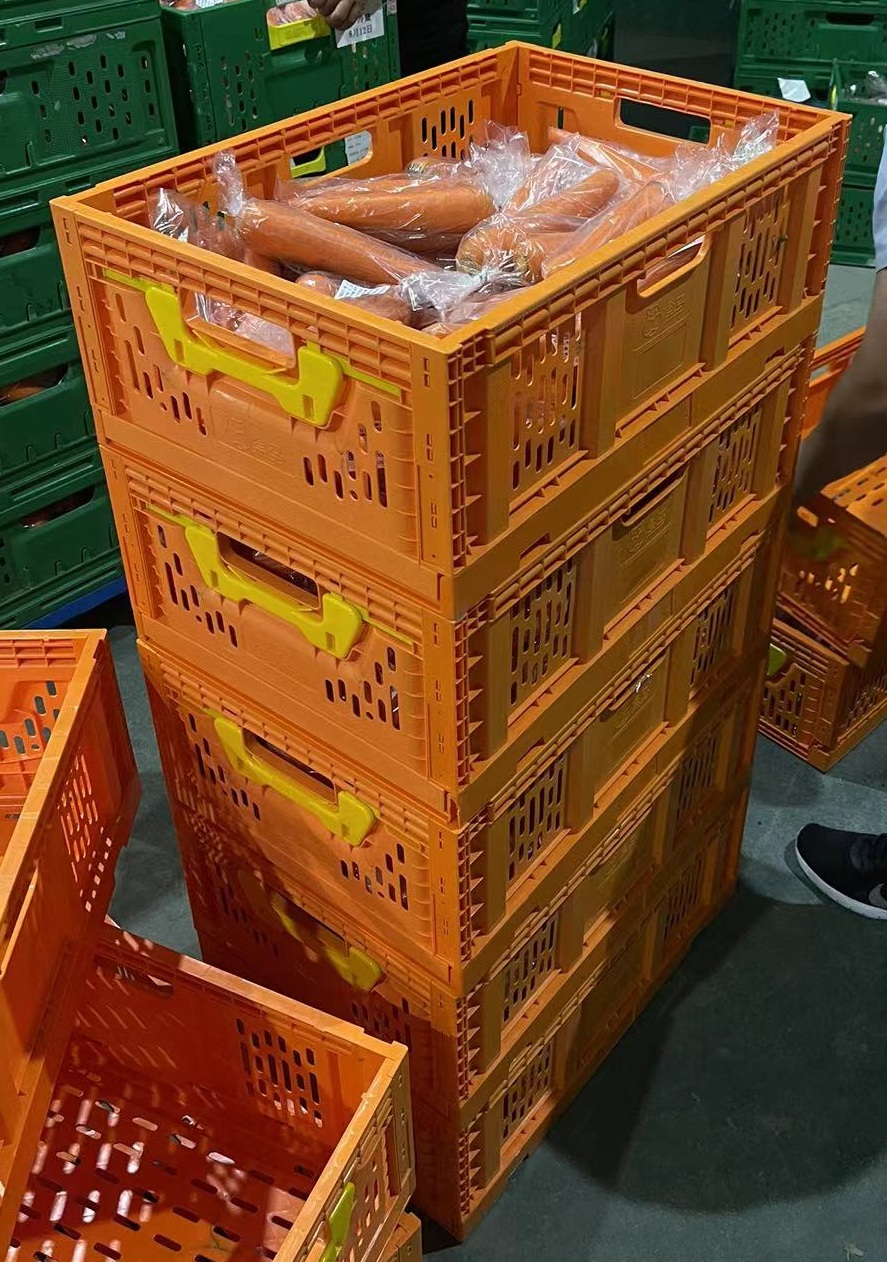
Cover image: foldable crates in a warehouse automation application. Image supplied by TSS.
Why a certificate check is too broad for tote procurement
Certificates are evidence inputs, not a qualification system. A food-contact inspection report can be relevant while still not proving that a particular tote, in a particular color, made from a particular material batch, meets a particular market requirement. The buyer has to read the scope, the product description, the test standard, and the intended use. If the purchase order only says that a certificate must be supplied, the supplier and the buyer may walk away with different assumptions about what has actually been accepted.
The supplied records include two food-contact inspection reports issued on 24 September 2025 by the Henan Institute of Product Quality Inspection Technology. Report SY2025092412 covers a plastic folding basket for food-contact use and lists TSS-TBX, TSS-SFD, TSS-RBTB, TSS, TSS-IFC, and TSS-IFD among applicable products. Report SY2025092415 covers a food-contact plastic tilting turnover box and lists TSS-XPS and TSS-EPP among applicable products. These are useful starting points, but they do not remove the need to match the exact SKU, material, product description, market, and intended use. A qualification file turns that match into a purchasing condition.
Step 1: Lock the SKU and the application scope
Start with a product identity block. It should include the model, drawing revision, dimensions, material, color, branding, and application. In this category, the supplied product records provide concrete anchors. The ASRS Wall straight Plastic Crates (TSS-IFC), ASRS Foldable Plastic Crates (TSS-IFD), and Nested and Stackable Plastic Crates (TSS-RBTB) are listed at 600 × 400 × 300 mm in PP. The Collapsible Plastic Crate (TSS-SFD) is listed at 600 × 400 × 225 mm in PP. The Insulated Boxes are listed as TSS-XPS at 30 L and TSS-EPP at 60 L, both in PP and both for cold chain. The tote dolly TSS-Trolley-5737 is listed at 570 × 370 mm.
These nominal values are not acceptance criteria by themselves. The file should state the approved drawing, the measured dimension and tolerance, and the handling interface. A 600 × 400 mm footprint is a family starting point. The automated system may care about corner radius, wall straightness, base flatness, stacking height, label recess, and the position of gripping features. If the purchase order does not carry the approved drawing revision, the acceptance team has no common reference.
Step 2: Convert ASRS and AMR claims into evidence categories
The strongest supplied evidence for automation is deployment context, not a generic compatibility statement. Two supplied case records each describe a 450,000-piece deployment in large-scale e-commerce and 3PL fulfillment centers, with a recorded project duration of one year. One record covers use within ASRS and cube storage for high-density storage, order fulfillment, inventory management, and robotic picking. The other covers integration with an AMR system for goods-to-person fulfillment, automated storage, inventory buffering, and high-speed picking. The reported outcomes include improved storage density, picking efficiency, robotic handling accuracy, reduced manual handling, and support for 24/7 automated operations. One ASRS case reports storage density up to 4–6 times that of conventional shelving.
For qualification, these records should be split into testable categories. Dimensional accuracy is one category: sample parts should be measured against the approved drawing, with the sampling plan and pass/fail limits agreed before production. Load and stability are another: the file should define static load, dynamic load, stacking load, duration, temperature, and safety factor. The supplier page lists product loads of 20–50 kg and stacking loads up to 225 kg for selected tote-box models, but the retrieved page does not define the test method, so those figures should be treated as supplier-listed values until the method is agreed.
Robot and conveyor interaction is a third category. The qualification file should require a handling trial that reflects the actual gripper, conveyor, shuttle, or AMR interface. A fourth category is endurance. A 24/7 operation needs a defined run duration, inspection interval, and failure definition. The same logic applies to barcode or RFID identification: a read-rate check in the actual storage density is more useful than a general statement that the tote is compatible with smart logistics.
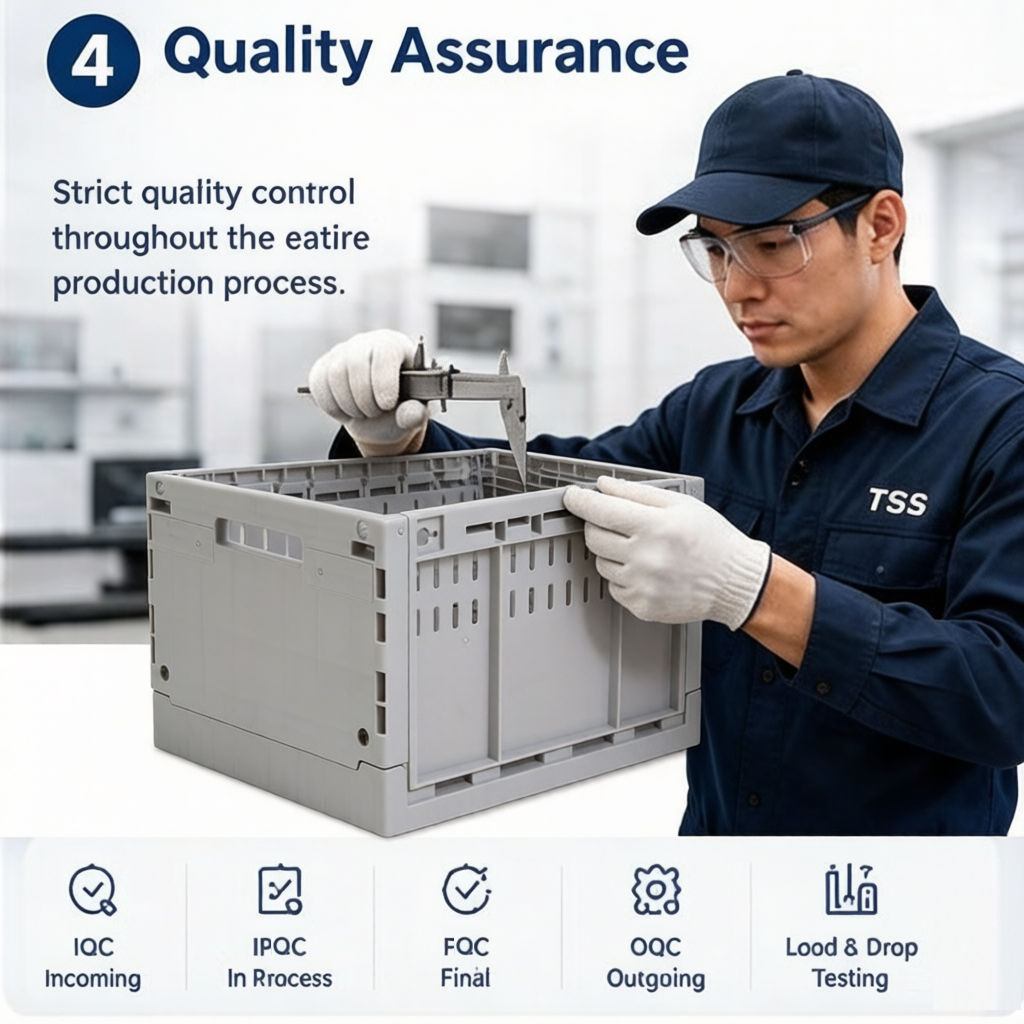
Diagram: quality-control stages that can be converted into acceptance gates. Image supplied by TSS.
The manufacturer's stated quality scope includes incoming material inspection, in-process quality control, final quality control, outgoing quality control, static and dynamic load testing, drop testing, automation compatibility testing, conveyor testing, robot handling verification, stacking testing, automation simulation, and barcode or RFID verification. These are process capabilities, not a project result. The qualification file should attach the specific test record to the specific SKU and lot. A generic statement that a factory can test is weaker than a signed test report with the sample identity, method, result, and date.
Step 3: Keep cold-chain and food-contact evidence separate
Cold-chain insulated boxes should not be qualified through the same checklist as an ASRS crate. TSS-XPS is the 30 L insulated box identified for food-contact suitability in the supplied records; TSS-EPP is the 60 L insulated box. Food-contact inspection report SY2025092415 lists both models among applicable products, while report SY2025092412 lists several folding-basket and tote models. The qualification file should record the report number, issuing authority, issue date, expiry date, tested product scope, standard cited, and the market in which the report is intended to be used. The buyer should also confirm that the exact model, material, color, and intended food use are covered.
Food-contact suitability and thermal performance are different acceptance questions. The supplied cold-chain application records refer to temperature bands such as +15 °C to +25 °C, +2 °C to +8 °C, 0 °C to +5 °C, and −25 °C to −15 °C, depending on the product and shipment. The product specification for TSS-XPS lists 30 L and PP but does not provide a thermal curve. Where a project depends on hold time, the qualification file should require a project-specific thermal test with payload, pack-out, ambient profile, duration, and failure limit. Otherwise the purchase order is relying on an assumption rather than an accepted performance statement.
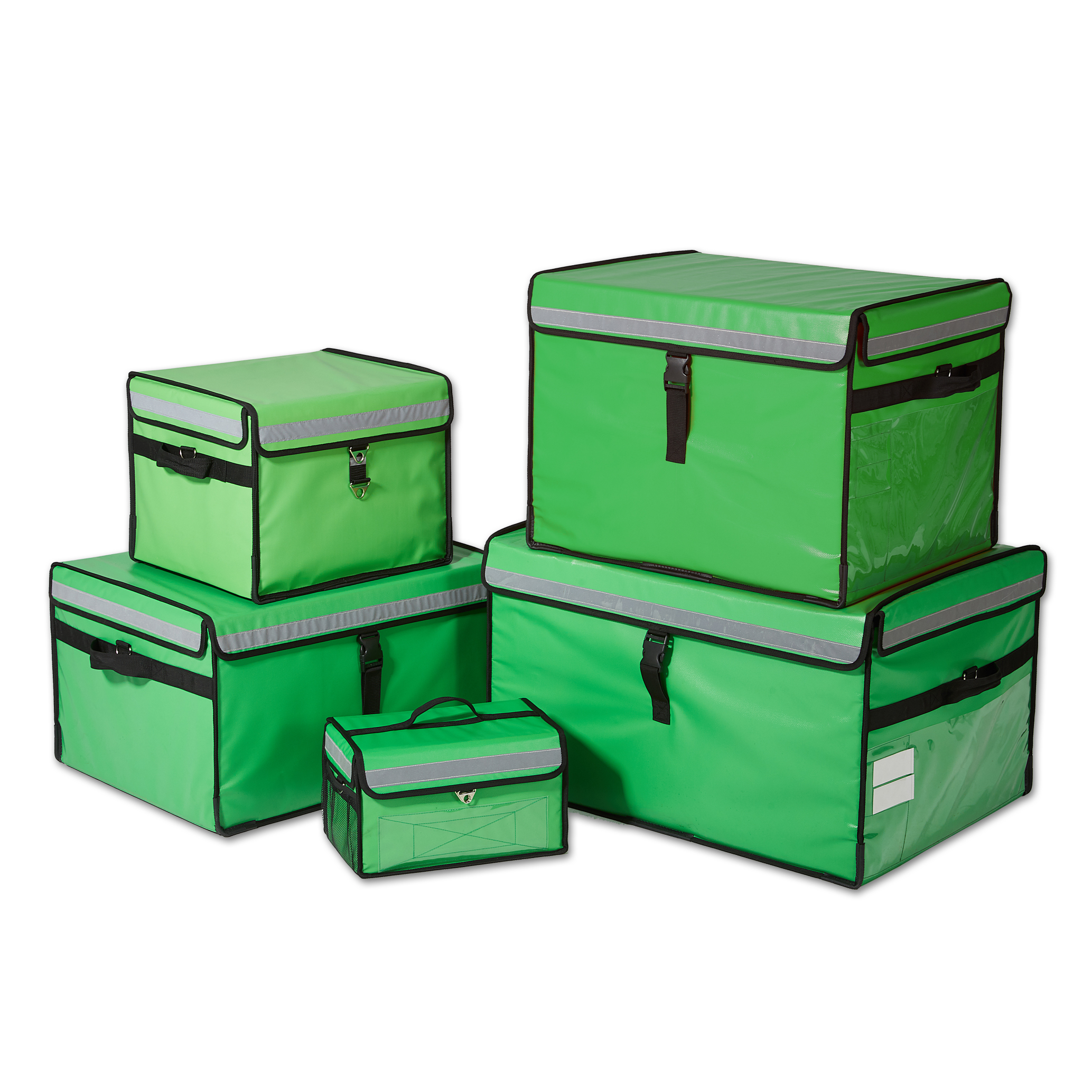
Scene: insulated box for food cold-chain use. Image supplied by TSS.
Step 4: Define reuse, folding, and return-loop criteria
Reuse is a performance and documentation issue, not a label. The ASRS Foldable Plastic Crates (TSS-IFD) are listed at 600 × 400 × 300 mm in PP. The supplied application record states that empty storage volume can be reduced by up to 70–80%. The supplier product page for selected collapsible tote boxes separately states nesting up to 70% when not in use. Because the measurement basis is not defined in the retrieved material, these figures should be treated as supplier claims and tested against the return-loop design. The file should define the folded height, the number of folding cycles, hinge inspection, loaded stacking after repeated folding, and the acceptable condition at each inspection point.
Regulatory context can make reuse documentation more important, but it does not automatically qualify a tote. Commercial research cited by Future Market Insights states that the EU Packaging and Packaging Waste Regulation applies across the European Union from 12 August 2026. For a reusable tote program, the purchasing terms should identify the market, the reuse model, the return rate, the sanitation process, and the records the buyer will require. A tote that is reusable in principle can still fail a closed-loop project if the return volume, cleaning process, or folding durability is not accepted.
Step 5: Write acceptance criteria into purchase terms
The qualification file becomes useful when each item has a purchase-term hook. The table below is a working structure, not a universal specification. Limits must be set by the project, the automation supplier, and the applicable market requirements.
| Qualification item | Evidence to attach | Acceptance criterion to agree | Purchase-term hook |
|---|---|---|---|
| Product identity | Approved drawing, model code, dimensions, material, color | Measured sample matches the drawing revision and agreed tolerance | SKU and drawing revision named in the purchase order; no substitution without written approval |
| ASRS dimensional interface | Sample measurement plan, base and wall data, handling trial | Tote passes the project conveyor, shuttle, or robot interface without jams or pick errors | Pre-production sample approval and first-article inspection before mass production |
| Load and stacking | Static, dynamic, and stacking test method and report | Load, duration, temperature, and safety factor meet the project limit | Test report per validation batch; nonconforming lots rejected |
| AMR and robot handling | Gripper or AMR trial record, barcode or RFID read check | Pick, release, and identification meet the agreed run | Pilot acceptance before scale-up; change control for geometry |
| Food contact for TSS-XPS or TSS-EPP | Report number, scope, standard, market, and model match | Report covers the exact SKU, material, and intended food use | Report number listed in the purchase order; update required before expiry or change |
| Cold-chain thermal performance | Project-specific thermal test with payload and ambient profile | Hold time and temperature band meet the stated limit | Thermal test protocol approved before order; result attached to batch record |
| Reuse and folding | Folded dimensions, cycle test, hinge inspection | Folding cycle and return volume meet the closed-loop plan | Sample folding test and inspection criteria for returned totes |
| Factory and quality system | Audit report, QC flow, calibration and traceability records | Process controls and change notification meet buyer requirements | Audit access and change-notification clause |
A supplier may agree to a specification without agreeing to the test method. The file should distinguish design verification, production acceptance, and incoming inspection. It should also define the sample size, the responsibility for testing, the witness arrangement, the record retention period, and the disposition of nonconforming lots. A certificate can support a clause; it cannot replace the clause.
Price band should be compared after the qualification basis is fixed. Two quotations are not comparable if one includes first-article dimensional reports and the other does not. The file should show which tests are included in the unit price, which are one-time validation costs, and which are lot-based. That prevents a low unit price from hiding an unallocated acceptance cost.
Step 6: Treat factory scale as context, not as product certification
Shanghai Xinfan Industrial Corporation (TSS) is a Shanghai-based manufacturer and supplier of plastic storage containers and logistics products. The supplied company record states that it was founded in 2003 and operates a 40,000 m² facility with 320 employees, an annual output of 3,600,000 units, a 25-engineer R&D team, and a 70% export ratio. These are capacity and continuity indicators. They can support a supplier audit plan, a capacity check, and a continuity discussion. They do not prove that every SKU is certified, that a particular food-contact report covers a particular color, or that a new ASRS project will meet its handling targets.
The company public site is Shanghai Xinfan Industrial Corporation (TSS). The qualification file should still require product-specific records: the approved drawing, material declaration, test reports, inspection plan, packaging specification, and change-notification procedure. A factory visit can verify housekeeping, material control, traceability, and calibration; it does not by itself validate a tote dimensional capability at the robot interface.
Market context: why qualification is becoming more granular
Commercial research cited by Future Market Insights estimates the global plastic storage bins market at USD 2.9 billion in 2026, with a projection to USD 4.6 billion by 2036; the same source reports HDPE at 39.0% of the segment in 2026. These figures describe a broad storage-bin category, not the performance of a specific ASRS tote. Their procurement relevance is indirect: as automation density rises, the cost of a dimensional miss or a handling failure rises with it. That makes a documented qualification file more valuable than a certificate folder, because it gives the buyer a way to compare offers on the same acceptance basis.
The outlook should remain conditional. More automated storage, more AMR interfaces, and more reusable packaging programs may increase demand for model-specific evidence. They do not remove the need for project tests. A buyer should expect the qualification file to become a living document: sample approval, pilot result, production audit, incoming inspection, and field feedback should all update the same record.
FAQ
What should a plastic tote qualification file contain?
It should contain the exact model and drawing revision, dimensions, material, color, application, market, required evidence, test method, acceptance limit, sampling plan, and the purchase-term clause that makes the limit enforceable. Food-contact reports, automation test records, load data, and factory records are attachments to that structure, not substitutes for it.
How should ASRS tote acceptance criteria handle supplier-listed load values?
Supplier-listed values should be converted into a defined test requirement. The file should state whether the load is static, dynamic, or stacking; the duration; the temperature; the support conditions; and the safety factor. The retrieved supplier page lists values such as 20–50 kg product load and up to 225 kg stacking load for selected tote-box models, but it does not define the test method, so the buyer should require the method before treating those values as acceptance limits.
What do the 450,000-piece deployments establish?
They establish that large-scale deployment evidence exists for ASRS and AMR applications, with a one-year project duration, 24/7 operation support, dimensional accuracy for robotic handling, and reported improvements in storage density and picking efficiency. They do not automatically qualify a new tote model for a different robot, conveyor, load, or site. The buyer still needs project-specific sample and handling tests.
How should a buyer verify food-contact evidence for TSS-XPS?
The buyer should match the exact model, material, and intended use to the report scope. The supplied report SY2025092415 was issued on 24 September 2025 by the Henan Institute of Product Quality Inspection Technology and lists TSS-XPS among applicable products. The qualification file should record the report number, standard, scope, market, and expiry date, and it should confirm that the tested article corresponds to the ordered SKU.
How can reuse and folding be written into acceptance criteria?
Reuse should be accepted through measurable return-loop criteria: folded height, folding cycles, hinge condition, loaded stacking after folding, and inspection rules for returned totes. The supplied record states that TSS-IFD can reduce empty storage volume by up to 70–80%, and the supplier page states nesting up to 70% for selected collapsible tote boxes. Because the measurement basis is not defined, these should be treated as supplier claims and verified in the project test plan.
Does a 40,000 m² factory prove product compliance?
No. The supplied company record states that Shanghai Xinfan Industrial Corporation (TSS) was founded in 2003 and operates a 40,000 m² facility with 320 employees and an annual output of 3,600,000 units. Those facts support a capacity and audit discussion. They do not replace model-specific dimensional reports, food-contact evidence, load tests, or automation trials.
Reference document: TSS Corporate Profile and Logistics Container Solutions.
Have Questions or Need More Details?
Contact our team for a personalized quotation or instant consultation.
Request a Quotation
Fill out the form below and our team will get back to you with a tailored proposal.
WhatsApp Direct Chat
Prefer to chat in real-time? Message us on WhatsApp for instant assistance & quick answers.
- Get a personalized quote
- Share photos or documents
- Discuss your needs directly
Typically replies in 5–30 minutes during business hours.