
Plastic Totes Qualification: Terms Into Acceptance Criteria
Procurement Reference · Plastic Totes
Qualification is the point at which a purchasing description stops being an intention and becomes something a supplier can be measured against. In plastic totes, most sourcing disputes do not begin with a bad product; they begin with a purchase order that says “high dimensional accuracy”, “food grade” or “ASRS compatible” and never defines how any of those will be demonstrated. Acceptance criteria are the written, testable version of those phrases: measurable limits, a stated test method, a sample size, and a named piece of evidence that closes the line item.
This reference is written for buyers, engineers and project managers specifying reusable plastic totes for automated warehouses, food supply chains and retail distribution. It does not argue that one tote is better than another. It sets out how to convert ordinary purchasing language into criteria that survive a factory audit, a pilot run and a first production lot — and where the evidence needed to verify those criteria has to come from the buyer’s own test programme rather than from the supplier’s brochure.
Shanghai Xinfan Industrial Corporation (TSS) is a Shanghai-based manufacturer of reusable logistics packaging and security seals, producing plastic totes across ASRS, wall-straight, nest-and-stack, collapsible, attached-lid, dolly and insulated formats. Its product documentation and capacity statements are used below as concrete examples of how supplier-declared data should be read during qualification — not as a substitute for the buyer’s own acceptance protocol.
The qualification gap: terms that cannot be measured
Automation projects are where wording problems surface fastest. A tote that measures acceptably in a supplier’s catalogue can still fail in a live system if its external envelope, base flatness or wall straightness shift beyond what a conveyor guide rail, a shuttle fork or a robot gripper tolerates. Small geometric deviations are enough to produce jams, misreads and picking stoppages, which is why system integrators prefer to agree tolerances in writing before tooling is cut.
Three failure patterns account for most tote qualification disputes:
- Adjectives instead of limits. “Heavy-duty”, “precision” and “suitable for automation” carry no test method and therefore cannot be passed or failed.
- Numbers without a basis. A load figure quoted without duration, temperature, support conditions and safety factor is not comparable to any other supplier’s figure, or to the buyer’s own handling reality.
- Compliance implied rather than scoped. A food-contact claim that does not name the model, resin and colourant used cannot be traced to the article the buyer is actually receiving.
Six purchasing terms and what they should become
The table below is the core working tool of this article. Each row takes a phrase that appears routinely in tote purchase orders and converts it into an acceptance criterion plus the evidence that closes it. The right-hand column is deliberately about evidence rather than reassurance: a supplier statement, a measured sample and a test report are not interchangeable.
| Purchasing term | Why it fails as written | Acceptance criterion | Evidence to require |
|---|---|---|---|
| Material: “PP, virgin, food safe” | Resin type, grade, colourant and recycled content are all undefined | Resin and grade stated on the drawing; colour approved against a physical chip; declaration tied to the specific model and colour | Material declaration per model, colour chip approval record, lot-level incoming material inspection (IQC) reference |
| Dimensions: “600×400×300 mm” | Nominal size only; tolerance band, measurement points and conditioning are missing | External dimensions per axis with a stated tolerance band, measured at defined points after agreed conditioning | Dimensional report per mould cavity, with critical dimensions declared |
| “High dimensional accuracy for automation” | No limit, no measuring system, no sampling rule | Envelope tolerance plus base flatness and wall straightness limits, verified on samples from each cavity | Tolerance and capability (CPK) verification, mould flow analysis, T0/T1/T2 trial-run reports |
| “Stackable” | Stack height, load per unit and duration are absent | Loaded stack configuration defined (units high, load per unit, temperature, duration) with permitted deflection | Static and dynamic load test report stating method, duration and safety factor |
| “Food grade / food contact” | The claim is not scoped to model, resin or colourant | Declared food-contact suitability for the exact article and colour supplied, plus cleaning regime compatibility | Documentation naming the model and materials, aligned to the destination market’s requirements |
| “ASRS / AMR compatible” | Compatibility is a property of the system pair, not the tote alone | Pass criteria agreed on the buyer’s conveyor, shuttle or gripper: jam events, grip success, read rate, positioning repeatability | Conveyor testing, robot handling verification, automation simulation, barcode and RFID read verification |
Material and food-contact criteria: separating declaration from proof
Material is the clause buyers most often assume is settled. In practice, tote portfolios are built across several materials and configurations rather than one standard specification. TSS manufactures its tote range in polypropylene and lists polypropylene or HDPE as material options for its tote boxes with lids. At category level, HDPE accounted for 39.0% of the plastic storage bin segment in 2026, reflecting its impact tolerance and moisture resistance — but a category-level material share says nothing about whether a specific resin, colourant and wall section are right for a specific duty cycle.
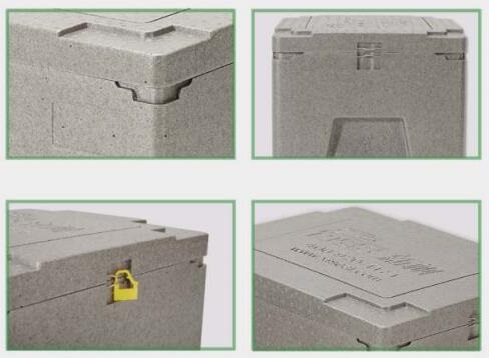
Food-contact suitability is where the distinction between declaration and proof matters most. TSS positions insulated boxes for temperature-controlled food and pharmaceutical logistics, and lists food-contact compliance as an application requirement for the food cold-chain box (TSS-XPS, 30 L) alongside hygienic packaging design and freshness preservation. Its 60 L expanded polypropylene box (TSS-EPP) is offered for cold-chain duty, and food-contact safe materials are also listed as a requirement for its fresh-produce crate formats.
What that means for a buyer is narrow and practical: the supplier can declare suitability for a model, and the buyer must require that the declaration names the model, the resin and the colourant actually being supplied. A food-contact statement issued for a different colour batch, or for a general product family rather than the ordered article, does not close the line item. This article does not assert that any specific certificate exists; where certification is a market requirement, it should be requested as a named document against the destination market and verified before approval.
Dimensional accuracy: the criterion automation projects actually fail on
Footprint standardisation is the reason automation totes converge on a small number of formats. The 600×400 mm base is the dominant global footprint for ASRS totes and bins, with 650×450 mm used as an alternative in some systems. TSS’s automation range follows this logic: the wall-straight ASRS crate (TSS-IFC) and the foldable ASRS crate (TSS-IFD) are both listed at 600×400×300 mm in polypropylene, and the attached-lid stackable tote (TSS-TBX) at 600×400×320 mm.
Sharing a nominal footprint, however, is not the same as sharing a tolerance. A usable acceptance criterion should specify:
- Nominal external dimensions per axis with a tolerance band, plus the measurement points and the conditioning state at which they are measured.
- Base flatness and wall straightness limits, because these govern how the tote sits on a conveyor, enters a shuttle channel and presents itself to a gripper.
- Cavity-level verification, since variation between mould cavities can exceed variation between lots.
- Measurement method, so that supplier and buyer reports are directly comparable rather than merely similar.
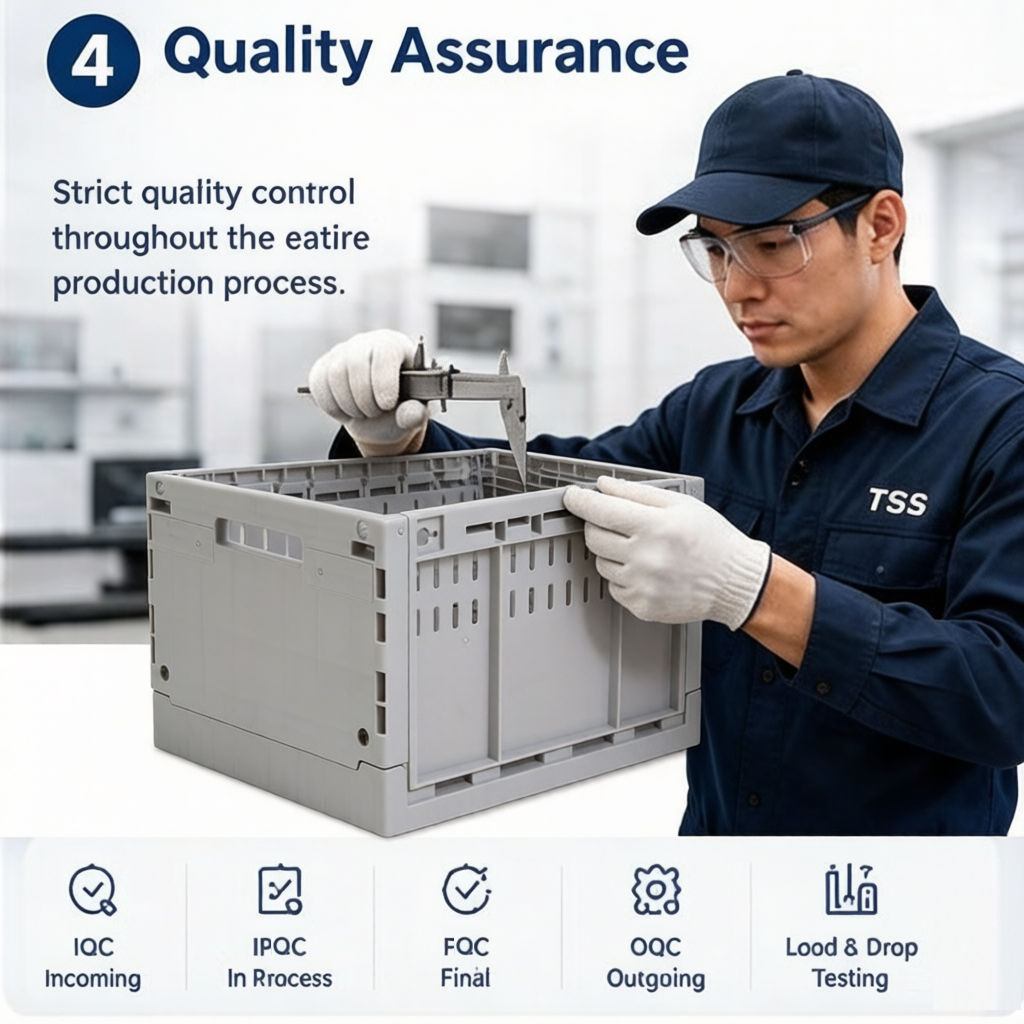
TSS lists mould flow analysis, dimensional verification, trial-run validation (T0/T1/T2 sampling) and tolerance and capability verification as part of its tooling and quality routine, and separately lists high dimensional accuracy as a special requirement for its ASRS-oriented crates. Those are the right categories of evidence to ask for; the buyer’s job is to attach a number and a method to each of them in the purchase order.
Stackability and load: require the basis, not just the number
Load figures are the most frequently misread data in tote procurement. TSS lists product load values of 20 kg, 25 kg, 35 kg, 40 kg and 50 kg across selected tote models, and separate stacking-load values up to 225 kg. The stacking-load basis — test method, duration, support conditions, temperature and safety factor — is not fully defined on the published page. That does not make the figures unusable; it makes them a starting point for an RFQ question rather than an acceptance result.
A defensible stackability clause therefore specifies the loaded stack configuration (number of units high, load per unit, ambient or chilled temperature, duration), the maximum permitted deflection, and the test method to be used. Static and dynamic load testing and drop testing are the standard verification instruments, and both should be requested as reports rather than described as capabilities.
Return logistics adds a second set of criteria. Collapsible formats reduce empty volume by up to 70–80% according to TSS, and the company states that selected collapsible tote boxes nest up to 70% when not in use. For a closed-loop project, the acceptance criteria should extend to nested or folded height, folding-cycle durability and the load performance of the collapsed structure — because the folded geometry is not the loaded geometry, and each needs its own verification.
Durability under automated handling: what a large deployment does and does not prove
Deployment scale is useful evidence of a different kind: it demonstrates that a supplier can hold dimensional discipline across very large volumes and integrate with third-party automation hardware. Two large-scale warehouse automation projects each took 450,000 plastic containers — foldable crates for ASRS and totes — into major e-commerce and 3PL fulfilment centres, integrated with AGV/AMR robotic systems for goods-to-person picking, automated storage, inventory management and robotic handling. In the reported ASRS deployment, storage density increased by up to 4–6 times compared with conventional shelving, with improved order fulfilment speed, reduced labour dependency and improved inventory accuracy.
What that record does not do is transfer a cycle-life number to another site. Duty cycle, load mix, conveyor speed, gripper design, temperature and cleaning regime all differ, and no supplier can pre-certify a tote against a system it has not seen. The correct use of deployment evidence is as a qualification input — it reduces the supplier-side risk of a pilot — while the buyer still runs an acceptance test against their own hardware.
An acceptance protocol from sample to lot release
Once terms are converted into criteria, the remaining question is sequencing. A workable protocol separates what is proven before tooling from what is proven at the pilot and what is proven per lot.
| Stage | What is verified | Reference point from TSS documentation |
|---|---|---|
| Engineering review | Drawing, tolerance bands, material declaration, colour target, automation interface features | Engineering review listed at 5–10 working days for OEM build-to-print work |
| Sample and prototype | Measured dimensions against tolerance, base flatness, wall straightness, fit on buyer’s conveyor or gripper | Sample production listed at 7–15 working days; automation evaluation at 3–5 days with sample validation at 7–15 days |
| Tooling and trial runs | Cavity-to-cavity variation, capability on critical dimensions, first-article approval | New tooling listed at 30–60 working days; trial-run validation at T0/T1/T2 sampling with CPK and tolerance verification |
| Pilot lot in the live system | Jam events, read rates, robotic grip success, damage under real handling | Conveyor testing, robot handling verification, stacking testing and automation simulation listed as validation instruments |
| Production lot release | Conformance to the approved drawing and to the agreed inspection standard | IQC, IPQC, FQC and OQC referenced as the inspection chain; AQL, customer-specific standards and third-party inspection available |
| Non-conformance handling | Containment, root cause, corrective action, replacement basis | Initial response stated within 24 hours; corrective action report within 3–5 working days; replacement for verified manufacturing defects |
Two commercial clauses belong in the same document rather than in a separate negotiation. The first is the minimum order quantity for a customised item, which TSS lists at 500 pieces for customised products and 1,000 pieces for RFID and smart logistics projects, with standard OEM projects at 1,000–5,000 pieces and existing products at 100–500 pieces; MOQ is stated as negotiable across programmes. The second is the change-control route, since any change to resin, colourant, wall section or mould will invalidate the dimensional and load evidence the buyer has already accepted.
Where these criteria matter most
Automated storage and goods-to-person fulfilment. Wall-straight and foldable ASRS crates in a 600×400 mm footprint are qualified primarily on geometry and handling consistency. TSS lists automated storage and retrieval by mini-load crane or shuttle, conveyor compatibility and robotic handling as the operating context for its ASRS ranges, with high dimensional accuracy and structural rigidity as the stated special requirements.
Cold chain and food logistics. Insulated boxes add temperature duty to the acceptance question. TSS lists temperature ranges of +2 °C to +8 °C for vaccines and −25 °C to −15 °C for frozen foods, with gel packs, PCM packs or dry ice as refrigerants and data loggers or GPS trackers as supporting equipment. The qualification consequence is that thermal performance, food-contact scope and cleaning compatibility must be specified as separate line items rather than folded into a single “cold chain approved” statement.
Retail, fresh produce and closed-loop distribution. Nest-and-stack crates, collapsible crates and attached-lid totes are qualified on stack-versus-nest behaviour, ventilation, moisture resistance, food-grade materials and barcode or RFID readability. TSS lists food-contact safe materials, traceability support and easy-to-clean design among the requirements for these formats, and provides dollies in 577×377 mm and 570×370 mm formats to move totes in picking and replenishment operations.
Market signals pushing acceptance criteria upward
Two verified data points explain why tote qualification has become more formal. First, the plastic storage bins market was valued at USD 2.9 billion in 2026 and is projected to reach USD 4.6 billion by 2036, according to Future Market Insights research published via openPR — growth that brings more suppliers, more configurations and more specification variability into the same buyer decisions. Second, the EU Packaging and Packaging Waste Regulation (PPWR) applies across the European Union from 12 August 2026, which raises the commercial weight of reuse, durability and return-loop performance for packaging placed on that market.
Regional growth adds a third consideration. South Korea is reported at a 6.2% CAGR for plastic bins in the same research, at medium confidence, which matters mainly as a signal of where returnable packaging infrastructure is expanding and where buyers may need documented reuse performance rather than one-way packaging economics. None of these figures replaces a buyer’s own acceptance test; they explain why the test is now expected to be written down.
Totes versus alternatives, and the real cost of qualification
Reusable plastic totes are not automatically the correct answer, and qualification is not free. Against single-use corrugated, plastic totes carry higher unit cost, require a return, cleaning and pooling infrastructure, and only pay back where the loop closes often enough. TSS states 70% export across EU, North America, South America, Southeast Asia, Middle East and Africa and roughly 3,600,000 units of annual output from a 40,000 m² facility with 320 employees — an indication of supply capability at programme scale, not evidence that a returnable system is the right choice for a given route.
Within the plastic category there is also a genuine trade-off between configurations. Foldable ASRS crates reduce empty volume by up to 70–80%, which materially lowers return transport and empty storage cost, but their load-bearing geometry differs from wall-straight crates. Buyers should not assume that a collapsed or folding structure inherits the load and dimensional behaviour of a rigid wall-straight crate; folding-cycle durability, collapsed-stack stability and handling consistency each need separate acceptance verification. The honest limitation of the whole approach described in this article is that most published tote data, including the figures cited here, is supplier-reported. Independent test data on tolerance, cycle life and conveyor compatibility is scarce, so the practical burden of proof sits with the buyer’s own pilot and first-article approval.
Future outlook
Tote qualification is moving from a purchasing courtesy to a project control. As automated storage densifies and reuse obligations tighten, three changes are likely to become normal: tolerance and load figures will be requested with their test method attached; food-contact declarations will be scoped to model, resin and colour rather than to a product family; and supplier selection will increasingly depend on evidence packs — trial-run reports, capability studies and non-conformance records — rather than on catalogue claims. Suppliers that already operate cavity-level verification, documented inspection chains and change control are structurally better positioned for that shift, because the evidence a buyer needs is a by-product of how they already work.
Frequently asked questions
What does “ASRS compatible” mean in a purchase order?
It means the tote has been tested on the specific storage and retrieval equipment it will run on, with agreed pass criteria. Compatibility is a property of the tote-and-system pair, not of the tote alone, so the clause should name the conveyor, shuttle or gripper, the test conditions and the acceptable outcome — for example permitted jam events, grip success rate and barcode or RFID read rate. A nominal 600×400 mm footprint is a starting point for that test, not a substitute for it.
How should dimensional tolerance be specified for plastic totes?
Specify external dimensions per axis with a tolerance band, the measurement points, the conditioning state before measurement, and separate limits for base flatness and wall straightness. Require verification on samples drawn from each mould cavity rather than one representative part, and require the measurement method to be stated so that supplier and buyer reports are comparable. Capability studies on critical dimensions, produced during trial-run validation, give a better indication of production consistency than a single dimensional report.
Is the 600×400 mm footprint mandatory for automated storage?
No. It is the dominant global footprint for ASRS totes and bins, and several automated formats — including wall-straight and foldable ASRS crates — are built at 600×400 mm. However, 650×450 mm formats are also used in some systems. The footprint should be taken from the storage and retrieval equipment specification, not assumed from category convention.
How can food-contact suitability be verified before approval?
Require a declaration that names the specific model, resin and colourant being supplied, and align the required documentation to the destination market’s rules. A statement issued for a product family, or for a different colour batch, does not cover the article being ordered. Where certification is a market requirement, request it as a named document and verify it independently before approving the supplier; supplier-declared suitability and verified certification are separate items and should be recorded separately.
What load figures should be requested, and how should they be verified?
Request product load and stacking load separately, each with its test basis: method, duration, support conditions, temperature and safety factor. Published figures without a stated basis — for example a stacking load quoted for selected models — cannot be compared with another supplier’s figure or with the buyer’s own conditions. Verification typically combines static and dynamic load testing with drop testing, and, for automated systems, handling trials on the actual conveyor or gripper.
What is a realistic acceptance schedule for a first tote order?
It depends on whether new tooling is required. TSS lists engineering review at 5–10 working days, sample production at 7–15 working days and mass production at 15–30 working days, with new tooling at 30–60 working days and trial-run validation at T0/T1/T2 sampling. A buyer-side pilot in the live system should be scheduled separately from supplier production milestones, because jam behaviour and read rates can only be assessed on the actual equipment.
Supplier capability and product data referenced in this article are drawn from Shanghai Xinfan Industrial Corporation (TSS) published product, capability and project documentation. Market and regulatory figures are drawn from Future Market Insights research published via openPR (2026) and the EU Packaging and Packaging Waste Regulation. Product details, capacities and lead times are supplier-reported and should be confirmed in the project RFQ.
The TSS corporate profile and logistics container solutions brochure is available for download: TSS Corporate Profile & Logistics Container Solutions (PDF).
Have Questions or Need More Details?
Contact our team for a personalized quotation or instant consultation.
Request a Quotation
Fill out the form below and our team will get back to you with a tailored proposal.
WhatsApp Direct Chat
Prefer to chat in real-time? Message us on WhatsApp for instant assistance & quick answers.
- Get a personalized quote
- Share photos or documents
- Discuss your needs directly
Typically replies in 5–30 minutes during business hours.