
Plastic Vacuum Forming: What Buyers Should Understand First
Plastic vacuum forming is a thermoforming process in which a thermoplastic sheet is heated until soft, drawn against a single-sided mold by vacuum pressure, cooled, and trimmed into a finished part. It is one of the most practical routes to large, low-to-medium-volume plastic housings, covers and panels — and it remains the default starting point for engineers who need a big part before they need a big mold.
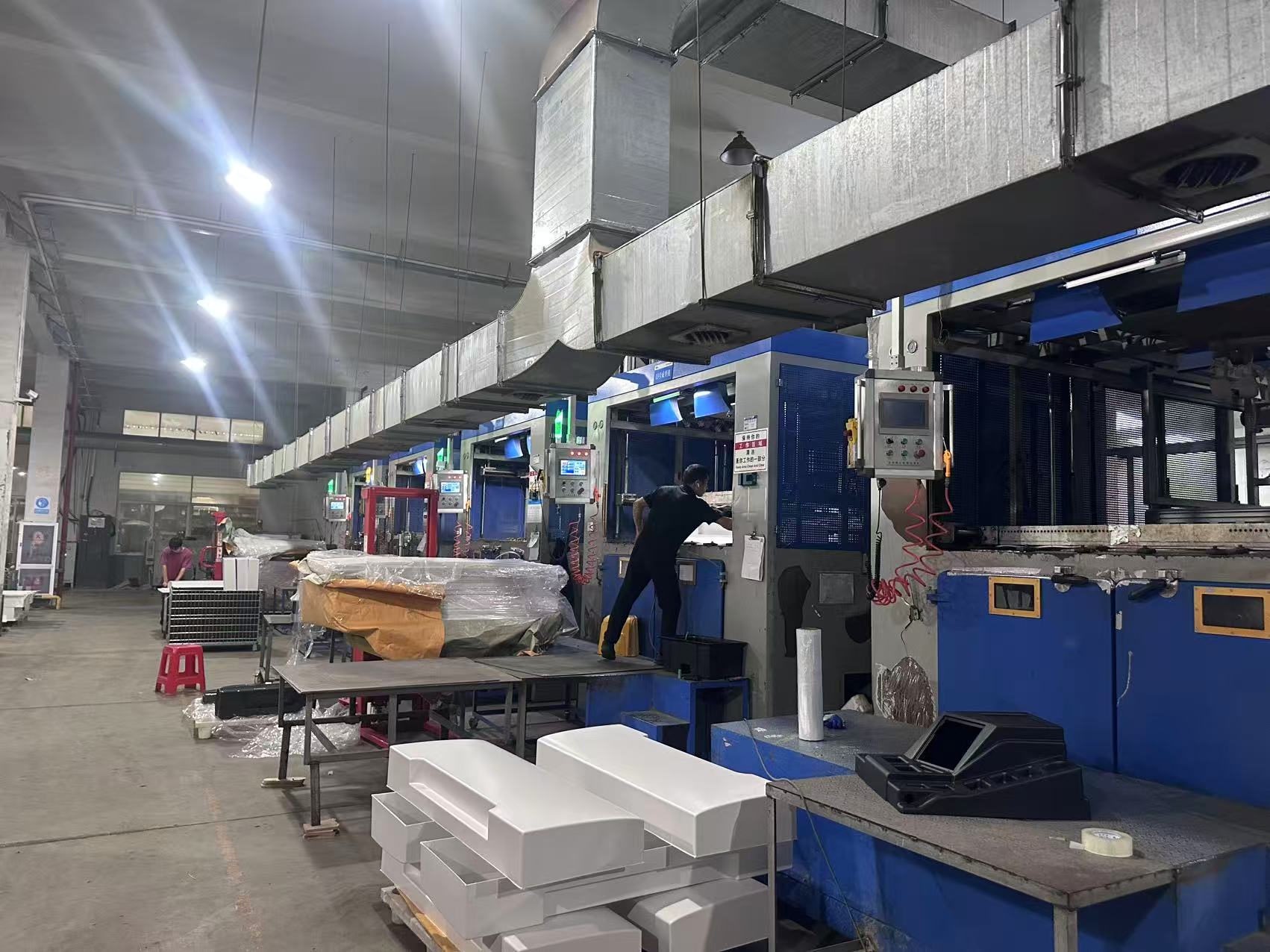
The category is not small. Grand View Research estimates the global plastic vacuum forming market at USD 4.8 billion in 2023 and projects USD 7.2 billion by 2030, while attributing 40.7% of 2023 regional share to Asia Pacific. Those figures describe a mature process serving mature industries, not a niche tooling method.
For buyers entering the category for the first time, the difficulty is rarely a lack of suppliers. It is understanding what the process can and cannot do, how thick-gauge work differs from the thin-gauge packaging world most people associate with thermoforming, and which questions need to be settled before a drawing becomes a piece of tooling.
Heavy-Gauge and Thin-Gauge Are Two Different Businesses
Thermoforming splits into two commercial worlds that share equipment principles but almost nothing else.
Thin-gauge forming uses sheet material under roughly 1.5 mm and produces high volumes of disposable or semi-durable items — trays, clamshells, inserts. It dominates the category by volume of revenue: Mordor Intelligence attributes 76.22% of the combined heavy- and thin-gauge thermoforming market in 2025 to thin-gauge processes. Heavy-gauge forming, by contrast, starts at thicker sheet and produces structural parts: equipment housings, machine covers, vehicle interior panels, radomes and outdoor components.
The distinction matters to buyers because the two segments have different tooling economics, different tolerance behaviour and different supplier bases. A supplier that excels at thin-gauge packaging is not automatically equipped for a 2 mm to 10 mm sheet drawn into a 3-metre housing.
The Buyer Problem: Large Parts, Low Volumes, Long Approval Cycles
Industrial equipment manufacturers repeatedly run into the same constraint. A new machine, robot platform, medical device or vehicle variant needs an enclosure — often large, often cosmetically visible, often needed in quantities that do not justify a hardened steel mold.
Injection molding solves that problem only at scale. Its tooling is expensive and its economics depend on spreading that tooling across a large number of parts. Sheet metal fabrication solves it differently, but struggles with compound curves, deep draws and integrated cosmetic surfaces. Vacuum forming occupies the space between: single-sided molds that cost a fraction of a high-volume tool, forming capability that scales to very large footprints, and a finish that can be painted, printed or textured after forming.
The cost of that flexibility is paid in precision, geometry and post-processing — a trade-off this article returns to later.
How a Heavy-Gauge Vacuum Forming Project Actually Runs
The process sequence is straightforward; the process control is not.
A thermoplastic sheet is clamped and heated until it reaches a formable state. The softened sheet is then drawn over or into a mold, with vacuum removing the air between sheet and mold so that atmospheric pressure pushes the material into shape. After cooling, the part is demolded and trimmed to its final outline and cut-outs.
The controlling variable is heat. Uneven heating of plastic sheets can trigger uneven wall thickness and dimensional errors, and over-stretching of plastic sheets can result in uneven wall thickness and dimensional deviation. In heavy-gauge work, uneven wall thickness and dimensional deviation is the main risk that separates a good part from a rejected one, because thick sheet cannot redistribute material the way thin sheet can.
Documented mitigation follows a consistent pattern: control heating, optimize the part structure for the draw, pre-review drawings before tooling, and verify and test samples before mass production. Pre-reviewing drawings is the cheapest of these controls and the one most often skipped. Testing samples before mass production is the last point at which a dimensional or cosmetic issue can be corrected without scrapping tooling.

Materials: What the Sheet Choice Changes
Material selection drives appearance, durability, compliance and cost, and it is usually decided before the mold is cut. In heavy-gauge thermoforming the common engineering options are ABS, flame-retardant ABS, ASA, PC, PETG, PMMA, PVC, HDPE and PE, alongside composite materials.
For reference, the dimensions that matter most to buyers in this segment are sheet thickness and forming footprint. A typical heavy-gauge specification supports sheet thickness of 2–10 mm and a maximum forming size of up to 3300 mm × 2000 mm — enough for machine enclosures, vehicle trim and large equipment covers formed as a single piece.
| Material | Why buyers specify it | Practical note |
|---|---|---|
| ABS | General-purpose structural housings with good surface finish after forming | Also available as flame-retardant ABS where a project requires it |
| ASA | Exterior and outdoor parts where appearance must survive weathering | Often paired with UV-resistant surface options |
| PC (polycarbonate) | Impact resistance and optical clarity where visibility is required | Available transparent or translucent, and with matte film finishes |
| PETG | Clean, tough parts where clarity and formability both matter | Common in covers and guards |
| PMMA (acrylic) | Optical clarity and a high-quality cosmetic surface | Best treated as a cosmetic material, not a structural one |
| PVC | Industrial covers and housings with defined chemical or flame behaviour | Project-specific grades required |
| HDPE / PE | Impact-resistant, chemical-tolerant parts | Impact-resistant PE is specified where impact is the dominant load |
Material behaviour notes reflect general industry practice; final selection and any fire rating, UV-resistance rating, dimensional tolerance or assembly requirement must be confirmed against the specific project.
Where the Process Meets Its Limits
Vacuum forming is not a precision-machining substitute, and buyers who treat it as one create problems for themselves and their supplier.
- Wall thickness is not uniform. Material thins where the sheet stretches most. Deep draws produce thinner walls at corners and radii, and this must be designed around rather than inspected away.
- Dimensional deviation is inherent. Thick-sheet forming involves thermal movement during cooling, so tolerances are wider than machined or molded alternatives.
- Ratings are project-specific. Fire rating, UV-resistance rating, tolerances and assembly requirements are not catalogue values — they require project confirmation.
- Secondary operations are normal. Trimming, routing and cut-out work are part of the process route, not an optional extra, and should be priced from the start.
The Supply Side: Hangzhou Baiheli New Materials Co., Ltd.
Hangzhou Baiheli New Materials Co., Ltd. is a Chinese heavy-gauge thermoforming processor established in 2011, based at No. 651 Fansheng Road, Guali Town, Xiaoshan District, Hangzhou. The company has more than 14 years of experience in heavy-gauge thermoforming processing, and its business focus covers design, production and custom processing of thermoformed products.
Its operational profile is documented at approximately 10,000 square metres of standard factory space, around 90 employees, and annual output of about 550,000 units, with an export ratio of 30–40% and a five-person R&D team. The company holds ISO 9001:2016 Quality Management System Certification and has stated plans to add on-site photovoltaic generation capacity.
The product portfolio is concentrated in thick-sheet thermoformed components: AGV housings, new energy vehicle parts, textile machine covers, intelligent machinery housings, medical equipment housings, amusement equipment thermoformed parts, marine antenna radomes and rooftop tents. In 2023, documented output included new energy auto parts, AGV housings, textile machinery housings, intelligent mechanical equipment housings, medical device housings, game console housings and shipborne radome housings.
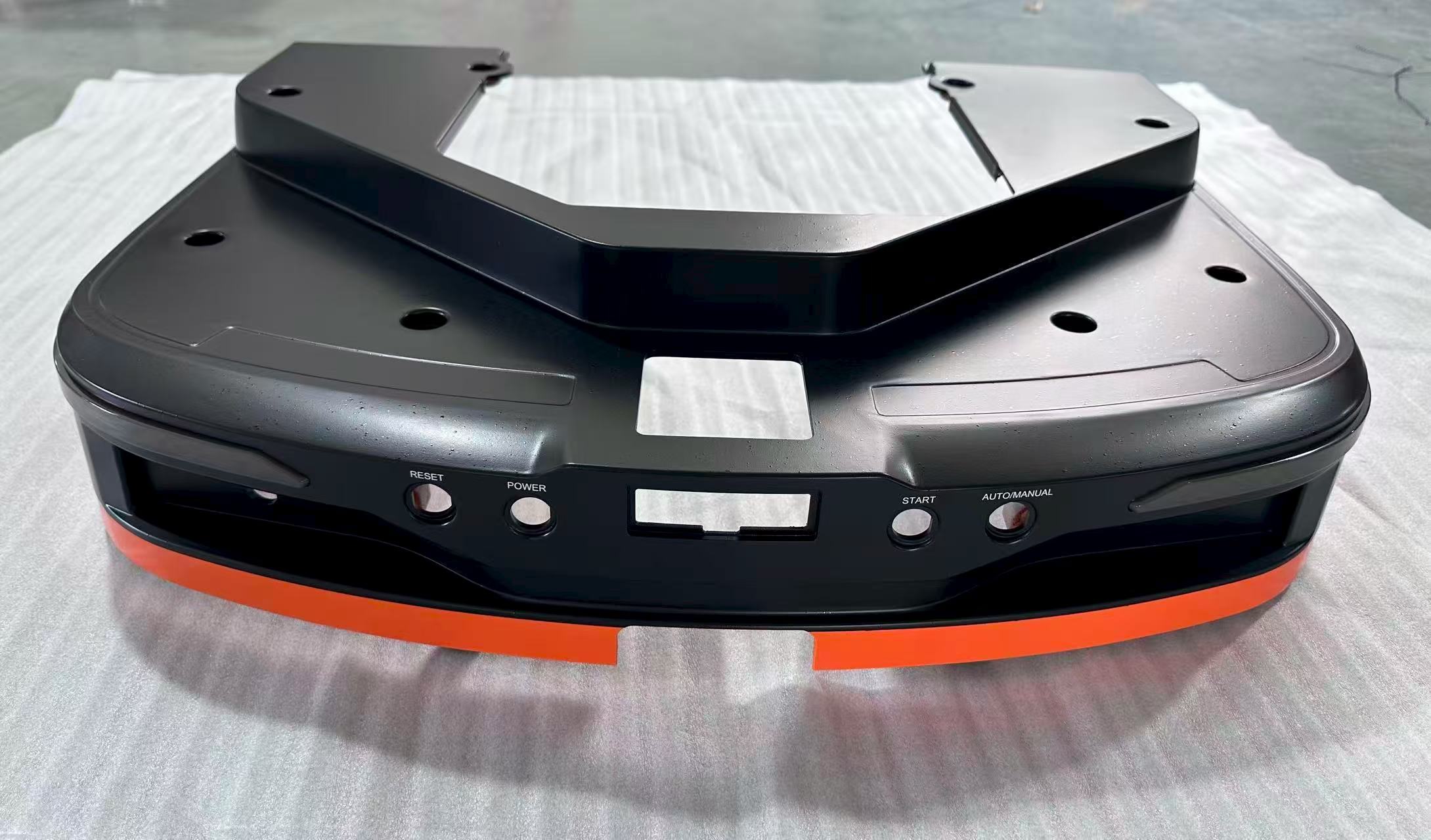
Two representative product families illustrate how the capability maps to demand. The Vacuum Thermoformed Housing (model designation Drone Housing) is a vacuum formed housing built from ABS, ASA, PC, PETG, PMMA, PVC or HDPE. The Automotive Interior Parts range, model designation Auto Interior Components, covers door trim panels and bumper covers in the same material set. Both are specified at 2–10 mm sheet thickness and a maximum forming size of up to 3300 mm × 2000 mm.
Application Landscape: Where Vacuum Formed Parts Fit
The applications that recur across the category share a common shape: a part that is large, structural only in a modest sense, cosmetically visible, and needed in quantities that do not justify high-volume tooling.
| Industry | Typical formed parts |
|---|---|
| New energy vehicles and automotive parts | Interior trim panels, bumper covers, structural covers |
| Logistics and AGV systems | AGV housings, robot housings, intelligent transport vehicle bodies |
| Robotics and intelligent equipment | Machine housings, protective covers, equipment enclosures |
| Medical equipment | Device housings and covers requiring clean, formable surfaces |
| Textile machinery | Machine covers and guards |
| Communication antennas | Radomes and antenna housings |
| Outdoor and recreation | Rooftop tent components, amusement equipment parts |
| Drones and unmanned systems | Drone housings and protective shells |
Service conditions in these applications are usually stated as an operating temperature range of −20°C to 70°C, indoor or outdoor, with an optional UV-resistant surface where the part will be exposed to sunlight. Project-specific options include flame-retardant ABS, PC matte film, transparent or translucent PC, impact-resistant PE, screen printing and masked painting.
Market Trend Analysis
Three structural signals are visible in the available market data.
First, growth is forecast but moderate. The move from USD 4.8 billion in 2023 to a projected USD 7.2 billion by 2030 describes steady expansion rather than a boom, which is consistent with a process tied to capital equipment cycles.
Second, supply is Asia-Pacific weighted. A 40.7% Asia Pacific share in 2023 means buyers outside the region are structurally dependent on Asian capacity for formed plastic parts, and regional sourcing decisions carry weight beyond unit price.
Third, heavy-gauge remains the specialist minority. With thin-gauge processes holding 76.22% of the combined thermoforming market in 2025, heavy-gauge capability is a narrower competence. For buyers, that means supplier shortlists for large formed parts will be shorter than the overall thermoforming supplier pool, and qualification effort should be planned accordingly.
It is also worth noting what the data does not say. Aggregate market figures describe direction, not the feasibility of any individual part. A buyer still has to verify that a specific supplier can form a specific geometry in a specific material.
Vacuum Forming Compared With Injection Molding and Fabricated Assemblies
Positioning the process honestly is more useful than promoting it.
| Criterion | Vacuum forming | Injection molding | Sheet metal / fabricated assemblies |
|---|---|---|---|
| Tooling cost | Low relative to the alternatives; single-sided molds | High; hardened precision tooling | Low to moderate; fixtures and dies |
| Economic volume | Prototypes through medium batches | High-volume production | Low to medium volume |
| Part size | Very large footprints formed as one piece | Practical size limits tied to press capacity | Large, but assembled from multiple pieces |
| Geometry | Compound curves and deep draws; limited undercuts | Complex geometry including undercuts | Flat and folded forms; curves require extra operations |
| Dimensional precision | Wider tolerance band | Tight tolerances | Moderate to tight, depending on process |
| Design change cost | Moderate; tooling can often be revised | High; tooling changes are costly | Low; revised cut files |
The limitation that matters most is precision. Vacuum forming cannot match injection molding on dimensional consistency, and thick-sheet work introduces wall thickness variation that is a property of the process rather than a defect. Buyers who need a sealed, high-tolerance interface, tight mating surfaces or heavy load-bearing structure should expect to combine a formed shell with machined inserts, brackets or a secondary frame.
A second limitation is compliance. Where a part sits inside an automotive supply chain, IATF 16949:2016 — the mandatory quality management standard for automotive supply chain members, maintained by the International Automotive Task Force — governs supplier qualification. A thermoforming supplier holding general quality certification is not automatically qualified for automotive work, and that gap should be identified before a program is quoted, not after.
How Buyers Should Evaluate a Thermoforming Supplier
A practical evaluation sequence for heavy-gauge work looks like this:
- Confirm the forming envelope. Match the part footprint and sheet thickness against the supplier's stated maximum forming size and thickness range before discussing anything else.
- Share drawings early for pre-review. Drawing pre-review is a documented defect-mitigation step and the cheapest correction point in the project.
- Verify a sample before mass production. Sample testing before mass production is the accepted control for wall thickness and dimensional risk.
- Agree the secondary operations. Trimming, cut-outs, screen printing and masked painting all affect lead time and cost and should be fixed in scope.
- Document the ratings. Fire rating, UV-resistance rating, tolerances and assembly requirements should be written into the project specification rather than assumed.
- Check the quality system against the destination industry. General quality certification and industry-specific qualification are different thresholds.
Future Outlook
Heavy-gauge thermoforming is unlikely to be displaced in its core territory. The economics that make it attractive — low tooling cost against large part size — become more valuable as equipment platforms multiply and product life cycles shorten, because each new platform needs an enclosure before volumes are known.
The more probable direction of change is in process control and material scope. Continued growth in the Asia Pacific supply base, alongside composite and engineering material options, will keep pressure on tolerances and surface quality. On the buyer side, the practical implication is that specification discipline matters more than supplier count: a clearly written material, tolerance and secondary-operation scope removes most of the risk that heavy-gauge forming carries.
Frequently Asked Questions
What is plastic vacuum forming?
Plastic vacuum forming is a thermoforming process in which a thermoplastic sheet is heated and drawn against a mold using vacuum pressure, then cooled and trimmed. Thick-sheet vacuum thermoforming refers specifically to forming solid plastic sheet into large, customised plastic housings.
What is the difference between thick-gauge and thin-gauge thermoforming?
Thin-gauge thermoforming uses thinner sheet and serves high-volume, lighter-duty products, while heavy-gauge thermoforming uses thicker sheet to produce structural parts such as equipment housings, machine covers and vehicle components. Thin-gauge processes account for the large majority of combined thermoforming market revenue, which makes heavy-gauge forming a distinct specialist segment.
Which materials can be used in plastic vacuum forming?
Common engineering options include ABS, flame-retardant ABS, ASA, PC, PETG, PMMA, PVC, HDPE and PE, along with composite materials. Selection depends on the required surface finish, impact behaviour, optical clarity and any project-specific fire or UV requirement.
What are the main quality risks in heavy-gauge vacuum forming?
The main risk is uneven wall thickness and dimensional deviation. It can be triggered by uneven heating of plastic sheets, and over-stretching of plastic sheets can also produce uneven wall thickness and dimensional deviation. Documented mitigation includes controlling heating, optimising the part structure, pre-reviewing drawings, and testing samples before mass production.
What part sizes and sheet thicknesses are practical?
In heavy-gauge work, a representative specification supports sheet thickness of 2–10 mm and a maximum forming size of up to 3300 mm × 2000 mm. Actual feasibility depends on material, draw depth and geometry, and should be confirmed per project.
Which industries use vacuum formed plastic parts?
Documented applications include new energy vehicles and automotive parts, logistics and AGV systems, robotics and intelligent equipment, medical equipment, textile machinery, communication antennas, outdoor camping products, amusement equipment and drone applications.
Reference Material
The company's corporate brochure, covering capability, facility and product scope, is available for download: Hangzhou Baiheli New Materials Co., Ltd. Corporate Brochure.
Have Questions or Need More Details?
Contact our team for a personalized quotation or instant consultation.
Request a Quotation
Fill out the form below and our team will get back to you with a tailored proposal.
WhatsApp Direct Chat
Prefer to chat in real-time? Message us on WhatsApp for instant assistance & quick answers.
- Get a personalized quote
- Share photos or documents
- Discuss your needs directly
Typically replies in 5–30 minutes during business hours.