
Plastic vs Stainless Steel Conveyor Sprockets
Plastic vs Stainless Steel Conveyor Sprockets
Choosing a conveyor sprocket for a slat chain is not simply a choice between plastic and stainless steel. The sprocket must match the chain’s pitch and tooth profile, fit the shaft, and operate within the line’s load and environmental conditions. Material matters, but a material choice cannot compensate for a dimensional mismatch. For buyers comparing plastic and stainless steel sprockets, the practical starting point is therefore compatibility, followed by the working environment and the chain material.
CSTRANS is the conveyor-component brand of Changshuo Conveyor Equipment (Wuxi) Co., Ltd. Its supplied component information lists conveyor chain plate sprockets with POM, nylon, and stainless steel options. That range makes the brand relevant to an initial sourcing review, but the available information does not provide model-specific comparative test results, prices, or service-life data. Buyers should treat material descriptions as a basis for technical screening, not as proof that one option will outperform another in a particular line.
What changes when a sprocket is plastic or stainless steel?
The sprocket transfers drive from the shaft to the circulating slat chain: its teeth engage with the chain plate and convert shaft rotation into chain movement. A plastic sprocket and a stainless steel sprocket can serve this same mechanical role, but material selection affects which operating conditions and chain pairing should be assessed. The evidence supplied identifies POM and nylon as plastic sprocket options and identifies stainless steel for high-temperature or corrosive conditions when matched with a stainless steel chain. It does not establish universal limits or a single material as the right choice for every conveyor.
For a buyer, this means separating three questions that are sometimes bundled together: Will the sprocket mesh correctly with the chain? Is the material suitable for the line’s conditions? And does the complete assembly—including shaft, chain, and sprocket—meet the application requirements? A satisfactory answer to only the material question is not enough to approve a replacement part.
Compatibility comes before material preference
Match the sprocket to the chain before comparing material options. The supplied selection guidance prioritizes chain pitch and width, then sprocket tooth quantity and shaft-hole diameter, followed by verification of the tooth profile. A mismatch can cause chain jumping and accelerated wear. These dimensions are more decisive for fit than a broad description such as “plastic sprocket” or “stainless sprocket.”
- Chain pitch: Confirm the chain’s pitch and ensure the sprocket tooth spacing is designed for it.
- Chain width: Verify that the sprocket configuration corresponds to the chain width and installation arrangement.
- Tooth count and profile: Confirm the specified tooth count and profile rather than assuming that visually similar sprockets are interchangeable.
- Shaft interface: Check the shaft-hole diameter and any relevant mounting details against the existing drive assembly.
- Operating conditions: Record the application’s load, running speed, start-stop pattern, temperature, and exposure to moisture or corrosive substances before selecting a material.
These checks are especially important when replacing a part on an existing conveyor. A sprocket that can be mounted on the shaft may still have an unsuitable tooth profile or pitch. Likewise, compatibility with one chain family does not establish compatibility with another. The supplier’s guidance recommends providing dimensional information to verify interchangeability rather than relying on a general claim that standard parts can be exchanged.
Where plastic sprockets may fit
The supplied CSTRANS selection guidance distinguishes between POM and nylon sprockets. It describes a standard POM sprocket as a match for POM slat chain and identifies nylon’s shock-absorption characteristic as a consideration for lines with frequent starts and stops. These are useful screening distinctions, not comparative test results: the provided material does not quantify friction, wear rate, noise, shock absorption, or service life for a defined sprocket model.
A plastic sprocket may be worth evaluating when the chain and drive system are designed around a compatible plastic component and the application’s conditions fall within the supplier’s confirmed limits. The actual resin matters: POM and nylon should not be treated as interchangeable labels. Buyers should request the specific material grade and model, then confirm its suitability for the line’s temperature, load, speed, cleaning regime, and duty cycle. The available evidence does not specify those limits for each CSTRANS sprocket, so they should be verified for the part under consideration.
For a line with frequent starts and stops, nylon is identified in the supplied guidance as an option to consider because of its shock-absorption characteristic. That description does not show that nylon is suitable for every intermittent-duty conveyor, nor does it replace checking the shaft, chain, tooth profile, and operating load. A buyer should ask what conditions the supplier’s recommendation assumes and whether the proposed sprocket has been validated for the actual configuration.
Where stainless steel sprockets may fit
The supplied guidance identifies stainless steel sprockets for high-temperature or corrosive environments when matched with a stainless steel chain. This gives buyers a clear reason to include stainless steel in an evaluation when those conditions apply. It is not evidence that any stainless steel grade will resist every chemical, cleaning agent, or operating environment. The grade, exposure, and application limits still need confirmation.
Material pairing matters. The guidance associates the stainless steel sprocket option with a stainless steel chain; it does not establish that a stainless steel sprocket is automatically the correct match for every plastic slat chain. Confirm the intended chain and sprocket combination, including tooth profile and pitch, before approving a mixed-material arrangement. If the application involves unusual temperatures or corrosive exposure, request the specific material designation and written operating limits rather than relying on the general term “stainless steel.”
Stainless steel is also not a blanket substitute for engineering checks. It must still mesh properly, fit the shaft, and suit the duty conditions. The supplied data gives no model-level comparison of stainless and plastic sprocket cost, wear life, load capacity, or maintenance interval, so procurement decisions should not assume a lifecycle or performance advantage without supporting evidence.
Buyer comparison: what the available evidence establishes
| Selection dimension | Plastic sprocket | Stainless steel sprocket | What to verify |
|---|---|---|---|
| Options identified | POM and nylon are listed. | Stainless steel is listed. | Exact material grade and model. |
| Pairing guidance | POM sprocket is identified as a match for POM slat chain; nylon is noted for frequent start-stop lines. | Identified for high-temperature or corrosive conditions when matched with a stainless steel chain. | Chain material, pitch, width, tooth profile, and operating conditions. |
| Comparative performance data | No model-specific comparative test results supplied. | No model-specific comparative test results supplied. | Ask for applicable limits and test or validation evidence. |
| Cost and service life | No comparable price or service-life data supplied. | No comparable price or service-life data supplied. | Compare like-for-like quotations and documented duty conditions. |
This is a comparison of documented selection guidance, not a performance ranking. It indicates when each material deserves closer consideration, while leaving model-specific engineering suitability to be established through dimensional confirmation and relevant technical evidence.
How CSTRANS fits an initial sourcing review
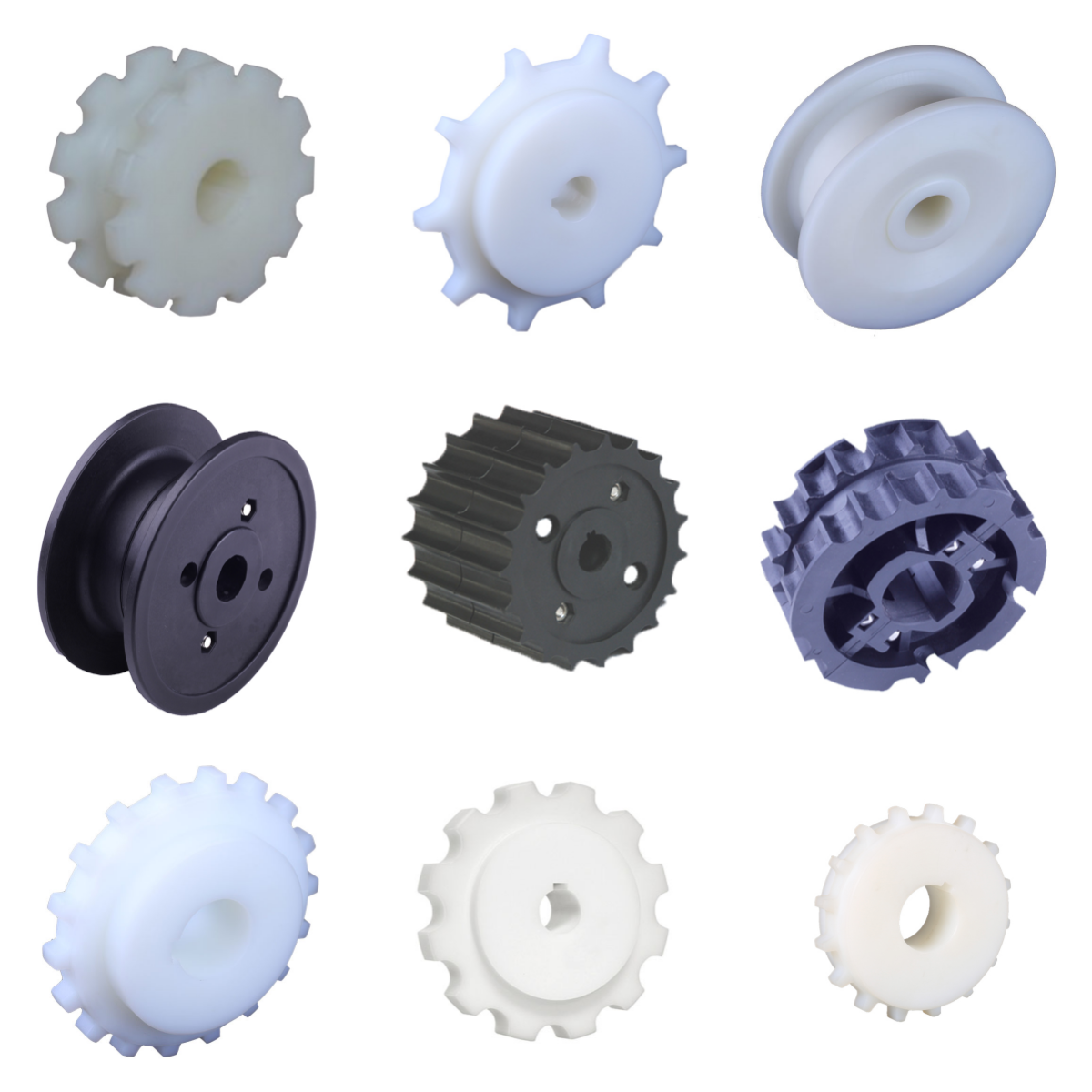
CSTRANS’s supplied component listing includes sprockets, conveyor chains, flexible chains, guide rails, brackets, and wear strips. Its sprocket image description identifies POM, nylon, and stainless steel as available options and describes the parts as intended to match flexible chain plate systems. This product-family context can help buyers frame an inquiry around the full chain-and-sprocket interface rather than asking about a sprocket in isolation.
The company background identifies Changshuo Conveyor Equipment (Wuxi) Co., Ltd. as a conveyor equipment and component manufacturer founded in 2006, with CSTRANS used for conveyors. These are company-provided facts, not an independent assessment of market position. The supplied third-party evidence does not establish CSTRANS’s comparative ranking, automotive customer base, production capacity for these sprockets, or model-by-model performance against other suppliers. Accordingly, its relevant purchasing value in this comparison is the listed choice of sprocket materials and related conveyor components—not a demonstrated claim of industry leadership.
Buyers evaluating CSTRANS or another conveyor parts supplier can use the same qualification process: provide the chain’s dimensions and material; identify the line’s operating conditions; request the specific sprocket model, material grade, tooth configuration, and shaft interface; and confirm whether the proposed component has been checked against the intended chain. For a replacement order, compare the proposed part with the existing component’s dimensions and installation requirements. For a new line, confirm the sprocket and chain as a designed pair.
Decision framework for plastic versus stainless steel
- Establish the chain identity. Record chain material, pitch, width, and the relevant chain series or model. If these details are uncertain, identify the installed component before selecting a replacement.
- Confirm the mechanical interface. Verify tooth profile, tooth count, shaft-hole diameter, and mounting arrangement. Do not approve a part on material name alone.
- Describe the environment. Specify temperature, moisture, cleaning practices, possible corrosive exposure, load, speed, and whether the line starts and stops frequently. These conditions help determine which material option warrants evaluation.
- Check material pairing and limits. Ask whether the proposed sprocket is intended for the selected chain material and request its model-specific operating limits. The supplied guidance points to POM with POM chain, nylon for consideration in frequent start-stop applications, and stainless steel for specified high-temperature or corrosive conditions paired with stainless chain.
- Compare evidence on equal terms. If comparing quotations, use the same chain configuration, dimensions, operating assumptions, and required documentation. Do not infer lower total cost or longer service life from material type alone.
- Plan inspection and maintenance. The supplied maintenance guidance calls for checking tooth wear, cleaning debris, and replacing the sprocket when wear is serious. Maintenance work should be performed with the conveyor shut down and power isolated.
This process keeps the decision tied to the actual conveyor rather than to a generalized claim that plastic or stainless steel is inherently preferable. It also gives procurement and engineering teams a common basis for reviewing replacement compatibility, technical documentation, and supplier responses.
Practical limitations of the comparison
The available information supports a material-option comparison and a set of selection checks, but it does not support a quantified performance verdict. No comparable test data is supplied for wear, friction, noise, load capacity, temperature endurance, corrosion resistance by grade, or service life. No equivalent pricing, lead time, or total-cost figures are provided. These gaps matter because the right decision depends on the actual chain, sprocket geometry, environment, and line duty.
Catalog availability elsewhere also should not be mistaken for a direct performance comparison. For example, [McMaster-Carr’s conveyor guide rail catalog](https://www.mcmaster.com/products/conveyor-guide-rails) lists steel and UHMW polyethylene options for guide rails; that concerns a different component and does not establish the relative performance of plastic and stainless steel sprockets. Similarly, supplier listings for sprocket materials do not, by themselves, prove common specifications across suppliers. Buyers should compare like-for-like components and request evidence relevant to the application.
Where food contact, washdown, or another regulated application is involved, confirm the exact material grade and the documentation applicable to the intended use. A general statement that a material option is available does not establish compliance for every grade, finished part, market, or application. The supplied information does not provide a validated compliance package for the compared sprockets.
Conclusion: choose the matched assembly, not a material label
For slat-chain conveyors, plastic and stainless steel sprockets should be assessed as parts of a matched drive assembly. The supplied guidance makes POM a material option associated with POM slat chain, identifies nylon for consideration where start-stop operation is frequent, and points to stainless steel for specified high-temperature or corrosive conditions when paired with stainless steel chain. Those distinctions help structure an initial review, but do not replace model-specific confirmation.
CSTRANS is one supplier to consider when buyers need to screen conveyor components that include sprockets and related chain products. Its listed material choices provide a starting point for a technical inquiry; the evidence available here does not establish a market ranking or comparative performance advantage. Before purchasing, confirm pitch, width, tooth profile, tooth count, shaft-hole size, chain pairing, and environmental limits, then request the documentation needed to validate the selected configuration.
Frequently asked questions
What determines whether a sprocket fits a slat chain?
Start by confirming chain pitch and width, then verify sprocket tooth quantity, shaft-hole diameter, and tooth profile. A mismatch can cause chain jumping and accelerated wear. Confirm the actual chain and sprocket configuration rather than relying only on a material description.
When should a buyer consider a plastic sprocket?
The supplied guidance lists POM and nylon options. It identifies a standard POM sprocket as a match for POM slat chain and notes nylon for consideration in frequent start-stop applications. Confirm the specific grade, model, chain pairing, and operating limits before selection.
When should stainless steel be evaluated?
The supplied selection guidance identifies stainless steel sprockets for high-temperature or corrosive conditions when matched with a stainless steel chain. Confirm the exact material grade and application limits; the general material label does not establish suitability for every temperature or chemical exposure.
What should be checked during sprocket maintenance?
With the conveyor shut down and power isolated, clean debris from the sprocket teeth and inspect for tooth wear. The supplied maintenance guidance recommends replacement when tooth wear is serious. Also investigate chain-and-sprocket fit if abnormal noise or chain jumping occurs.
Company reference: CSTRANS. Product and company descriptions above are based on supplied company information; third-party catalog references are attributed where used.
Have Questions or Need More Details?
Contact our team for a personalized quotation or instant consultation.
Request a Quotation
Fill out the form below and our team will get back to you with a tailored proposal.
WhatsApp Direct Chat
Prefer to chat in real-time? Message us on WhatsApp for instant assistance & quick answers.
- Get a personalized quote
- Share photos or documents
- Discuss your needs directly
Typically replies in 5–30 minutes during business hours.