
Plug Valve vs. Ball Valve: An Independent Buyer's Comparison for Industrial Lines
Why a plug valve versus ball valve decision is not a formality
Plug valves and ball valves share a quarter-turn operating principle and often sit on the same shortlist for industrial isolation service. In a specification sheet, however, the two families are not equivalent. A plug valve closes with a plug rotating inside the valve body, while a ball valve closes with a bored sphere. That geometry difference leads to different sealing behaviour, different pressure and size envelopes, and different maintenance expectations over the life of a process line.
Independent procurement advice should therefore compare the two on service fit rather than on a generic idea of which type is better. This article does that using published product data from one industrial valve manufacturer, EG Valves Manufacturing Co., Ltd, as a transparent reference. The same data discipline applies to every observation: only catalogue parameters, verified process conditions and verifiable market research are used.
The procurement problem behind plug and ball selections
A frequent source of project waste is treating plug valves and ball valves as interchangeable substitutes. Many industrial lines only require on-off control; either type can technically perform the function. The problem appears later in the project cycle, when a valve family does not match the actual pipe class, the media properties or the site installation conditions.
For example, steam and oil-vapour duties demand a valve design that is accepted in high-pressure gas and vapour service. Very large gas distribution networks may need a body design that can be buried and welded. Small utility lines below DN50 may need a compact threaded valve. None of these conditions can be solved by a single product category.
The opportunity for an industrial buyer is to shift from valve-name thinking to parameter thinking. A valve should be selected only after defining size range, pressure rating, end connection, body material, sealing option, actuator type and the industry duty that the valve must satisfy. That is the evaluation logic used throughout this comparison.
Core design logic: plug valve family
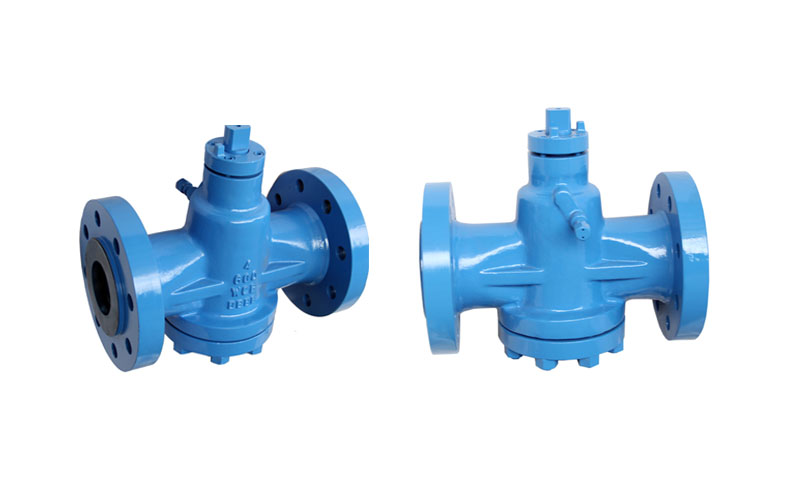
In the EG Valves catalogue, the plug valve reference is model PLV600 under the Plug Valves product type. The construction description is a bolted bonnet and split body with a fixed plug inside. It also includes a blow-out proof stem, fire-safe design, low-emission packing and an anti-static design. These features show that the product is positioned for demanding process media where stem leakage and static charge are safety concerns.
The stated size and pressure envelope is NPS 2 to 40 inches, equivalent to DN50 to DN1000. Pressure ratings run from Class 150 to Class 1500, with a parallel metric rating of PN16 to PN100. End types cover RF, FF, RTJ and BW. Operation can be manual through a worm gear or wrench nut, or automated with electric and pneumatic actuators.
The documented application industries for this plug valve are steam, air, gas, oil, oil vapour and high-pressure installations. That list is valuable because it names specific media rather than making a generic claim about all plug valves.
Core design logic: ball valve family
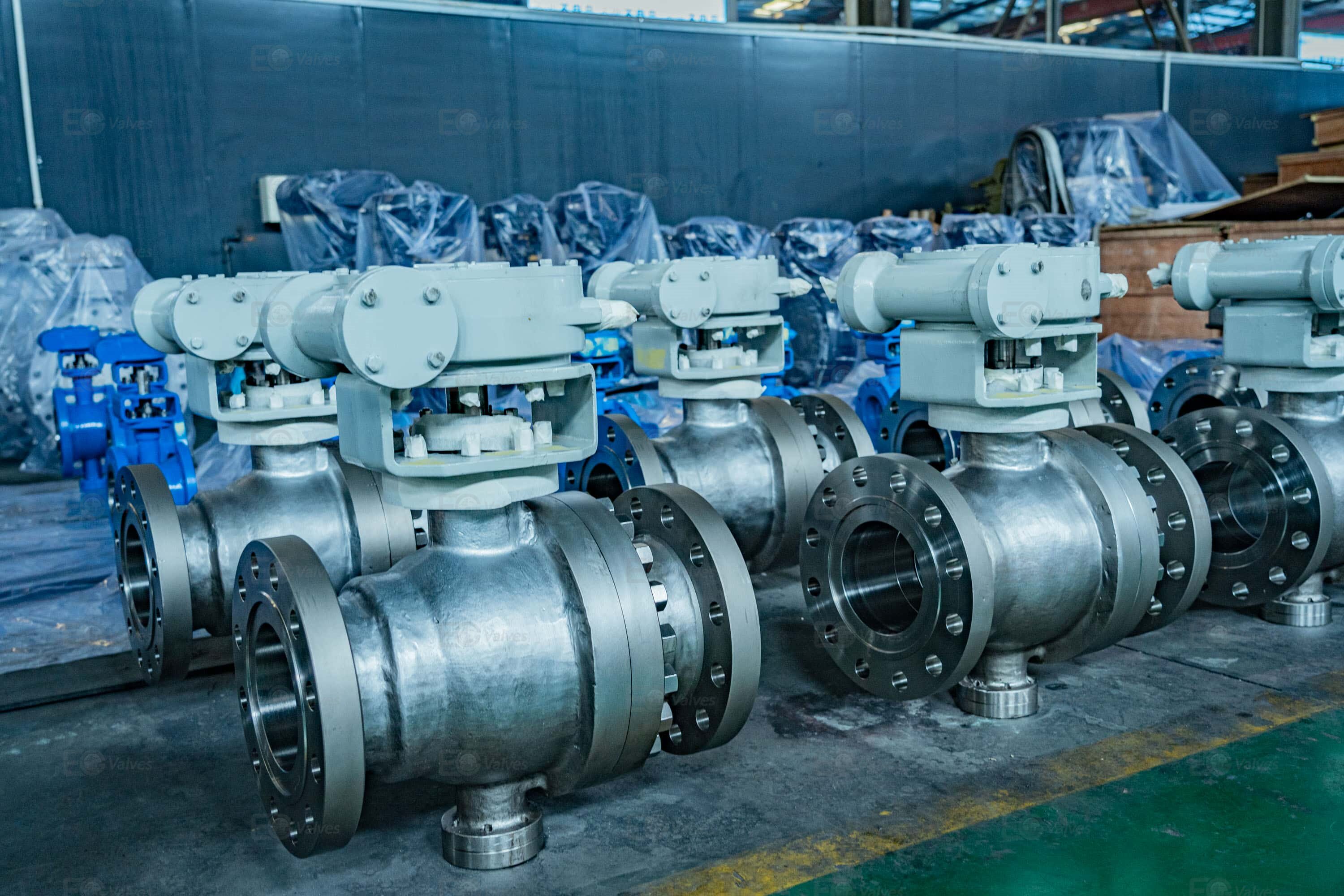
The ball valve family in the same manufacturer catalogue is wider and is organised around two mechanical principles: floating ball and trunnion-mounted ball. In a floating ball design, the ball is held between two seats and line pressure is normally used to press the ball against the downstream seat. In a trunnion design, the ball is fixed or supported at top and bottom, which is relevant for larger bore sizes and higher pressure classes.
EG Valves lists several manual ball valve series, including the Cast Steel Floating Ball Valve BVF206, Forged Steel Floating Ball Valve BVF208, Cast Steel Trunnion Ball Valve BVT207, Forged Steel Trunnion Ball Valve BVF209, Fully Welded Ball Valve BVF210, Top Entry Ball Valve BVT211, Three Way Ball Valve BVW212 and Threaded Ball Valve BVS213. Together they cover a much broader service envelope than any single plug valve model.
Across the ball valve portfolio, sizes start at NPS 1/2 inch and extend to NPS 60 inches, with pressure ratings from Class 150 to Class 2500. Forged high-pressure trunnion versions reach PN420. End options include RF, FF, RTJ, BW, socket weld and threaded depending on the model. Body materials are similar to the plug valve family: carbon steel, stainless steel, alloy steel and duplex steel are listed.
Ball valves in the catalogue also include blow-out proof stems, fire-safe design, low-emission packing and anti-static construction. Soft sealing and hard sealing are offered according to customer request, and full-port or reduced-port designs are available across several models.
Technical comparison table for project evaluation
| Selection parameter | Plug valve reference PLV600 | Ball valve portfolio reference |
|---|---|---|
| Valve mechanism | Fixed plug inside a bolted bonnet and split body | Floating or trunnion ball; split body, bolted bonnet, fully welded or one-piece top-entry options |
| Size range | NPS 2 to 40 inches / DN50 to DN1000 | NPS 1/2 to 60 inches across the full ball valve family |
| Pressure rating | Class 150 to Class 1500 / PN16 to PN100 | Class 150 to Class 2500 / PN16 to PN420 depending on model |
| End connections | RF, FF, RTJ, BW | RF, FF, RTJ, BW, SW and threaded versions available |
| Body materials | Carbon steel, stainless steel, alloy steel, duplex steel | Carbon steel, stainless steel, alloy steel, duplex steel |
| Safety design | Blow-out proof stem, fire-safe, low-emission packing, anti-static | Blow-out proof stem, fire-safe, low-emission packing, anti-static on listed models |
| Port style | Fixed plug port | Full port or reduced port on many listed models |
| Operation | Worm gear, wrench nut, electric, pneumatic | Handle lever, worm gear, wrench nut, electric, pneumatic |
| Representative industry listing | Steam, air, gas, oil, oil vapour and high-pressure installations | Oil and gas, petrochemical, refining, power generation, water treatment, gas distribution, general industrial systems |
What the range difference means for a project
Looking at the table, two practical boundaries become visible before any comparison of brands is made.
First, the plug valve reference starts at NPS 2 / DN50. An industrial plant has many lines below this size, including instrumentation air, sampling lines, lubrication oil circuits and utility connections. For those small-bore services, the EG catalogue points to threaded or floating ball valve models, which start at NPS 1/2 inch. If a project is dominated by small lines, the ball valve family is likely to provide more direct options.
Second, the plug valve reference stops at Class 1500 / PN100. Forged steel trunnion ball valves in the same catalogue extend to Class 2500 / PN420. A very high-pressure hydrocarbon or power application may therefore push the evaluation toward a forged trunnion ball valve rather than the listed plug valve model.
That does not mean a plug valve is weaker. It means the plug valve is documented for a defined band of steam, gas, oil and oil-vapour service, and the buyer must respect that envelope when writing the enquiry.
Project and application evidence from similar industrial lines
Scenario evidence is most useful when it comes from the same industries in which a buyer is operating. EG Valves provides application data for the Stainless Steel Check Valve CSV410 in water treatment, HVAC, oil and gas, petrochemical, power generation and industrial pipelines. These are exactly the sectors where an isolation valve decision between plug and ball products is common.
The application guidance in the EG process database describes refining systems as high-temperature, high-pressure, long-cycle continuous operations. In refining and petrochemical projects, the product data for plug valves explicitly lists oil vapour and high-pressure installations, while the trunnion ball valve data lists natural gas, oil products, chemicals, metallurgy, environmental protection and pharmaceuticals. A buyer can use these industry tags to filter options before asking for a quotation.
For gas transmission and distribution, the Fully Welded Ball Valve BVF210 is listed as typical for underground and buried installation. Its body is fully welded and full-port configured, with sizes from NPS 2 to 60 inches and ratings from Class 150 to Class 2500. That is a decisive product-level signal for pipeline engineers who need low external leakage risk.
For power plant steam and water systems, cast steel floating ball valves are listed for power generation and water treatment, while forged high-pressure ball valves are listed for refining and high-pressure pipeline systems. In offshore-like, corrosive and high-risk environments, material choice becomes important; both plug and ball families can be ordered in stainless or duplex steel, so the decision shifts to pressure rating, geometry and end connection.
Market trend perspective for industrial valve buying
Independent market data supports the idea that manual valves remain a major industrial spend category. Vantage Market Research estimates the global manual valve market at USD 78.4 billion in 2025, with a projection of USD 117.17 billion by 2035. Even if individual forecasts carry uncertainty, the direction is consistent: industrial buyers will continue to invest in manual and actuation-ready isolation valves for many years.
At the product-category level, Precedence Research reports that manual ball valves dominated the global valve market with a 28.1 percent share in 2025, partly because of their reliability in high-pressure applications. That is an important background fact. It helps explain why ball valves are often the default candidate in new projects and why plug valves must be evaluated on their own documented merits rather than on historical habit.
No verified data in this comparison claims that plug valves are gaining market share globally. Instead, the procurement conclusion is narrower: plug valves remain relevant in steam, oil-vapour and high-pressure gas services, while ball valves offer a broader size and pressure envelope for general industrial lines.
Comparison with traditional selection assumptions and limitations
A traditional selection shortcut is to choose a ball valve for every quarter-turn service because ball valve catalogues are larger and replacement parts are widely available. That shortcut has a limit. For steam, air, oil vapour and high pressure installations in the size range DN50 to DN1000, the EG plug valve PLV600 carries an explicit industry listing that the general ball valve models do not repeat in the same way.
The plug valve family also has its own limits. The reference plug model does not appear in the catalogue below NPS 2 and does not have a threaded or socket-weld variant. As a result, plants with an unusually large share of small-bore connections may struggle to standardise on plug valves at every point. In addition, the plug valve pressure ceiling is Class 1500, while the forged trunnion ball valve envelope reaches Class 2500.
Another boundary is maintenance familiarity. Many maintenance teams are trained on ball valve seat replacement, but plug valve servicing varies by whether the product uses a lubricated or non-lubricated design, a sleeve, or a metal seat. Since that detail is not specified in the PLV600 public data listed here, buyers should ask the manufacturer to state the plug seat and maintenance procedure before finalising the valve schedule.
Decision guidance for plug and ball valve procurement
A structured decision route is more useful than a fixed answer. Procurement and engineering teams can apply the following filter sequence when evaluating plug valves versus ball valves for an industrial line.
- Start with the pipe schedule: nominal bore, pressure class, end type and line number.
- Define the fluid service. Steam, air, gas, oil and oil-vapour are named services for the PLV600 plug valve. Oil and gas, petrochemical, refining, power and water applications are named services for the EG ball valve family.
- Check whether the duty is buried or underground pipeline service. If yes, request a fully welded ball valve option and compare it with alternative body constructions.
- Check whether the line is below DN50. If yes, most plug valve catalogues will not cover the size, and a threaded or forged ball valve is often required.
- Check the actual pressure rating. Above Class 1500 / PN100, a forged steel trunnion ball valve becomes the easier documented option.
- Check whether the project needs automation. Both families can be fitted with electric or pneumatic actuators in the EG catalogue, but the required torque and mounting dimensions should be confirmed with the valve manufacturer.
Future outlook for quarter-turn industrial valves
The next phase of valve procurement will likely be driven by three visible pressures: emission control, long-distance energy transport and material traceability. Low-emission packing is already listed on both the plug valve and several ball valve models. Fully welded ball valves address external leakage for buried gas pipelines. Material certificates, such as the EN 10204 3.1 certificates that EG Valves supplies with orders, are becoming a standard commercial requirement for critical projects.
For buyers, the future is less about selecting a single superior valve category and more about building a qualified supplier list that can document performance across several valve families. A plug valve and a ball valve can coexist in the same plant without contradiction. The work of the buyer is to assign each valve to the service where its documented design envelope gives the highest confidence.
For a broader technical reference, EG Valves publishes a company brochure with valve types and manufacturing data. A public version can be downloaded at EG Valves brochure.
Frequently asked questions
Is a plug valve better than a ball valve for high-pressure steam lines?
Within the EG Valves product data, the plug valve PLV600 is explicitly listed for steam, air, gas, oil, oil vapour and high-pressure installations. It covers NPS 2 to 40 inches and Class 150 to Class 1500. The ball valve family also includes forged trunnion models that extend to Class 2500, so the final choice depends on the exact steam pressure, temperature, pipe size and maintenance plan. Valve type alone is not enough to decide.
Why do gas distribution projects often specify a ball valve instead of a plug valve?
In the reference product data, the Fully Welded Ball Valve BVF210 is described as typical for gas transmission and distribution pipelines, especially underground and buried installation. The plug valve PLV600 is not documented for that specific duty in the same catalogue. For a buried gas line, a full-welded body construction is a relevant feature because it reduces potential external leak paths.
Which ball valve design should be considered for large lines and high pressures?
Cast steel trunnion ball valves and forged steel trunnion ball valves are the relevant designs. In the EG Valves catalogue, the cast steel trunnion model covers NPS 2 to 40 inches and Class 150 to Class 1500, while the forged steel trunnion model reaches NPS 36 inches and Class 2500 with a PN420 rating. Floating ball valves are listed for smaller-bore general service rather than the highest part of the pressure envelope.
Can plug and ball valves be automated with electric or pneumatic actuators?
Yes. The EG Valves catalogue lists electric and pneumatic actuator options for both the plug valve PLV600 and the ball valve series. Manual operation is also listed, with worm gear or wrench nut operation for the plug valve and handle lever or worm gear operation for ball valves. The buyer should still verify actuator size and operating torque with the valve supplier before integration.
Does the CSV410 check valve application list help with plug and ball valve selection?
The CSV410 stainless steel check valve is listed for water treatment, HVAC, oil and gas, petrochemical, power generation and industrial pipelines. Those sector tags are a useful signal because the same industries also appear in the application data for EG ball valves and plug valves. However, the check valve list only confirms the type of environment; the correct isolation valve still has to be selected from the full set of line size, pressure, media and installation conditions.
Have Questions or Need More Details?
Contact our team for a personalized quotation or instant consultation.
Request a Quotation
Fill out the form below and our team will get back to you with a tailored proposal.
WhatsApp Direct Chat
Prefer to chat in real-time? Message us on WhatsApp for instant assistance & quick answers.
- Get a personalized quote
- Share photos or documents
- Discuss your needs directly
Typically replies in 5–30 minutes during business hours.