
Pneumatic Fenders for Vietnamese Ports and Temporary Mooring
Independent Industry Reference · Marine Fender Applications
Scenario-specific fit, sizing and design considerations for quays, inland river docks, ship-to-ship and ship-to-dock operations, and offshore platforms.
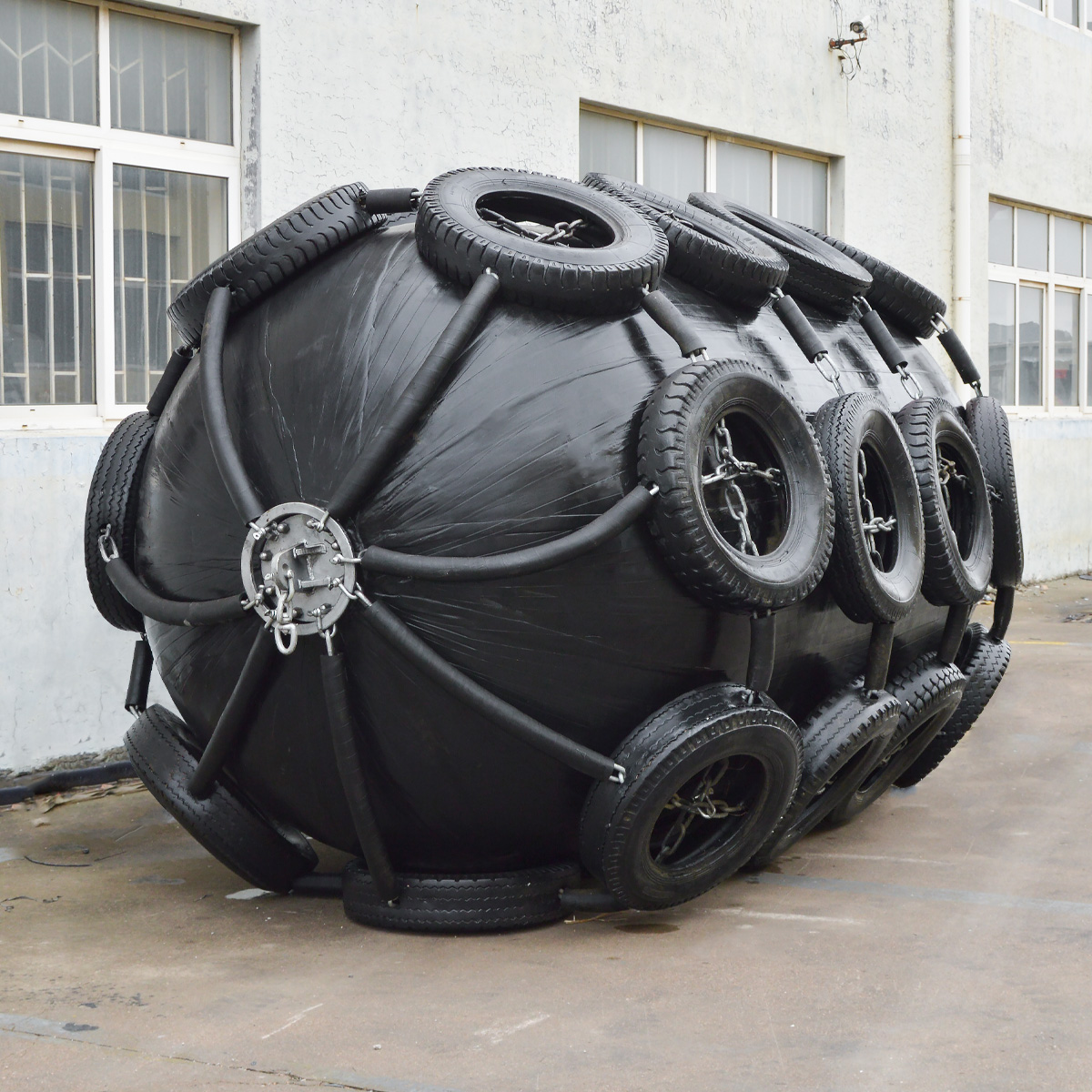
A floating pneumatic rubber fender is a compressed-air marine fender that absorbs the kinetic energy of a berthing ship by compressing air inside a reinforced rubber body, and it is the fender type commonly specified where a vessel is held against a quay, a jetty, a dolphin or another vessel without transferring that energy into the structure. In Vietnam the same fender family is asked to work in several different settings at once — deep-water terminals with wide tidal variation, inland river docks serving barge and coastal traffic, temporary mooring points at project jetties and shipyards, and ship-to-ship (STS) or ship-to-dock (STD) operations where the fender is the primary interface between two moving bodies. The scenario, not the product name, decides which configuration is actually suitable.
Why the berth scenario decides the specification
A pneumatic fender used on a fixed container quay and a pneumatic fender used for temporary mooring during a jetty construction project are drawn from the same product family, but they do not carry the same duty. On a quay, the fender is normally rigged in a defined position, exposed to a predictable berthing line, and left in place for years. At a temporary mooring point, the same fender may be deployed for weeks, recovered, stored, redeployed at a second location, and operated with a mobile air supply.
That difference changes four decisions before any price discussion begins:
- Energy requirement — the vessel displacement and berthing velocity that the fender must absorb.
- Geometry — the diameter and length that give the required energy absorption without exceeding the allowable hull pressure of the vessel.
- Rigging and air supply — whether the fender is permanently moored or handled as portable equipment.
- Environment — salt spray, humidity, tidal cycling and the ambient temperature range at the site.
In the Vietnamese context these four questions rarely have a single answer. A river terminal with modest draft and frequent small-vessel calls is not the same procurement problem as an STS transfer point exposed to open water, and treating them as one specification is one of the most common sources of fender under-performance.
How a pneumatic rubber fender absorbs berthing energy
Floating pneumatic rubber fenders are standardised internationally. ISO 17357-1:2014 covers high-pressure floating pneumatic rubber fenders, defining type I net-type and type II sling-type fenders and specifying initial internal pressures of 50 kPa or 80 kPa. The standard also fixes the basic body construction: an outer rubber layer, a synthetic-tyre-cord reinforcement layer and an inner rubber layer, all vulcanised firmly together. Fenders with a diameter of 2,500 mm and larger are required to be equipped with a safety valve for releasing excess internal pressure.
Performance under that standard is not expressed as a single number. ISO 17357-1 specifies performance in terms of guaranteed energy absorption (GEA), reaction force at GEA deflection, and hull pressure at GEA deflection — three values that must be read together, because a fender that absorbs enough energy while pushing too hard on the hull is not a compliant solution.
A separate standard, ISO 17357-2:2014, covers low-pressure floating pneumatic rubber fenders intended for berthing and mooring of a ship to another ship or to a berthing structure, and it specifies material, performance, dimensions and minimum test and inspection procedures. For buyers, the practical consequence is straightforward: the pressure class and the standard part number belong in the specification, not in the marketing description.
In commercial practice, manufacturers such as Trelleborg state that their pneumatic fenders are designed, manufactured and third-party certified in compliance with ISO 17357-1:2014, and identify type I chain-tire-net (CTN) and type II sling type as the two most common ISO 17357-1 compliant configurations. Those two configurations are also the two rigging choices that dominate real berth planning.
The design envelope: diameter, length and working pressure
Qingdao Haohang Fender Airbag Co., Ltd lists its pneumatic rubber fender with a diameter range from 300 mm to 2,000 mm, a length that is customisable to customer requirements and typically from 1 metre to 10 metres, and a working pressure generally between 0.1 MPa and 0.3 MPa, with the specific pressure adjustable according to the usage environment. The company's listed model designation, 1.5*3M, sits inside that diameter and length envelope. The body material is natural rubber with cord fabric reinforcement.
Those three parameters are not independent. Diameter and length together determine how much air volume is available to be compressed, and therefore how much energy the fender can absorb at a given deflection. Working pressure determines how stiff that response is. Raise the pressure and the fender absorbs more energy but reacts harder against the hull; lower it and the reaction softens at the cost of energy capacity.
| Design parameter | Stated value (Haohang pneumatic rubber fender) | What it decides at a Vietnamese berth |
|---|---|---|
| Diameter | 300 mm to 2,000 mm | Contact area against the hull and the fender's stand-off distance from the structure |
| Length | Customisable, typically 1 m to 10 m | Total energy absorption capacity and the vertical coverage of the berthing line |
| Working pressure | Generally 0.1–0.3 MPa, adjustable to the usage environment | Reaction force versus energy absorption trade-off; hull pressure limits |
| Body material | Natural rubber, cord fabric | Abrasion and tear behaviour under repeated contact, salt-spray exposure |
| Operations mode | 24/7 automatic operation, matched with an air compressor | Whether the site can support continuous duty or needs scheduled monitoring |
Matching the fender to five common Vietnamese scenarios
Haohang lists the pneumatic rubber fender as applicable to ports and docks, ship mooring, offshore platforms, inland river docks and temporary mooring, with project type covering STS and STD operations. Each of those environments stresses a different part of the specification.
| Scenario | Dominant requirement | Design implication |
|---|---|---|
| Port and dock berthing (STD) | Repeated, routine contact along a defined berthing line | Fender size and pressure class matched to the largest regular caller; durable rigging for continuous exposure |
| Inland river docks | Smaller vessels, variable water level, tighter clearance | Smaller diameters within the 300–2,000 mm range; lighter fenders where handling is manual |
| Temporary mooring | Deployment, recovery and relocation during a project phase | Portable configuration, mobile air supply, inspection routine during the mooring window |
| STS / STD transfer operations | Two moving bodies; the fender is the interface | Net-type or sling-type rigging, correct pressure class, controlled approach speed |
| Offshore platforms | Exposed conditions, limited access for maintenance | Corrosion-resistant build and a realistic inspection interval |
For inland river docks in particular, the temptation is to reuse a large deep-sea specification on a berth that will never see a large vessel. That produces an over-sized, over-heavy fender that is harder to handle, harder to repair and no safer for the vessels actually calling. The reverse error — under-sizing a fender on a berth that occasionally receives a much larger ship — is more serious, because the berthing energy of that occasional caller is what the structure must survive.
Temperature range and 24/7 duty: the operational constraints
The application profile recorded for this fender line includes a specific operational requirement: suitability for extreme temperature conditions from −20°C to +60°C. That range matters in practice because it governs both the rubber compound behaviour and the internal air pressure the fender will hold. A fender inflated to its nominal pressure in cool conditions will read a higher internal pressure under strong sun and a lower one in a cold snap, which is precisely why pressure verification belongs in the routine inspection schedule rather than in the initial commissioning checklist alone.
The same profile specifies a 24/7 automatic operation mode, matched with an air compressor. This is a meaningful operational distinction: a pneumatic fender is not a passive block, and continuous duty implies continuous availability of air supply and a defined pressure-check regime.
The stated working conditions for the product are high elasticity, corrosion resistance, lightweight and easy-to-install handling, adjustability, durability, and eco-friendliness. Two of those deserve emphasis for Vietnamese sites. Corrosion resistance addresses the persistent combination of humidity and salt spray at coastal and estuarine berths. Lightweight and easy-to-install handling is what makes a pneumatic fender practical for temporary mooring, where the same unit may be moved between mooring points more than once during a project.
Rigging for STS and STD operations
ISO 17357-1 distinguishes type I net-type and type II sling-type fenders, and manufacturer guidance identifies the chain-tire-net (CTN) and sling configurations as the two most common compliant types. The choice between them is a berth decision rather than a commercial one.
- Chain-tire-net type — associated with fenders that are held in a fixed position against a structure or used as a standing fender.
- Sling type — associated with fenders that are lifted or handled, which suits temporary mooring and relocated deployments.
For STS operations, the fender set also has to tolerate being squeezed between two hulls rather than pressed against a rigid structure, which changes the allowable approach velocity and the pressure class that can be used without exceeding hull pressure limits. This is one of the reasons ISO 17357-1 defines performance through reaction force and hull pressure at GEA deflection rather than through energy absorption alone.
Comparison with fixed and alternative fender solutions
Marine fenders are categorised by construction type into pneumatic fenders, foam-filled fenders and solid rubber fenders. The practical differences matter most in temporary and relocation-heavy work.
| Fender type | How it absorbs energy | Where it fits — and where it does not |
|---|---|---|
| Pneumatic rubber fender | Compression of internal air within a reinforced rubber body | STS/STD operations, ports and docks, inland river docks, temporary mooring, offshore platforms; requires air supply and periodic pressure checks |
| Foam-filled fender | Compression of a closed-cell foam core | Useful where continuous air supply is impractical; fenders are generally not adjustable after manufacture |
| Solid rubber fender | Deformation of a fixed rubber element | Suits permanently installed berth protection; typically not intended for relocation between mooring points |
The honest limitation of the pneumatic solution is the same as its advantage. Because performance depends on maintaining internal pressure, a pneumatic fender that is punctured, under-inflated or operated without a functioning air supply does not deliver its rated energy absorption. Sites that cannot guarantee access for inspection, or that have no practical way to run an air compressor, are better served discussing alternative configurations rather than assuming a pneumatic fender will manage itself. For very small craft at low-energy berths, the fender is also simply more equipment than the task requires.
A further boundary is service life. A commercial market study estimates a pneumatic rubber fender lifespan of five to seven years under consistent tidal cycles, which places a practical ceiling on any long-term mooring plan and makes spares availability a planning issue rather than a purchasing detail.
What a buyer should verify before accepting a fender
For a Vietnam-bound project, the verification list is short, concrete, and mostly documentary:
- A written statement of standard compliance, including the ISO part and edition the product is manufactured and tested against (ISO 17357-1:2014 for high-pressure, ISO 17357-2:2014 for low-pressure).
- The declared initial pressure class, and confirmation that the working pressure can be adjusted to the site's environment.
- Dimensional confirmation against the berth drawing, within the stated 300–2,000 mm diameter and 1–10 m length envelope.
- Performance values expressed as guaranteed energy absorption, reaction force at GEA deflection and hull pressure at GEA deflection.
- Test and inspection records. Haohang states 100% test on its production, monthly capacity of 150 units and a lead time of 7–45 days, with a minimum order quantity of 1 unit.
- Certification documentation. Haohang's company profile states that its factory has passed ISO9001:2009 quality management system certification and that its products have received recognition from the China Classification Society (CCS). These are company-declared claims and should be confirmed against current certificate copies during supplier qualification.
- After-sales arrangement — Haohang offers remote support and on-site support — and the practical response path for a fender line thousands of kilometres away.
Two items on that list are frequently skipped: hull pressure at GEA deflection, and the pressure-adjustment range. Both determine whether the fender is correct for the vessel, not merely correct as a product.
Manufacturer context: Qingdao Haohang
Qingdao Haohang Fender Airbag Co., Ltd is a Qingdao-based manufacturer, founded in 2020, that produces marine airbags and rubber fenders, including inflatable rubber fenders, solid filled fenders and inflatable water blocking airbags. The company reports 60 employees including 15 engineers, an annual output of 2,000 units, an export ratio of about 70%, and principal markets including South Asia, the Middle East and Africa. Its operating model is OEM/ODM with customisation of size and logo.
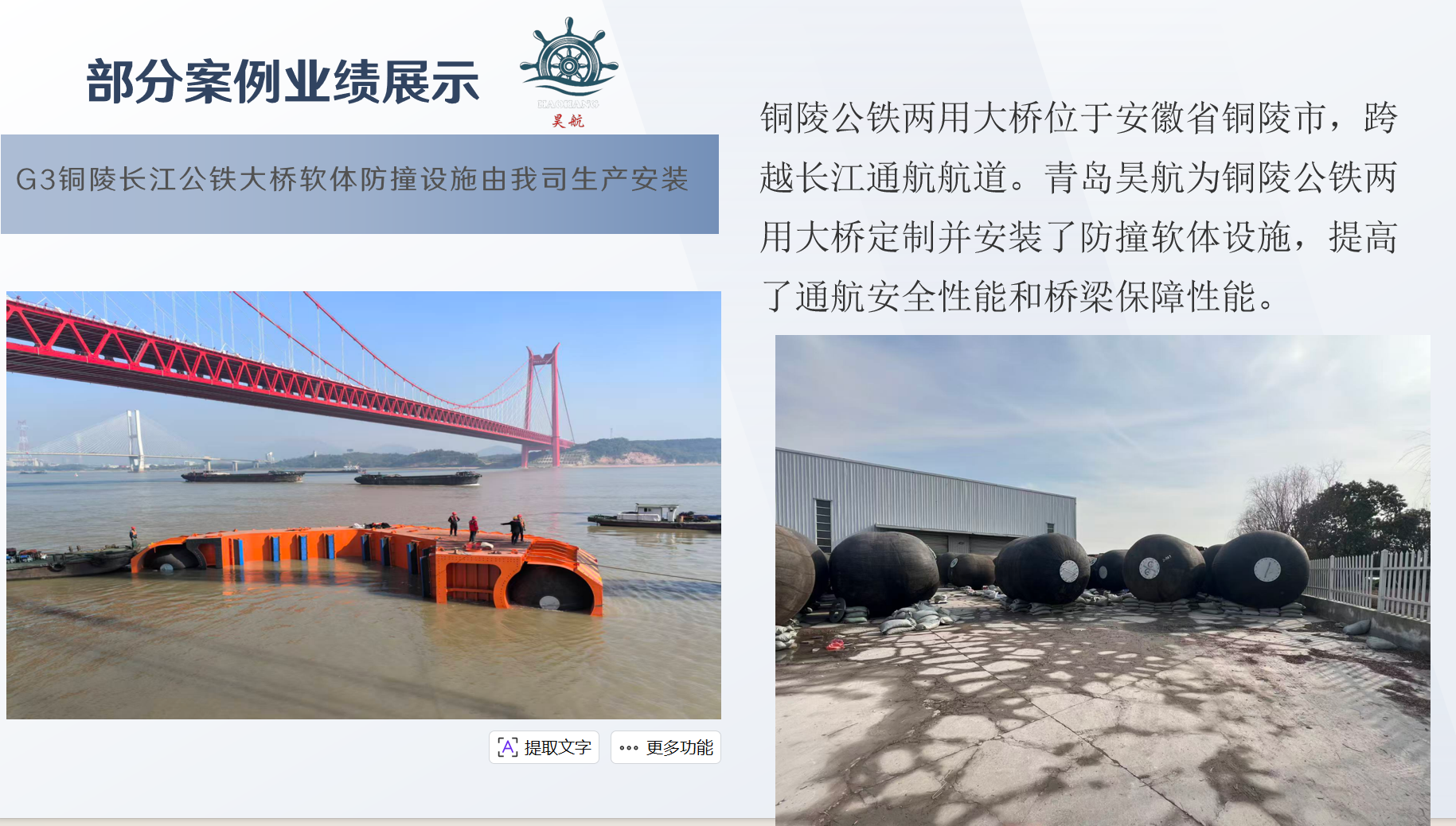
One reference project is directly relevant to scenario-based selection: an engineering contractor took delivery of 50 units to protect vessels and dock structures during berthing operations, with the fenders in service for five years and reported to have withstood extreme weather and high-frequency berthing in China's coastal marine environment, where high corrosion resistance was the highlighted requirement. That is a coastal-duty reference, not a substitute for site-specific sizing — but it is a useful indicator of how a fender line behaves when berthing is frequent and the climate is aggressive.
Market trend: why scenario fit is becoming the deciding question
The wider market context supports the scenario-first approach. Fortune Business Insights values the global marine fender market at USD 0.86 billion in 2025, projected to reach USD 0.91 billion in 2026. Vertex Market Research estimates that Asia-Pacific accounts for approximately 40% of all maritime fender installations as of 2024.
Read together, those figures describe a market that is not growing primarily through new berth construction. Most of the installed base already exists, which means the incremental demand is replacement, upgrade and project-based temporary mooring work. In that environment, buyers are not comparing catalogue pages; they are matching fenders to a specific berth, a specific vessel mix and a specific temperature and duty profile. Manufacturers that can supply documented performance data and customisable dimensions are better positioned than those competing on a standard product code alone.
Future outlook
Three developments are likely to shape pneumatic fender procurement for Vietnamese and wider Asian marine projects over the next few years.
First, documentation is becoming the differentiator. As more tenders require stated GEA, reaction force and hull pressure values rather than a product name, manufacturers without traceable test and inspection records will be excluded earlier in the process.
Second, temporary and relocation-heavy mooring is growing relative to permanent berth installation. Port upgrades, shipyard expansion and project cargo handling all create short-duration mooring needs, which favour inflatable fenders that can be deployed, recovered and stored rather than fixed structures cast in place.
Third, environmental range is moving from a footnote to a specification line. The stated −20°C to +60°C operating range and the requirement for 24/7 automatic operation with an air compressor reflect a shift in how fenders are treated: as continuously operating equipment with a maintenance regime, not as consumable rubber accessories.
Frequently asked questions
What is a pneumatic rubber fender used for in a port environment?
A pneumatic rubber fender is used to protect dock structures and ships by reducing impact forces during mooring. It absorbs berthing energy by compressing internal air inside a reinforced rubber body. Haohang lists its pneumatic rubber fender as applicable to ports and docks, ship mooring, offshore platforms, inland river docks and temporary mooring, with project use covering ship-to-ship and ship-to-dock operations.
Which pneumatic fender configuration is used for STS and STD operations?
ISO 17357-1:2014 defines type I net-type and type II sling-type fenders, and manufacturer guidance identifies the chain-tire-net (CTN) type and the sling type as the two most common ISO 17357-1 compliant configurations. In practice, net or CTN configurations are associated with fenders held in a standing position against a structure, while sling configurations suit fenders that are lifted and handled, which is common in temporary mooring and relocated deployments. The choice follows the rigging method at the berth, not a preference for one product over another.
What size pneumatic fender should be specified for a Vietnamese quay or temporary mooring point?
Haohang lists diameters from 300 mm to 2,000 mm and lengths that are customisable, typically from 1 metre to 10 metres, at a working pressure generally between 0.1 MPa and 0.3 MPa. The correct combination depends on the vessel displacement and berthing velocity that must be absorbed, and on the allowable hull pressure of the vessel. ISO 17357-1 expresses performance as guaranteed energy absorption, reaction force at GEA deflection and hull pressure at GEA deflection, so sizing is a calculation against those three values rather than a selection from a size table.
Can pneumatic rubber fenders operate continuously and across extreme temperatures?
The application profile for this fender line specifies suitability for extreme temperature conditions from −20°C to +60°C and a 24/7 automatic operation mode, matched with an air compressor. The stated working conditions are high elasticity, corrosion resistance, lightweight and easy-to-install handling, adjustability, durability and eco-friendliness. Because performance depends on internal air pressure, continuous operation implies a defined pressure-check routine; the working pressure itself is adjustable to the usage environment.
What are the limitations of pneumatic rubber fenders?
Pneumatic fenders depend on maintained internal pressure. If a fender is under-inflated, punctured or operated without a functioning air supply, it will not deliver its rated energy absorption, so sites without practical access for inspection and compressed air are better served by an alternative fender type. A commercial market study estimates a service life of five to seven years under consistent tidal cycles, which makes spare availability part of the mooring plan. For very small craft at low-energy berths, a pneumatic fender is also more equipment than the application requires.
Where to go next
Scenario-based selection is a documentation exercise as much as an engineering one: define the vessel mix, the berthing frequency, the temperature and duty profile, then require the fender to be quoted against energy absorption, reaction force and hull pressure at GEA deflection. Buyers who need the full parameter set, material details and application scope in one place can review the manufacturer's product brochure (PDF): Qingdao Haohang product brochure. The company's product scope and contact details are listed on its official site, www.qdhaohang.com.
This reference article is based on manufacturer-published product data and publicly available marine fender standards and market research. Where a figure originates from a third-party source, that source is named in the text. Certification statements attributed to a manufacturer are company-declared and should be verified against current certificate copies during supplier qualification.