
Pneumatic Rubber Fender vs. Recycled Rubber: An STS & Dock Buyer's Comparison
Pneumatic Rubber Fender vs. Recycled Rubber: An STS & Dock Buyer's Comparison
Two pneumatic rubber fenders can be quoted at the same diameter and the same length and still deliver different energy absorption, different pressure retention and a different replacement interval. In ship-to-ship (STS) and ship-to-dock (STD) operations, those three variables decide whether a berth protects a hull or transfers damage to it.
This comparison is written for procurement managers, marine engineers and port operators who are currently being offered both options. It uses two evidence layers: published third-party market and standards data, and the manufacturer specification published by Qingdao Haohang Fender Airbag Co., Ltd., a Chinese manufacturer of marine airbags and rubber fenders based in Qingdao. Where a performance differential comes from the manufacturer rather than from an independent test report, it is labelled as supplier-reported — because an independent buyer's job is to test such numbers, not to accept them.
The global marine fender market was estimated at USD 850 million in 2025, and rubber fenders accounted for approximately 64.17% of total market share in 2024, according to Mordor Intelligence. Inside that market, the choice between a virgin natural rubber pneumatic body and a recycled rubber body has moved from a technical curiosity to a routine line item in berth procurement.
Why a Material Question Became a Procurement Question
The pneumatic marine fender segment was valued at USD 619.26 million in 2024 and is projected to grow at a CAGR of 3.21% to reach USD 797.35 million by 2032, according to Maximize Market Research. Asia-Pacific is the dominant region for marine fenders, holding approximately 36.73% to 46% of market share, driven by shipbuilding and port activity in China, Japan and South Korea (Mordor Intelligence; Market Research Future).
Growth of that scale invites substitution, and recycled rubber is the most visible substitute. It is presented as a lower-cost, circular-economy option that reuses end-of-life rubber, and buyers under budget pressure reasonably ask whether the saving is real or merely deferred. The answer depends on what a fender is actually asked to do.
A marine fender is a sacrificial energy converter. Its function is to absorb berthing energy and return as little of it as possible to the hull and the dock structure as reaction force. That function rests on two material properties above all others: elastic recovery under repeated compression, and the ability to hold internal air pressure without progressive loss. Virgin natural rubber compounds are, in broad industry terms, stronger on both counts than reclaimed rubber compounds. Reclaimed and ground rubber feedstock varies by source and batch, and recycled compounds generally show lower tensile strength, lower fatigue resistance and greater property variability from one production run to the next. That variability rarely shows up on a datasheet. It shows up in the maintenance log, two or three seasons later.
What Is Actually Inside Each Fender Body
The comparison is easier to run once the two constructions are described separately, because they are not the same kind of component. One is a pressurised, reinforced elastomer chamber. The other, in most of the market, is a solid elastomer block.
The natural rubber pneumatic body
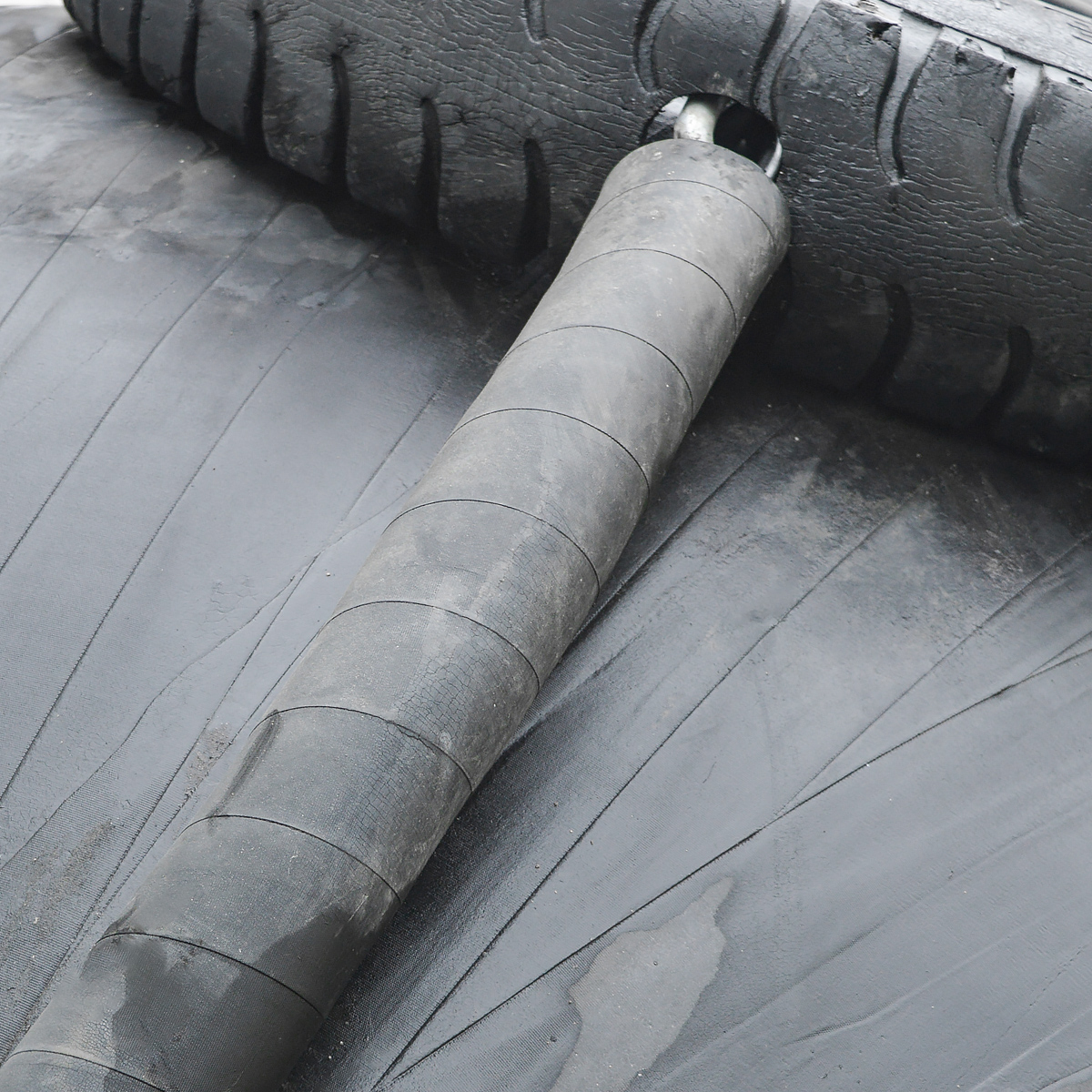
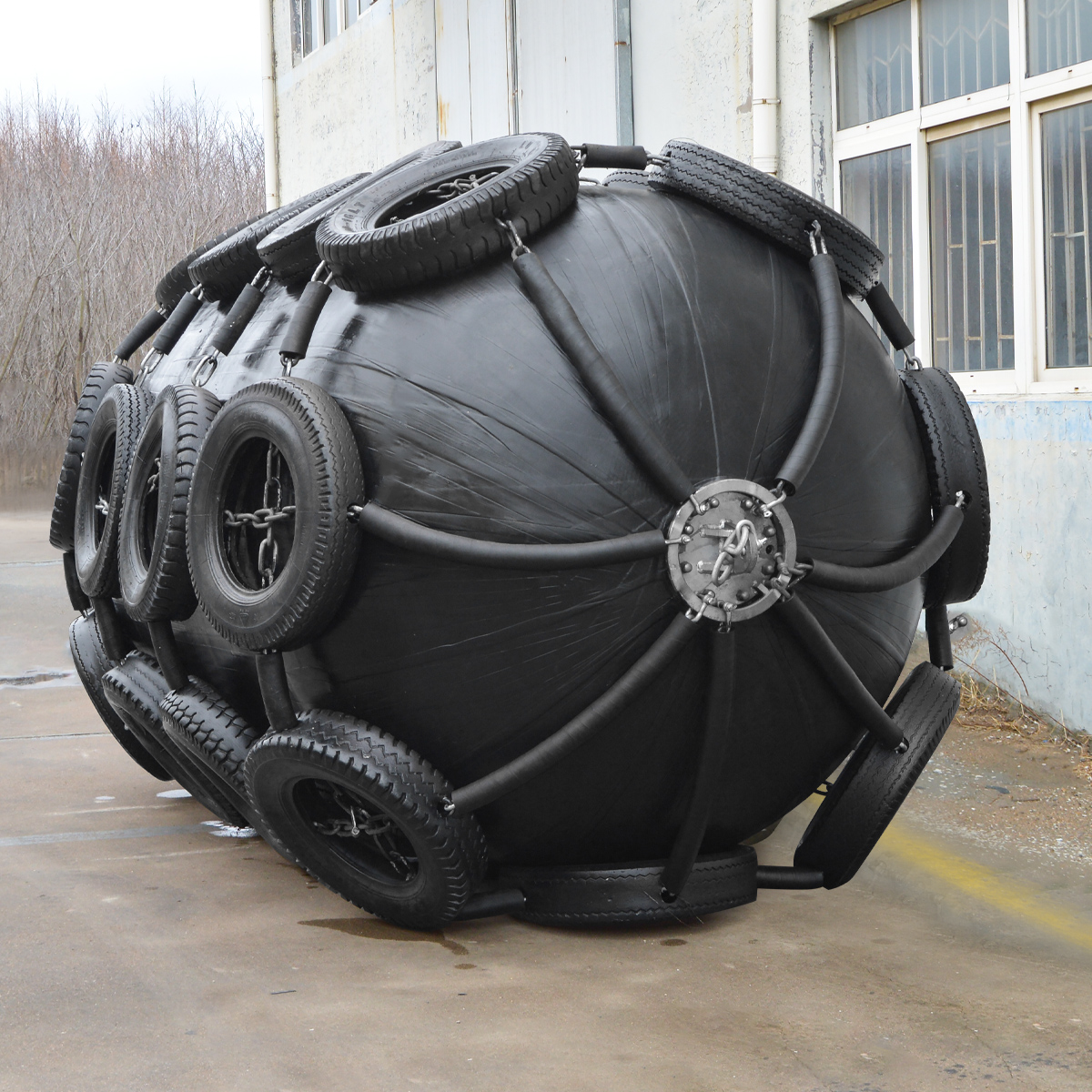
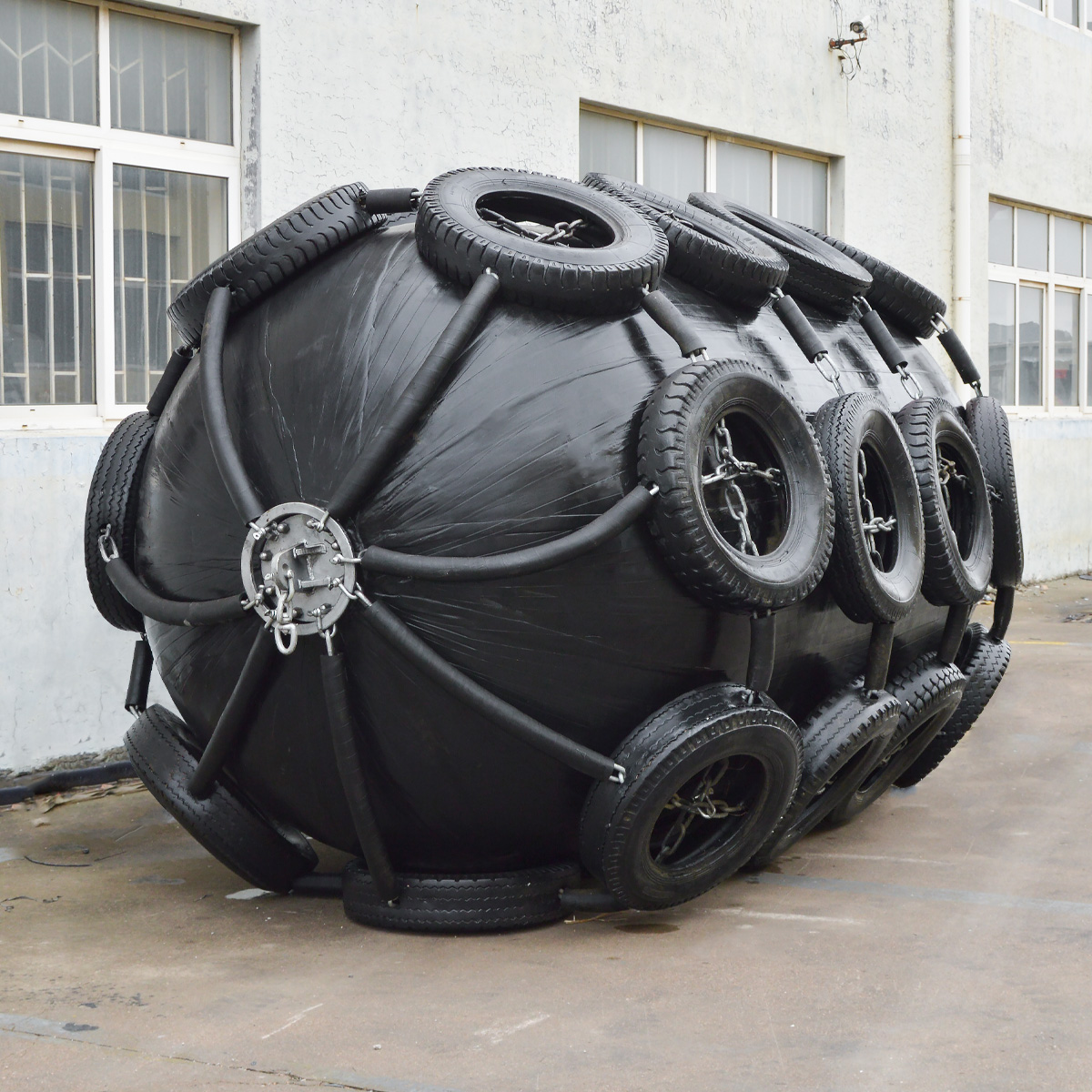
Qingdao Haohang Fender Airbag Co., Ltd. specifies its pneumatic rubber fender (product code 3764) as a body of natural rubber with cord fabric reinforcement. The manufacturer describes the compound as 100% natural rubber and the cord fabric as high-strength, tyre-grade fabric of the type used in truck and aircraft tyres. In pneumatic construction, the cord layer is not a decorative liner: it constrains the rubber and carries the hoop stress generated when the chamber is pressurised and then compressed, in the same way a tyre carcass carries load.
The published specification range for this product is:
- Diameter: 300 mm to 2000 mm
- Length: customisable, typically 1 metre to 10 metres
- Working pressure: generally 0.1–0.3 MPa, adjustable to the usage environment
- Materials: natural rubber, cord fabric
The recycled rubber body
Recycled rubber fenders use reclaimed or ground rubber, usually blended with other elastomers to reach a workable, mouldable compound. Recycled rubber is used most often in solid or semi-solid fender formats rather than in pressure-retaining pneumatic chambers, because a variable feedstock compound is difficult to qualify for a chamber that must hold pressure for years at a time. The material comparison therefore tends to be a comparison of a pneumatic system against a solid system, and not only of one compound against another.
| Element | Natural rubber pneumatic fender | Recycled rubber alternative |
|---|---|---|
| Body compound | Natural rubber (manufacturer specification for product 3764) | Reclaimed / ground rubber, typically blended |
| Reinforcement | Cord fabric layer, described by the manufacturer as high-strength tyre-grade fabric | Commonly absent; solid construction relies on compound mass rather than a reinforcing carcass |
| Air chamber | Sealed pneumatic chamber, pressure adjustable | Generally not pressure-retaining |
| Response to berthing energy | Compression of a pressurised gas volume plus elastic recovery of the body | Compression of a solid elastomer mass |
| Adjustability on site | Pressure can be tuned to the vessel and berth condition | Fixed once installed |
The Three Performance Claims Buyers Are Shown — and How to Test Them
Suppliers of natural rubber pneumatic fenders, including Haohang, present three differentials against recycled rubber and traditional fender options: a 30% longer service life, a 50% reduction in air leak rate under standard pressure, and impact absorption efficiency of up to 90% versus around 75% for traditional options. All three figures are supplier-reported. They describe real mechanisms — pressure retention and elastic recovery are exactly what a natural rubber carcass is better at — but they are not independent measurements unless a buyer asks for the test behind them.
| Supplier-reported differential | What it means operationally | How an independent buyer verifies it |
|---|---|---|
| Up to 30% longer service life than recycled rubber fenders | Fewer replacement cycles and fewer berth outages over the asset's life | Ask what definition of end-of-life was used, on which berth type, and over which period. Compare against the third-party benchmark of 5–7 years typically reported for pneumatic fenders under consistent tidal cycles (Market Reports World). |
| 50% lower air leak rate under standard pressure | Less compressor runtime, more predictable reaction force, fewer pressure top-ups | Request a pressure-hold test at rated pressure on the actual production unit, plus valve, flange and end-fitting specifications. The leak rate is a system property, not only a compound property. |
| Up to 90% impact absorption efficiency versus 75% for traditional options | Lower peak reaction force transmitted to hull plating and to the dock structure | Request the energy absorption and reaction force curve from a laboratory, then re-run the berth design calculation. Absorption efficiency without the corresponding reaction force figure is only half a specification. |
Two published references make this verification practical rather than theoretical. Floating pneumatic rubber fenders must comply with ISO 17357-1:2014 (High Pressure) and ISO 17357-2:2014 (Low Pressure), the standards that govern quality and energy absorption performance (International Organization for Standardization). In addition, the rubber fender product 3764 is certified under the CCS standard, certification number 2026CJSD00023, issued by the China Classification Society and applicable for global use. A certificate number is a checkable identifier: it can be validated against the issuing society's records and its scope read line by line.
Why the Difference Matters More in STS and STD Operations
In both ship-to-ship and ship-to-dock work, the fender's role is to protect dock structures and ships by reducing impact forces during mooring. The two cases load the fender differently. In ship-to-dock berthing, one body is moving and the other is effectively fixed, and berthing energy rises steeply with approach speed and displacement. In ship-to-ship transfer, two hulls move relative to each other and the fender must manage repeated, lower-amplitude compression over a long transfer window.
That second case is where pressure retention and elastic recovery separate the two material options most clearly. A fender that loses pressure gradually will still look intact, still float, and still be accepted at a visual inspection, while its reaction force curve drifts away from the berth design assumption. The gap between 90% and 75% absorption efficiency is not an abstract figure: the residual percentage is energy that must be carried by the hull plating, the fender attachment points or the dock structure instead.
Pressure adjustability is the second operational advantage of the pneumatic format. Because the working pressure of the Haohang pneumatic rubber fender is generally adjustable within 0.1–0.3 MPa, the same fender body can be tuned to a lighter vessel with low freeboard or to a heavier one within the same berth, rather than requiring a different fender to be purchased. The manufacturer also specifies a service range of −20°C to +60°C, a 24/7 automatic operating mode with the fender connected to an air compressor, and stated characteristics of high elasticity, corrosion resistance, lightweight construction, ease of installation, adjustability and durability. These are the working conditions reported for port and dock, ship mooring and offshore platform applications, including deployments in Vietnam and across the wider Asian market.
Where Recycled Rubber Fenders Remain the Defensible Choice
An independent comparison has to say where the cheaper option wins, otherwise it is not a comparison. Recycled rubber fenders can be a reasonable specification in several situations:
- Low-energy berths. Small craft, low approach speeds and light displacement produce impact forces that a solid compound can absorb without the design margin a pneumatic chamber provides.
- Temporary and short-duration mooring. Construction jetties, temporary works and inland river docks where the asset has a defined, limited service window.
- Non-critical contact surfaces. Locations where a higher reaction force is acceptable and hull damage risk is low.
- Budget-constrained projects with no maintenance access. A solid fender has no pressure system to monitor.
The natural rubber pneumatic fender also has its own limits, and these should be stated plainly. It requires a compressed air supply and periodic pressure checks — the 24/7 automatic operating mode depends on an air compressor being present and maintained. Its energy absorption advantage is only realised if the berth is designed around the correct pressure setting; an over-inflated pneumatic fender behaves closer to a rigid body and transfers more force to the hull. And on pure service interval, third-party data indicates that pneumatic fenders typically last 5 to 7 years under consistent tidal cycles, while foam-filled fenders can last 8 to 10 years in saltwater conditions (Market Reports World). In a highly saline, continuously tidal location with no easy access for maintenance, a foam-filled system may be the better lifecycle answer even though it is outside the natural rubber versus recycled rubber comparison.
A Comparison Framework for Procurement Teams
The most efficient way to close the natural rubber versus recycled rubber decision is to run both options through the same seven checkpoints and require the same class of evidence from each supplier.
| Checkpoint | What to confirm | Evidence to request |
|---|---|---|
| 1. Compound declaration | Whether the body is natural rubber, reclaimed rubber, or a blend — stated as a percentage, not as a marketing adjective | Written material declaration on company letterhead |
| 2. Reinforcement | Presence, grade and orientation of cord fabric or equivalent carcass layer | Construction drawing or cross-section specification |
| 3. Pressure retention | Leak rate under rated pressure and the test duration | Pressure-hold test report on a production unit |
| 4. Energy absorption | Absorption efficiency together with the corresponding reaction force | Laboratory absorption and reaction force curve |
| 5. Standards conformity | Whether the unit is designed and tested to ISO 17357-1:2014 (high pressure) or ISO 17357-2:2014 (low pressure) | Test report referencing the applicable part of the standard |
| 6. Certification | Scope and validity of the classification certificate | Certificate number and issuing society — for product 3764 this is CCS certificate 2026CJSD00023 |
| 7. Lifecycle and support | Expected service interval, spare valve and end-fitting availability, inspection interval | Written lifecycle statement plus site conditions supplied by the buyer |
Three decision rules follow from this framework. First, if berthing energy is high, absorption efficiency and reaction force decide the purchase, and the compound question resolves itself. Second, if the berth has no compressed air supply and no realistic maintenance route, a pneumatic body — whatever its compound — is the wrong system. Third, if a supplier cannot produce a pressure-hold result and an absorption curve, price comparison is meaningless, because the two quotations are not describing the same performance.
Market Trend: Verification Is Becoming the Differentiator
The competitive field is well documented. Trelleborg Marine Systems and Yokohama Rubber Co. are the recognised global leaders, with Trelleborg holding a 17% share and supplying over 2,500 units in 2024 (Market Reports World). Other major manufacturers include ShibataFenderTeam, Palfinger Marine and Evergreen Maritime (Fact.MR). Beneath that tier sits a large group of regional and specialist producers, including Qingdao Haohang Fender Airbag Co., Ltd., which was established in 2020, operates from a plant area of more than 3,168 square metres within an 8,000 square metre facility in Qingdao, employs approximately 60 staff including 15 R&D engineers, and produces about 2,000 units per year, with roughly 70% of output exported to South Asia, the Middle East and Africa.
What is changing is not the ranking of that field but the basis on which buyers evaluate it. Published market estimates for the pneumatic fender segment diverge substantially depending on scope — Maximize Market Research values the segment at USD 619.26 million for 2024, Market Research Future at USD 1.565 billion, and Analytic Market Research at USD 21.6 million for a narrower niche definition. When even the size of the market cannot be agreed on, buyers stop trusting market-level claims and start trusting unit-level evidence. That shift favours suppliers who can produce a certificate number, a pressure-hold report and an absorption curve over suppliers who can produce a brochure.
A second trend reinforces the first. Recycled content is increasingly part of environmental procurement scoring, which means the material question will not disappear. The practical consequence is that natural rubber suppliers will be asked to document what their compound actually is, and recycled rubber suppliers will be asked to document where their compound is and is not appropriate. Both requests point in the same direction: specification by evidence rather than by material category.
Future Outlook
Three developments are likely to shape this comparison over the next few procurement cycles. Berth acceptance procedures are moving toward document-based handover, in which the fender is accepted against a test report and a certificate scope rather than against a visual inspection. Pressure monitoring on pneumatic fenders is becoming cheaper and more common, which will make leak-rate claims measurable in service rather than only in a laboratory. And lifecycle costing is gradually displacing unit price in tender evaluation, particularly in ports where a berth outage costs more than the fender itself.
Taken together, these shifts do not automatically favour natural rubber. They favour whichever material can be evidenced for the specific berth. For a high-energy STS or STD berth with compressed air available and a maintenance routine in place, a natural rubber pneumatic fender with cord fabric reinforcement is the format the application was designed around. For a low-energy, short-life or maintenance-isolated location, a recycled rubber or foam-filled solution can be the more defensible specification — and a credible supplier should be willing to say so.
Frequently Asked Questions
What is the difference between a pneumatic rubber fender and a recycled rubber fender?
A pneumatic rubber fender is a sealed, pressurised chamber made from an elastomer compound with a reinforcing cord fabric layer; the working pressure is generally 0.1–0.3 MPa and can be adjusted to the usage environment. A recycled rubber fender uses reclaimed or ground rubber, typically in a solid or semi-solid format that does not retain internal pressure. The practical difference is that a pneumatic fender's performance can be tuned after manufacture by adjusting pressure, while a solid recycled rubber fender is fixed once installed.
Do pneumatic rubber fenders require a compressor at the berth?
Yes in practice. The product is specified for 24/7 automatic operation and is matched with an air compressor, which maintains the internal pressure that produces the energy absorption behaviour. Without a controlled air supply, the pressure setting drifts and the reaction force delivered to the hull or dock structure changes. Solid and recycled rubber fenders do not require an air supply, which is one of their main operational arguments in locations with limited maintenance access.
Which standard should a buyer cite when requesting test reports for a floating pneumatic fender?
Floating pneumatic rubber fenders are expected to comply with ISO 17357-1:2014 for high pressure units and ISO 17357-2:2014 for low pressure units, the standards covering quality and energy absorption performance. A test report should state which part of the standard applies and should report both energy absorption and the corresponding reaction force. A quotation that cites a standard without a report attached has not yet demonstrated conformity to it.
How should a buyer evaluate a claim such as 30% longer service life than recycled rubber fenders?
Treat it as a supplier-reported differential and ask for the method behind it: the definition of end-of-life used, the berth type, the pressure regime and the observation period. Compare it against the third-party benchmark indicating that pneumatic fenders typically last 5 to 7 years under consistent tidal cycles. The useful question is not whether the percentage is attractive but whether the same reference conditions were applied to both the natural rubber and the recycled rubber fender being compared.
Are recycled rubber fenders suitable for ship-to-ship operations?
Their suitability depends on berthing energy rather than on the operation type by name. Ship-to-ship transfer involves repeated compression over a long window, which places a premium on elastic recovery and stable pressure — properties where natural rubber pneumatic bodies are generally stronger. For low-energy transfer between small vessels, a solid recycled rubber fender may be adequate. For high-energy transfer between large vessels, the absorption efficiency and reaction force curve should decide the specification, and those figures should come from a test report rather than from a material description.
How long do pneumatic rubber fenders typically last?
Third-party data indicates a typical service life of 5 to 7 years for pneumatic fenders under consistent tidal cycles, compared with 8 to 10 years for foam-filled fenders in saltwater conditions. Actual life depends on tidal exposure, salinity, UV exposure, berthing frequency, pressure setting and whether the unit is inspected and maintained. Service-life claims are therefore only comparable between two fenders when they are tied to the same site conditions and the same inspection regime.
What does the CCS certification on a rubber fender actually cover?
The rubber fender product code 3764 is certified under the CCS standard, certification number 2026CJSD00023, issued by the China Classification Society and applicable for global use. Certification of this kind is a checkable identifier rather than a general endorsement: the number can be validated with the issuing society and the certificate scope read to confirm which product type, size range and standard the approval covers. Buyers comparing a certified and an uncertified supplier should compare scope against scope, not certificate against no certificate.
Reference Materials
A downloadable technical brochure covering the current pneumatic rubber fender specification range and construction details is available here: Qingdao Haohang Fender Airbag Co., Ltd. product brochure (PDF).
Have Questions or Need More Details?
Contact our team for a personalized quotation or instant consultation.
Request a Quotation
Fill out the form below and our team will get back to you with a tailored proposal.
WhatsApp Direct Chat
Prefer to chat in real-time? Message us on WhatsApp for instant assistance & quick answers.
- Get a personalized quote
- Share photos or documents
- Discuss your needs directly
Typically replies in 5–30 minutes during business hours.