
Policy, Production, Export: A Buyer's Framework for Window Cleaning Robots
A window cleaning robot crosses borders as three different things at once: a consumer electronics product, a radio device, and a piece of automated cleaning machinery. Each identity carries its own documentation burden. A model shipped into Germany is assessed against one set of requirements, the same model shipped to Argentina or Mexico against another, and both may leave the same assembly line in southern China.
That overlap is why supplier comparison based only on a specification sheet tends to fail later than it should. Policy, production capacity and export performance are not background context for a sourcing decision — they determine the purchase terms and acceptance criteria a buyer can realistically enforce.
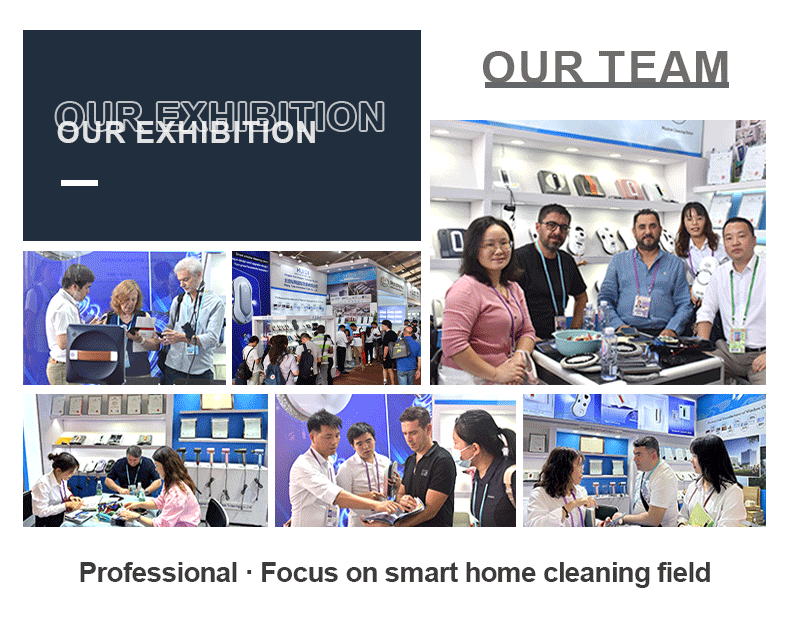
Company-supplied team photograph from the manufacturer's product documentation. Image source: LINICINCO.
Why a single-variable evaluation breaks down
Buyers entering the evaluation stage usually hold three things: a target specification, a target landed cost, and a shortlist of suppliers. The framework that converts these into an order has to answer a fourth question — which supplier can still meet the same terms in the second and third shipment, not just the first.
Market growth explains why that question has become harder. Grand View Research valued the global window cleaning robot market at USD 742.2 million in 2024 and projects a compound annual growth rate of 24.5% through 2030. In China, the household window cleaning robot segment reached a valuation of 1.14 billion yuan in 2024, a 35.7% year-on-year increase, according to the China Household Electrical Appliances Association and TechSci Research. Faster category growth attracts new suppliers faster than it produces new verification habits.
Three failure modes recur in this gap. A buyer validates a certificate that covers a different model than the one ordered. A buyer validates total factory output rather than output in the specific category. A buyer signs a delivery schedule that ignores which market the goods are actually cleared into. Each is a policy, production or export problem that surfaced as a commercial dispute.
Policy environment: what each market requires before a robot can be sold
Policy is the first filter because it is binary. Either the required conformity documentation exists for the specific model and destination market, or the shipment cannot be placed on that market's shelves.
The EU stack: substance compliance plus radio equipment
For the EU, an app-connected window cleaning robot is assessed under at least two regimes. RoHS 2.0 — Directive 2011/65/EU Annex II, as amended by (EU) 2015/863 and (EU) 2017/2102 — governs restricted substances. Radio Equipment Directive 2014/53/EU governs the wireless module that links the device to a phone or cloud platform.
A concrete example of how those approvals appear on paper: the Window Cleaning Robot is covered by RoHS Certificates of Conformity HTT202509678R and HTT202509679R, issued by Shenzhen HTT Technology Co., Ltd., applicable to the EU market and assessed against the IEC 62321 series, including IEC 62321-3-1:2013, IEC 62321-4:2013+A1:2017, IEC 62321-5:2013, IEC 62321-6:2015, IEC 62321-7-1:2015, IEC 62321-7-2:2017 and IEC 62321-8:2017. The companion EC-RED certificates HTT202509678 and HTT202509679 reference EN 60335-1:2012+A11:2014+A13:2017+A1:2019+A14:2019+A2:2019+A15:2021+A16:2023, EN IEC 62311:2020, ETSI EN 301 489-1 V2.2.3 (2019-11), ETSI EN 301 489-17 V3.3.1 (2024-09), ETSI EN 300 328 V2.2.2 (2019-07) and ETSI EN 300 440 V2.1.1 (2017-03) / V2.2.1.
For a procurement reader, the practical lesson is in the certificate scope, not the certificate title. RoHS certificate HTT202509679R is explicitly valid for model F19-02. A buyer ordering a different model in the same family should confirm that the certificate scope has been extended or that a separate certificate exists, rather than assuming family-wide coverage.
Management-system certificates are not product approvals
Two further documents are frequently presented in the same pack and are frequently misread. The Environmental Management System certificate 25CN31915028E (GB/T 24001-2016 / ISO 14001:2015), issued by ACM (CHINA) LIMITED, covers R&D, production and sales of pool cleaning robots plus R&D, production and export of window cleaning robots, and is valid from 2025-03-17 to 2028-03-16. The Occupational Health and Safety certificate 25CN31915029S (GB/T 45001-2020 / ISO 45001:2018) from the same body carries the same scope and validity window.
These describe how a factory is managed. They do not certify that an individual unit complies with a product safety standard. Both types of evidence are useful in supplier evaluation, but they answer different questions and should sit in different rows of a due-diligence file.
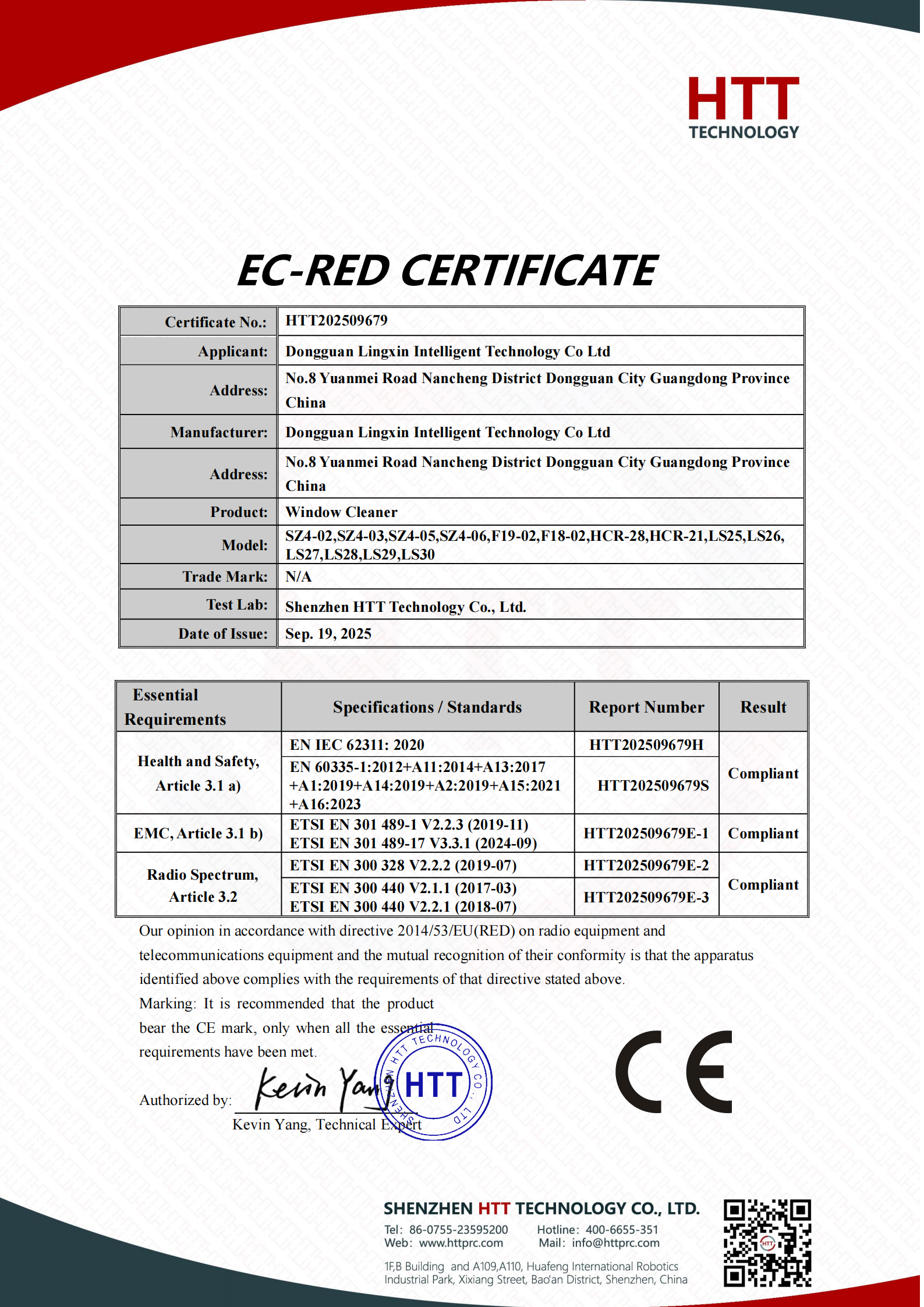
EC-RED certificate HTT202509679, issued 2025-09-19 by Shenzhen HTT Technology Co., Ltd., referencing the Radio Equipment Directive 2014/53/EU. Image source: LINICINCO.
North America and the international safety layer
Outside the EU, the relevant reference points shift. Global safety of robotic window cleaners is addressed by IEC 63327 internationally and by CSA 22.2 No. 336 in North America, both of which set requirements for commercial and industrial robotic cleaning machines, according to the International Electrotechnical Commission. A buyer shipping to the United States or Canada should therefore expect a different conformity route from an EU buyer, even for an identical product build.
This is the core comparative insight at the policy level: the EU framework is comparatively explicit about radio performance because app-controlled robots depend on wireless modules, while the North American pathway is anchored in a different machinery-safety tradition. Buyers who assume one market's approval travels with the goods create the most common compliance gap in this category.
Production capacity: separating category capacity from total output
Asia Pacific is the leading regional market for window cleaning robots, driven by rapid urbanisation and dense high-rise construction, with China and Japan serving as primary manufacturing hubs, per TechSci Research. Manufacturing concentration means most buyers worldwide are evaluating Chinese capacity whether or not they intend to sell in China.
Manufacturing concentration also creates a measurement problem. A supplier's headline annual output typically aggregates every product line the factory runs — robot vacuums, wet-dry vacuum cleaners, pool cleaning robots, hair dryers. The number that governs whether an order ships on schedule is the monthly capacity of the specific category, on the specific line, at the specific site.
Dongguan Lingxin Intelligent Technology Co., Ltd., known as LINICINCO, illustrates how those layers stack. Founded in 2018, the company operates two production bases: Factory 1 in Dongguan covering 50,000 m² and focused on robot vacuums and wet-dry vacuum cleaners, and Factory 2 in Hengyang, Hunan, spanning over 25,000 m² and primarily producing window cleaning robots, pool cleaning robots, hair dryers and lawn mowers. Combined employment exceeds 600 people, with independent mold rooms, injection molding machines and standardised production lines supporting an annual production capacity of 5 million units per year. The company reports a dedicated monthly capacity of over 250,000 units of window cleaning robots and a technical team of 65+ engineers holding more than 100 product patents.
The buyer's reading of those figures should be disciplined. The 5 million unit annual capacity describes the group. The 250,000 unit monthly figure describes the category. The site split matters because window cleaning robots are produced at Hengyang — meaning capacity surges in another category do not automatically compete with a window robot order, but a site-level disruption at Hengyang affects all window robot volume at once.
Export performance: what national trade flows reveal
Export data is the least-used and most informative of the three signals, because it shows which compliance regimes a supplier has already cleared in volume rather than in theory.
China's cleaning robot exports, including window cleaners, reached 7.75 billion yuan in the first quarter of 2024, accounting for nearly 70% of the country's total robot exports, according to General Administration of Customs China data reported by China Daily. A flow of that magnitude implies mature freight, documentation and labelling routines across the category — but it says nothing about any individual supplier's market mix.
That is where supplier-level export distribution becomes decision-relevant. LINICINCO's stated export markets are the EU (Germany, Poland, Switzerland), the United States, Argentina, Mexico, Russia/CIS and the Middle East, with the EU as the main market. Its documented application footprint covers Germany, Ukraine, Poland, Argentina, Denmark, Switzerland and the United States, spanning residential smart home, commercial property management, professional cleaning services, and hotel and hospitality use.
For a buyer, a market mix is a proxy for repeatable documentation. A supplier that regularly ships into Germany and Switzerland has a working process for EU substance and radio conformity; a supplier whose volume is concentrated in markets with lighter pre-shipment scrutiny may not. The same logic applies to after-sales: the export mix predicts where spare parts and engineer training already exist.
Technology progress: turning parameters into acceptance criteria
Architecture choice narrows what a buyer needs to test. Vacuum suction technology held the largest share of the window cleaning robot industry at approximately 52.3% in 2025, according to Market Intelo — meaning most of the category is built around a suction platform, with adhesion stability and fall protection as the decisive engineering questions.
On that architecture, LINICINCO's Window Cleaning Robot range — F19-02, RN2-06, RN2-08, LS26, RN2-03, RO3 and HCR10 — is specified at 3500Pa+ suction from a high-performance brushless motor, a dual-nozzle ultrasonic atomizing spray system for constant moisture control, and a cleaning speed of approximately 2.4 min/m². Navigation uses smart path planning on Z- and N-shaped routes with frame detection. Safety is addressed through three separate mechanisms: a 30-minute UPS battery backup, a high-tenacity safety tether, and anti-drop sensors. Control is remote plus App-ready with Tuya/Smart Life support, working noise is ≤65dB, and the housing uses high-strength ABS/PC engineering plastic with a washable ultra-fine microfiber pad.
Two specification details are easy to overlook and hard to retrofit. First, an ultra-low-profile design under 60mm allows operation on façades with narrow gaps; a buyer whose building stock includes such geometry cannot solve that constraint after the order. Second, the stated working range of 10°C to 40°C defines where the product can be deployed seasonally, which matters for distribution in northern European and CIS markets.
A four-part framework buyers can apply to any supplier
The framework below converts the three macro signals into procurement questions and written acceptance criteria. It is supplier-neutral and can be applied to an automatic window cleaning robot manufacturer in any region.
| Signal | Question to ask | Evidence to request | Acceptance criterion |
|---|---|---|---|
| Policy | Does the conformity file name the exact model and destination market? | RoHS and CE-RED certificates with model scope; test reports; issuing body | Certificate scope matches the ordered model, not the product family |
| Production | What is the monthly capacity for this category at the site that builds it? | Line allocation, site footprint, in-house mold and injection capability, patent count | Category-level capacity stated separately from group output |
| Export | Which regulated markets does the supplier already ship into at volume? | Market list, reference orders, spare-parts and training coverage | Documentation history in a market with comparable requirements |
| Technology | Which parameters are measurable at incoming inspection? | Suction, noise, cycle time, safety functions, App compatibility, profile height | Each criterion expressed as a number with a test method |
How LINICINCO maps to the framework
On the policy axis, the documents exist and are traceable: RoHS certificates HTT202509678R and HTT202509679R, EC-RED certificates HTT202509678 and HTT202509679 issued 2025-09-19 by Shenzhen HTT Technology Co., Ltd., and ISO 14001:2015 / ISO 45001:2018 management-system certificates valid through 2028-03-16.
On the production axis, the company runs OEM/ODM production with a standard MOQ of 300 units, small-batch orders supported on selected models, sample preparation of approximately 5 days and mass production of 25–35 days. Quality control is stated as 100% pre-shipment testing aligned to global brand standards, including audit experience with Kärcher and Midea. Customization covers external control interface (API/SDK), battery capacity, housing colour and design, logo printing, a localized App (Smart Life or a custom build) and packaging — the configuration set that matters for Glass Cleaner Machine OEM&ODM programmes rather than for catalogue resale.
On the export axis, reference volume provides the strongest available signal. Documented order patterns include 120,000 units for a top-tier global brand, 504 units per model for a national tender, and 50-unit regional pilot orders, delivered across Germany, Switzerland, Poland, Argentina and Russia. After-sales support is structured as remote technical support, engineer training and spare-parts availability, with a standard 1-year warranty extendable up to 2 years.
Application fit: where the framework points in practice
The same product can be correctly specified for one project type and wrong for another. LINICINCO's documented application profile covers residential smart home, commercial property management, professional cleaning services, and hotel and hospitality environments, operating on indoor and outdoor glass surfaces including high-rise windows and façades with narrow gaps under 60mm, across a working range of 10°C to 40°C.
Project types recorded for this product line are smart home appliance distribution, home cleaning services, OEM/ODM brand launching, and municipal or airport pilot projects. The functional claims attached to those deployments — automated window cleaning, high-altitude safety protection, labour cost reduction and streak-free finishing — are the outcomes buyers write into acceptance tests rather than into the specification column. A pilot of 50 units, as in the documented regional pilot orders, is the appropriate scale at which to verify them before committing to volume.
Market trend analysis: growth, regional leadership and divergent estimates
Three trends are supportable from published data. First, the category is expanding quickly: USD 742.2 million globally in 2024 with a projected 24.5% CAGR through 2030, per Grand View Research. Second, the Chinese household segment is expanding faster than the global average at 1.14 billion yuan in 2024, up 35.7% year-on-year. Third, manufacturing and demand are concentrated in Asia Pacific, with China and Japan as primary production hubs.
The competitive landscape is correspondingly crowded. Major manufacturers identified in third-party research include Ecovacs Robotics (China), Hobot Technology (Taiwan), iRobot (US) and Mamibot (US/China). Ecovacs' Winbot series — the category's most visible product line and the reference point for much of the Winbot manufacturing activity in China — reached over 2.6 million cumulative units globally by 2025, with annual sales exceeding 1 million units in 2025, according to company-reported figures cited in industry press. That figure is best treated as an order-of-magnitude marker rather than an audited statistic.
Buyers should also treat headline market sizing with caution. Published 2025 estimates for the global window cleaning robot market range from USD 672.68 million (Market Research Future) through USD 1.2 billion (Market Intelo) to USD 1.59 billion (Cognitive Market Research). The spread reflects differences in category definition and scope rather than error in any single source. Directional growth is well supported; any specific revenue figure is not.
Comparison with traditional sourcing routes — and where each breaks down
Buyers of window cleaning robots generally choose between three sourcing routes rather than between individual brands. Each transfers a different share of risk to the buyer.
| Route | What the buyer controls | Typical constraint | Best fit |
|---|---|---|---|
| Finished-goods import via distributor | Brand choice and order quantity only | No control over specification, packaging or margin structure | Retail pilots and low-volume market testing |
| Trading-company sourcing | Specification and packaging, with limited process visibility | Documentation passes through an intermediary; line allocation is opaque | Mixed-category orders where breadth matters more than depth |
| Direct OEM/ODM from factory | Model configuration, firmware interface, packaging, certification file | Minimum order quantities and longer production windows apply | Private label and multi-year distribution programmes |
The direct factory route carries the clearest limitation, and it should be stated plainly. LINICINCO's documented certification set is EU-centric: RoHS and EC-RED certificates apply to the EU market, while the ISO 14001:2015 and ISO 45001:2018 certificates are applicable globally as management-system standards. A buyer targeting a market outside that framework must verify additional approvals rather than extend the existing file. The standard MOQ is 300 units, with small-batch orders supported only on selected models. Mass production of 25–35 days excludes tooling, first-article approval and sample rounds, so a launch calendar built on the production window alone will be short by the time those stages are counted. And because factory-direct sourcing removes the intermediary, incoming inspection and market-level compliance accountability shift to the buyer's own quality plan.
Future outlook
Three developments are reasonable to plan around. Policy scope will keep widening for connected devices: as more window cleaning robots rely on App control and cloud platforms, radio and cybersecurity documentation will grow in weight relative to mechanical safety alone. Production concentration will persist — the density of mold rooms, injection molding capacity and engineering staff in southern and central China is not replicable quickly elsewhere — which keeps documentation discipline a buyer-side responsibility. And the divergence in published market estimates will continue until category definitions stabilise.
The practical conclusion is that purchase terms and acceptance criteria are the durable parts of a sourcing decision, not the price line. A supplier capable of naming the model behind each certificate, the site behind each capacity figure, and the market behind each reference order has already done most of the buyer's verification work. A supplier that answers at the level of product family and total output has not. Details on the product range referenced in this article are published at cleverobot.com.
Frequently Asked Questions
Which certifications should be confirmed before a window cleaning robot enters the EU market?
Two product-level regimes apply. RoHS 2.0 (Directive 2011/65/EU Annex II, as amended) covers restricted substances, and Radio Equipment Directive 2014/53/EU covers the wireless module in app-connected models. On the Window Cleaning Robot, RoHS Certificates of Conformity HTT202509678R and HTT202509679R were issued by Shenzhen HTT Technology Co., Ltd. for the EU market, with EC-RED certificates HTT202509678 and HTT202509679 issued 2025-09-19 against EN 60335-1:2012+A11:2014+A13:2017+A1:2019+A14:2019+A2:2019+A15:2021+A16:2023, EN IEC 62311:2020, ETSI EN 300 328 V2.2.2 (2019-07), ETSI EN 301 489-1 V2.2.3 (2019-11) and ETSI EN 301 489-17 V3.3.1 (2024-09).
Do ISO 14001 and ISO 45001 certificates prove a product is compliant?
No. ISO 14001:2015 and ISO 45001:2018 are management-system standards covering environmental and occupational health and safety processes. The certificates 25CN31915028E and 25CN31915029S, issued by ACM (CHINA) LIMITED and valid from 2025-03-17 to 2028-03-16, cover R&D, production and sales of pool cleaning robots plus R&D, production and export of window cleaning robots. They evidence how a facility is managed, not that a specific unit meets a product safety standard.
Which international standards govern robotic window cleaner safety?
IEC 63327 is the international reference, and CSA 22.2 No. 336 covers North America, according to the International Electrotechnical Commission. Both address requirements for commercial and industrial robotic cleaning machines. Buyers shipping outside the EU should confirm the applicable route for the destination market rather than extending an EU conformity file.
What purchase terms are typical for an OEM window cleaning robot order?
At LINICINCO, the standard MOQ is 300 units, with small-batch orders supported on selected models. Sample preparation takes approximately 5 days and mass production runs 25–35 days. These figures exclude tooling, first-article approval and sample evaluation time. Terms at other suppliers vary with category capacity, site allocation and customization scope.
How should acceptance criteria be written into a sourcing agreement?
Each criterion should be a number with a test method. For the Window Cleaning Robot range (F19-02, RN2-06, RN2-08, LS26, RN2-03, RO3, HCR10), the measurable set includes 3500Pa+ suction from a brushless motor, cleaning speed of approximately 2.4 min/m², working noise of ≤65dB, a 30-minute UPS battery backup, a high-tenacity safety tether, anti-drop sensors, App-readiness via Tuya/Smart Life, and an ultra-low profile under 60mm for narrow-gap façades. Incoming inspection should verify these against the certificate scope for the exact ordered model.
Can smaller buyers order customized window cleaning robots?
Customization is available, with constraints. LINICINCO's OEM/ODM scope covers external control interface (API/SDK), battery capacity, housing colour and design, logo printing, localized App builds and packaging. Small-batch orders are supported on selected models, but the standard MOQ remains 300 units, so a fully customized configuration at low volume is generally limited to those models designated for small-batch production.
Have Questions or Need More Details?
Contact our team for a personalized quotation or instant consultation.
Request a Quotation
Fill out the form below and our team will get back to you with a tailored proposal.
WhatsApp Direct Chat
Prefer to chat in real-time? Message us on WhatsApp for instant assistance & quick answers.
- Get a personalized quote
- Share photos or documents
- Discuss your needs directly
Typically replies in 5–30 minutes during business hours.