
Poly Linen Sofa Fabric TL0415/TL0469/TL0484: OEM Scenario Fit
Poly Linen Sofa Fabric TL0415/TL0469/TL0484: OEM Scenario Fit
Home textile fabric sourcing rarely fails at the swatch stage. It fails later, when a fabric that looked correct on a sample card has to survive a cutting plan, a sewing or bonding line, and a repeat order placed eighteen months after the first shipment. For furniture OEMs, the practical question is not whether a fabric resembles linen — it is whether a named, specifiable construction can be planned into a sofa, upholstery or cushion program without changing from batch to batch.
This reference examines one such specification family in detail: the polyester linen sofa fabric models TL0415, TL0469 and TL0484 from T-LAND TEXTILE, recorded as 100% polyester in 600D × 600D and 300D × 300D constructions, 230 gsm, 150 cm usable width, with a bonded back side and a linen hand feel.
Suzhou T-land Textile Co., Ltd. (trading as T-LAND TEXTILE) is a textile manufacturer based in Shengze, Jiangsu Province, China — an area known as the “Silk Capital of China” — founded in 2014, operating a 5,000 m² facility with 91 employees and an annual output stated at 5,000,000 meters. Its main products are sofa fabric and curtain fabric; approximately 90% of output is exported, with the EU listed as its principal market. The company holds OEKO-TEX and GRS certification and operates an in-house laboratory for lot-level quality testing.
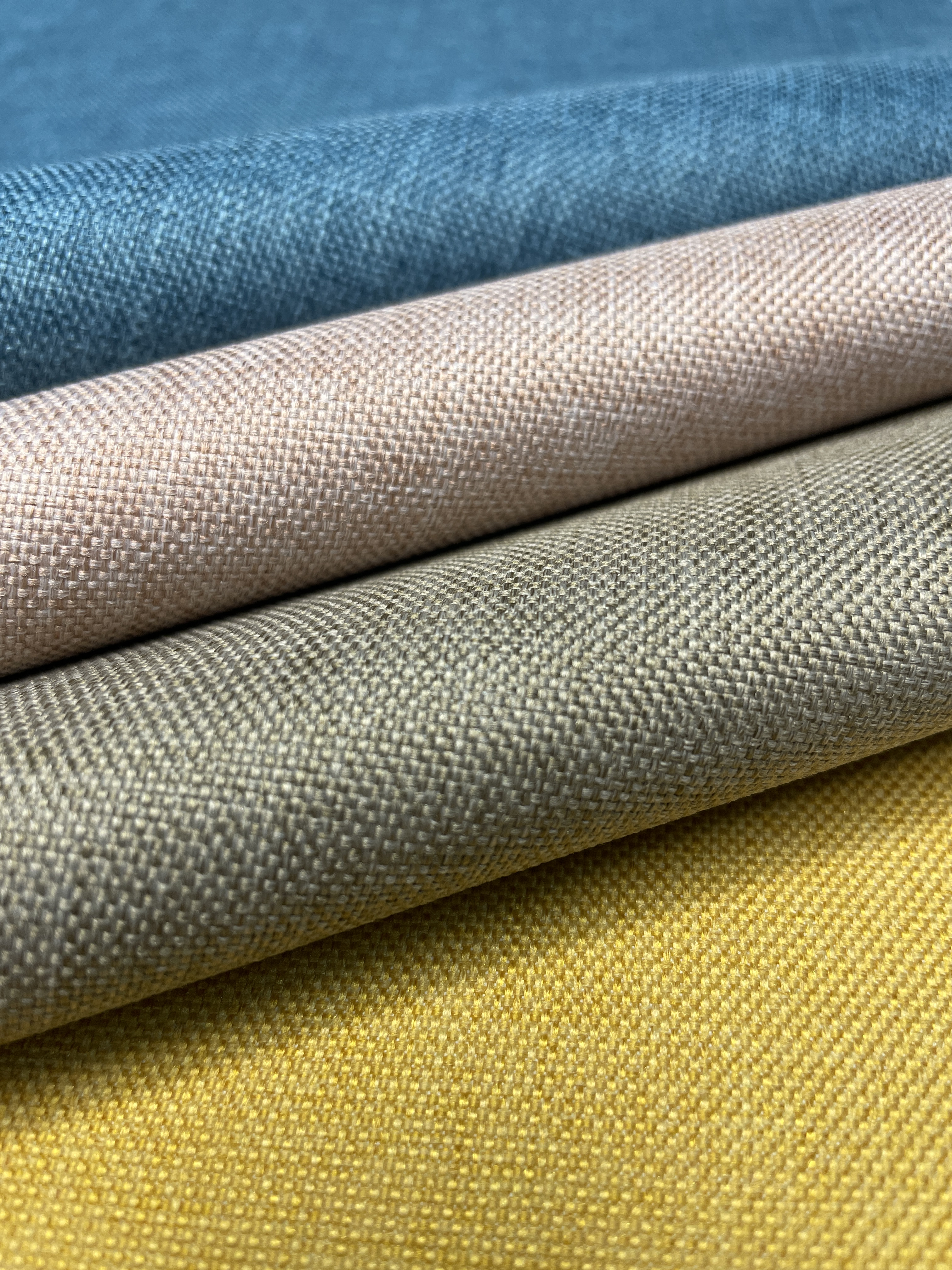
TL0469 — one of the three polyester linen sofa fabric models in the TL0415 / TL0469 / TL0484 family, shown as a bonded poly linen construction.
The OEM Problem: Specification Families, Not Single Fabrics
A furniture OEM program is not a purchase of one attractive fabric. It is a commitment to a construction that must be reproduced across a sofa range, across colourways, and across repeat orders. Three failures are common in that setting, and each one is a specification problem rather than a design problem.
- Repeat inconsistency. A fabric that passes the first order but shifts in hand feel or colour shade on the third order forces re-approval, re-cut panels and, in some cases, customer claims.
- Line mismatch. Constructions that are too heavy, too stiff or too narrow for an existing cutting and sewing line raise material waste and slow throughput even when the aesthetics are correct.
- Application mismatch. A range that covers both indoor and outdoor SKUs cannot use a fabric that has only been validated for interior use, and a fabric specified for commercial seating cannot be assumed to suit high-contact public environments without confirmation.
These issues are visible in the supplier's own case record. The documented OEM case in the T-LAND TEXTILE material concerns an OEM client sourcing fabric for sofa and curtain programs, involving a supply volume of 20,000 meters, with the stated main issue being the need for stable fabric performance in repeat sofa and curtain orders. The record describes the requirement as consistent hand feel and colour fastness in bulk supply, and reports results of stable fabric performance for both sofa and curtain end uses, with hand feel and colour fastness meeting the stated requirement. That is the operating definition of scenario fit: the fabric must behave the same way in the tenth order as in the first.
What the TL0415 / TL0469 / TL0484 Specification Actually States
Before any application claim is made, it is worth separating what the model record contains from what buyers sometimes assume. The recorded specification for this family is as follows.
| Parameter | Recorded specification |
|---|---|
| Models | TL0415, TL0469, TL0484 |
| Material | 100% polyester |
| Construction | 600D × 600D / 300D × 300D |
| Weight | 230 gsm |
| Usable width | 150 cm |
| Back side | Bonded back side |
| Hand feel | Linen |
| Stated end-use fit | Sofa or cushion; indoor and outdoor |
| Applicable industries | Furniture manufacturing, home decoration, wholesaler |
Two features of that table carry most of the procurement weight. First, the construction field groups two different yarn combinations — 600D × 600D and 300D × 300D — under a single 230 gsm weight target and a single 150 cm width. Second, the back side is bonded rather than left as a plain woven reverse.
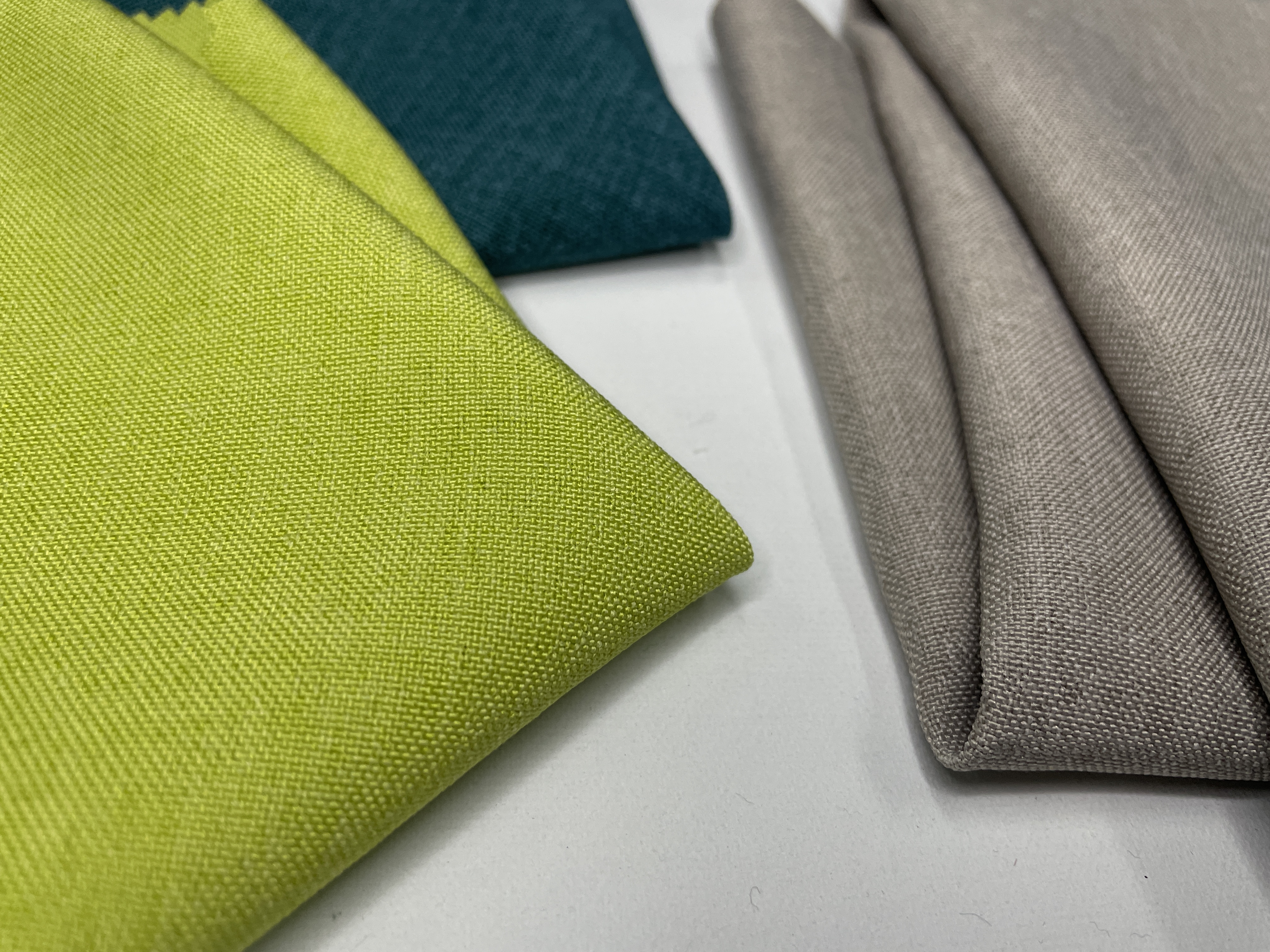
TL0415 — 100% polyester poly linen sofa fabric, 230 gsm, 150 cm usable width, bonded back side.
Technical Explanation: Denier, Weight, Width and Backing
Denier and the two constructions
Denier (D) is a yarn linear-density unit: it describes how heavy a given length of yarn is. In a woven upholstery fabric, the warp × weft notation — 600D × 600D, or 300D × 300D — indicates which yarns run in each direction. A 600D yarn is heavier than a 300D yarn, so the two constructions inside this family do not deliver the same surface. They give an OEM a choice between a heavier, more pronounced weave and a finer one, while the finished fabric weight remains specified at 230 gsm. For a buyer, this means the selection question inside the family is about surface character and weave openness, not about gram weight.
230 gsm in the context of the wider range
At 230 gsm, this poly linen family sits in the lighter half of the supplier's published sofa fabric range, which spans from 160 gsm (TL07377-2, velvet) to 450 gsm (TL07408, jacquard). Lighter constructions are generally easier to handle and manipulate through cutting and sewing, and they reduce material weight per finished unit. The trade-off is that heavier structures are usually the first comparison point when a program's stated requirement includes high Martindale wear resistance. That requirement is listed among the possible special requirements in the application data for this fabric category, and it is not stated as a performance value for TL0415, TL0469 or TL0484 in the model record.
150 cm usable width and cutting-plan consequences
The family is recorded at 150 cm usable width only. Elsewhere in the same supplier's range, several models are offered at 150 cm / 300 cm — for example TL12199, TL12210, TL0329, TL08229 and TL0888. For an OEM, the difference matters at the cutting table: a 150 cm width is well suited to standard upholstery panel layouts, but wide-seat platforms, large cushions or seamless panel designs may require seaming or a different, wide-width model. Confirming the usable width against the actual panel plan before sampling avoids a redesign later in the program.
Bonded back side
A bonded back side means the reverse of the fabric is finished with a bonded layer rather than left as an open woven back. The model record lists the bonded back side alongside the statement that the fabric can be made into sofa or cushion. In production terms, the relevant questions for a buyer are not aesthetic but procedural: what the backing material is, what the bonded weight is, and how the bonding behaves during cutting and sewing. Those parameters are not stated in the model record, so they should be confirmed with the supplier as part of specification approval rather than assumed.
Linen hand feel in a 100% polyester construction
The linen hand feel described in the record is a yarn-selection and finishing outcome, not a fibre-content outcome — the fabric contains no flax. For furniture OEMs this is often the point of the exercise: the visual and tactile language of linen, delivered through a polyester substrate whose fibre behaviour is uniform and whose colour development and cleaning profile follow the polyester route.
Indoor and Outdoor Fit: What Is Stated, and What Is Not
The model record for TL0415, TL0469 and TL0484 states that the fabric is fit for indoor and outdoor use, that it can be made into sofa or cushion, and that any colour can be developed to match home decoration. The application-scenario data associated with this fabric category describes operation under household low-frequency friction and sunlight conditions as well as commercial heavy-duty conditions.
Several important parameters are not stated for this family, and buyers should treat them as open items rather than implied capabilities:
- No light fastness grade is recorded for this family, which is the parameter that governs colour retention under sustained sunlight exposure.
- No Martindale abrasion figure or pilling grade is recorded.
- No water-repellent or stain-resistant finish is recorded as part of the base specification.
- No flame-retardant treatment is recorded as part of the base specification.
Scenario Fit: Where This Fabric Family Enters a Furniture Program
Sofa and upholstery
In sofa applications, the stated function of this fabric type is to cover and protect the sofa base material, resist friction, decorate the space and improve sitting comfort. The mechanical reality is that sofa fabric is fixed onto a sofa frame and bears repeated sitting pressure and friction, together with the sponge filling and sewing processing equipment that make up the matched production set. A bonded 230 gsm poly linen construction with a linen hand feel is therefore evaluated on three things at once: how it behaves on the frame, how it behaves under the needle, and how it looks across a room setting.
Cushion and soft furnishing
The model record explicitly lists cushion as an end use, and the statement that any colour can be developed for home decoration supports matching cushions to a sofa body within a single program. For OEM clients building coordinated sets, this reduces the number of separate fabric specifications the purchasing team has to manage.
Project types
The application data for this fabric category covers residential decoration projects, hotel and B&B projects, office commercial projects, healthcare institutions, exhibition and cultural tourism projects, and special soft furnishing customization for RVs and yachts. Those project types do not share one requirement profile. A residential sofa cover and a healthcare-institution soft furnishing specification can be built from the same base fabric, but the healthcare project usually adds finishing and test requirements that must be confirmed separately.
What this family is not
TL0415, TL0469 and TL0484 are recorded as sofa fabric, not curtain fabric. The supplier's dedicated curtain range — including dimout constructions such as TL08166, TL08229, TL0888 and TL12199 — serves window applications with functions such as light blocking, light adjusting, sun shading, privacy protection and noise reduction. The documented OEM case covers both sofa and curtain programs, but the two ends of that program are served by different fabric families.
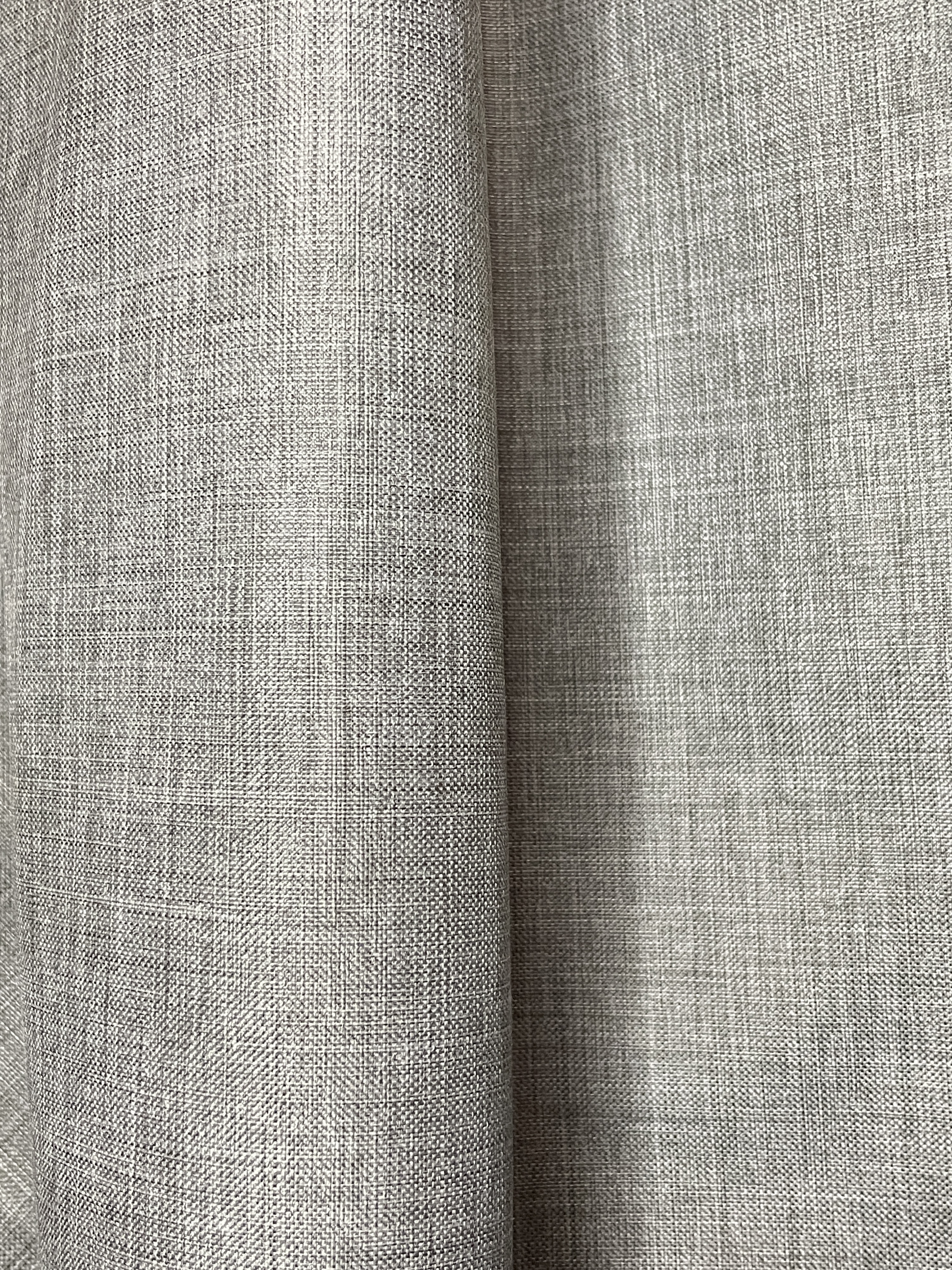
TL0484 — poly linen sofa fabric for sofa and cushion construction, 100% polyester, 230 gsm, bonded back side.
Market Context: Why Poly Linen Specification Work Is Growing
Three published data points frame the demand environment around this fabric category. The global home textile market reached USD 144.76 billion in 2025, according to The Business Research Company. Within that market, Asia Pacific held a 44.17% share in 2025, according to Fortune Business Insights — a concentration that reflects the region's role as the production base for furniture and furnishing programs serving Europe, North America and other export markets. Separately, the upholstery fabric market was valued at USD 44.5 billion in 2023 by Verified Market Research, and China's home textile exports reached USD 2,870.94 million in March 2024.
Market sizing figures of this kind should be read with their definitions in view. The comparison group attached to the 2025 home textile market value notes that published sources vary between roughly USD 137 billion and USD 231 billion depending on whether floor coverings and hard home décor are included. For a buyer, the direction of the trend is more useful than the absolute figure: the category is large, Asia-dominated in supply, and structured around repeat export programs rather than one-off orders — which is exactly the environment in which fabric families such as TL0415 / TL0469 / TL0484 are specified.
Comparison with Traditional Upholstery Structures
Poly linen is one option among several established upholstery structures. The table below compares the specification logic of the three main structure types used in the same supplier's sofa range, using published model data as the reference point for construction. General characteristics describe the structural families; they are not performance ratings for a specific model.
| Structure | Reference example | Recorded specification | Typical specification logic |
|---|---|---|---|
| Polyester linen, bonded | TL0415 / TL0469 / TL0484 | 100% polyester, 600D × 600D / 300D × 300D, 230 gsm, 150 cm, bonded back | Mid-light weight, linen surface character, coordinated sofa-and-cushion programs |
| Velvet / chenille-style | TL07410 | 100% polyester, 350D × 450D, 300 gsm, 150 cm, bonded back | Soft pile surface, heavier hand, deeper colour effects |
| Jacquard | TL07408 | 100% polyester, 1150D × 4500D, 450 gsm, 150 cm, bonded back | Patterned surface structure, highest weight in the compared set |
Boundaries that should be stated openly
- Weight. At 230 gsm, this family is the lightest of the three compared structures. Where a project's stated requirement includes high Martindale wear resistance, the heavier velvet and jacquard options are the natural first comparison, and the appropriate abrasion level should be confirmed for the specific model under consideration.
- Width. 150 cm only, against 300 cm options available on other models in the same supplier's range. Wide panels need re-planning.
- Finishing. Flame retardancy, water repellency and stain resistance are listed as customization options, not as base properties. A project that requires any of them adds a finishing and verification step.
- Outdoor exposure. Although indoor and outdoor use is stated in the model record, no light fastness grade is recorded for this family. Buyers specifying for continuously exposed outdoor furniture should confirm the applicable light fastness grade rather than infer it.
- Backing detail. The bonded back side is stated, but the backing composition and bonded weight are not.
An OEM Evaluation Checklist for This Specification Family
The following sequence reflects how the supplier documents its own commercial terms and how a furniture OEM can move from interest to bulk order with the fewest surprises.
- Fix the end use first. Decide whether the fabric will run on sofa bodies, cushions or both, and whether the SKUs are indoor, outdoor or mixed. The model record supports sofa, cushion, indoor and outdoor use.
- Select the construction. Choose between 600D × 600D and 300D × 300D on surface and weave character, since both are recorded under the same 230 gsm target.
- Check the width against the cutting plan. Confirm that 150 cm usable width covers the panel layout without unplanned seaming.
- Confirm the backing. Ask for the backing composition and bonded weight, and validate behaviour through cutting and sewing on a trial panel.
- Specify finishing needs explicitly. Flame retardancy, water repellency and stain resistance are customization options and must be requested and tested rather than assumed.
- Develop colour against a reference. Colour and shade development, including any colour for home decoration matching, is listed as a customization capability; batch-to-batch colour difference control should be part of the agreed specification.
- Agree the test and inspection regime. The supplier documents 100% in-house testing or random inspection by the customer, alongside OEKO-TEX and GRS certification and an in-house laboratory. The inspection mode should be written into the order.
- Confirm commercial parameters. Documented terms are a minimum order quantity of 500–1,000 meters per colour, a lead time of 30–45 days, monthly capacity of 200,000 meters, and after-sales support within two months of goods receipt by the customer. OEM and ODM production modes are both documented, including development against a customer sample.
Future Outlook
Two regulatory developments are shaping how upholstery fabric specifications will be documented in the coming years. In the European Union, the General Product Safety Regulation (GPSR) 2023/988 sets safety obligations for home textiles, with Digital Product Passports expected for textiles by 2027 — which moves fabric traceability from a quality-department topic to a data topic. In the United Kingdom, the Furniture and Furnishings (Fire) (Safety) Regulations 1988 remain the core regime governing domestic upholstered products, with the standard having been amended since. Scope differences matter here: BS 5867 is the established UK fire safety standard specifically for curtains and drapes, so a supplier that is compliant for curtain programs is not automatically demonstrating compliance for upholstered furniture.
For furniture OEMs, the practical consequence is that fabric families will increasingly be selected not only on hand feel, weight and colour, but on how completely their specification and conformity evidence can be documented at model level. Suppliers that already operate in-house lot testing, third-party certification such as OEKO-TEX and GRS, and digital order documentation are structurally better positioned for that shift than suppliers that treat documentation as an after-sales task.
Frequently Asked Questions
What is the recorded specification of TL0415, TL0469 and TL0484?
They are recorded as sofa fabric in a polyester linen construction: 100% polyester, 600D × 600D / 300D × 300D, 230 gsm, 150 cm usable width, with a bonded back side and a linen hand feel. The recorded end-use fit is sofa or cushion, for indoor and outdoor use, with applicable industries listed as furniture manufacturing, home decoration and wholesalers.
What does “poly linen” mean if the fabric is 100% polyester?
Poly linen describes the surface character rather than the fibre content. The fabric contains no flax; the linen hand feel is produced through yarn selection and finishing on a polyester substrate. This gives the visual and tactile language of linen while the fibre behaviour, colour development and cleaning route follow polyester.
Why does a bonded back side matter in sofa and cushion production?
The model record states that the fabric has a bonded back side and can be made into sofa or cushion. A bonded reverse gives the fabric a finished back rather than an open woven one, which is relevant when the fabric is fixed onto a sofa frame and bears repeated sitting pressure and friction. The backing composition and bonded weight are not stated in the model record, so buyers should confirm them during specification approval.
Can this fabric be used for both indoor and outdoor furniture?
The model record states that the fabric is fit for indoor and outdoor use, and the application data describes operation under household low-frequency friction and sunlight conditions as well as commercial heavy-duty conditions. However, no light fastness grade is recorded for this family. For continuously exposed outdoor furniture, the applicable light fastness grade should be confirmed rather than assumed from the indoor/outdoor statement.
Is 230 gsm a limitation compared with heavier upholstery fabrics?
It is a positioning point rather than a defect. Within the same supplier's published sofa fabric range, weights run from 160 gsm to 450 gsm, with velvet and jacquard models at 300 gsm and 450 gsm respectively. At 230 gsm the poly linen family is lighter, which generally suits handling and cutting efficiency, while heavier structures are the more natural comparison where high Martindale wear resistance is a stated project requirement.
What should be confirmed before placing a bulk order on this specification?
Confirm the chosen construction (600D × 600D or 300D × 300D); confirm that 150 cm usable width fits the cutting plan; obtain the backing composition and bonded weight; request any required flame-retardant, water-repellent or stain-resistant finishing explicitly, since these are listed as customization options rather than base properties; agree colour and shade development against a reference and the batch colour-difference control; and confirm the inspection mode, minimum order quantity of 500–1,000 meters per colour, and the documented 30–45 day lead time.
For buyers who need the full company and product background in one document, the T-LAND TEXTILE brochure is available here: T-LAND TEXTILE product brochure (PDF).