
Polyester Mesh Belt Scenario Fit: Pulp Washing to Latex Drying
Polyester Mesh Belt Scenario Fit: Pulp Washing to Latex Drying
Scenario first, specification second
Polyester mesh belt selection in papermaking, textile finishing, meltblown non-woven and dewatering lines rarely fails because the belt is the wrong product family. It fails because the buyer ordered the family with the wrong priority. In pulp washing the belt must hold fibre while releasing water; in fabric pre-shrinking it must not mark the cloth and must come off the machine quickly; on a meltblown line the airflow value sets how the web forms; in latex wire drying the belt is a drying medium rather than a filter. Henan Yiheng Mesh Belt Industry Co., Ltd. (Yiheng Mesh), a polyester mesh belt manufacturer founded in 2009 that exports 62% of its output to Asia, Europe and North America, publishes one belt family against the same set of duties — which makes the buyer's job a matter of reading the three traits that differ between models, not of finding a different supplier.
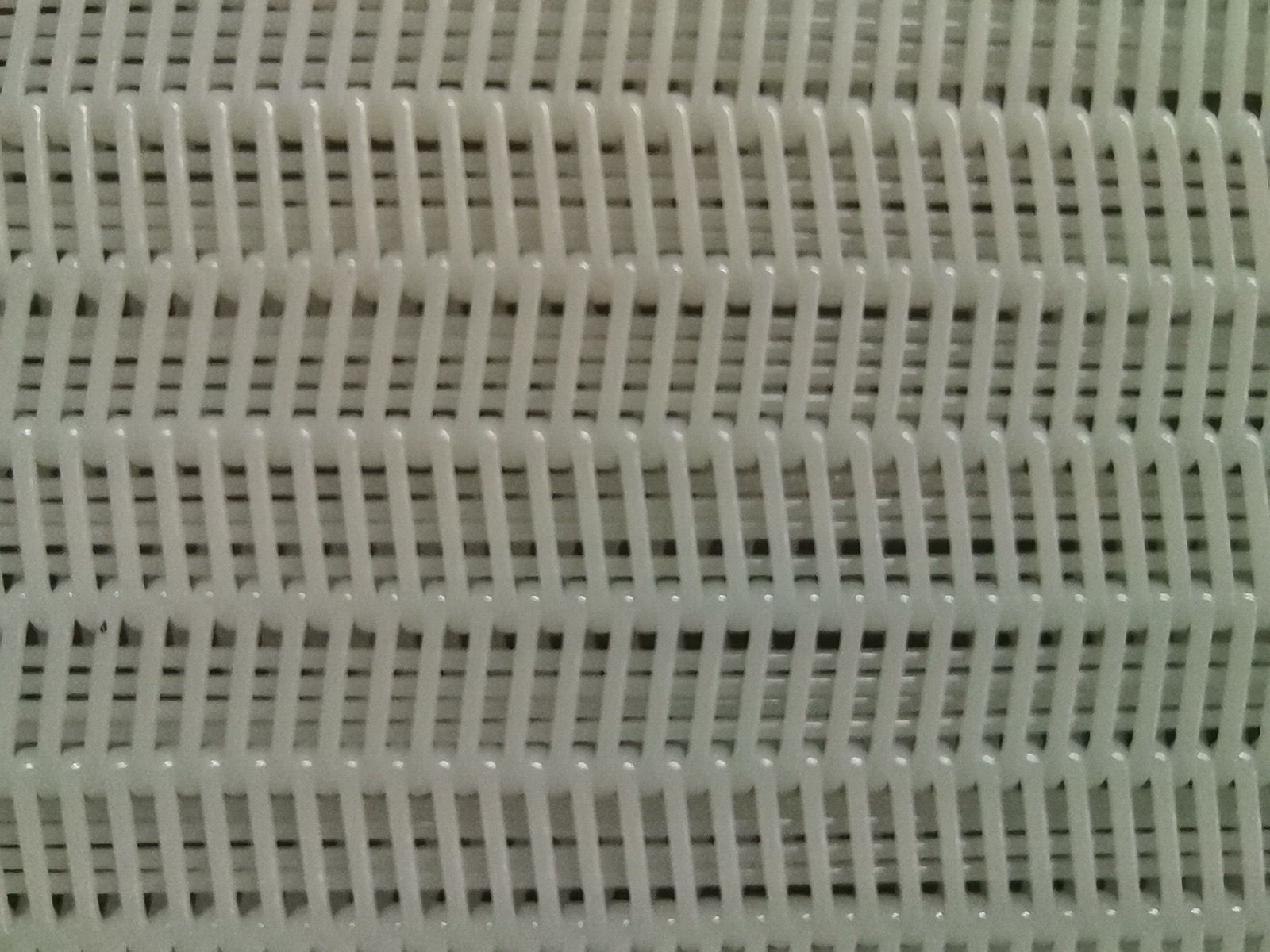
Spiral mesh construction: loop pitch, threading and filler choice set the airflow and thickness that each process position can accept.
Why an identical application list still produces different belt orders
Yiheng Mesh lists belt filter presses, papermaking pulp washing, meltblown non-woven equipment, fabric pre-shrinking machines, and latex wire drying and conveying as suitable applications across three filler-wire loop models. If the application list is shared, the application list cannot be the specification. The order is actually separated by measurable geometry and airflow.
Small Loop-Filler Wire uses a 0.65 × 1.65 mm flat-wire filler with 0.80 mm threading, is 1.90 mm thick, and is rated at 7,300 ±500 m³/㎡·h air permeability (450 ±30 CFM at 127 Pa) with strength at break of ≥2000 N/cm. Medium Loop-Filler Wire uses a 0.68 mm ring wire, 0.90 mm threading and 0.68 × 3 or 0.68 × 4 fillers; it is 2.32 mm thick and rated at 10,700–12,000 ±500 m³/㎡·h (660–740 ±30 CFM) at ≥2000 N/cm. Large Loop-Filler Wire uses a 0.90 mm ring wire, 1.00 mm threading and 0.90 × 3, 0.90 × 4 or 0.90 × 5 fillers; it is 2.95 mm thick and rated at 9,000–13,700 ±500 m³/㎡·h (550–840 ±30 CFM) at ≥2300 N/cm.
Two further options sit outside that series. The Small Loop spiral (warp 0.52 mm, weft 0.70 mm, 5.20 mm loop distance) is also 1.90 mm thick but reaches 17,500 m³/㎡·h, and the Medium Loop spiral (warp 0.68 mm, weft 0.90 mm, 6.50 mm loop distance) is 2.32 mm thick at 18,300 m³/㎡·h. The same thickness, at very different airflow, is the clearest illustration that these belts are configured rather than simply bought.
Three traits that decide the match
Smooth surface and arbitrary disassembly
Every filler-wire loop model in the series and both spiral loops are described as having a smooth mesh surface with arbitrary disassembly and assembly. In practice that trait carries two different costs: a smooth surface protects the product being carried or formed from marking, and arbitrary disassembly shortens the maintenance window when a seam has to be opened or a section replaced. For a plant running continuous shifts, the second is often the deciding factor — a belt that cannot be opened easily turns a planned maintenance stop into an extended one.
Controlled filtration through lower air permeability
Air permeability is the clearest proxy for how open the belt is. Yiheng states that the 7,300 m³/㎡·h rating of the Small Loop-Filler Wire, combined with its fine flat-wire structure, is intended for controlled filtration where maximum solids retention and filtrate clarity matter. The trade is straightforward: a more open belt drains faster, a tighter belt retains more. Neither is better in the abstract — the correct choice depends on whether the cost of a wetter cake or a cloudier filtrate exceeds the cost of slower drainage on that particular press.
The 1.90 mm profile for tight roller spacing
The 1.90 mm thickness of the Small Loop-Filler Wire is the slimmest in the filter press series. Yiheng lists three consequences: it fits machines with tight roller spacing, it reduces belt weight, and it lowers energy consumption. The boundary is equally explicit — the same slim profile carries a ≥2000 N/cm strength rating, below the ≥2300 N/cm of the 2.95 mm Large Loop. Where the machine geometry allows the thicker belt and the load is heavy, the thicker belt is the stronger option; where roller spacing is fixed and tight, the 1.90 mm belt is the one that fits at all.
Papermaking pulp washing and pressing
Pulp washing is a filtration duty before it is a conveying duty. Water has to leave the stock while fibres stay on the belt, and any fibre that passes through becomes a yield loss rather than a maintenance problem. Two configurations in the range address that directly.
Model 16402 is a 2-shed plain weave with 41 mesh, 0.4 mm warp and weft, 0.2 mm pitch, 550 g/m² and 6,900 m³/㎡·h air permeability. Its fine pitch and smooth plain-weave surface are the reason Yiheng positions it for precision pulp washing and chemical filtration, with corrosion resistance listed for chemical exposure. Where the washing stage is the fine end of the process, this is the more logical starting point than an open spiral.
Pressing is a different problem. Model 16903 uses a herringbone, diagonal weave with 0.70 mm warp, 0.90 mm weft, 16 warp ends/cm and 5.33 weft ends/cm, ≥2200 N/cm strength at break and 7,894 ±500 m³/㎡·h air permeability, in acid- and alkali-resistant PET. Yiheng lists paper pulp pressing among its duties and states that the herringbone structure reduces adhesion between cake and mesh so the cake releases more cleanly at discharge. On a press, cake release is a throughput variable, not a cosmetic one: a belt that holds the cake back slows the whole cycle.
The filler-wire loops (8577, 8575 and 8574) also list papermaking pulp washing and pressing in their application set, so a mill running several positions can standardise on one construction family and vary thickness and filler count by position rather than by supplier.
Fabric pre-shrinking in textile finishing and dyeing
Pre-shrinking is where the belt's surface quality and its mechanical envelope matter more than its filtration rating. The belt has to carry fabric under tension through a heated sequence without imparting a pattern, and it has to be serviceable in a finishing house where space around the machine is limited.
All three filler-wire loops and both spiral loops list fabric pre-shrinking machines as a suitable application, and Yiheng lists the textile and dyeing industry as an applicable sector for the filter press series. The differentiators here are the ones the scenario actually stresses: the smooth mesh surface, which is the stated reason the range is used where marking must be avoided; arbitrary disassembly, which shortens seam work between batches; and thickness. A 1.90 mm belt fits tighter roller spacing than a 2.32 mm or 2.95 mm belt, and the same slim profile is the one Yiheng credits with lower belt weight and lower energy consumption.
For a finisher running more than one machine type, the practical rule is to measure roller spacing and the available take-up first, then select the thickest belt the geometry accepts. Choosing a thin belt where a thicker one fits gives away strength for no benefit.
Meltblown non-woven equipment
On meltblown equipment the belt is part of the forming and suction system, so airflow is the primary specification and surface quality is the secondary one. A web that is carried on a belt with an uneven or open surface shows that structure in the finished fabric; a belt whose airflow does not match the suction system forms unevenly across the width.
The filler-wire loops list meltblown non-woven equipment directly, and the filler count gives a graded set of airflow options: 0.68 × 3 fillers at 12,000 m³/㎡·h for the most open medium-loop build, 0.68 × 4 at 10,700 m³/㎡·h for a finer structure, and 0.90 × 3, 0.90 × 4 or 0.90 × 5 on the large loop spanning 13,700 down to 9,000 m³/㎡·h. Two plain-weave options extend the range at the fine end: 05802 (12–14 mesh, 0.8 mm warp and weft, 700–750 g/m²) is listed for non-woven forming including spunlace and meltblown at 13,384–20,775 m³/㎡·h with a smooth, anti-staining surface, and 16402 at 6,900 m³/㎡·h covers fine forming where retention outweighs open area.
The selection question is therefore not "which belt is best for meltblown" but "what airflow does this line's suction system require, and what surface finish can the web tolerate". Once those two values are fixed, the choice usually collapses to one or two models.
Latex wire drying and conveying
Drying inverts the logic of filtration. Instead of holding material back, the belt has to let hot air through as evenly as possible while carrying the product without distortion. The open spiral constructions are the natural fit, and the range offers a documented spread.
The Small Loop spiral delivers 17,500 m³/㎡·h through a 5.20 mm loop distance at 1.90 mm thickness, and the Medium Loop spiral delivers 18,300 m³/㎡·h at 6.50 mm loop distance and 2.32 mm thickness. Yiheng describes both as dryer-belt configurations where high air permeability supports fast, even drying. Latex wire drying and conveying is listed as a suitable application across the filler-wire series and both spiral loops, and rubber and chemical fibre processing is listed as an applicable sector.
Adjacent evidence from a rubber duty cycle is worth noting for scale rather than for direct transfer: in Malaysia, a rubber products manufacturer installed polyester mesh belts across 8 curing and cooling lines, and over two years reported 15% higher productivity, 30% lower maintenance cost and zero major failures, with heat resistance, air permeability, easy release and dimensional stability cited as the relevant properties. That is a curing and sheet-cooling application, not a latex wire drying line, so the numbers should be read as evidence of how the construction behaves under continuous heat and release duty rather than as a forecast for a latex line.
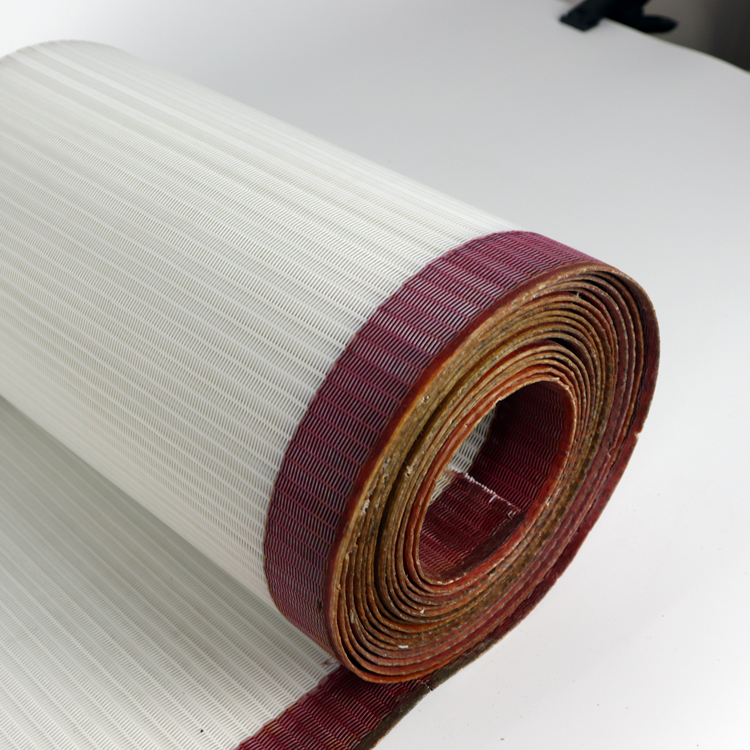
Loop pitch, filler dimensions and threading together determine a belt's thickness, airflow and strength — the three variables that separate the models in this range.
Belt filter presses
A belt filter press is the scenario where all three traits are under load at once. The belt runs under high mechanical pressure and tension in an abrasive, high-load environment (Yiheng's sludge dewatering scenario data), so strength and cake release come first, filtration fineness second, and serviceability third — though all three decide whether the press stays available.
The strength ladder is explicit: ≥2000 N/cm for the 1.90 mm and 2.32 mm filler-wire loops, ≥2300 N/cm for the 2.95 mm large loop, and ≥2200 N/cm for the herringbone 16903. Cake release separates 16903 from the spiral family, because its herringbone weave is specifically described as reducing cake adhesion so the solids peel away at discharge, and its surface is described as resisting deep embedding of fibres and particles, which limits blinding between washes.
Drainage separates the filler-wire models from each other. The 0.90 × 3 large loop reaches 13,700 m³/㎡·h for high-volume dewatering, 0.90 × 4 sits at 12,700 m³/㎡·h as a balanced build, and 0.90 × 5 drops to 9,000 m³/㎡·h for a drier cake. On the medium loop the same logic runs from 12,000 down to 10,700 m³/㎡·h. A press that is throughput-limited and a press that is cake-moisture-limited should therefore not be ordered with the same filler count.
Wastewater treatment and sludge dewatering
Wastewater duty adds chemistry and continuity to the press mechanics. Yiheng's sludge dewatering scenario data specifies a chemically active, abrasive, high-humidity environment under 24/7 cyclic operation, with corrosion resistance, anti-fouling, cake release and dimensional stability listed as requirements.
Model 16903 addresses the chemical side with acid- and alkali-resistant PET and lists municipal sewage dehydration among its duties. The filler-wire loops list environmental protection and wastewater treatment as an applicable sector. Yiheng also cites a municipal plant in Malaysia where polyester filter press belts were installed on 12 belt filter presses: over a six-month period the installation reported 8% lower cake moisture, 40% lower maintenance cost and zero major failures, with high open area to prevent clogging and chemical resistance cited as the contributing properties. The six-month window is short relative to a full belt life, so the maintenance figure should be treated as an early-stage result rather than a lifetime average.
Flat-wire filler versus standard loop: a real distinction, with a boundary
The most useful comparison inside this range is between two belts of identical thickness. The Small Loop spiral and the Small Loop-Filler Wire are both 1.90 mm, yet they are rated at 17,500 and 7,300 m³/㎡·h respectively. The filler is what closes the structure: Yiheng states that the 0.65 × 1.65 mm flat-wire filler creates a denser, finer mesh than round-wire belts, capturing smaller particles and producing a drier filter cake.
That claim comes with a boundary the buyer should apply. A denser structure resists flow, so a line whose bottleneck is drainage rate rather than filtrate clarity will do better with the open spiral or a lower filler count — 0.68 × 3 at 12,000 m³/㎡·h, or 0.90 × 3 at 13,700 m³/㎡·h. The flat-wire advantage is a filtration advantage, not a universal one. Similarly, the 1.90 mm profile solves a geometry problem but gives up strength against the 2.95 mm large loop's ≥2300 N/cm; where roller spacing permits the thicker belt, the thinner one is not the stronger choice.
Scenario-to-configuration fit table
| Process scenario | Trait that governs | Matching configuration | Documented figures |
|---|---|---|---|
| Papermaking pulp washing | Controlled filtration, smooth non-marking surface | 16402 plain weave; Small Loop-Filler Wire | 41 mesh, 0.2 mm pitch, 6,900 m³/㎡·h; 7,300 ±500 m³/㎡·h at 1.90 mm |
| Papermaking pulp pressing | Cake release plus tensile strength | 16903 herringbone | ≥2200 N/cm, 7,894 ±500 m³/㎡·h, acid/alkali-resistant PET |
| Fabric pre-shrinking (textile finishing/dyeing) | Smooth surface, easy disassembly, thin profile | Small Loop-Filler Wire (1.90 mm) or Medium Loop-Filler Wire (2.32 mm) | ≥2000 N/cm; 7,300 ±500 or 10,700–12,000 ±500 m³/㎡·h |
| Meltblown non-woven equipment | Airflow matched to suction; uniform surface | Medium Loop-Filler Wire 0.68 × 3 / 0.68 × 4; 05802 for open forming | 12,000 / 10,700 ±500 m³/㎡·h; 13,384–20,775 m³/㎡·h |
| Latex wire drying and conveying | High, even air permeability with release | Small Loop spiral (1.90 mm) or Medium Loop spiral (2.32 mm) | 17,500 m³/㎡·h at 5.20 mm loop; 18,300 m³/㎡·h at 6.50 mm loop |
| Belt filter press | Strength under pressure; drainage versus cake dryness | Large Loop-Filler Wire 0.90 × 3 / 0.90 × 4 / 0.90 × 5 | ≥2300 N/cm, 13,700 / 12,700 / 9,000 ±500 m³/㎡·h, 2.95 mm |
| Wastewater treatment / sludge dewatering | Chemical resistance, anti-clogging, continuous duty | 16903 herringbone; Small Loop-Filler Wire for tight layouts | Acid/alkali-resistant PET; 7,300 ±500 m³/㎡·h at 1.90 mm |
What the wider market says about these duties
Two external data points frame the demand side. Straits Research reports that polyester held a 28.4% share of the global conveyor belt market by material in 2025, the leading material segment in that classification (published August 2026). The same source projects the global conveyor belt market rising from USD 6.24 billion in 2026 to USD 8.53 billion by 2034. Separately, Grand View Research estimates that belt filter press technology is growing at a compound annual rate of 8.8% between 2025 and 2033 within the sludge dewatering equipment market.
These figures should be read with their definitions attached: market-size estimates for conveyor belts vary noticeably between research houses because the boundaries differ on heavy-duty mining belts and modular plastic belts. The useful reading for a buyer is narrower — the dewatering and filtration end of the market, where mesh belts sit, is an area of sustained equipment investment, which keeps pressure on belt specification rather than belt price alone. On the trade side, textile products and articles for technical uses, including polyester mesh belts, are commonly classified under HS code 5911.90, which is the classification importers typically need for documentation.
FAQ: matching a polyester mesh belt to a duty
Which polyester mesh belt fits papermaking pulp washing?
For fine washing, model 16402 is the closer match: 41 mesh, 0.4 mm warp and weft, 0.2 mm pitch and 6,900 m³/㎡·h air permeability, with corrosion resistance listed for chemical exposure. Where the washing position runs alongside pressing and a common construction family is preferred, the filler-wire loops list papermaking pulp washing and pressing among their applications, and 16903 covers pulp pressing with a herringbone weave for cake release.
What changes when a filter press belt has lower air permeability?
Lower air permeability means a denser structure. The 1.90 mm Small Loop-Filler Wire is rated at 7,300 ±500 m³/㎡·h and is described as providing controlled filtration with maximum solids retention and filtrate clarity; the 2.32 mm medium loop ranges from 12,000 down to 10,700 m³/㎡·h and the 2.95 mm large loop from 13,700 down to 9,000 m³/㎡·h, depending on filler count. A press limited by cake moisture and a press limited by throughput point to opposite ends of that range.
Why does a 1.90 mm belt thickness matter in practice?
Thickness determines whether the belt fits at all. The 1.90 mm profile is listed as the slimmest in the filter press series, fitting machines with tight roller spacing, reducing belt weight and lowering energy consumption, while retaining a ≥2000 N/cm strength rating. It is a geometry solution as much as a performance choice.
Can one belt cover both fabric pre-shrinking and latex drying?
Both duties appear in the application list of the filler-wire series and the spiral loops, so overlap is possible, but the priorities differ. Pre-shrinking depends on a smooth surface, easy disassembly and a thin profile; latex drying depends on high, even air permeability, which is why the spiral loops are rated at 17,500 and 18,300 m³/㎡·h rather than the 7,300 m³/㎡·h used for controlled filtration. Roller spacing, tension and the airflow the line actually needs should be confirmed before treating the two duties as interchangeable.
Summary
The six scenarios in this guide do not require six different suppliers; they require one belt family read against three variables. Smooth surface and arbitrary disassembly govern the maintenance-sensitive positions in textile finishing. Lower air permeability governs pulp washing, meltblown forming and dewatering, where retention and filtrate clarity matter more than open area. The 1.90 mm profile governs any position where roller spacing is fixed and tight. Yiheng Mesh publishes the figures needed to make that reading — thickness, air permeability with tolerance bands, filler dimensions and strength at break — across the Small, Medium and Large Loop-Filler Wire belts, the two spiral loops, the herringbone 16903 press belt and the plain-weave 16402 and 05802 constructions.
Further specification detail, including the full model range and construction options, is available in the Yiheng Mesh product brochure. Company information and the current product list are published by Henan Yiheng Mesh Belt Industry Co., Ltd.
Have Questions or Need More Details?
Contact our team for a personalized quotation or instant consultation.
Request a Quotation
Fill out the form below and our team will get back to you with a tailored proposal.
WhatsApp Direct Chat
Prefer to chat in real-time? Message us on WhatsApp for instant assistance & quick answers.
- Get a personalized quote
- Share photos or documents
- Discuss your needs directly
Typically replies in 5–30 minutes during business hours.