
Polyester Mesh Belt Technology: Types, Filtration Roles and Buying Context
Polyester mesh belts are usually classified as conveyor components, but in many production lines their actual job is closer to that of a filter or processing surface than to a simple transport strip. A woven polyester belt can drain sludge inside a belt filter press, carry a newly formed paper web, support meltblown nonwoven production, or act as a printing bed for UV printers. For buyers, this changes the selection conversation: the key questions are not only about width and tension, but also about weave geometry, permeability, cake release, surface smoothness, dimensional stability and chemical resistance.
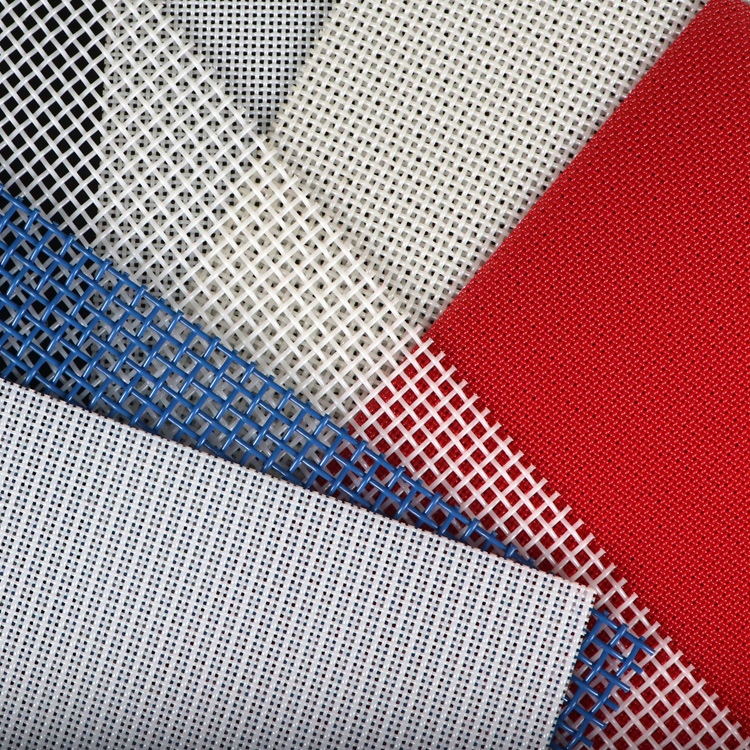
Polyester square mesh is a common plain-weave construction in filtration and drying belts.
Polyester is also an important material in the wider conveyor market. A 2025 market review published by Straits Research identifies polyester as the leading material segment in the global conveyor belt market, with a 28.4% revenue share. This does not mean that every polyester belt is a woven mesh belt. Rubber and plastic covered conveyor belts also contain polyester carcasses. But it does explain why industrial buyers now treat polyester as a mature, high-volume material platform for moving and processing materials.
One company that represents this specialised manufacturing segment is Henan Yiheng Mesh Belt Industry Co., Ltd., known commercially as Yiheng Mesh. It is a National High-tech Enterprise in China, founded in 2009, focused on the R&D, customisation and production of nonwoven forming belts and industrial filter belts. The company operates a factory of 4,237 m² with a monthly output capacity of 12,800 m² and annual capacity of 150,000 m². Its export share is 62%, with major markets in Asia, Europe and North America. Yiheng Mesh is not presented here as the whole industry, but as a practical reference point for what a dedicated polyester mesh belt producer looks like.
Why woven polyester mesh matters in processing lines
The industrial demand for polyester mesh belts is driven by a simple requirement: process water or air has to pass through a moving surface while the product stays on that surface. Solid-liquid separation, pulp washing, food drying, nonwoven forming and sludge dewatering all depend on this ability.
Compared with traditional rubber belts or solid conveyor bands, a woven mesh belt creates an open structure that permits drainage and airflow. Compared with metal wire belts, polyester mesh offers lighter weight, easier joining and better resistance to many chemicals. The result is a processing tool that can be engineered for different levels of filtration fineness, cake dryness, open area and mechanical strength.
The challenge is that polyester mesh belts are not a single product. The phrase covers at least four structural families:
- polyester square mesh and plain weave mesh;
- polyester spiral mesh in small, medium and large loop formats;
- filter press belts with flat wire fillers;
- forming fabrics and dryer fabrics made from high-tenacity PET monofilaments.
Each structure favours a different set of process outcomes. Buying the right belt therefore starts with understanding which family matches the application.
Main technical families of polyester mesh belts
Most polyester mesh belts are woven from PET monofilament. The monofilament diameter, mesh count, weave pattern and loop geometry control the belt's permeability, surface contact and mechanical strength. In practice, the market can be organised into the following families.
Polyester square mesh and plain weave belts
Square mesh belts are flat woven constructions, usually a 2-shed plain weave. Because the weave is planar and compact, these belts provide a smooth surface and predictable filtration openings.
A representative square mesh model, type 05802, uses 0.8 mm warp and weft monofilament, has a mesh range of 12–14 and a pitch range of 1.0–1.2 mm. Belt weight is 700–750 g/m² and airflow ranges from 13,384 to 20,775 m³/m²·h. This relatively open square mesh is used in food and feed drying, spunlace and meltblown nonwoven forming, pulp washing and sewage treatment. The material is described as non-toxic, odourless, corrosion-resistant and stable under continuous industrial tension.
Finer filtration is possible in a plain weave belt such as model 16402, which uses 0.4 mm warp and weft monofilament, a 41 mesh count and a 0.2 mm pitch. The combination of high mesh count and fine pitch creates a smooth surface suitable for high-precision filtration. Its weight is 550 g/m² and air permeability is 6,900 m³/m²·h. Endless and self-ring joint options are available.
Polyester spiral mesh belts
Spiral mesh belts are built from interlinked spiral coils rather than only crossing warp and weft yarns. This construction gives higher open area in some configurations, better flexibility around rollers and a more three-dimensional drainage path.
The large loop polyester spiral mesh is the strongest of the standard spiral family, with a strength at break of at least 2,300 N/cm in filter press form. In a dryer configuration it can reach an air permeability of about 19,000 m³/m²·h. The medium loop variant offers a balanced profile: minimum strength at break of 2,000 N/cm, thickness of 2.32 mm and dryer airflow of about 18,300 m³/m²·h. The small loop variant, at 1.90 mm thickness, is suited to machines with tighter roller spacing and lower weight requirements.
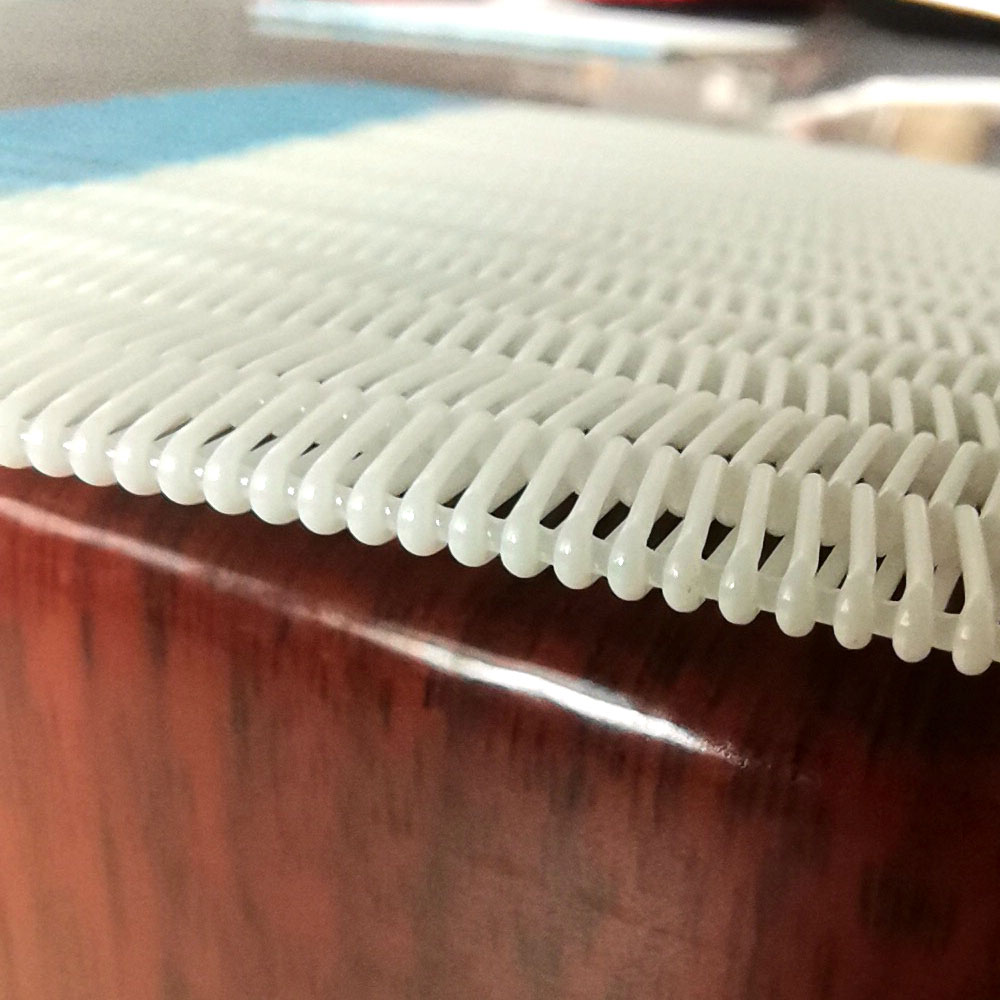
Polyester spiral mesh belts are available in several loop sizes; loop geometry is a key variable in dryer and filter applications.
Filter press belts with flat wire fillers
Filter press belts combine spiral mesh construction with inserted filling wires. The fillers change the filtration behaviour: they create a denser structure that captures smaller particles, improves cake release and produces a drier filter cake.
In Yiheng Mesh's product range, the large loop filler wire model has a ring wire of 0.90 mm, threading of 1.00 mm and filler options of 0.90×3, 0.90×4 or 0.90×5 mm. Belt thickness is 2.95 mm, air permeability ranges from 9,000 to 13,700 ±500 m³/m²·h, and strength at break is at least 2,300 N/cm. The medium loop filler wire model adds flexibility through two filler choices: 0.68×3 mm for higher drainage and 0.68×4 mm for finer filtration. The small loop filler wire belt uses a 0.65×1.65 mm flat wire and reaches a lower air permeability of about 7,300 ±500 m³/m²·h, which supports controlled filtration and drier cake.
Specialised structures: herringbone filter belts, forming fabrics and UV belts
Dewatering presses often use a herringbone or diagonal weave to improve sludge discharge. Model 16903 is one such filter press belt: warp density is 16 wires/cm, weft density is 5.33 wires/cm, air permeability is 7,894 ±500 m³/m²·h, and strength at break is at least 2,200 N/cm. The herringbone pattern reduces adhesion between filter cake and mesh, making cake peeling easier and keeping the belt clean during discharge.
For paper forming, forming fabrics are usually woven from 100% high-tenacity PET monofilaments. They can be single-layer or double-layer, with air permeability ranging from 4,750 to 29,200 m³/m²·h. On modern high-speed machines these fabrics support stable sheet forming, dewatering and surface finish.
Another specialist product is the UV printer belt, made from high-grade black PET in a spiral structure with flat wire filler. It is designed for digital printing, packaging printing, label printing and advertising production, where a smooth, burr-free surface prevents damage to both printed media and delicate printheads.
| Main belt type | Typical structure | Air permeability range | Representative strength | Typical applications |
|---|---|---|---|---|
| Square mesh / plain weave | 2-shed plain weave from PET monofilament | 6,900 – 20,775 m³/m²·h | High tensile strength, no single standard value | Sludge dewatering, food and feed drying, pulp washing, nonwoven forming |
| Spiral mesh, small loop | Spiral coils with 5.20 mm loop distance | About 17,500 m³/m²·h in dryer form | ≥2,000 N/cm | Filter presses, paper pulp washing, nonwoven equipment, latex wire drying |
| Spiral mesh, medium loop | Spiral coils with 6.50 mm loop distance | About 18,300 m³/m²·h in dryer form | ≥2,000 N/cm | Dryer sections, papermaking, textile finishing, environmental protection |
| Spiral mesh, large loop | Spiral coils, 7.00 mm loop distance in dryer form | 9,000–13,700 m³/m²·h in filter press; about 19,000 m³/m²·h in dryer | ≥2,300 N/cm | Heavy dewatering, high-tension belt filter presses |
| Filter press belt with flat wire filler | Spiral structure plus filling wires | 7,300–13,700 ±500 m³/m²·h | ≥2,000–2,300 N/cm | Sludge dewatering, papermaking, nonwoven production, chemical filtration |
| Herringbone filter press belt | Herringbone / diagonal weave | 7,894 ±500 m³/m²·h | ≥2,200 N/cm | Municipal sewage, mine tailings, paper pulp, juice pressing |
How engineering choices influence performance
There is no single best polyester mesh belt because every process has a different balance of drainage rate, solids retention, belt life and cake discharge. Several variables matter most.
Mesh count and pitch determine filtration fineness
A 41-mesh belt with 0.2 mm pitch will retain much finer particles than a 12–14 mesh square mesh belt. The cost is lower air permeability and a higher risk of surface blinding. Applications that need very fine solids retention should select dense plain weave belts; coarser applications such as primary sludge dewatering can tolerate open meshes and benefit from faster drainage.
Air permeability controls water removal and drying speed
Air permeability, measured in m³/m²·h, is one of the most useful specification values. High airflow, such as 20,775 m³/m²·h in an open square mesh, supports rapid water removal and heat penetration. Lower airflow, such as 7,300 m³/m²·h in a small loop filler wire belt, supports more controlled filtration and can produce a drier cake because the belt retains more solids on the surface. Engineers therefore choose permeability based on the trade-off between throughput and filtrate clarity.
Strength at break defines what the machine can apply
Belt filter presses operate under high tension. A belt with higher strength at break allows higher pressing pressure and heavier sludge loading. In Yiheng Mesh's product data, the large loop filler wire belt was rated at ≥2,300 N/cm, while several medium formats are rated at ≥2,000 N/cm. For very heavy dewatering duties, the higher strength design is usually preferred; for lighter or more compact machines, a thinner belt is easier to install and consumes less energy.
Joint type and dimensional stability affect uptime
Joint options include endless, self-ring and, in forming fabrics, double-pins. The joint must not create a raised mark on the processed product. Stable heat-setting is equally important: belts that are not dimensionally stable can shrink, ruffle, develop bell mouths or deviate from their tracking path during operation. Yiheng Mesh's product descriptions emphasise stable heat setting, no deviation, no ruffles and no bell mouths, which are practical signals for buyers who want predictable running behaviour and low maintenance.
Application landscape: where polyester mesh belts are used
Polyester mesh belts have a genuinely multi-industry application profile. The following list is not exhaustive, but it reflects the main documented use cases in the industry.
- Sludge dewatering and environmental protection. Belt filter presses use polyester filter belts to separate water from municipal sludge, industrial waste, mine tailings and pulp. Models with herringbone weave and high strength are designed for continuous pressing duty, cake peeling and resistance to chemically active environments.
- Papermaking. Forming fabrics carry the paper web in the forming section and allow water to drain through the mesh. Dryer fabrics support the web through hot dryer sections while permitting vapor removal. The product data for polyester forming fabrics shows mesh counts from 5 to 108 and thicknesses from 0.30 to 1.80 mm, giving papermakers a wide process window.
- Nonwoven production. Spunbond, meltblown, spunlace and airlaid lines use belts as forming surfaces and conveying media. For meltblown equipment, polyester mesh belts must combine high permeability with a smooth, mark-free surface. Yiheng Mesh states that its nonwoven-related belts are compatible with machine speeds ranging from 20 m/min to 850 m/min, and the forming fabric series is engineered for stability at high speed.
- Food, feed and pharmaceuticals. Fine plain weave belts such as model 16402 are used in food and feed processing, pharmaceutical filtration and other hygiene-sensitive processes. Polyester is described as non-toxic and odourless in the relevant product documentation, and a food contact certificate is held for applicable products.
- Textile and rubber processing. Polyester mesh belts are used in fabric pre-shrinking machines, latex wire drying and conveying, and related textile finishing operations. The smooth, open structure supports even drying without marking the fabric.
- Digital and packaging printing. The UV printer belt is a black PET spiral belt with flat wire fillers, designed for vacuum transport of media through UV curing machines. Its surface must be smooth without burrs so that printed fabrics and printheads remain undamaged.
Market signals: polyester materials in a growing belt economy
Market data helps explain why polyester mesh belts have become a mainstream purchasing category rather than a niche textile product.
First, the global conveyor belt market is projected to expand from USD 6.24 billion in 2026 to USD 8.53 billion by 2034, according to Straits Research in its August 2026 report. Because polyester is already the leading material segment in this market, a rising overall market tends to increase the installed base of polyester-based belts.
Second, belt filter press technology is growing within the sludge dewatering equipment category. Grand View Research expects belt filter press technology to grow at a CAGR of 8.8% from 2025 to 2033. Since belt filter presses consume polyester mesh belts as wear parts and replacement media, this trend strengthens demand for filter press belt products, particularly in municipal and industrial wastewater treatment.
Third, customs classification confirms the identity of the product as a technical textile. According to the US International Trade Commission Harmonized Tariff Schedule, HS code 5911.90 applies to textile products and articles for technical uses, including polyester mesh belts. This classification is useful for importers, freight forwarders and procurement teams because it separates technical mesh belts from general conveyor machinery and highlights the component-like nature of the purchase.
Comparison with traditional belt solutions: strengths and limits
In a typical plant, polyester mesh belts compete with metal wire belts, nylon or polypropylene synthetic belts, and conventional rubber conveyor belts. Each has a different value proposition.
Polyester mesh belts generally offer good chemical compatibility, stable monofilament structure, easy installation and removal, and a smoother product-facing surface than many metal alternatives. Spiral polyester belts can be opened for disassembly and reassembly, which simplifies installation, seam changes and maintenance. Their light weight also reduces energy consumption compared with equivalent metal belts on many tensioning systems.
Versus metal mesh belts, the most important limitation is temperature. Polyester is a thermoplastic material, so it does not offer the same tolerance as stainless steel for extreme heat. Applications such as high-temperature sintering, annealing, glass processing or other processes that require prolonged exposure well above the normal drying range are not suitable for polyester mesh belts. Buyers should confirm the applicable temperature range with the manufacturer before using polyester mesh belts in hot-air dryers, because operating margins matter. Yiheng Mesh's large loop belt is described as designed for continuous high-temperature operation in hot-air nonwoven equipment, but that statement refers to the thermal requirements of that equipment class, not to metal-equivalent temperatures.
Another limit is mechanical abuse. The open structure of a mesh belt can be cut or damaged by sharp, heavy or abrasive materials. For processes that handle heavy scrap, sharp mineral fragments or extremely abrasive feeds, metal belts may remain the safer choice. Polyester mesh belts are best applied where the process material is pumpable, suspendable, fibrous or granular but not aggressively cutting.
Chemical resistance also has boundaries. High-grade PET is stable in acidic and alkaline environments, and the 16903 filter belt is marketed as acid- and alkali-resistant. However, no single polymer grade can resist every chemical at every concentration and temperature. A belt that performs well in municipal sludge may not have the same life in a chemically aggressive mining liquor. Process chemistry should always be part of the selection conversation.
How procurement teams should evaluate polyester mesh belt suppliers
Mesh belt purchasing is not just a transaction; it is a specification exercise. Buyers who start with a model number or price risk missing the variables that determine belt life and line efficiency.
The first habit of effective evaluation is to ask for the weave specification, not only the product name. Exact warp diameter, weft diameter, mesh count, pitch, air permeability, thickness and strength at break should be available for each model. These parameters allow an engineer to compare different suppliers on a rational basis.
The second habit is to check production consistency. A supplier with controlled weaving and heat-setting equipment can keep airflow variation within a tighter band. Yiheng Mesh controls CFM fluctuation within ±5%, according to its company profile, by using high-position warping machines and ultra-wide heat-setting looms. For buyers, this reduces the risk that a new belt behaves differently from the original sample.
The third habit is to evaluate customisation speed and flexibility. Nonwoven lines, paper machines and filter presses often require non-standard belt sizes, seam forms or joint types. Yiheng Mesh offers an MOQ of 1 m² and can deliver custom prototypes in roughly three days, which is relevant for users who want to test a new belt design without committing to high volume. In the UV belt segment, the company offers customised size, joint selection and free samples.
Documentation also matters. Buyers should look for clear company credentials, including high-tech enterprise recognition where relevant, food contact certification where the application demands it, and registration for markets with packaging and environmental rules. Yiheng Mesh is registered under the German Packaging Law (LUCID) and reports compliance with EU environmental regulations, which supports smoother export logistics to European buyers.
Future outlook: mesh belts as process engineering tools
The direction of the industry is away from treating mesh belts as commodity consumables and toward treating them as tunable process tools. Faster nonwoven lines, higher filter press throughput and stricter product-surface requirements all create pressure for better belt design rather than cheaper generic weaving.
Three developments are likely to shape future procurement. First, more manufacturers will offer application-specific belt families, such as separate hydrolysable-resistant monofilaments for humid environments and anti-static filaments for dry, high-speed processes. Second, customisation will become more flexible at the sample stage, as evidenced by lower MOQs and faster prototyping among specialised Chinese producers such as Yiheng Mesh. Third, quality assurance will shift from visual inspection to measured parameters, especially air permeability consistency, thickness tolerance, seam quality and dimensional stability after heat-setting.
For industrial buyers, this means the long-term value of a belt supplier will depend on engineering capability: the ability to explain why a particular mesh geometry is right for the process, to support troubleshooting during commissioning and to deliver repeatable quality across batches. Yiheng Mesh's technical documentation references more than 122 real-world troubleshooting cases for nonwoven production issues such as tracking, fibre hanging, static and seam marks. This kind of accumulated process knowledge is more useful than a simple price list because it helps minimise downtime and improve yield.
Company-level information and product data are available in the Yiheng Mesh corporate brochure for procurement teams that require a fuller technical reference.
FAQ: Polyester mesh belts in industrial buying
What is a polyester mesh belt used for?
A polyester mesh belt is used for conveying, filtration, dewatering, drying and sheet forming. It is suitable for equipment such as belt filter presses, papermaking pulp washers, meltblown nonwoven machines, fabric pre-shrinking machines, dryer sections and latex wire dryers. In those applications the mesh allows water or air to pass through while retaining the product being processed.
What is the difference between polyester square mesh and polyester spiral mesh?
Polyester square mesh is a flat, 2-shed plain weave structure with orthogonal warp and weft monofilaments. It provides a smooth, compact surface and a well-defined filtration opening. Polyester spiral mesh is made from interlinked spiral coils joined with cross filaments. Spiral mesh usually has a more open, three-dimensional structure and can offer higher airflow, a thicker profile and different drainage characteristics.
Can polyester mesh belts be used in belt filter presses for sludge dewatering?
Yes. Polyester filter press belts are specifically designed for solid-liquid separation in belt filter presses. Models such as the large loop filler wire belt offer strength at break of at least 2,300 N/cm and air permeability up to 13,700 m³/m²·h, which supports continuous sludge dewatering. Herringbone designs such as model 16903 also improve cake release during discharge.
What does air permeability mean in a polyester mesh belt specification?
Air permeability describes how easily air passes through the belt, normally expressed in m³/m²·h or CFM at a defined test pressure. A high airflow value supports faster water drainage and heat transfer, while a lower value gives more controlled filtration and often better retention of fine solids. The right value depends on the application and the desired dryness of the filter cake.
How should I select a filter press belt for a sludge dewatering machine?
Selection should start with the machine's tension capacity, required cake dryness, sludge type and chemical environment. Key specification points are weave structure, mesh density, air permeability, thickness, strength at break, joint type and ease of cleaning. For high-pressure or heavy-load dewatering, a belt with strength at break of at least 2,000 N/cm is normally recommended; the larger loop formats go up to 2,300 N/cm.
Are polyester mesh belts resistant to acids and alkalis?
High-grade PET polyester provides a useful level of resistance to acidic and alkaline environments. Some products, such as model 16903, are explicitly manufactured with acid- and alkali-resistant PET for municipal sewage, mine tailings and pulp pressing applications. However, chemical resistance depends on the specific concentration, temperature and exposure duration, so the supplier should confirm compatibility for each process chemistry.
What temperature range is suitable for a polyester mesh belt?
Polyester is a thermoplastic material and therefore has a lower continuous temperature ceiling than metal belts. Polyester mesh belts are engineered for industrial drying, hot-air nonwoven and dryer section applications, but they should not be used where process temperatures exceed the normal thermoplastic drying range or where metal-equivalent heat resistance is required. Buyers should verify the recommended operating range for each belt model before installation.
What is a polyester dryer belt or dryer fabric?
A polyester dryer belt, also called dryer fabric or spiral dryer fabric, is an open mesh belt used in the drying section of a paper machine, nonwoven line or similar heat-processing system. It allows hot air and vapor to pass through the product while it is supported between dryer rolls. Large loop and medium loop spiral constructions are common because they provide high airflow and good dimensional stability.
Have Questions or Need More Details?
Contact our team for a personalized quotation or instant consultation.
Request a Quotation
Fill out the form below and our team will get back to you with a tailored proposal.
WhatsApp Direct Chat
Prefer to chat in real-time? Message us on WhatsApp for instant assistance & quick answers.
- Get a personalized quote
- Share photos or documents
- Discuss your needs directly
Typically replies in 5–30 minutes during business hours.