
Pool Equipment Supplier Evaluation: Focus on Long-Term Fit
Buyers evaluating swimming pool equipment suppliers in 2026 face a different challenge from five years ago. Product specifications remain important, but the procurement conversation has shifted toward supply continuity, product ecosystem compatibility, and whether a manufacturer can support a brand or project over multiple seasons. This article explains how to evaluate long-term supplier fit and what Laswim offers as a manufacturing partner in that context.
Market context supports this shift. Market Research Future, as referenced in a Vertex AI analysis, estimates the global swimming pool equipment market at USD 14.22 billion in 2025, with projected growth to USD 21.33 billion by 2033. The Observatory of Economic Complexity separately reports that China was the leading exporter of sports and pool equipment in 2024, with a trade value of approximately USD 3.77 billion. For international buyers, this means the sourcing decision is not only about product capability but also about manufacturing scale, lead-time reliability, and the long-term relationship behind the equipment.
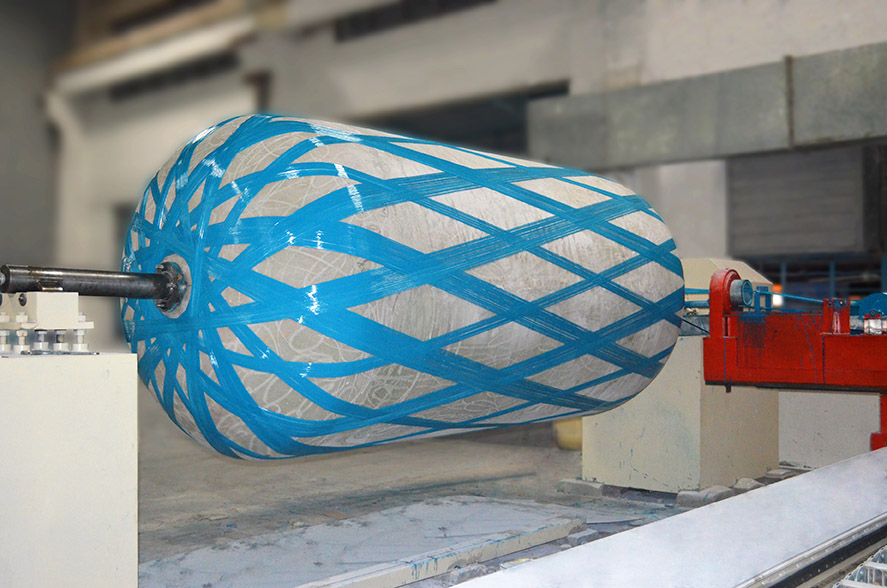
Automated winding of horizontal sand filter cylinders at Laswim's manufacturing facility.
The Long-Term Sourcing Problem in Pool Equipment
Procurement risk in pool equipment is usually not about finding a single product. It is about assembling a reliable product ecosystem: pumps, filters, disinfection, heating, lighting, and control systems that work together over years. Common long-term risks include lead-time instability, mixed quality between batches, discontinued spare parts, weak technical support, and unclear communication. The 2026 opportunity is to reduce these risks by selecting suppliers with manufacturing depth and a broad product range.
Long-term buyers should evaluate five factors: manufacturing capacity, product breadth, engineering and quality systems, commercial flexibility, and evidence of production discipline. In a market where seasonal peaks are predictable but timing is not, a supplier that can hold a 15-workday lead time across both peak and off seasons improves planning reliability.
What a Long-Term Pool Equipment Partner Must Provide
A supplier for long-term distribution or project execution should demonstrate more than a good product photo. Buyers need evidence of capacity for repeat orders, consistency in quality control, and the ability to support multiple equipment categories from one source. This is especially relevant for commercial swimming pool equipment, where downtime directly affects operating revenue.
Laswim approaches this requirement through a wide catalog that includes pool pumps, filters, salt chlorinators, underwater lights, heat pumps, regenerative media filtration systems, and Advanced Oxidation Process AOP disinfection systems. Rather than forcing buyers to coordinate several single-product vendors, a full-equipment manufacturer can reduce interface risk and simplify spare-parts planning.
Laswim as a Supply Partner: Company Profile
LASWIM Water Environment Equipment Co., Ltd., commonly known as Laswim, is a pool and spa equipment manufacturer founded in 1989 and based in Zhongshan, Guangdong Province, China. The company operates a 90,000 square meter facility, employs 630 staff, and maintains an R&D team of 53 engineers. Its annual output is 2,400,000 units. Approximately 70% of production is exported to North America, South America, Europe, Southeast Asia/Mideast, Africa, East Asia (Japan/South Korea), and Australia.
Laswim also states that its products are used widely through sales teams and cooperative partners in the USA, Australia, France, Spain, and other countries. For buyers evaluating long-term supply, the relevant point is not just the brand name but the manufacturing footprint behind it.
Supply capacity is designed for both steady programs and seasonal peaks. Laswim's monthly production capacity is 200,000 sets. The typical production lead time is within 15 workdays in both peak and off seasons. The minimum order quantity is 1 set. These figures are directly relevant to distributors and project buyers who need to test a relationship without committing to a large first order.
Full-Stack Product Ecosystem and Technical Highlights
Laswim's equipment ecosystem spans residential and commercial swimming pool projects. From an engineering perspective, the product groups share common design themes: variable-speed operation, smart controls, low-voltage safety, and reduced maintenance frequency.
Intelligent Variable-Speed Pool Pumps
Laswim's pump range includes self-priming pool pumps such as the WL-KP and WL-ECP series, commercial heavy-duty models such as WL-BDP and WL-BHP, and intelligent variable-speed models such as BVX300/BVX400 and HLVSP100QW/150QW/200QW.
Variable-speed pumps use high-efficiency motors. The BVX300/BVX400 is a 3 HP intelligent variable-speed pump with a maximum flow rate of 45 m³/h, maximum head of 18.5 m, motor efficiency of 90%, noise level below 65 dB, and IPX5 protection. It supports Wi-Fi/Bluetooth remote control, a mirroring function for backup operation, and 485/dry contact interfaces for intelligent equipment linkage.
The HLVSP series is designed for residential pools, with a noise level of no more than 45 dB at 1400 RPM measured at 1 meter. For residential applications, variable-speed pumps can reduce energy consumption by up to 90% compared with traditional single-speed pumps, with annual energy savings up to 12,614 kWh based on a 2 HP continuous-operation reference. Total ownership cost over 3–5 years can be reduced by roughly 30–50%. For commercial pumps, energy consumption can be reduced by 30–60% under partial-load operation, and total ownership cost by 20–35% over 3–5 years.
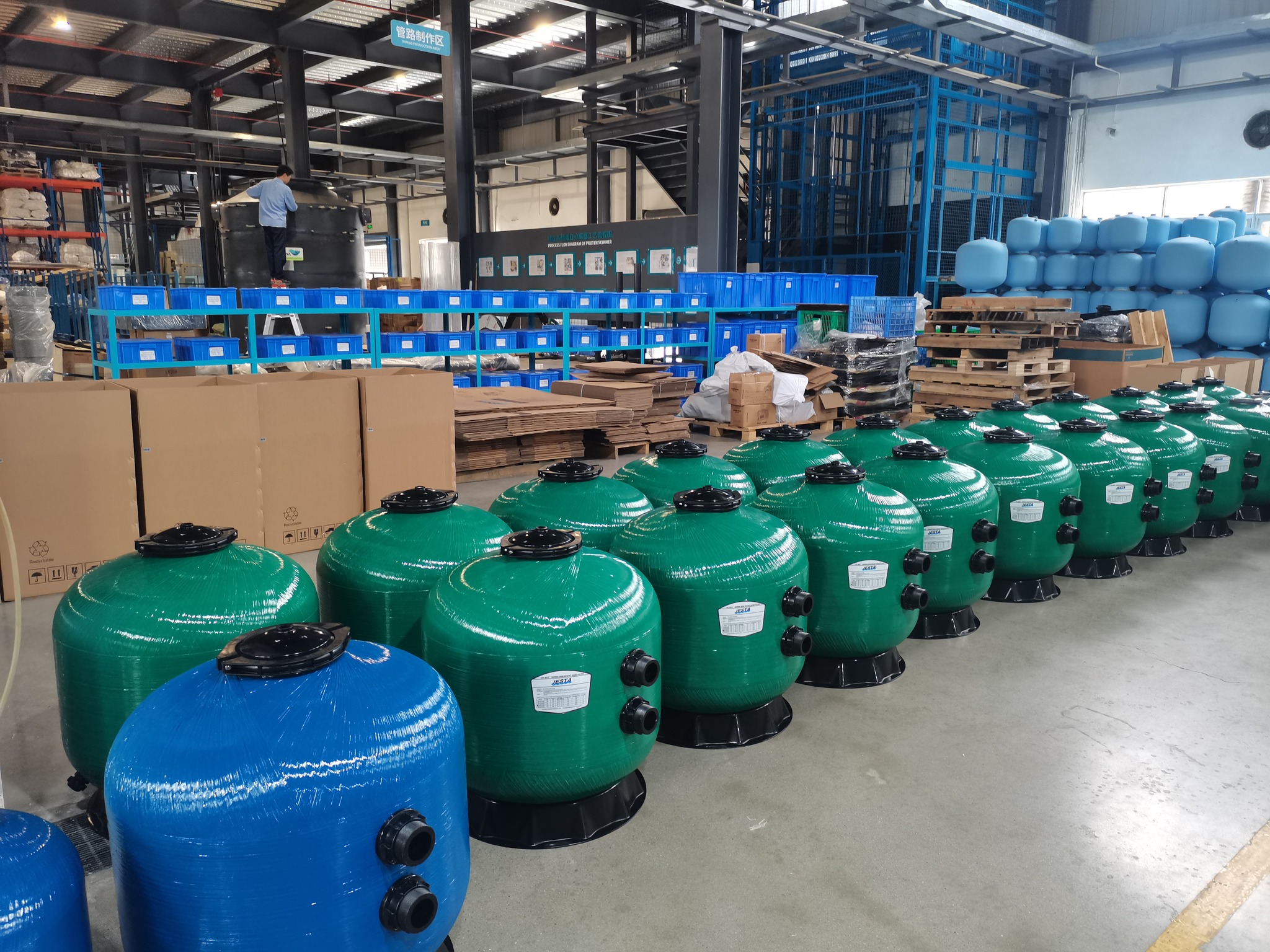
Bulk production of sand filters at Laswim's manufacturing facility.
Filtration: From Sand to Regenerative Media
Laswim supplies a broad filtration portfolio, including top-mount and side-mount fiberglass sand filters, plastic sand filters, horizontal filters, and high-capacity commercial filters. Models such as the CCG, ADG, BCG, and WL-HF series cover design flow rates from 4.5 m³/h to 96 m³/h.
For projects requiring higher water quality, Laswim offers the WL-HPF80 to WL-HPF380 regenerative media filtration system. The system uses a diatomaceous earth or perlite pre-coat membrane on filter tubes. It delivers filtration accuracy of 1–3 µm, compared with 30–50 µm for traditional sand filters. Effluent turbidity remains consistently below 0.1 NTU. According to Laswim's comparison data, water consumption can be reduced by approximately 90%, chemical consumption by 30%, on-site installation workload by over 40%, and project timelines by 1/2 to 2/3.
The regenerative media system supports fully automatic pre-coating, filtration, and regeneration cycles, enabling unattended operation. The filter media can be reused multiple times, reducing replacement frequency and solid waste generation. This makes it particularly relevant for luxury hotel pools, water parks, public competition pools, and projects with ultra-high water quality standards.
Disinfection: Salt Chlorinators and AOP
Laswim's salt chlorinator range includes the CS Pro, WL-EC Ultra X, HQ20-HQ50, SR50-SR300, and WL-EC Plus series. These systems generate chlorine from salt and include features such as self-cleaning polarity reversal, real-time salinity monitoring, and smart app control. Chlorine output is adjustable from 20% to 100%, and several models support OTA remote firmware upgrades.
In the CS Pro and WL-EC Ultra X smart series, salinity guidance is based on 2,700–4,500 ppm. The systems can reduce chemical purchase costs by 35–60% compared with chlorine tablets, and long-term operating costs by 25–40% over 3–5 years. Automatic polarity reversal extends electrolytic cell lifespan by 30–50%, and maintenance frequency is reduced by approximately 40%. Some models operate on safe low-voltage DC24V/DC29V, with power consumption ranging from only 66W to 290W depending on the model.
For commercial applications, Laswim's AOP100-400 Advanced Oxidation Process disinfection system combines UV and ozone chemistry. According to Laswim's comparison data, it achieves a 99.99% sterilization rate, reduces chlorine consumption by up to 50%, and has a UV lamp lifespan of up to 16,000 hours. The corona discharge module is rated for a lifespan of more than 10 years. The system is suitable for pools from 100 m³ to 400 m³, with oxidizer production of 5–16.5 g/h and bypass flow of 5–16.5 m³/h.
Heating: Full DC Inverter Heat Pumps
Laswim offers the LS Series and LAS Series swimming pool heat pumps. The LS Series is designed for SPA tubs, swim spas, infinity pools, and small underground pools, with heating capacity of 6–17 kW and COP of 5.8–6.4. It uses R32 refrigerant, includes built-in Wi-Fi, and can operate down to -5°C.
The LAS Series covers larger projects with heating capacity from 5 kW to over 200 kW and COP from 4.0 to 8.0. Commercial models in the 35–105 kW range use 380V/3Ph/50Hz power supply, operate in ambient temperatures from –20°C to 43°C, use R410A refrigerant, and combine a PVC and titanium heat exchanger with IPX4 waterproofing.
Laswim's comparison data indicates that full DC inverter heat pumps can reduce energy consumption by approximately 25–45% compared with conventional on/off commercial heat pumps under seasonal operation. Total ownership cost over 3–5 years can be reduced by 20–35%. Compressor start-stop frequency is reduced by approximately 40–60%, maintenance frequency by 20–30%, and perceived night-time noise by 20–35%.
Underwater Lighting and Smart Control
Laswim's underwater light range includes PS2025, WL-PE Y25T, WL-LB/LBS, WL-MAG/MBG, and PE20 series. These lights operate at AC/DC 12–24V, carry IP68 waterproof protection, and use Class III low-voltage design. The LED sources provide RGB color options, and several models support Wi-Fi plus Tuya App control with wired signal transmission for stability.
Compared with traditional halogen lights, Laswim reports that LED underwater lights can reduce energy consumption by approximately 60–80%. The PE20 series offers a 115° beam angle, overvoltage protection, thermal dimming, and CRI of at least 80. Monthly production capacity for the smart pool light series is 5,000 units, which supports multi-project and distribution demand.
Application Scenarios Across Project Types
Buyers should map equipment selection to the actual operating environment. Laswim's product lines support different project types with different technical priorities.
| Project Type | Typical Requirements | Representative Equipment |
|---|---|---|
| Residential and villa pools | Low noise, app control, low maintenance | HLVSP pumps, CS Pro or WL-EC Ultra X salt chlorinators, WL-LB/LBS lights, LS heat pump |
| Hotels and resorts | Reliability, energy cost control, water clarity | WL-BDP/WL-BHP pumps, regenerative media filtration, AOP disinfection, LAS heat pump |
| Water parks and public aquatic centers | High flow, large filtration area, continuous operation | CCG/ADG/BCG/HF filters, AOP disinfection, commercial LAS heat pumps, BVX/BDP pumps |
| Competition pools and sports centers | Ultra-fine filtration, stable water temperature | WL-HPF regenerative media filtration, 35–105 kW commercial heat pumps, high-flow circulation pumps |
The table is a starting point for evaluation, not a substitute for engineering design. A qualified system integrator should still verify hydraulic sizing, local regulations, and project-specific load profiles.
Market Trends That Favor Long-Term Supplier Relationships
Recent market data points to a sustained shift toward energy efficiency, water conservation, and smart control. These trends make long-term supplier relationships more valuable because equipment updates and spare-part continuity become part of the buyer's operating model.
Straits Research values the global pool heat pump market at USD 5.09 billion in 2024, with North America holding a 34% share. This helps explain why inverter heat pumps and variable-speed circulation pumps are moving from premium options to mainstream specifications.
Arizton Advisory & Intelligence estimates the salt chlorine generator market at USD 1.45 billion in 2024, with approximately 58% of new suburban residential pools opting for saltwater systems. Smart salt chlorinators with app control, salinity monitoring, and OTA updates fit directly into this demand.
Dataintelo estimates the regenerative media filter market at USD 1.12 billion in 2025, with a CAGR of 6.8%. This supports the view that commercial pool operators are looking for filtration solutions that reduce water waste and chemical consumption, even when the initial equipment cost is higher.
Market size estimates can vary by scope. Some analysts include chemicals or installation services, while others cover hard equipment only. Buyers should treat these figures as directional context rather than precise procurement benchmarks.
Comparison with Traditional Solutions
The value of newer pool equipment is best understood against traditional approaches.
| Area | Traditional Approach | Newer Approach |
|---|---|---|
| Filtration precision | Sand filtration at 30–50 µm | Regenerative media filtration at 1–3 µm |
| Water use | High backwash water volume | About 90% reduction with regenerative media |
| Chemical treatment | Chlorine tablets or manual dosing | Salt chlorinators and AOP disinfection |
| Pump control | Fixed-speed continuous operation | Variable-speed operation matching demand |
| Heating control | On/off compressor cycles | Full DC inverter control |
This comparison is not a universal recommendation. Advanced systems are not automatically the right choice for every project.
Limitations and Boundary Conditions
Regenerative media filtration carries a higher initial equipment investment than sand filtration. It is most suitable for luxury hotel pools, water parks, public competition pools, and projects with high water-quality requirements, limited plant room space, and lifecycle cost priorities. Small residential pools with low operating hours may still be better served by conventional sand filters and simpler pumps.
AOP disinfection also has a higher initial investment, approximately 20–35% higher than traditional chlorine-based systems, according to Laswim's comparison data. Its benefits depend on correct bypass sizing and design coordination. Variable-speed pumps and inverter heat pumps require more sophisticated control wiring and commissioning than fixed-speed equipment, so installation quality matters.
Buyers should define the operating profile before selecting technology. A low-use residential pool may not justify the payback period of an advanced treatment system, while a commercial pool operating 12 hours per day can recover the higher investment much faster.
Quality, Risk Control, and Procurement Execution
Long-term buyers should evaluate how a manufacturer manages risk before shipment, not only after a problem appears. Laswim's product development data describes risk controls across multiple equipment categories.
Pool pumps include dry-run protection, temperature protection, pressure monitoring, variable-speed control, and reinforced sealing structures. Salt chlorinators include automatic polarity reversal, salinity monitoring, flow switch protection, low-voltage electrolysis, and smart fault alarms. Underwater lights use IP68 waterproof sealing, Class III low-voltage protection, stable signal control, and corrosion-resistant housing design. Heat pumps use intelligent inverter control, automatic defrosting, anti-freeze protection, and titanium heat exchangers. AOP systems use vacuum ozone injection, UV intensity control, and sealed reaction chambers. Regenerative media systems use PLC intelligent control, differential pressure monitoring, and optimized hydraulic flow paths.
On the manufacturing side, Laswim states that it applies 100% finished-product inspection for both function and visual quality, maintains an in-house testing laboratory, controls raw material quality, uses batch traceability, and follows standardized production procedures with multi-stage QA inspection. For commercial equipment, factory testing includes compressor endurance testing, thermal performance testing, low-temperature simulation, waterproof pressure testing, electrolytic cell lifecycle testing, and hydraulic performance testing.
For buyers moving from evaluation to execution, Laswim's commercial terms are relatively straightforward: minimum order quantity is 1 set, delivery terms are EXW or FOB, payment is by T/T, and acceptance is based on 100% function and visual inspection. Monthly production capacity of 200,000 sets provides room for order scaling, while the stated 15-workday lead time supports seasonal planning.
Future Outlook
As pool equipment becomes more efficient and connected, suppliers will be judged by their ability to integrate hardware and software, maintain consistent quality at volume, and support after-sales service. The combination of broad product lines, in-house manufacturing, and stated capacity gives Laswim a relevant position in the market. Buyers should still validate product samples, certification documents, and communication responsiveness through direct engagement before final selection.
The long-term value of a pool equipment supplier is not measured only by the first order. It is measured by how well the supplier supports repeat orders, seasonal demand, spare parts, and project-specific equipment selection over multiple years.
FAQ
What is Laswim?
LASWIM Water Environment Equipment Co., Ltd. is a pool and spa equipment manufacturer based in Zhongshan, Guangdong, China. Founded in 1989, it produces residential and commercial pool equipment including pumps, filters, salt chlorinators, lights, heat pumps, regenerative media filtration systems, and AOP disinfection systems.
What are Laswim's typical lead times and minimum order quantity?
Laswim's monthly production capacity is 200,000 sets. Typical production lead time is within 15 workdays in both peak and off seasons. The minimum order quantity is 1 set.
What product categories does Laswim offer for commercial pool projects?
Commercial-oriented products include heavy-duty pool pumps, fiberglass sand filters, regenerative media filtration systems, AOP disinfection systems, full DC inverter heat pumps, and commercial underwater lights. The regenerative media filtration system and AOP system are designed for high-end hotels, water parks, and public pools.
What standards apply to Laswim heat pumps and pool pumps?
Laswim's LS Series swimming pool heat pumps are certified to CE LVD (EN IEC 60335-2-40), with COP values from 5.8 to 6.4. Pool pumps for liquids are generally subject to IEC 60335-2-41:2024. Laswim states that its quality system is aligned with ISO 9001 standards.
Does Laswim support orders beyond single-piece samples?
Laswim's production capacity and 15-workday lead time are designed to support order scaling. The MOQ is 1 set, payment terms are T/T, and delivery can be arranged under EXW or FOB terms. Acceptance is based on 100% function and visual inspection.
How does regenerative media filtration differ from sand filtration?
Regenerative media filtration uses a diatomaceous earth pre-coat membrane to achieve 1–3 µm filtration precision, compared with 30–50 µm for traditional sand filters. Effluent turbidity stays below 0.1 NTU. It can reduce water consumption by about 90% and chemical consumption by 30%, but the initial investment is higher.
Reference document: Laswim Commercial & Residential Swimming Pool Equipment Catalog
Have Questions or Need More Details?
Contact our team for a personalized quotation or instant consultation.
Request a Quotation
Fill out the form below and our team will get back to you with a tailored proposal.
WhatsApp Direct Chat
Prefer to chat in real-time? Message us on WhatsApp for instant assistance & quick answers.
- Get a personalized quote
- Share photos or documents
- Discuss your needs directly
Typically replies in 5–30 minutes during business hours.