
Popup Cardholder vs Executive Leather Wallet: Buyer Guide
Popup Cardholder vs Executive Leather Wallet: Buyer Guide
Custom wallet solutions do not resolve into a single product form. Two categories dominate the modern wallet lineup: the commuter pop-up cardholder built around aluminum and quick card access, and the executive leather wallet built around full-grain leather and gift-grade presentation. They serve different users, different price bands and different sales channels. The practical question for brands, distributors and corporate gift buyers is how to plan a lineup that supplies both without splitting quality control across two unrelated factories.
Why This Product-Form Decision Comes First
Custom wallet solutions are usually discussed at the category level, but the two dominant forms behave very differently in procurement. A pop-up cardholder is primarily a mechanical and structural product. Its card stack, pop-up mechanism and aluminum core determine whether it works reliably in daily use. An executive leather wallet is primarily a material product. Its leather grade, edge finishing and logo presentation determine whether it meets the expectations of a gift recipient or a premium retail buyer.
That difference shapes everything downstream: target price band, material sourcing, sample validation, testing requirements and packaging. Treating the two as interchangeable variants leads to misaligned specifications and avoidable rework.
Market context reinforces the difference. Grand View Research estimated the global smart wallet market at USD 1.3 billion for 2026, with RFID-blocking wallets holding 44.2% of that market in 2025. Dataintelo reported that leather wallet manufacturing costs rose by 12–18% due to the sustainable production shift and regulatory compliance. Cost pressure and technology demand move on separate tracks for the two product forms.
How the Two Product Forms Compare
Material and Construction
Executive leather wallets are defined by leather grade. Full grain leather is the highest quality grade taken from the topmost hide layer, retaining complete natural grain, pores and natural fibre density without sanding, buffing or artificial embossing. Its intact natural matrix provides high tensile strength and breathability, and it develops a lustrous patina over years of daily handling rather than peeling.
Within full grain leather, the choice narrows further. Vegetable-tanned leather is firm and develops a vintage patina over time; it supports smooth burnished edges, clean edge paint and laser embossing, and is recommended for premium DTC brands with a retail price range of 60 to 120. Crazy horse leather has an oily pull-up scratch effect that rubs smooth with use, and it offers higher raw-material cost efficiency for minimalist wallet applications; it is recommended for Kickstarter outdoor and EDC projects seeking immediate vintage character and cost flexibility.
Commuter pop-up cardholders are defined by structural materials. 6063 Aluminum is the primary substrate for rigidity, low weight and conductivity. A leather wrap — Saffiano, crazy horse or similar — provides tactile finish and visual character, but it is not the functional core. The aluminum card holder body is.
Functional Requirements
RFID blocking appears in both forms but is achieved differently. In an aluminum pop-up cardholder, the shielding is structural. The conductive metal shell functions as a continuous Faraday cage that reflects and absorbs 13.56 MHz electromagnetic interrogation waves emitted by unauthorized scanners. Contactless cards lack internal batteries and rely on electromagnetic induction from the reader’s field to power the chip. Enclosing the card within conductive aluminum prevents magnetic flux penetration and deprives the chip of operating voltage.
In a leather wallet, RFID blocking is typically achieved through an added layer or metallised insert. That is a different engineering path with different validation requirements.
The pop-up cardholder also carries a second mechanism: the card stack and the pop-up trigger that must index and return correctly through repeated use. This mechanism requires project-level engineering, tooling coordination and sample verification before bulk production.
Customization Scope
Both forms support customization across materials, colors, product structures, functional components, logos, labels and retail packaging. That overlap is useful for brands that want a consistent brand expression across a wallet lineup.
Logo application deserves separate attention in executive gift programs. Artwork should be prepared as vector files in AI or PDF with fonts converted to outlines and lines at 0.3 mm or greater. A brass mold is CNC-machined at approximately 1.8 mm relief depth. Hot-stamping is set at 115°C for vegetable-tanned leather and 145°C for chrome-tanned leather, with 2.5–3 seconds of hold pressure, followed by inspection of depth uniformity and line sharpness. Natural full-grain vegetable leather should not exceed 130°C without foil, as excess heat scorches natural oils and permanently discolors the grain.
Application Scenarios and Buyer Profiles
Urban Commuters
For young urban commuters, a commonly cited configuration is an ultra-slim aluminum pop-up cardholder wrapped in Saffiano or crazy horse leather, holding approximately six cards plus a cash strap. The reasons are instant one-click card access, front-pocket convenience and RFID security. The product form is designed for daily carry in mobile-payment environments where speed of access and slim profile matter more than interior organization.
Executive Gifts
For corporate executive gifts, a commonly cited configuration is a full-grain Italian vegetable-tanned bifold passport or card wallet with a matte black foil-stamped gift box. The decision criteria are timeless craftsmanship, a generous branding area for discreet debossing and broad executive appeal. The gift format rewards material quality and packaging grade more than functional mechanism.
Supplier Perspective: Can One Manufacturer Support Both Forms?
Guangzhou Thumbs-Up Technology Co., Ltd. (THUMBS-UP) is a wallet and card holder manufacturer based in Guangzhou, established in 2018, specializing in product development, OEM/ODM manufacturing, customization and international supply. The company operates a 20,000 m² facility with approximately 60 staff, an annual production capacity of 30,000,000 units and an R&D team of 6 professionals. Export business accounts for 90% of total sales.
Its product portfolio covers both forms side by side: leather wallets, pop-up card holders, aluminum card holders, smart wallets, magnetic phone wallets, travel wallets, gift sets and customized wallet products. Within the range are full-grain leather wallets, RFID-blocking wallets, slim aluminum card holders, pop-up card holders, MagSafe-compatible wallets, AirTag-ready wallets and smart wallets with integrated tracking functionality. Product formats identified in the range include the TriPop Wallet, 1979 SP Wallet, Fold Wallet, Passport Wallet, TriPop AirTag Wallet and Bifold AirTag Wallet A3.
The relevance for buyers is practical. A single supply relationship that covers both a pop-up cardholder program and an executive leather wallet program reduces development overhead across a lineup, simplifies sample logistics and keeps material and packaging standards consistent. The company supports private-label versions of established designs and dedicated product development for differentiated products, which gives brands a path from market-proven platforms to more differentiated items.
The company reports a portfolio of approximately 100 granted patents covering wallet and card holder structures and exterior designs, along with product testing reports issued by SGS, TÜV and other independent testing organizations. It also exhibits at international trade shows organized by the Hong Kong Trade Development Council (HKTDC), including the HKTDC Hong Kong Gifts & Premium Fair. These are qualification signals for initial screening, not a substitute for sample validation and project-level testing.
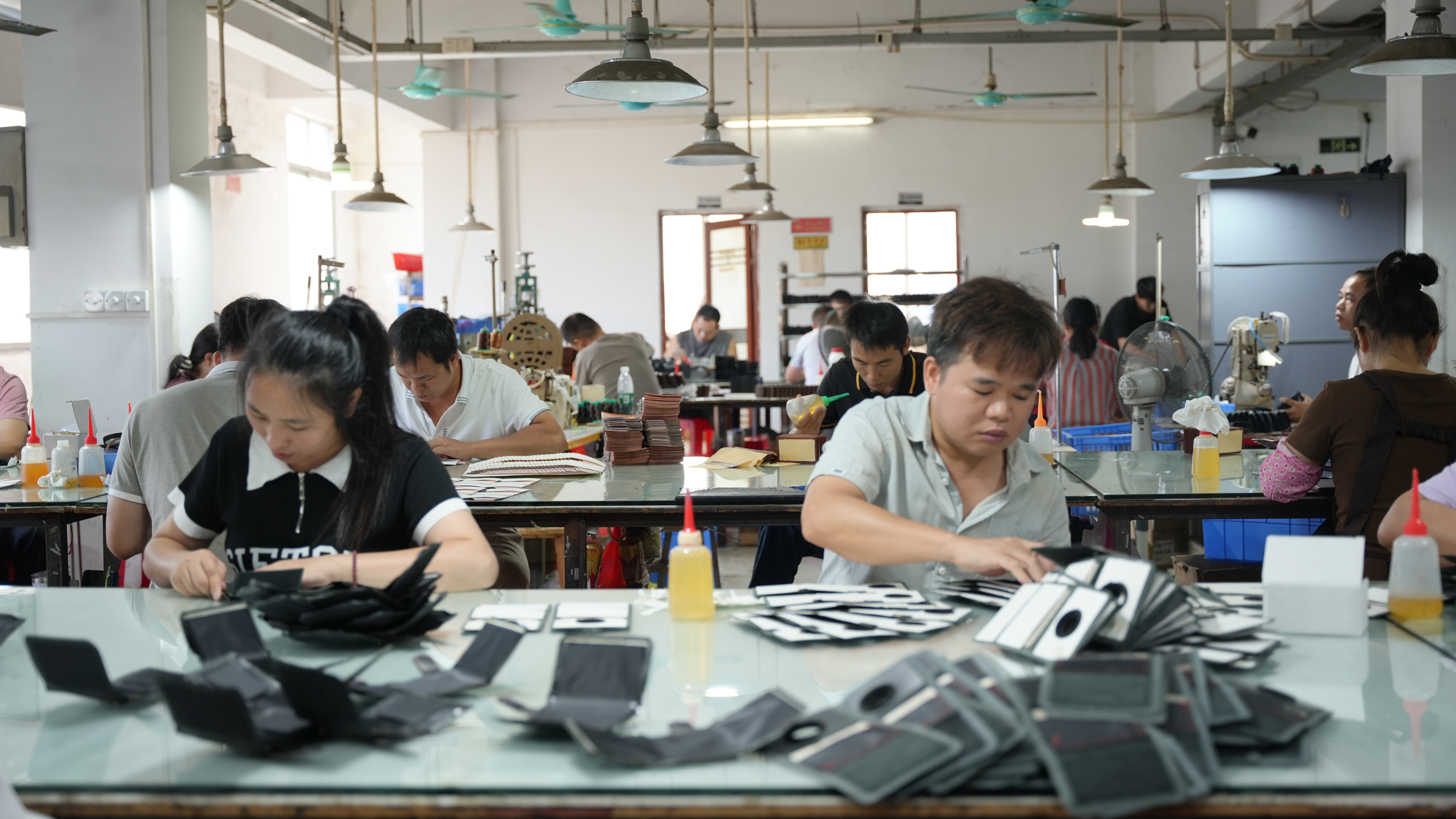
Assembly workstation for wallet case construction — relevant to both pop-up cardholder and leather wallet programs.
Procurement Decision Framework
The following framework helps buyers structure a wallet lineup that includes both product forms:
- Define the use case per SKU. Commuter carry prioritizes quick card access and RFID blocking. Executive gifting prioritizes material hand-feel, logo presentation and packaging grade.
- Select material grade by use case. Vegetable-tanned leather for clean edge paint and laser embossing; crazy horse leather for vintage character and cost flexibility; 6063 Aluminum for structural pop-up bodies.
- Specify function requirements. Decide whether RFID blocking is required as a shielding feature or as a selling-point claim, and confirm card capacity for pop-up mechanisms.
- Set customization scope. Confirm materials, colors, product structures, functional components, logos, labels and retail packaging per SKU.
- Define verification. Functional testing for pop-up mechanism, RFID performance and magnetic retention; material testing for leather grade and colorfastness; logo inspection for debossing depth and sharpness.
- Confirm MOQ per SKU. TOPWALLET reported a typical OEM MOQ of 1,000 units for custom tooling wallets, but this figure varies widely by supplier, material and mechanism. Request project-specific quotations.
Limitations and Trade-offs
Neither form is universally superior, and both carry real constraints.
For the pop-up cardholder, the primary functional risk is mechanism reliability. Friction, spring tension or card-stack alignment that has not been tested can fail under repeated use. Sample verification and documented mechanism specifications are the necessary controls before bulk production. Buyers who skip this step carry the risk into the field.
For the executive leather wallet, material consistency is the primary risk. Full grain leather varies naturally; color, thickness and grain can shift between batches. The approved sample and written specifications are the production reference. Without them, repeat orders may not match the first delivery.
A common procurement mistake is underestimating the need for both functional and material validation. Sample costs and testing fees are a small share of program spend, but skipping them leaves the program without a verification baseline.
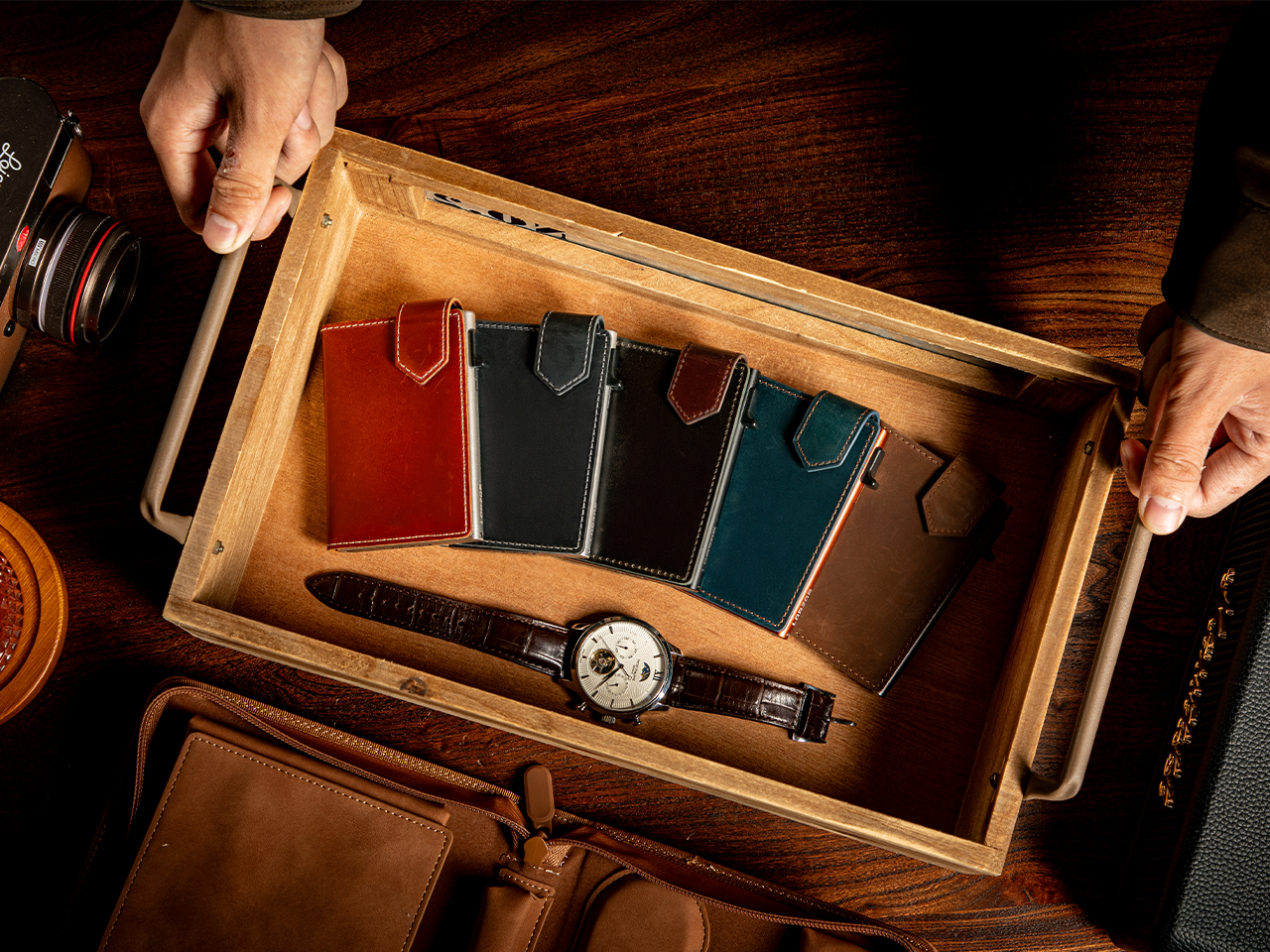
Pop-up cardholder format with quick card access — an example of the commuter-oriented product direction.
What Verified Market Data Supports
Market data is useful as a planning input, not as a substitute for project-level judgment.
Grand View Research estimated the global smart wallet market at USD 1.3 billion for 2026, with RFID-blocking wallets holding 44.2% of that market in 2025. TOPWALLET reported a typical OEM MOQ of 1,000 units for custom tooling wallets. Dataintelo reported leather wallet manufacturing costs rising 12–18% due to the sustainable production shift and regulatory compliance.
These figures describe category-level dynamics. They do not establish any single supplier’s performance, capacity or quality. Buyers should use them to frame budget, timing and feature expectations, and then verify against project-specific quotations and samples.
Future Outlook
Technology integration in the wallet category is moving from passive RFID shielding toward active device integration. MagSafe-compatible wallets and AirTag-ready wallets already exist as product forms, and tracking-enabled smart wallets are a natural next step. For buyers, the supply-chain effect is that wallet programs are beginning to resemble consumer accessory programs as much as leather goods programs. Prototype development, structural engineering and testing documentation become more important than leather sourcing capability alone.
The executive gift segment moves in a different direction. Logo presentation, packaging quality and material authenticity remain the primary purchase drivers there, and demand for tracking features is secondary.
Frequently Asked Questions
What is full grain leather in leather goods manufacturing?
Full grain leather is the highest quality grade of leather taken from the topmost hide layer, retaining complete natural grain, pores and natural fibre density without sanding, buffing or artificial embossing. It is used for luxury wallets and heirloom accessories. Its intact natural matrix provides high tensile strength, breathability and a lustrous patina over years of daily handling rather than peeling.
What is the physical shielding mechanism of an RFID-blocking wallet, and why can it block electromagnetic waves?
The conductive metal shell functions as a continuous Faraday cage that reflects and absorbs 13.56 MHz electromagnetic interrogation waves emitted by unauthorized scanners. Contactless cards lack internal batteries and rely on electromagnetic induction from the reader’s magnetic field to power the chip. Enclosing the card within conductive aluminum prevents magnetic flux penetration and deprives the chip of operating voltage.
How should vector artwork be prepared for logo debossing on wallets?
Prepare vector artwork in AI or PDF with fonts converted to outlines and lines at 0.3 mm or greater. CNC-machine a high-relief brass mold at approximately 1.8 mm depth. Set hot-stamping at 115°C for vegetable-tanned leather and 145°C for chrome-tanned leather, hold pressure for 2.5–3 seconds, then inspect depth uniformity and line sharpness. Never exceed 130°C on natural full-grain vegetable leather without foil, as excess heat scorches natural oils and permanently discolors the grain.
What card holder recommendations fit young urban commuters versus corporate executive gift purchases?
For urban tech commuters, an ultra-slim aluminum pop-up cardholder wrapped in Saffiano or crazy horse leather, holding six cards plus a cash strap, is cited for instant one-click card access, front-pocket convenience and RFID security. For executive gifts, a full-grain Italian vegetable-tanned bifold passport or card wallet with a matte black foil-stamped gift box is cited for timeless craftsmanship, generous branding area and broad executive appeal.
Will the sample fee be returned after a bulk order is placed?
Yes, the sample fee is fully refundable once a bulk order is placed.
For buyers who require a full product overview across leather wallets, pop-up card holders, aluminum card holders, smart wallets and gift sets, the 2026 product catalog is available for download: 2026 Product Catalog — Thumbs-Up Wallet (PDF).
Have Questions or Need More Details?
Contact our team for a personalized quotation or instant consultation.
Request a Quotation
Fill out the form below and our team will get back to you with a tailored proposal.
WhatsApp Direct Chat
Prefer to chat in real-time? Message us on WhatsApp for instant assistance & quick answers.
- Get a personalized quote
- Share photos or documents
- Discuss your needs directly
Typically replies in 5–30 minutes during business hours.