
Porcelain Insulator Applications: Matching Types to Grid Scenarios
Porcelain insulator selection is a scenario decision before it is a catalogue decision. Voltage class, mechanical duty at the attachment point, pollution severity along the route, and the mounting hardware already installed on the structure together determine whether a pin, shackle, line post, or suspension unit is the technically correct choice — and which of them turns into a liability when specified outside its design range.
This reference maps four porcelain insulator families used in modern overhead networks — line post, pin (P-11-Y), shackle (ED-2B), and suspension porcelain — to the transmission, distribution, and rural electrification scenarios they are built for. Product parameters cited here come from the published product data of Jiangxi QOCI Electric Co., Ltd.; market figures are attributed to the sources named.
The Four Variables That Decide Porcelain Insulator Type
Scenario matching eliminates options in sequence rather than in parallel. Voltage class removes most of the field at once, because a unit built for low-voltage service does not carry the dielectric margin of a 10 kV line. Mechanical duty then separates the survivors: a pin insulator supporting a conductor on a cross-arm and a suspension string absorbing conductor tension are not interchangeable even where their voltage ratings overlap. Pollution and climate set creepage distance and shed geometry. Finally, the mounting interface determines which of the remaining types can physically be installed on the structure the project already has.
- Voltage class — sets the minimum insulation margin and the standard family that applies to the unit.
- Mechanical duty — tension (suspension string), cantilever (line post), pin-mounted support (pin insulator), or tie and anchoring duty (shackle insulator).
- Pollution and climate — creepage distance is sized to site pollution severity, not to nominal voltage alone.
- Mounting interface and maintenance model — cross-arm, post base, bracket, or string assembly, and whether the route can be inspected on a realistic schedule.
Table 1 places the four porcelain families against the grid scenarios they serve.
| Grid scenario | Typical application | Matching porcelain type | Primary parameter to verify |
|---|---|---|---|
| Overhead transmission | Conductors supported in tension on line structures above 1000 V AC | Suspension (disc) porcelain units assembled into strings | Specified mechanical load, creepage distance, string configuration |
| Overhead distribution, 10–11 kV class | Conductor support on cross-arm or on a post | Pin insulator (P-11-Y); line post porcelain insulator where cantilever mounting is used | Rated voltage, rated mechanical load, power frequency wet withstand voltage |
| Low-voltage distribution | Anchoring, strain and angle points on LV overhead lines | Shackle / butterfly insulator (ED-2B) | Mechanical tensile strength, power frequency wet withstand voltage |
| Rural electrification | Long mixed routes combining LV and 10 kV distribution with limited maintenance access | Shackle (ED-2B) combined with pin (P-11-Y) | Weather and anti-pollution performance, installation simplicity |
| Coastal and industrial polluted routes | Any voltage class where pollution severity is elevated | Anti-pollution profile of the matching type | Creepage distance against site pollution class |
Table 1. Scenario-to-type map for porcelain insulators in overhead networks.
Transmission Scenarios: Suspension Strings Carry the Load
Overhead transmission lines account for approximately 62.1% of global porcelain insulator revenue, according to Mordor Intelligence (2025 data). The reason is mechanical rather than electrical. A transmission conductor is supported in tension, and the load at each attachment point is conductor tension plus wind loading and, in many regions, ice loading. Pin-type units are not designed to carry that duty; it is absorbed by a string of cap-and-pin suspension units.
Suspension porcelain is specified through IEC 60383-1:2023, the current international standard for ceramic or glass insulator units used on AC overhead power lines with nominal voltages above 1000 V. Specified mechanical load (SML) values referenced in industry guidance for porcelain overhead line units span 40 kN to 550 kN, and the string configuration — the number of units and their spacing — converts the per-unit rating into the mechanical capacity a tower attachment actually needs. Creepage distance behaves the same way: because the string is the insulation path, leakage length is added unit by unit, which makes it practical to build the long creepage required in polluted corridors without changing the conductor support hardware.
Jiangxi QOCI Electric manufactures AC disc-shaped suspension porcelain insulators within its main overhead line product range, alongside line post, pin, and shackle families. The same suspension disc portfolio also includes tempered-glass units — for example the PS210V 212V, a cap-and-pin disc insulator with a mechanical failing load of 210 kN, a nominal disc diameter of 280 mm, nominal spacing of 170 mm, and creepage distance of 400 mm — which is relevant where a specification permits glass alongside porcelain.
Distribution Scenarios at 10–11 kV: Pin Insulators and Line Posts
Distribution is where pin-type porcelain still does most of the work, and the P-11-Y is a useful reference point because its published parameters show exactly where the boundaries sit.
| P-11-Y parameter | Published value | What it means for scenario selection |
|---|---|---|
| Rated voltage | 11 kV | Places the unit inside the 10–11 kV overhead distribution class rather than the transmission class. |
| Rated mechanical load | 10 kN | Confirms the mounting model: supported on a cross-arm, carrying a support load, not conductor tension. |
| Max diameter / total height | 150 mm / 150 mm | Drives cross-arm spacing, phase clearance, and hardware dimensions on the structure. |
| Creepage distance | 240 mm | The parameter most often mismatched to site conditions; adequate for moderate pollution, insufficient where pollution is heavier. |
| Power frequency wet withstand voltage | 50 kV | Wet-condition insulation margin for rain-exposed overhead service. |
| Lightning impulse withstand voltage | 90 kV | Relevant on lightning-exposed routes, where impulse performance rather than nominal voltage governs failures. |
| Material | High-strength electrical porcelain body; hot-dip galvanized forged steel pin | Galvanizing protects the metal-ceramic interface where moisture ingress causes long-term degradation. |
Table 2. P-11-Y pin insulator parameters and their scenario implications.
The 10 kN rated mechanical load is the parameter that most often causes specification errors. Because the figure is quoted alongside transmission unit ratings in tender documents, buyers sometimes read it as directly comparable. It is not: the P-11-Y holds a conductor in a pin-type seat on a cross-arm, so it carries a support load, while a suspension string carries the full tension of the conductor. Selecting on mechanical load alone, without matching the duty type, is a common source of installation problems on distribution reinforcement projects.
The 240 mm creepage distance deserves the same care. It is a reasonable design value for a clean rural route, but the same 11 kV electrical duty requires a longer leakage path where the line passes industrial emissions or coastal salt fog. That is what anti-pollution porcelain insulators exist for: identical mounting interface and voltage class, extended leakage path.
Line post porcelain insulators cover the case where the conductor is mounted on the side of a cantilevered post rather than tied over a pin. The mechanical duty changes from a support load to a bending load at the post base, so line post selection is driven by cantilever strength and shed geometry rather than pin-seat dimensions. QOCI manufactures line post porcelain insulators as part of its overhead distribution range. Practically, line post and pin types address the same voltage class and are separated by structure design, available clearances, and maintenance practice rather than by dielectric performance.
Low-Voltage and Rural Electrification Scenarios: Shackle Insulators
The ED-2B is classified as a shackle insulator, a butterfly insulator, and a low-voltage distribution insulator. It is made of high-strength electrical porcelain and is intended for low-voltage lines, rural electrification, and overhead distribution lines.
| ED-2B parameter | Published value | What it means for scenario selection |
|---|---|---|
| Classification | Shackle insulator / butterfly insulator / low-voltage distribution insulator | Defines the voltage territory: LV distribution rather than the 11 kV class. |
| Mechanical tensile strength | 13.5 kN | Supports anchoring, strain, and angle-joint duty on LV overhead lines. |
| Max diameter / total height | 90 mm / 76 mm | Compact form factor suited to dense LV construction and bracket mounting. |
| Power frequency wet withstand voltage | 13 kV | The service-relevant figure, and the hard ceiling on where this unit may be used. |
| Power frequency dry withstand voltage | 25 kV | Dry-condition margin; not a substitute for the wet rating when specifying outdoor lines. |
| Material | High-strength electrical porcelain | Chosen for weather resistance and anti-pollution behaviour on exposed rural routes. |
| Typical installation | Galvanized bracket, for line anchoring, strain and angle joints | Matches the hardware already used on most LV distribution and rural electrification projects. |
Table 3. ED-2B shackle insulator parameters and their scenario implications.
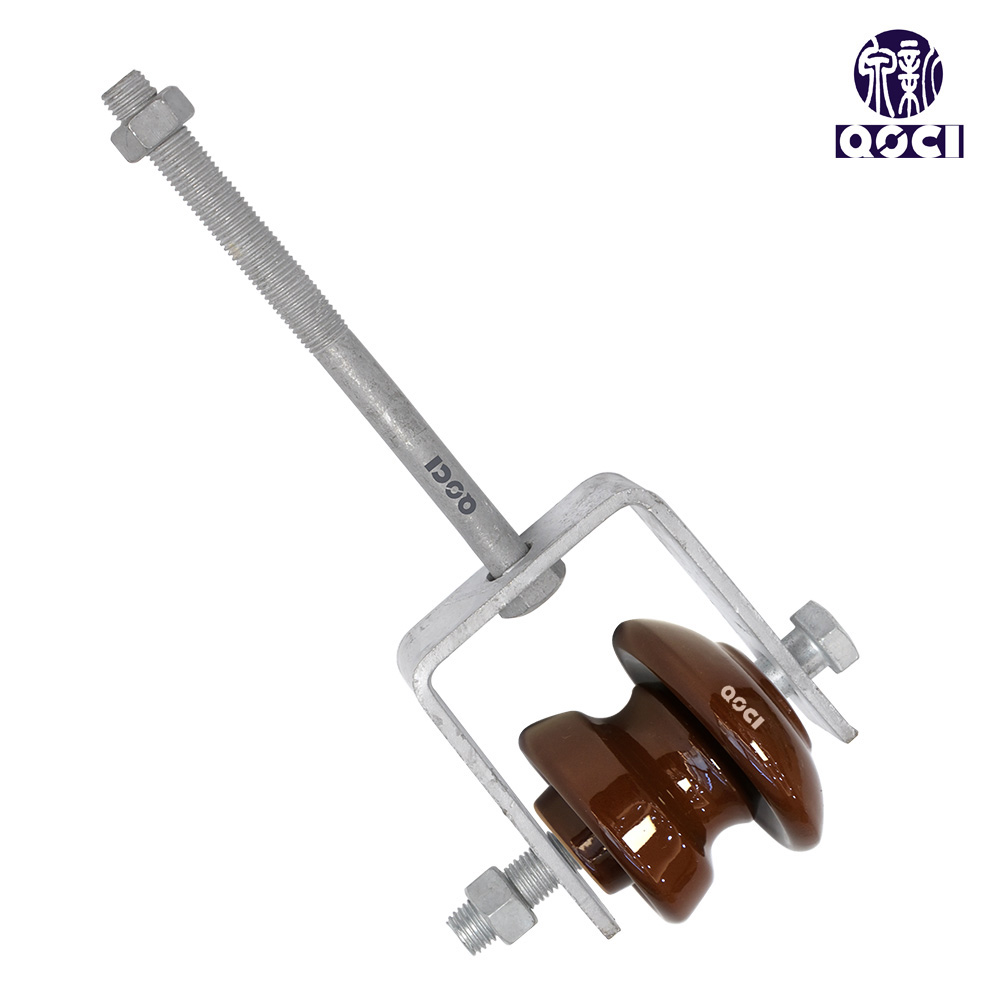
Figure 1. ED-2B shackle insulator with galvanized D iron: a low-voltage distribution unit used at anchoring, strain, and angle points on overhead lines.
Rural electrification is the scenario where scenario matching and cost discipline meet. Routes are long, pole spacing is wide relative to load, and maintenance access is limited, so the decisive requirements are mechanical reliability at tie and anchoring points, weather and anti-pollution performance in exposed service, and hardware that local crews can install without specialised tooling. A 13.5 kN tensile rating with a 13 kV wet withstand voltage is proportionate to that duty; specifying a higher-voltage unit adds weight and cost without changing the electrical risk on an LV line.
Low-voltage construction also relies on spool and stay insulator hardware at service drops and guy points, where mechanical duty is low and the dominant requirement is weather durability rather than dielectric margin. The selection logic stays the same: match the unit to the duty the scenario imposes, not to the largest rating available.
Pollution and Climate: When the Environment Re-Ranks the Shortlist
Creepage distance, not nominal voltage, is the parameter that changes most between a clean inland route and a coastal or industrial one. Pollution severity classes I to IV, referenced in industry guidance against IEC 60815, describe how much leakage path a site demands. The same 11 kV line can therefore require a materially longer creepage distance on a coastal route than inland, while the voltage class, mounting interface, and mechanical duty remain unchanged.
Anti-pollution porcelain insulators respond by extending the leakage path through shed geometry. Field evidence from distribution deployments illustrates the effect. A project covering Sri Lanka (10,000 pieces), Egypt (40,000 pieces), and Ukraine (10,000 pieces) — 60,000 pieces in total, used for coastal and inland distribution line insulation and monsoon-region grid reinforcement over three years to 2026 — reported salt fog flashover incidents reduced by 60% against a previous composite batch, no UV degradation recorded, maintenance cost reduced by 50%, a replacement rate below 2% over the three-year period, and an initial cost approximately 20% lower than the composite alternative.
These are project-reported outcomes from distribution deployments using the P-11-Y and ED-2B families. They are a reference point for evaluating a route with comparable pollution exposure, not a performance guarantee for a different project.
Boundaries and Trade-Offs Buyers Should Respect
Every porcelain type has a defined edge, and pricing a project on a type that crosses that edge is more expensive than specifying correctly the first time.
- Voltage ceiling on LV units. The ED-2B is rated 13 kV power frequency wet withstand and 25 kV dry withstand. It belongs on low-voltage lines. Using it on a 10 kV circuit is a specification error, not an economy.
- Mechanical ceiling on pin types. The P-11-Y carries a rated mechanical load of 10 kN as a support-type insulator. It does not replace a suspension string in tension duty.
- Mass and handling. Porcelain units are heavier than composite equivalents for the same duty, which increases structure loading and installation effort on long routes, and the ceramic body is brittle — chipping during transport or installation can damage the glaze and reduce pollution performance even when the unit still passes a basic electrical check.
- Invisible degradation. A porcelain unit can fail internally, as a zero-value unit, without any visible external change, so visual inspection alone will not find it. Industry guidance points to 100% dye penetration testing at manufacture and periodic live-line testing, commonly every three to five years, using voltage gradient or spark gap methods.
- Anti-pollution geometry has a cost. Longer creepage increases unit dimensions and, in suspension strings, string length, which changes tower geometry, clearances, and hardware selection.
- Material trade-off. Composite insulators are lighter and easier to handle where weight governs, but industry guidance notes UV-related ageing under tropical exposure and the need for periodic hydrophobicity monitoring, while porcelain is not subject to UV ageing degradation. The right answer depends on the scenario, and on whether the route can support the monitoring regime the chosen material requires.
Market Signals Behind Scenario Demand
Demand growth is concentrated in the same scenarios that drive type selection. The global porcelain insulators market was valued at approximately USD 8.27 billion in 2023 and is projected to reach USD 15.04 billion by 2033, according to Spherical Insights. Asia-Pacific dominated the market with a revenue share of 49.4% in 2025, per Mordor Intelligence, and China was the world's largest exporter of electrical insulators in 2024, accounting for 31.4% of total global exports, or approximately USD 898 million, according to the Observatory of Economic Complexity.
By application, overhead transmission lines account for approximately 62.1% of global porcelain insulator revenue, while the substation porcelain insulator segment is projected to grow at a CAGR of 7.2% through 2031, driven largely by GIS upgrades, per Mordor Intelligence. On the standards side, IEC 60383-1:2023 is the current international standard for ceramic or glass insulator units on AC overhead lines above 1000 V, ANSI C29.1 specifies American national test methods for electrical power insulators, and the primary HS code for porcelain electrical insulators is 8546.20. Procurement rules increasingly matter as well: India's DPIIT procurement policy requires 50% local content for porcelain insulators to be classified under Class I for government contracts.
Third-party 2025 market-size estimates diverge noticeably — for example USD 9.87 billion (Mordor Intelligence), USD 9.6 billion (Metastat Insight), and USD 4.0 billion (Dataintelo) — mainly because sources define product scope and voltage range differently. Buyers using market data to size a purchase programme should confirm which product categories a figure includes before treating it as a planning input.
Cross-Scenario Manufacturing Evidence
Jiangxi QOCI Electric Co., Ltd. is a Chinese insulator manufacturer established in December 2002 and located in Luxi Industrial Park, Pingxiang City, Jiangxi Province. The company is a national high-tech enterprise and a participating unit of the Insulator Standard Committee, and it specialises in the automated and intelligent production of glass insulators and porcelain insulators.
Its products are widely used in power grid construction projects of State Grid Corporation of China and China Southern Power Grid, and in power grids in over 40 countries and regions, including Europe and the Middle East. Export markets are listed as the EU, the US, the Middle East, Asia, Africa, and South America, with an export ratio of 20%. For a buyer assembling a scenario-matched bill of materials, the practical significance is that low-voltage shackle units, 11 kV pin units, and transmission-grade suspension units come from one production and quality system rather than three separate supply chains.
Manufacturing and supply parameters are published as follows: monthly capacity of 750,000 units, lead time of 15–35 days, minimum order quantity of 50 units, OEM and ODM production with customization by voltage and logo, 100% pre-shipment testing with third-party inspection (SGS), and after-sales support consisting of online technical support and replacement of defective products. Management system certifications include the Occupational Health and Safety Management System Certificate to GB/T 45001-2020 / ISO 45001:2018, certificate number 00125S30581R3M/3600, issued by CHINA QUALITY CERTIFICATION CENTRE with validity from 2025-03-07 to 2028-03-24, and the Environmental Management System Certificate to GB/T 24001-2016 / ISO 14001:2015, certificate number 00125E30701R3M/3600.
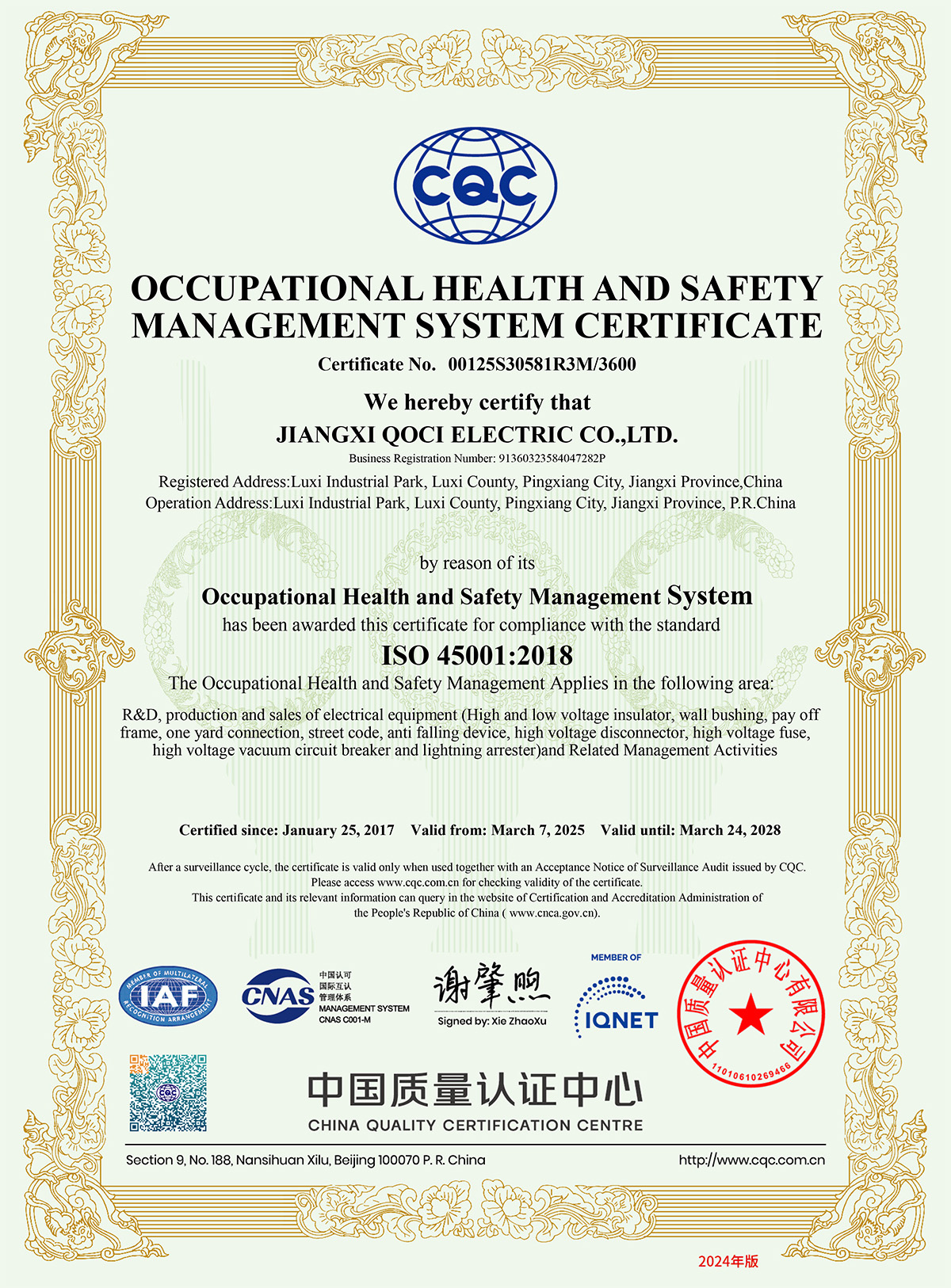
Figure 2. Occupational health and safety management system certificate (ISO 45001:2018) held by Jiangxi QOCI Electric Co., Ltd., issued by CHINA QUALITY CERTIFICATION CENTRE.
Future Outlook
Three developments are likely to sharpen scenario matching over the next several years. First, grid modernisation and GIS substation upgrades are directing procurement attention towards units whose documentation can be verified against IEC and ANSI test methods rather than against marketing claims. Second, rural electrification and distribution reinforcement in emerging markets will keep demand concentrated on the mid- and low-voltage types where a type mismatch produces immediate field failures rather than gradual degradation. Third, as pollution severity rises on coastal and industrial corridors, anti-pollution creepage design will move from an optional upgrade to a baseline requirement, and the units that fail to match will be identified during service rather than at delivery.
For procurement teams, the durable takeaway is procedural. Define the scenario — voltage class, mechanical duty, pollution severity, mounting interface — before opening a supplier catalogue, then verify each candidate type against published parameters, test coverage, and management system certification. That sequence is what prevents a technically sound insulator from being used in a scenario it was never designed for.
Frequently Asked Questions
Which porcelain insulator type is used on an 11 kV overhead distribution line?
A pin-type porcelain insulator rated for the 10–11 kV class, such as the P-11-Y: rated voltage 11 kV, rated mechanical load 10 kN, maximum diameter 150 mm, total height 150 mm, creepage distance 240 mm, power frequency wet withstand voltage 50 kV, and lightning impulse withstand voltage 90 kV, with a high-strength electrical porcelain body and a hot-dip galvanized forged steel pin. Where the structure is designed for cantilever mounting instead of a pin seat, a line post porcelain insulator covers the same voltage class. Both carry support or cantilever loads rather than conductor tension.
What is the difference between a shackle insulator and a pin insulator?
Both are porcelain support types, but they serve different voltage classes and mounting duties. The ED-2B shackle (butterfly) insulator is a low-voltage distribution unit with a mechanical tensile strength of 13.5 kN, maximum diameter of 90 mm, total height of 76 mm, power frequency wet withstand voltage of 13 kV, and dry withstand voltage of 25 kV; it is used with a galvanized bracket for anchoring, strain, and angle joints on low-voltage overhead lines. A pin insulator such as the P-11-Y is rated 11 kV with a 50 kV wet withstand voltage and 240 mm creepage distance, and is mounted on a cross-arm or post to support a conductor. The wet withstand values, 13 kV against 50 kV, define the boundary between the two.
When is a suspension porcelain insulator string required instead of a pin insulator?
When the attachment point must carry conductor tension rather than a support load. Suspension units are used on overhead transmission lines with nominal voltages above 1000 V AC, the scope of IEC 60383-1:2023, and specified mechanical load values referenced in industry guidance for porcelain overhead line units span 40 kN to 550 kN, with string configuration determining total capacity. A pin insulator with a 10 kN rated mechanical load cannot substitute for that duty.
How is creepage distance matched to pollution and climate conditions?
Creepage distance is sized against site pollution severity, commonly referenced to pollution classes I to IV (IEC 60815 in industry guidance). A coastal or industrial route requires a longer leakage path than a clean inland route at the same voltage. Anti-pollution porcelain insulators achieve the longer path through shed geometry while keeping the same mounting interface. The trade-off is larger unit dimensions and, in strings, greater length, which affects tower geometry and clearances.
What should a buyer verify before ordering porcelain insulators for a specific scenario?
Four items. First, type-to-duty match: the voltage class and whether the duty is tension, cantilever, or support. Second, published parameters: rated mechanical load, creepage distance, power frequency wet withstand voltage, and impulse withstand voltage. Third, quality process coverage: whether crack detection is applied to 100% of units through dye penetration testing rather than batch sampling, plus checks on cement joint integrity and glaze quality referenced to ceramic materials standards such as IEC 60672. Fourth, management system certification, such as ISO 45001:2018 (certificate 00125S30581R3M/3600 issued by CHINA QUALITY CERTIFICATION CENTRE) and ISO 14001:2015 (certificate 00125E30701R3M/3600), plus reference data from comparable climate and pollution conditions.
What is the typical service life of a porcelain insulator, and how is degradation detected?
Porcelain insulators typically have a service life of 20–25 years in normal conditions; in heavy pollution or extreme climate environments, effective life may be shorter and require more frequent inspection. The failure mode that matters most is zero-value degradation, an internal electrical breakdown with no visible external change, which visual inspection cannot identify. It is detected by periodic live-line testing, commonly every three to five years, using voltage gradient or spark gap methods.
How does a manufacturer's cross-scenario deployment record inform supplier evaluation?
A deployment record across voltage levels and climates shows whether a supplier's quality control holds outside a single product line. Jiangxi QOCI Electric's products are used in grid construction projects of State Grid Corporation of China and China Southern Power Grid and in grids in over 40 countries and regions including Europe and the Middle East, and a distribution project spanning Sri Lanka (10,000 pieces), Egypt (40,000 pieces), and Ukraine (10,000 pieces) covered 60,000 pieces of P-11-Y and ED-2B units over three years to 2026. Such records are used to check whether a supplier has shipped the specific type and duty being procured; they are not a substitute for type-test documentation.
For readers who need the full parameter set behind the families discussed above, a downloadable product catalogue is available: QOCI product catalogue (PDF). Additional product documentation is published at www.quanxinelectric.com.