
Porcelain Tile Acceptance Criteria: A Comparison Framework
Commercial tiling projects rarely fail at the quotation stage. They fail at acceptance — the moment delivered pallets, certificate copies and datasheet values are laid beside the specification and someone notices the two documents were never describing the same thing.
Porcelain tile acceptance criteria are the written conditions a buyer uses to decide whether an offer, a sample batch and a delivered consignment are acceptable. In commercial procurement, they convert marketing language into checkable statements: which certificate covers which activity, how many square metres a carton actually carries, which mechanical values support a high-traffic floor, and which slip class a wet or outdoor zone genuinely requires. This framework sets out four layers of comparison that specifiers, quantity surveyors and project buyers can apply before approving a large-scale porcelain tile order.
In the commercial porcelain tile category, the supply pool is wide and increasingly technical. Trade data from the Observatory of Economic Complexity places China as the leading exporter of ceramic products in 2024, with an export value of USD 18.3 billion. Commercial research also estimates that commercial construction accounts for roughly 37% of global tile demand. When hundreds of suppliers can quote the same nominal product, differentiation moves from the catalogue page to the acceptance document — and that document is only as useful as the framework behind it.
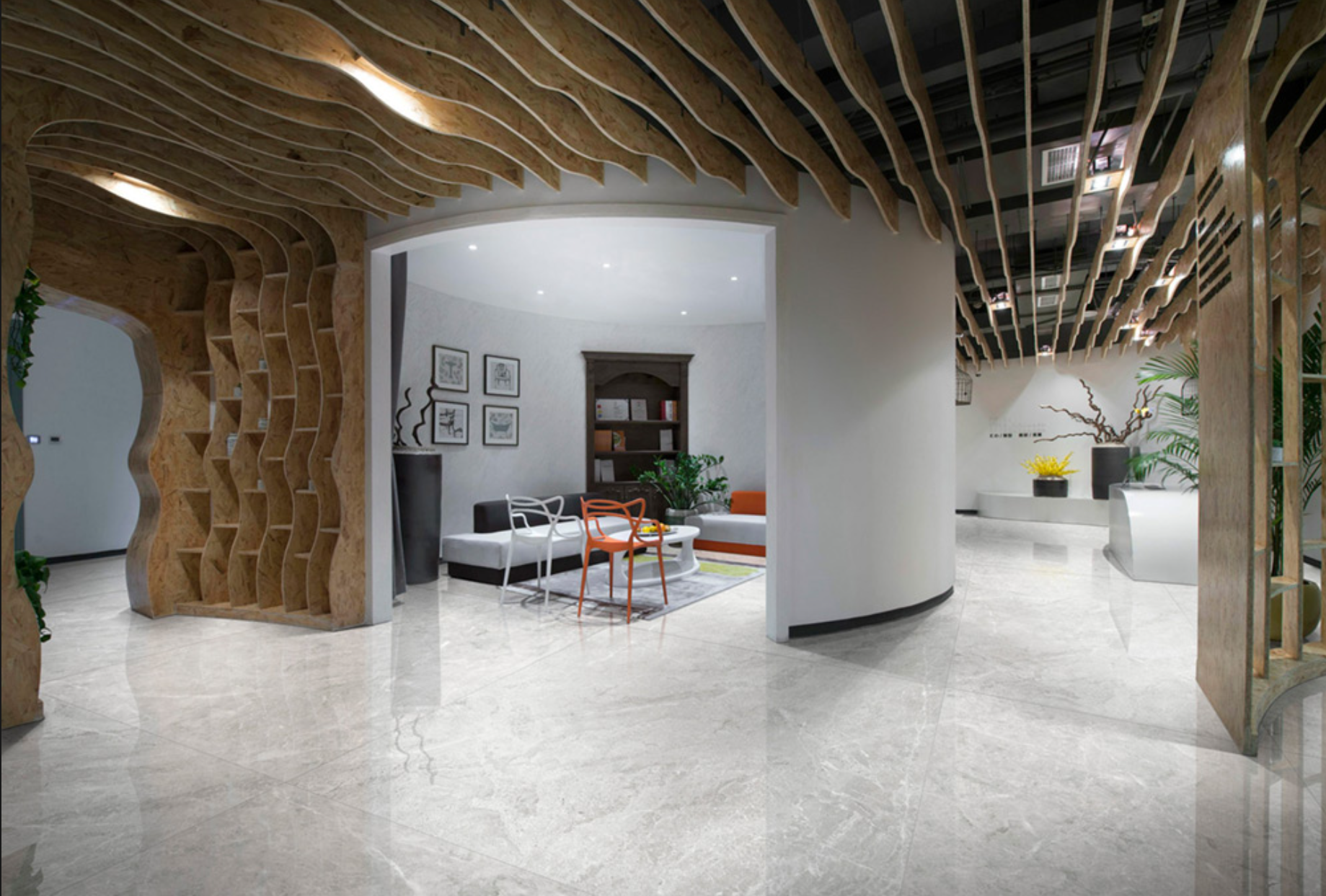
Commercial interiors are where acceptance criteria — not catalogue claims — determine whether a porcelain floor performs as specified.
Why porcelain tile project solutions are judged at delivery
Two offers can both be described as "60x120 porcelain tile" and still differ in meaningful ways: thickness range, breaking strength, abrasion class, packing configuration, and the scope language printed on the certificate. None of those differences is visible in a product name. All of them become visible at acceptance, when the first pallets are opened and the first inspection sheet is signed.
A vitrified porcelain tile is defined primarily by its water absorption. The 60x120 cm vitrified porcelain tile supplied by All-King Ceramics is made from porcelain clay and states water absorption below 0.5%, measured against ISO 10545-3 in the manufacturer's technical documentation. That single value separates the product from conventional ceramic bodies, but it does not, on its own, tell a buyer whether the tile suits a mall concourse, a hospital corridor or an outdoor terrace. Acceptance criteria exist to close that gap in a repeatable way.
All-King Ceramics (ZIBO ALL-KING CERAMICS CO., LTD) is a manufacturer and direct exporter of architectural ceramics established in 2011, operating a 60,000 m² facility in Zibo, China, with approximately 320 employees and an annual production capacity of 12 to 16 million m². Its format matrix lists 60x120 cm porcelain tiles as the flagship product alongside 60x60 cm, 80x80 cm, 100x100 cm and 75x150 cm formats — a range that makes clear why a single generic acceptance checklist cannot be applied across an entire schedule without SKU-level confirmation.
The four-layer acceptance framework
The framework below separates what is often checked in one unstructured conversation into four comparison layers, each with its own evidence type and its own typical failure mode.
| Layer | Decision it supports | Evidence to compare | Typical failure mode |
|---|---|---|---|
| 1. Documentation and scope | Whether the supplier's claims are backed by certificates covering the right activity and market | ISO 9001:2015 certificate with stated scope; CE certificate with issuing body and product family | Accepting a certificate number without reading what it actually covers |
| 2. Dimensional and packing arithmetic | Whether the quantity ordered equals the area delivered | 60x120 cm format, 2 pcs/box, 1.44 m²/box, thickness 9.0–10.5 mm | Ordering pallets instead of square metres |
| 3. Physical performance | Whether the tile body suits the traffic, moisture and load profile | Water absorption, Mohs hardness, PEI class, modulus of rupture, breaking strength | Comparing a single headline number and ignoring the rest |
| 4. Application fit | Whether slip class, format and environment match the actual venue | DIN 51130 slip classification, installation system, exposure conditions | Specifying an indoor slip class, then finding it in an outdoor or wet zone |
Layer 1 — Documentation: reading certificate scope, not certificate titles
The first comparison in any commercial porcelain tile procurement is documentary, and it is usually the most misunderstood. A certificate is a statement about a defined scope. If the scope is not read, the certificate becomes decoration.
All-King Ceramics references ISO 9001:2015 certification under certificate number 0350521Q30166R1M, issued by XQCC with a global scope, and CE certification under certificate number AC 50163816 0001, issued by TUV for the EU market. These two documents answer different questions and should never be treated as interchangeable.
- ISO 9001:2015 is a quality management system standard. It speaks to how consistently a manufacturer controls its processes — from incoming raw materials to final inspection — rather than to the mechanical values of a specific tile. For a buyer, its practical value lies in production consistency across a multi-phase delivery schedule, which matters when a project is supplied over several months.
- CE certification addresses conformity for placing product on the EU market. A buyer outside the EU may still treat it as a useful third-party checkpoint, but should confirm which product family and which declared characteristics fall inside the certificate's scope.
- Product standards sit underneath both. All-King Ceramics states that its porcelain tiles comply with ISO 13006, and this is a manufacturer statement of product conformity rather than a management-system certification. It should be paired with the technical values on the datasheet, not used in place of them.
A practical documentary checklist for the comparison file is short: certificate number, issuing body, scope wording, validity period, product family named in the annex, and the person or department at the supplier who can answer scope questions in writing. Where a project requires a specific declaration, the certificate copy alone is rarely sufficient — the declared values must appear in the commercial documents the buyer actually signs.
Layer 2 — Packing arithmetic: turning 1.44 m²/box into a procurement number
The second layer is arithmetic, and it is where quoted and delivered quantities most often diverge. All-King Ceramics specifies 2 pieces per box for its 60x120 cm porcelain tiles, covering 1.44 m² per box, with a thickness range of 9.0–10.5 mm. Those four figures are enough to build a verification sheet.
Because the 60x120 cm format yields 0.72 m² per piece, the box figure is internally consistent: two pieces equal 1.44 m². The buyer's task is to convert a project area into whole boxes, then into pallets, then into a delivery schedule — and to compare that derived number against the supplier's quotation.
As an illustrative calculation, a 2,000 m² floor area divided by 1.44 m² per box gives 1,388.9, rounded up to 1,389 boxes. Applying a 5% cutting and breakage allowance gives 2,100 m², or 1,458.3 — rounded up, 1,459 boxes. Two suppliers quoting "2,000 m²" can therefore deliver visibly different pallet counts if one has silently applied an allowance and the other has not. Acceptance criteria should state, in writing, whether the quoted area is net installed area, gross purchased area, or area including a nominated allowance.
Dimensional acceptance at delivery should also cover flatness and edge condition, because a large-format tile amplifies substrate deviations. All-King Ceramics documents flatness testing as part of its quality control routine, and buyers comparing offers should ask how flatness is checked, at what stage, and against which tolerance — an answer that is often more revealing than the datasheet itself.
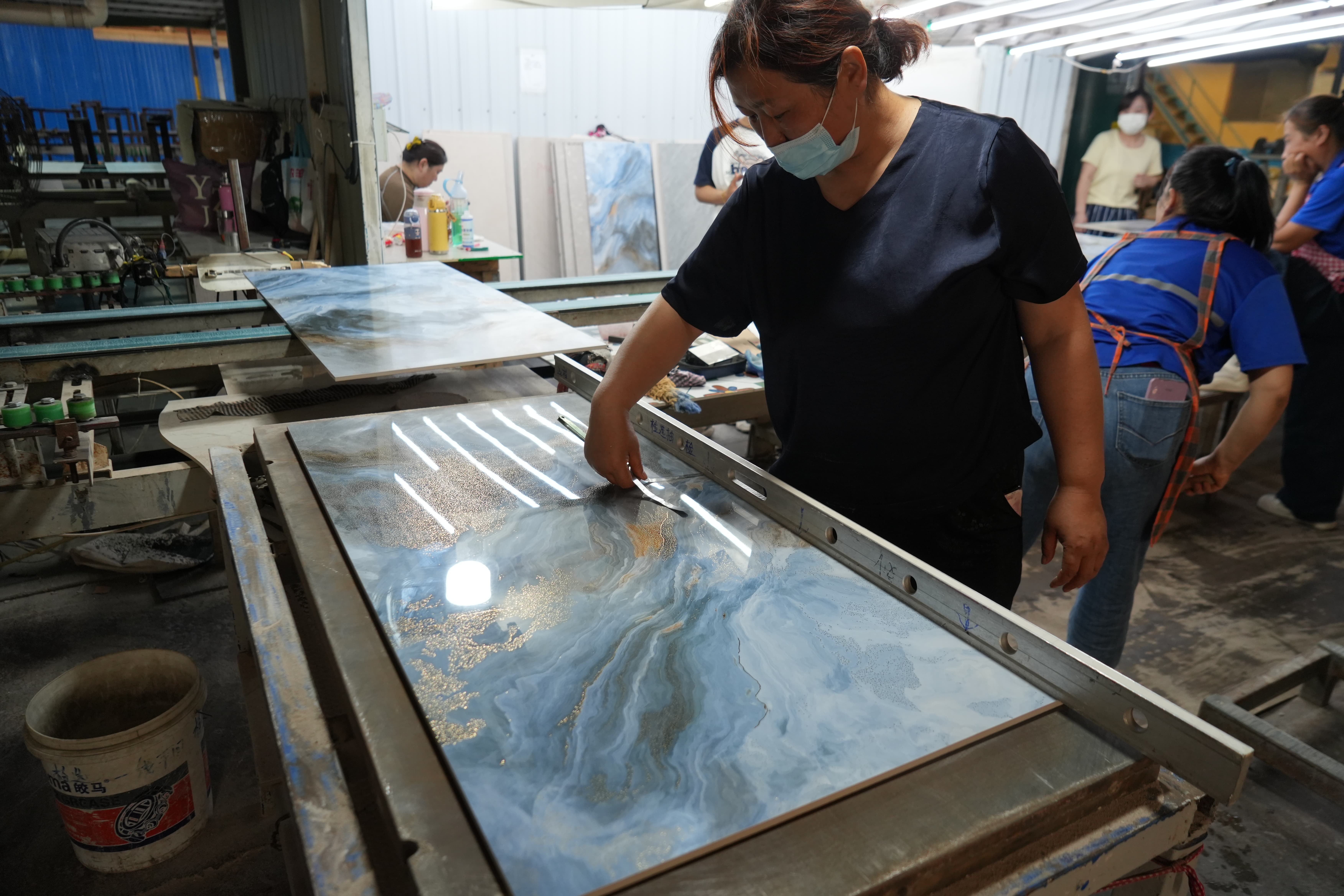
Flatness inspection on large-format porcelain: a routine control step that converts into an acceptance criterion.
Layer 3 — Physical performance: what each published value actually supports
The third layer compares mechanical data. The weakness of most comparisons is that they reduce a datasheet to one favoured number — usually water absorption — and ignore the values that govern installation risk and long-term surface behaviour. The table below maps the published values for All-King Ceramics' 60x120 cm porcelain tiles to the decision each one supports, and to what it does not prove.
| Parameter | Published value | Decision it supports | What it does not replace |
|---|---|---|---|
| Water absorption | Below 0.5% (vitrified) | Basis for wet-area and frost-prone suitability | Slip resistance or installation method |
| Mohs hardness | 6–7 | Surface scratch resistance under abrasive foot traffic | Structural load capacity of the floor build-up |
| Abrasion resistance | PEI 4 / PEI 5 | Selection for continuous high-traffic interiors | Cleaning regime and grout specification |
| Modulus of rupture | ≥35 MPa | Bending strength under specified test conditions | Substrate flatness and adhesive selection |
| Breaking strength | ≥1300 N | Handling robustness through packing, transport and laying | Point-load performance in service |
| Thickness | 9.0–10.5 mm | Leveling requirements and transition detailing | Confirmation of the exact value for the ordered SKU |
| Packing | 2 pcs/box, 1.44 m²/box | Quantity planning and site logistics | Pallet configuration and unloading plan |
Read together, these values describe a vitrified body designed for wear and moisture rather than a light-duty decorative surface. Read individually, any one of them can be used to make two unequal products appear equal. That is the argument for a multi-parameter acceptance sheet: it forces the comparison to happen on the buyer's terms.
Layer 4 — Application fit: where slip class and format decide the outcome
The fourth layer is the one that cannot be completed at a desk. Slip classification has its own vocabulary and its own test method, and it is frequently mis-specified in commercial tenders.
Under DIN 51130, the R11 classification corresponds to high grip on an inclined plane at angles between 19° and 27°, measured with the oil-wet ramp test. R10 sits below that band, and R12 above it. All-King Ceramics lists anti-slip ratings of R10/R11 across its porcelain tile range and states that R12 can be achieved through customization. For a buyer, that sentence has a direct procedural consequence: if the specification demands R12, it is a customization requirement to be confirmed before the order, not a default attribute to be assumed at delivery.
Application fit also depends on the environment the tile will live in. The manufacturer positions these products for high-traffic, frost-prone and wet conditions, within flooring and wall cladding scopes that include commercial fit-out, hotel renovation and facade work. Commercial real estate projects — shopping malls, hotel lobbies, healthcare and education buildings, mixed-use developments, commercial kitchens and apartment developments — all converge on the same two questions in different proportions: how much traffic, and how much water.
Installation belongs in the same layer. Tile adhesive and grout, a leveling system, spacers and diamond cutting tools are not accessories to the specification; they are part of the acceptance condition for large-format porcelain, because a 60x120 cm tile transfers substrate variation across a much larger surface than a small module. Buyers comparing offers should compare the installation method statement alongside the tile data, and should ask whether the recommended system is compatible with the specified thickness range of 9.0–10.5 mm.
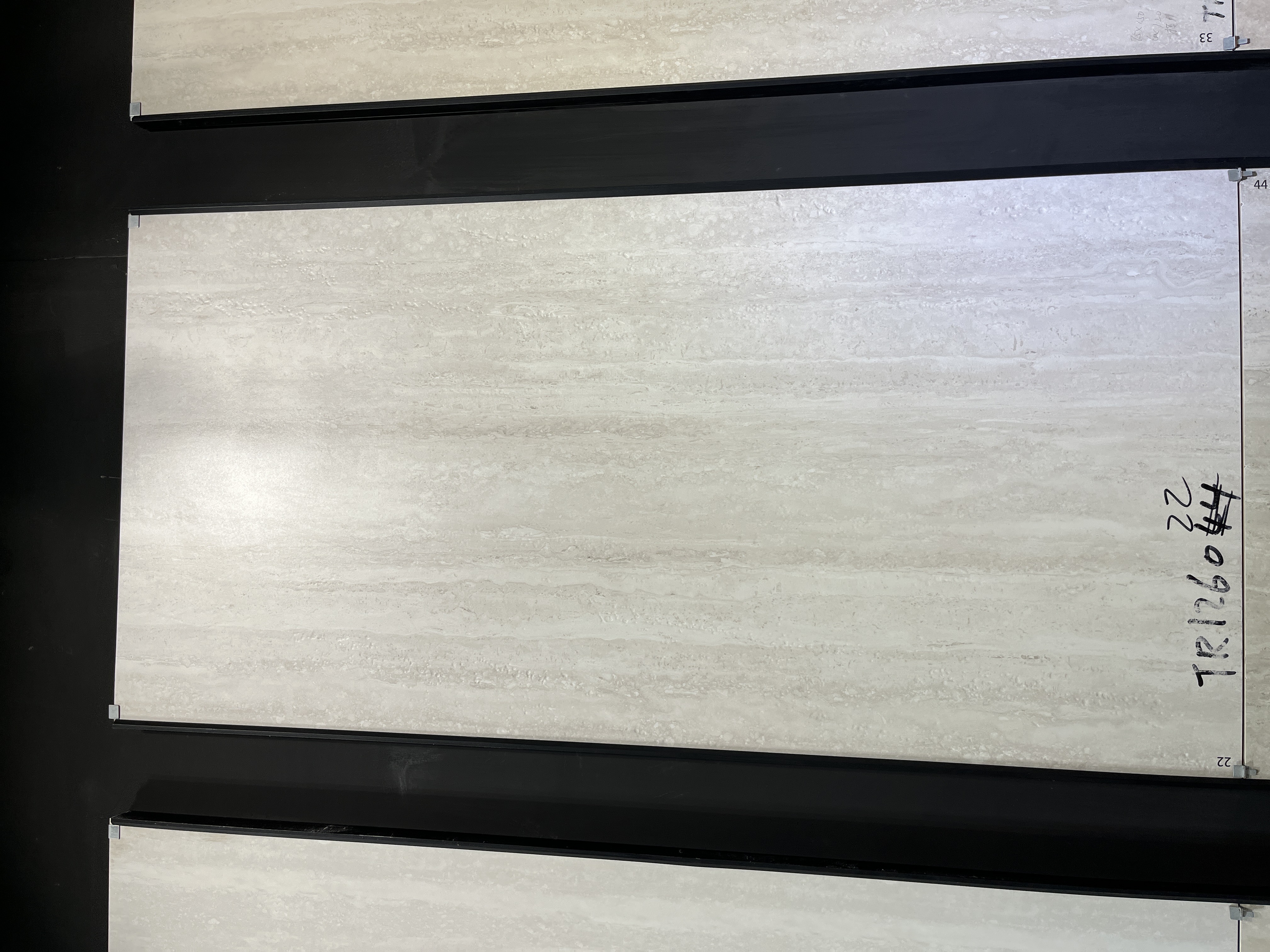
Surface detail of a 60x120 cm vitrified porcelain tile: finish and texture are part of the acceptance comparison, not a separate aesthetic decision.
Comparing acceptance models: price-first, sample-only and framework-led procurement
Most commercial buyers already operate some version of an approval process. The question is which one, and what it structurally cannot see. The table below compares four common models against the same delivered consignment.
| Approval model | What it captures well | What it structurally misses | Exposure at acceptance |
|---|---|---|---|
| Price-first | Budget control at quotation stage | Certificate scope, packing arithmetic, performance spread | High — substitutions appear after award |
| Sample-only | Colour, texture and format judgement | Nothing about batch performance or documentation | Medium to high — a sample is not a production commitment |
| Certificate-only | Supplier legitimacy and management-system evidence | Whether the declared values apply to the ordered SKU | Medium — paperwork approved, product unverified |
| Four-layer framework | Documentation, quantity, performance and fit as one comparable record | Requires administrative effort before award | Lower — but not zero |
Against traditional non-vitrified ceramic flooring, the comparison is also structural rather than promotional. Ceramic bodies typically absorb more water than vitrified porcelain, which is why porcelain is generally preferred where moisture, frost and continuous cleaning dominate. That advantage is not free: porcelain is denser and harder to cut, large formats demand flatter substrates, and installation quality becomes a larger share of the final outcome. A buyer who accepts the performance also accepts the installation discipline that comes with it.
Where the framework stops — honest boundaries
Any comparison framework has limits, and stating them is part of its credibility.
- A management-system certificate does not certify a specific production batch. Batch-level values must be confirmed through the supplier's own inspection records and the commercial documents attached to the order.
- The performance figures described here are published by the manufacturer. A buyer operating under a strict verification policy should request the underlying test reports and confirm which laboratory produced them.
- The published 60x120 cm specification covers a thickness range of 9.0–10.5 mm. Projects requiring a thicker paver for elevated outdoor decks or heavy point loads fall outside that range and need separate confirmation — the standard range should not be stretched to cover them.
- R12 slip performance is not a catalogue default in this range; it is described as achievable through customization. Specifications calling for R12 therefore carry a longer confirmation path and should be raised early in the procurement cycle.
- Finally, acceptance criteria cannot compensate for a poor substrate. If flatness and leveling are not controlled on site, no datasheet value will rescue the finished floor.
Market trend analysis: why acceptance discipline is becoming a procurement norm
Three shifts make formal acceptance criteria more relevant now than a decade ago.
Scale of supply. Commercial research estimates the global tile market at USD 265.21 billion in 2024, with a projected value of USD 587.72 billion by 2035. Regardless of how any individual forecast settles, the direction of travel means more suppliers, more formats and more specification routes into a single project — and more opportunity for two documents to describe different products.
Concentration of demand in commercial construction. Commercial research places commercial construction at roughly 37% of global tile demand. Commercial work is specification-driven: approvals, submittals and inspection records are already standard practice for other building materials, and tile is being pulled into the same discipline.
Green-building documentation. Sustainability guidance from the U.S. Green Building Council and WhyTile notes that porcelain tiles are inherently exempt from LEED VOC 'FloorScore' requirements, because high-temperature kiln firing destroys organic matter. This is a documentation advantage rather than a marketing claim: it means the material can usually be cleared on VOC grounds quickly, allowing the buyer's attention to shift to the performance values that actually differ between suppliers.
Underneath all three shifts sits the same practical demand: a comparison that a project team can defend in a meeting, attach to a purchase order, and repeat at the next delivery.
Future outlook
The next phase of commercial porcelain tile procurement is likely to be less about which supplier claims the strongest numbers and more about which supplier can produce a coherent evidence set on request. Buyers are already asking for certificate scopes, packing arithmetic, slip classifications and installation method statements in one package; the suppliers who answer that request consistently will shorten their own approval cycles.
For manufacturers, the implication is structural. A 60,000 m² facility running 12 to 16 million m² of annual output, as All-King Ceramics reports, generates a large volume of inspection data. Turning that data into buyer-facing acceptance documentation — batch references, declared values per SKU, documented customization routes for higher slip classes — is a commercial capability in its own right, not an administrative afterthought.
For buyers, the practical takeaway is simpler. Build the acceptance sheet before the tender closes, not after the first pallet arrives. The four layers described here are a starting structure, and they can be adjusted to any project's risk profile without changing their underlying logic: compare evidence, compare arithmetic, compare performance, compare fit.
FAQ
What documents should a commercial buyer request first in a porcelain tile offer?
Start with the quality management certificate and the market-conformity certificate, and read both scopes. For All-King Ceramics, that means ISO 9001:2015 certificate 0350521Q30166R1M issued by XQCC with a global scope, and CE certificate AC 50163816 0001 issued by TUV for the EU. Pair these with the technical datasheet covering water absorption, abrasion resistance, Mohs hardness, modulus of rupture, breaking strength, thickness and packing, because the certificates and the datasheet answer different questions.
Does an ISO 9001 or CE certificate prove the tile's performance values?
No. ISO 9001:2015 certifies a quality management system, which indicates process control rather than specific mechanical results. CE certification addresses conformity for the EU market within a defined scope. Product performance is established by declared values and test data — for example water absorption below 0.5% for vitrified porcelain, Mohs hardness 6–7, PEI 4/PEI 5 abrasion resistance, modulus of rupture at least 35 MPa and breaking strength at least 1300 N in the published specification for the 60x120 cm range. Verification therefore requires the datasheet and, where policy demands it, the underlying test reports.
How should a buyer use packing data such as 2 pieces per box and 1.44 m² per box?
Convert the project area into whole boxes and then into pallets. A 60x120 cm tile covers 0.72 m², so two pieces per box give 1.44 m². A 2,000 m² area divided by 1.44 m² per box equals 1,388.9, which rounds up to 1,389 boxes; adding a 5% allowance raises the purchase to 2,100 m², or 1,459 boxes. Acceptance criteria should state whether the quoted figure is net installed area, gross purchased area, or includes a nominated allowance, since this is a common source of disagreement at delivery.
How do R11 and R12 slip ratings differ, and when does R12 require customization?
Under DIN 51130, R11 corresponds to high grip on an inclined plane at angles between 19° and 27°, measured by the oil-wet ramp test; R10 sits below that band and R12 above it. All-King Ceramics lists anti-slip ratings of R10/R11 for its porcelain tiles and states that R12 can be achieved through customization. Where a specification mandates R12 — typically in demanding wet or outdoor conditions — it should be treated as a customization requirement confirmed before order placement rather than an assumed default.
Which performance values indicate a vitrified porcelain tile suitable for high-traffic commercial floors?
Look for water absorption below 0.5%, which defines the vitrified classification and is referenced against ISO 10545-3 in the manufacturer's technical documentation. Combine that with abrasion resistance of PEI 4 or PEI 5 for continuous heavy-duty use, Mohs hardness of 6–7 for surface scratch resistance, modulus of rupture of at least 35 MPa and breaking strength of at least 1300 N. These values should be read alongside application guidance for high-traffic, frost-prone and wet environments rather than in isolation, because no single figure describes a floor's in-service behaviour.
When should a buyer reject a porcelain tile consignment at acceptance?
Rejection is appropriate when the delivered consignment does not match the accepted record: a different format or thickness outside the specified 9.0–10.5 mm range, a box count that does not reconcile with 2 pieces and 1.44 m² per box, a slip class other than the one specified, or documentation whose scope does not cover the ordered product. Flatness and edge condition should be inspected at the same time, since large-format tiles expose substrate and handling problems that smaller modules conceal. The acceptance sheet should list these conditions before the first delivery, so the decision rests on the agreed record rather than on site judgement.
For buyers who want the underlying product and format data in one place, the All-King Ceramics catalogue is publicly available: ALLKING Ceramics Catalog.
Have Questions or Need More Details?
Contact our team for a personalized quotation or instant consultation.
Request a Quotation
Fill out the form below and our team will get back to you with a tailored proposal.
WhatsApp Direct Chat
Prefer to chat in real-time? Message us on WhatsApp for instant assistance & quick answers.
- Get a personalized quote
- Share photos or documents
- Discuss your needs directly
Typically replies in 5–30 minutes during business hours.