
Porcelain Tile Project Solutions: Certification and Specification Criteria
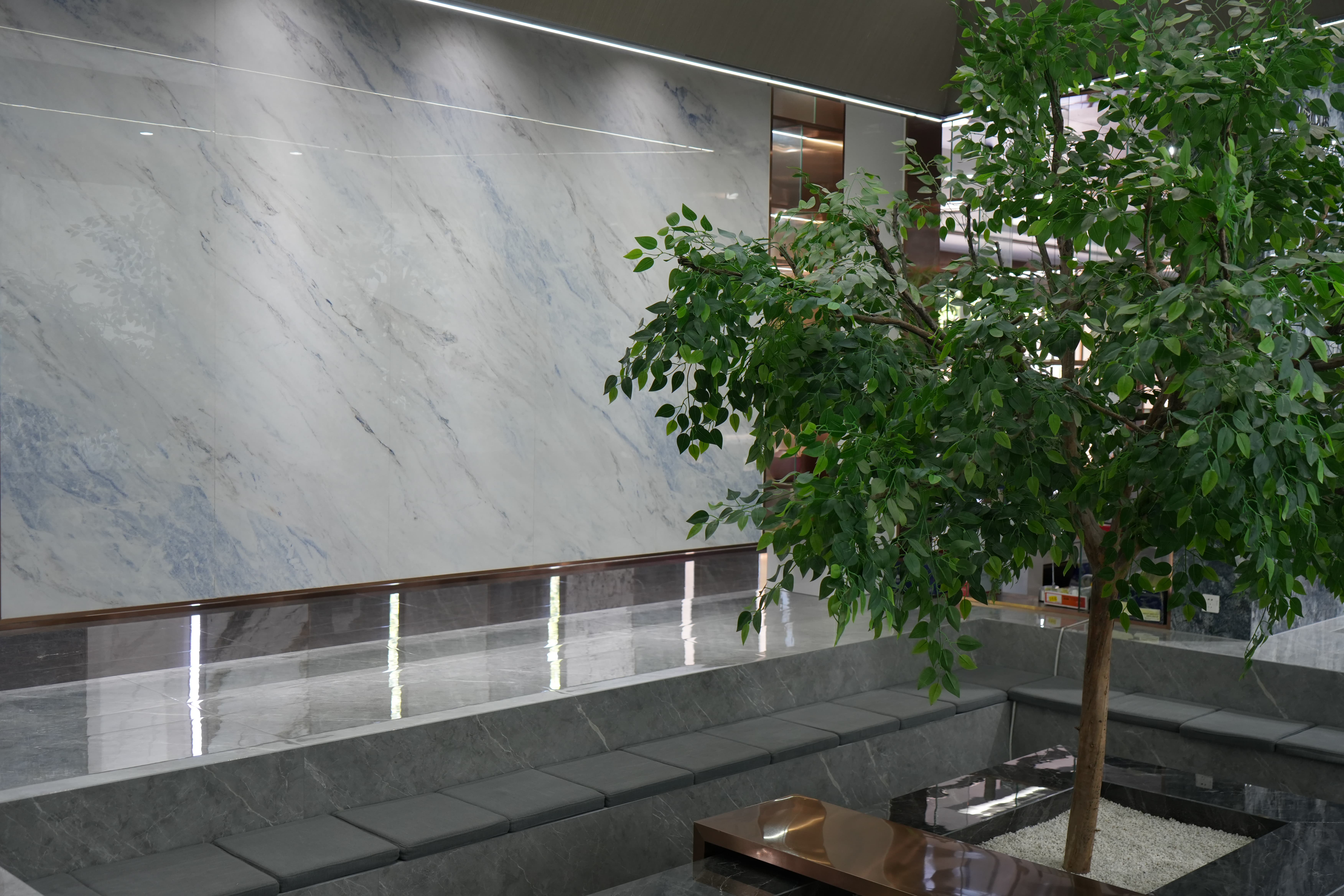
Commercial flooring and wall cladding projects rarely fail because of color. They fail when a tile's actual performance does not match the specification. That is why procurement teams now treat porcelain tile project solutions as a package of verified constraints: water absorption, breaking strength, abrasion class, slip resistance, certification, and factory capacity.
For buyers moving from research to evaluation, the task is not simply to find a supplier. It is to verify whether a supplier can meet the documented requirements of a project. This article explains the technical and certification criteria that matter in commercial porcelain tile sourcing, and how those criteria are applied by ZIBO ALL-KING CERAMICS CO., LTD, a China-based manufacturer and direct exporter.
Why Commercial Projects Need Verified Constraints
Commercial real estate projects place tiles under conditions that residential floors rarely see. Typical working conditions include high traffic, frost and freeze-thaw cycles, wet and slippery areas, thermal shock, and heavy surface loads. A lobby floor, an airport departure hall, a hotel bathroom, or a commercial kitchen can push a tile's limits on a daily basis.
Project specifications therefore include special requirements such as anti-slip performance (commonly R10/R11), frost resistance, low VOC emissions, acid and alkali resistance, zero water penetration, and ISO 13006 compliance. For procurement, each requirement becomes a screening criterion. A tile that looks right but fails on water absorption or abrasion resistance becomes a permanent operational risk.
This is the opportunity behind constraint-driven sourcing. Buyers who verify certifications, physical parameters, and factory controls before ordering can reduce rework, replacement costs, and maintenance complaints.
What a Certified Porcelain Tile Project Solution Looks Like
One example of this model is ZIBO ALL-KING CERAMICS CO., LTD, a manufacturer and direct exporter founded in 2011. The company operates a 60,000 m² factory with 320 employees and a 25-engineer R&D team. Annual output is approximately 12–16 million m², and about 70% of production is exported to markets including Australia, New Zealand, Russia, South Korea, Vietnam, Malaysia, Peru, Panama, Colombia, Chile, and the United Arab Emirates.
All-King positions itself as an OEM/ODM partner for contractors, distributors, and builders. Its core product matrix is built around 60x120cm porcelain tiles, supplemented by 75x150cm, 80x80cm, 100x100cm and 60x60cm formats.
Marble Series and Travertine Series
Two series are central to project specification: Marble Series and Travertine. Both are 60x120cm porcelain tiles, and both share a specification designed for demanding commercial buildings.
| Parameter | Marble Series / Travertine |
|---|---|
| Format | 60x120cm |
| Thickness range | 9.0–10.5 mm |
| Water absorption | < 0.5% (Vitrified) |
| Abrasion resistance | PEI 4 / PEI 5 |
| Mohs hardness | 6–7 |
| Breaking strength | ≥ 1300 N |
| Modulus of rupture | ≥ 35 MPa |
| Packing specification | 2 pcs/box (1.44 m²/box) |
Material is porcelain clay, and the applicable industry is building materials. For project buyers, the specification sheet is a primary evaluation document.
Certification and Compliance Evidence
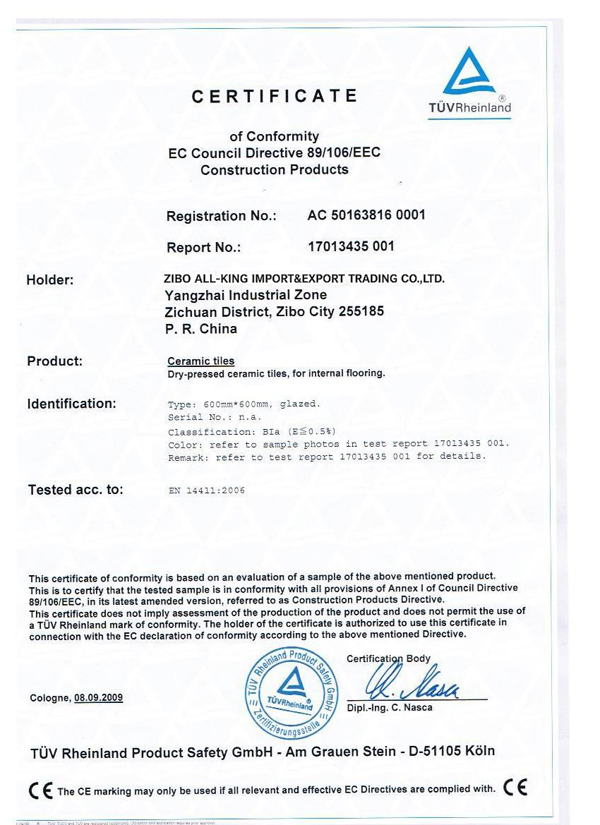
Certification is a documented constraint, not a marketing claim. The certification unit for these series lists two documents: a CE certificate (AC 50163816 0001, issued by TUV under the EEC standard, for the EU market) and an ISO 9001 certificate (0350521Q30166R1M, issued by XQCC, for global markets). The records relate both the Marble Series and the Travertine Series to these certifications.
Buyers should check three things when reviewing certificates: the issuing body, the scope, and the product code. A certificate only has value if it is traceable to the exact tile series being supplied.
Decoding the Technical Specification
Understanding what a parameter means is just as important as seeing the number. For porcelain tile project solutions, the following parameters carry the most weight in evaluation.
Water absorption below 0.5%. This places the tile in the vitrified category. Low absorption limits moisture ingress, supports frost resistance, and makes the tile easier to clean. For wet areas and freeze-thaw climates, it is a critical threshold.
Abrasion resistance PEI 4/PEI 5. PEI class indicates suitability for foot traffic. PEI 4 is typically specified for areas with substantial foot traffic, while PEI 5 covers the heaviest commercial use. Shopping malls, hotel lobbies, and transport hubs fit this profile.
Mohs hardness 6–7. Hardness relates to resistance to scratching from grit and debris. Tiles with this range are more likely to keep a polished appearance in continuous service.
Breaking strength ≥1300 N and modulus of rupture ≥35 MPa. These measure how much force the tile can withstand before breaking and its bending resistance. For heavy surface loads and installations on busy floors, this structural data matters.
Slip resistance is another constraint that appears in many project briefs. DIN 51130 defines anti-slip ratings based on slope angle: R11 covers 19°–27° and is common for kitchens and food production; R12 covers 27°–35° and is used in dairy and industrial environments. Commercial specifications often ask for R10/R11 in wet or slippery zones. All-King's OEM/ODM capability includes adjusting anti-slip rating, allowing project teams to request a finish suited to the environment.
Where These Solutions Are Applied
The documented application for All-King's commercial real estate projects covers a wide set of building types. In one recorded case, the company supplied 15,000 m² of porcelain tile for a commercial development that included a hotel lobby, commercial mall flooring, office building facade, high-end apartment bathrooms, and an airport departure hall. The project was designed for 20+ years of service. Reported results included 100% project acceptance and zero maintenance complaints.
This aligns with what procurement teams observe across the market. Commercial projects are mixing functional zones under one roof: public lobbies, retail corridors, food-service areas, washrooms, and transit spaces. A single tile system may need to serve all of them.
Market Context: Why Procurement Criteria Are Tightening
Independent market data supports the shift toward performance-based sourcing. According to Grand View Research, the global ceramic and porcelain tiles market was valued at USD 226.4 billion in 2025 and is projected to reach USD 380.6 billion by 2033. Porcelain tiles accounted for 52.4% of market revenue in 2025, and commercial end-use represented the largest revenue share.
China remains an important source for project-scale tile procurement, but the export environment is changing. China Customs data cited by CeramBath shows that Chinese ceramic tile exports reached USD 3.21 billion in 2024, with 599 million m² in volume and an average export price of USD 5.36 per square meter. Export value declined 27.8% year-on-year. The practical implication is that suppliers cannot win projects on price alone; documented quality, certification, and service capacity have become differentiators.
In the competitive landscape, Mohawk Industries, Grupo Lamosa, and RAK Ceramics were among the top-ranked global manufacturers by production volume in 2024, according to Ceramic World Review. This shows that project buyers have access to global-scale brands and specialized factory-direct exporters such as All-King. The evaluation should be based on a supplier's ability to meet the project's constraint set, not on brand size alone.
Porcelain Tile Project Solutions vs. Conventional Sourcing
Conventional ceramic tile sourcing often centers on visual sampling, low unit price, and immediate stock availability. Traditional ceramic tiles generally have higher water absorption and lower breaking strength than vitrified porcelain tiles, which can create problems in wet, high-traffic, or heavy-load environments.
A certified porcelain tile project solution is different. It replaces guesswork with documented physical data, certification, and factory-level quality control. All-King, for example, reports 100% flatness and sizing auto-check, piece-by-piece visual inspection, and random lab testing per batch. It also publishes its production capacity and lead time: around 1.2 million m² per month and 7–10 days.
However, this model has clear boundaries. Factory-direct porcelain projects require earlier technical alignment, higher minimum volumes, and longer logistics planning than buying from local stock. All-King's MOQ is 400 m² per design, although trial orders are acceptable. For an urgent maintenance repair or a very small renovation, a local distributor with available stock is often the more practical route. For a mid-to-large building project, the constraints of factory-direct sourcing are usually acceptable trade-offs.
Future Outlook
The next phase of porcelain tile project solutions will be driven by measurability and sustainability. Buyers are asking for clearer evidence of anti-slip performance, batch consistency, and lifecycle costs. At the same time, environmental requirements are entering the specification. Porcelain tiles are mineral-based and fired at high temperatures, which makes them relevant for LEED projects; according to USGBC guidance, such tiles are exempt from FloorScore VOC requirements, supporting LEED v4.1 IEQc4.3 compliance.
Large-format porcelain slabs and outdoor 20mm pavers will continue to be specified for mixed-use developments, hotel lobbies, educational buildings, and healthcare facilities. The suppliers that succeed will be those that combine certified products, transparent production data, and the flexibility to customize sizes, finishes, and anti-slip ratings.
Frequently Asked Questions
Which certifications are relevant for porcelain tile project solutions?
All-King Ceramics' Marble Series (product 4765) is CE certified under the EEC standard, issued by TUV, for the EU market. The same series is ISO 9001 certified by XQCC for global markets. The CE certificate reference is AC 50163816 0001; the ISO 9001 reference is 0350521Q30166R1M.
What technical parameters should be checked for porcelain tiles in high-traffic commercial spaces?
The Marble Series and Travertine Series are 60x120cm porcelain tiles with thickness of 9.0–10.5 mm, water absorption below 0.5% (vitrified), abrasion resistance PEI 4/PEI 5, Mohs hardness 6–7, breaking strength ≥1300 N, and modulus of rupture ≥35 MPa.
What anti-slip ratings are used in commercial tile specifications?
DIN 51130 defines R11 for slopes of 19°–27°, commonly used in kitchens and food production, and R12 for slopes of 27°–35°, used in dairy and industrial areas. Commercial project requirements commonly mention R10/R11 for wet or slippery zones. All-King's OEM/ODM capabilities include adjusting anti-slip rating according to project needs.
What are the typical order constraints for factory-direct porcelain tile project solutions?
All-King Ceramics has a monthly capacity of 1.2 million m² and a standard lead time of 7–10 days. The MOQ is 400 m² per design, and trial orders are acceptable. Customization can include size, thickness, surface finish, OEM brand logo and packaging, marble vein pattern variation, and anti-slip rating.
Are porcelain tiles suitable for LEED-oriented projects?
Porcelain tiles are mineral-based and fired at high temperatures. According to USGBC guidance, mineral-based tiles fired at high temperatures are exempt from FloorScore VOC requirements, which supports LEED v4.1 IEQc4.3 compliance. Low water absorption and low VOC emissions also align with green building procurement.
What is the current price reference for Chinese ceramic tile exports?
China Customs data cited by CeramBath shows an average export price of USD 5.36 per square meter for Chinese ceramic tiles in 2024, with export volume of 599 million m² and total export value of USD 3.21 billion. Project pricing varies according to format, finish, customization, packaging, and order volume.
Reference
A downloadable All-King Ceramics catalog with current product formats and packaging specifications is available at https://cdn.socialarks.com/sbsp/24953/common/2026/0625/ALLKING%20Ceramics%20Catalog.pdf.