
Porcelain Tile Shortlist: Monalisa Options for Commercial Flooring
Commercial flooring is specified against failure modes, not mood boards. A retail concourse, a hospital corridor, a transit terminal or a hotel lobby is judged on water absorption, abrasion class, slip resistance, stain resistance and freeze–thaw stability long before finish and pattern are agreed. This shortlist sets out how Monalisa porcelain tile options map to those acceptance criteria for commercial flooring projects, anchored by the 1200×2700×12 mm homogeneous body porcelain tile 120-270FEG12207M, and adds the purchasing terms and verification checkpoints that buying teams need at the Decision and Execution stages.
Why a Commercial Shortlist Starts With the Acceptance Envelope
Porcelain tile is legally and technically a defined product class, not a marketing term. Under ISO 13006:2018, dry-pressed porcelain tiles fall into Group BIa with a water absorption coefficient (E) of ≤0.5%, and an average mechanical resistance exceeding 40 N/mm². That classification threshold is the floor of any commercial specification — not the target.
For commercial and public-area flooring, purchase specifications typically sit above the classification floor. The envelope below reflects the criteria used in commercial flooring programs, and forms the framework this shortlist is scored against.
| Acceptance criterion | Typical commercial target | What fails without it | Verification artefact |
|---|---|---|---|
| Water absorption | ≤0.5% (ISO 13006:2018 Group BIa) | Deeper stain penetration, frost damage in unheated or outdoor zones | Standard absorption test result per production batch |
| Abrasion resistance | PEI 4 or higher for commercial / public areas | Visible wear paths in pedestrian traffic lanes | PEI abrasion class report |
| Slip resistance | R9–R11, selected by area and wet exposure | Slip incidents in washrooms, entries and wet zones | Pendulum friction test; wet BPN value |
| Stain resistance | Grade 5 | Permanent marking from coffee, oil and ink in food courts and lobbies | Stain test set (ink, oil, tea) |
| Freeze–thaw stability | 100 cycles without cracking | Surface spalling on plazas, ramps and unheated areas | Freeze–thaw cycle report |
| Colour, dimension and flatness | Shade consistency across phased delivery; tight flatness tolerance | Visible patchwork across phases; water ponding on large-format floors | Shade sorting records; dimensional and flatness inspection data |
Note on scope: capacity, performance and certification figures in this article are drawn from company-reported material and from a verification harvest that explicitly flags what is not yet independently documented. Where the public record is incomplete, this article says so rather than filling the gap.
The Anchor Option: 1200×2700×12 mm Homogeneous Body Porcelain Tile 120-270FEG12207M
The 120-270FEG12207M is a 1200×2700×12 mm homogeneous body porcelain tile from Monalisa Group Co., Ltd., a Foshan-headquartered manufacturer founded in 1992 that develops, designs, produces and markets architectural ceramics. Homogeneous body construction matters commercially for a simple reason: the colour and pattern run through the body rather than sitting only in a surface layer, so the consequences of edge chipping or point impact in heavy-duty circulation areas are less visually severe than on a glazed-only surface.
Monalisa’s published comparison data for its homogeneous-body porcelain range — the body type used for this format — reports the following performance position:
- Water absorption of ≤0.08%, against a Group BIa classification ceiling of ≤0.5%.
- Surface Mohs hardness of ≥7 and abrasion resistance at PEI Grade 5.
- Wear volume of ≤140 mm³, with breaking strength of ≥45 MPa.
- Flatness tolerance of ≤±0.15%.
- Freeze–thaw resistance of 150 cycles without cracking, against the 100-cycle commercial target above.
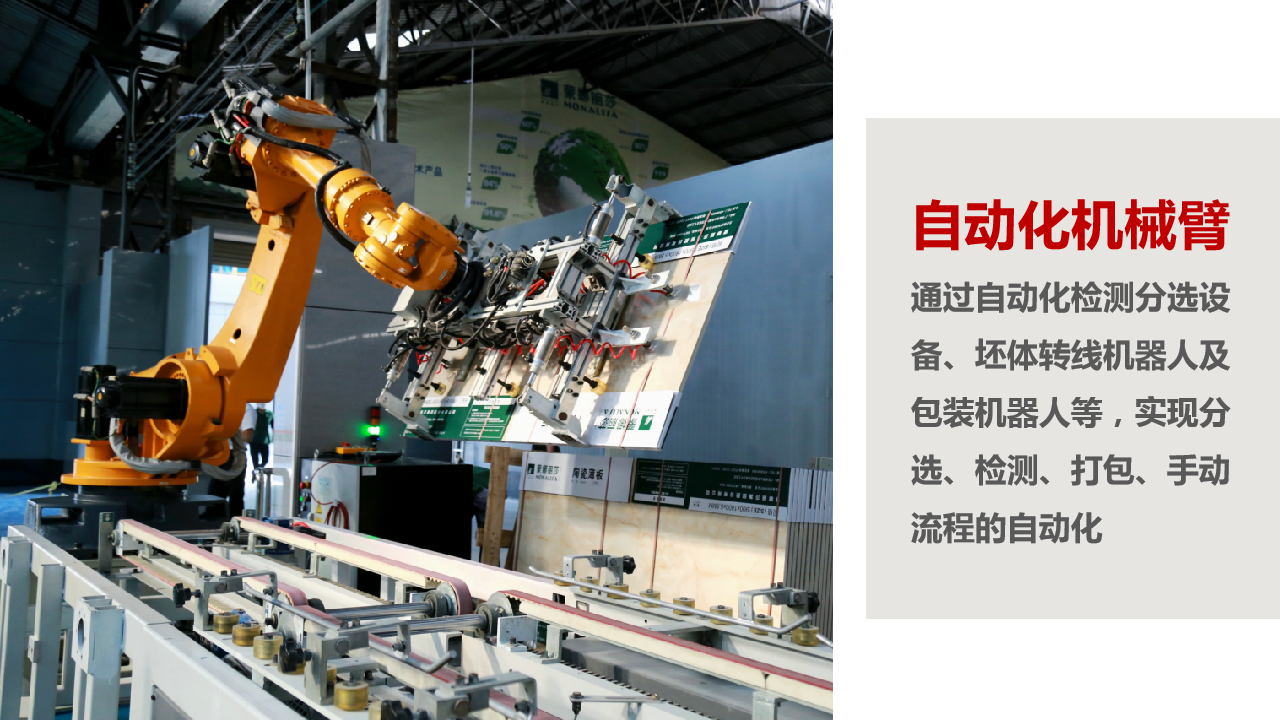
Production of this product family uses fully automatic ultra-high-pressure presses with a compaction force of up to 48,000 kN, combined with nano-scale glaze technology. Surface design is produced through high-definition inkjet printing with an adhesive dry grain process, which the company describes as reaching 98% realism compared with natural stone. That combination is what makes marble look, stone look, concrete look and other digitally printed porcelain finishes viable as commercial flooring rather than as decorative compromise.
The Shortlist: Mapping Monalisa Options to Commercial Spaces
Monalisa’s portfolio covers ceramic tiles, ceramic slabs (thin plates, large plates and rock plates) and porcelain art paintings, with three brands — “Monalisa”, “QD” and “Merqi” — and SPC Floor also listed among main products. For commercial flooring procurement, the useful cut is by format and substrate condition rather than by collection name.
| Shortlist option | Format and body notes | Best-fit commercial areas | Verification focus |
|---|---|---|---|
| Homogeneous body porcelain tile 120-270FEG12207M | 1200×2700×12 mm, homogeneous body, digital printed surface | Commercial porcelain floor tiles in concourses, lobbies, retail circulation, terminals, public corridors; heavy duty porcelain tile duty cycles | Per-SKU absorption, PEI, slip and freeze–thaw reports; flatness and shade records |
| Large-format thin ceramic plate | 1800×900×5.5 mm thin plate; first prize of the China Building Materials Science and Technology Progress Award (introduced 2007) | Wall cladding and retrofit work where substrate load and floor-to-ceiling build-up are constrained | Fixity system approval; substrate survey; batch shade control |
| Ultra-large ceramic slab | 9000×1800×10.5 mm, launched in 2021 and described by the company as a record for China’s ceramic industry | Continuous surfaces; curtain wall engineering and prefabricated building applications | Structural interface design; handling and joint planning |
| Wood-look porcelain range (ceramic wood) | Listed as an official catalog category alongside porcelain tile | Aesthetic continuity in office, hospitality and corridor zones specified with a warm finish | Slip class by area; joint width; batch consistency |
| Surface design routes: marble look, stone look, concrete look, digital printed | High-definition inkjet printing with adhesive dry grain; 98% realism reported against natural stone | Front-of-house zones where design intent and technical performance must both be satisfied | Reference sample vs. delivered batch; visual mock-up approval |
Adjacent areas inside a commercial building use the same shortlist logic. Commercial washrooms and back-of-house kitchens need waterproof porcelain tiles with stable absorption and a wet-area slip class; outdoor terraces, ramps and plaza thresholds need frost resistant porcelain tiles with proven freeze–thaw behaviour; office interiors and public waiting areas follow the same anti-slip and stain resistant porcelain tile requirements but at a lower abrasion severity. The product does not change — the criteria weighting does.
Technical Read-Through: What Each Number Changes on Site
Water absorption and frost performance
The ≤0.5% BIa threshold defines porcelain; the reported ≤0.08% figure creates a wider safety margin because a denser body absorbs less water and therefore has less internal moisture available to expand under freezing. This is the mechanism behind the reported 150 freeze–thaw cycles without cracking, against a 100-cycle commercial requirement. For outdoor porcelain tiles in cold regions, this margin is the difference between a maintenance item and a warranty claim.
Abrasion resistance
PEI 4 is the entry point for commercial and public areas. A reported PEI Grade 5 classification places the product above that entry point, which is relevant where pedestrian traffic concentrates along defined lanes rather than spreading across a floor plate. Wear volume of ≤140 mm³ is the measurable form of the same property.
Slip resistance
Slip resistance is specified per area, not per project. The commercial envelope of R9 to R11 covers the practical range: R9 for dry interior circulation, moving up through R10 and R11 as wet exposure increases. The manufacturer-side control method uses a special dry grain or textured mould surface validated by pendulum friction testing, with a wet BPN of ≥50 or R10+ required in the internal protocol. Buyers should restate the required class per zone in the specification and require the corresponding test evidence.
Stain resistance
Grade 5 stain resistance is the practical requirement wherever food, beverages or marking materials are present. The control route is a high-density transparent frit over the decorative layer, validated against ink, oil and tea. For facility managers, the operational consequence is that daily cleaning requires only water or a neutral detergent, with no waxing or sealing cycle.
Dimensional accuracy and flatness
Tight-joint large-format installation — grout gaps of 0.5 mm or less — is only possible when dimensional and flatness control is genuinely tight. Reported control measures include high-precision moulds with tolerances of ≤±0.1 mm, laser measurement with automatic rejection of out-of-tolerance pieces, press pressure uniformity compensation, kiln roller fine levelling and 100% post-kiln flatness scanning. Flatness additionally governs drainage behaviour on external floors, where ponding is a safety and liability issue rather than a cosmetic one.
Purchasing Terms and Verification Checkpoints
At Execution stage, the decisive question is not which tile performs best on paper but whether the delivered batches can be proven to match the approved sample. The commercial terms associated with Monalisa porcelain tile orders are:
- MOQ: 2000 m².
- Delivery terms: FOB, CIF or EXW.
- Payment terms: TT or LC.
The acceptance protocol attached to those terms is structured in three stages:
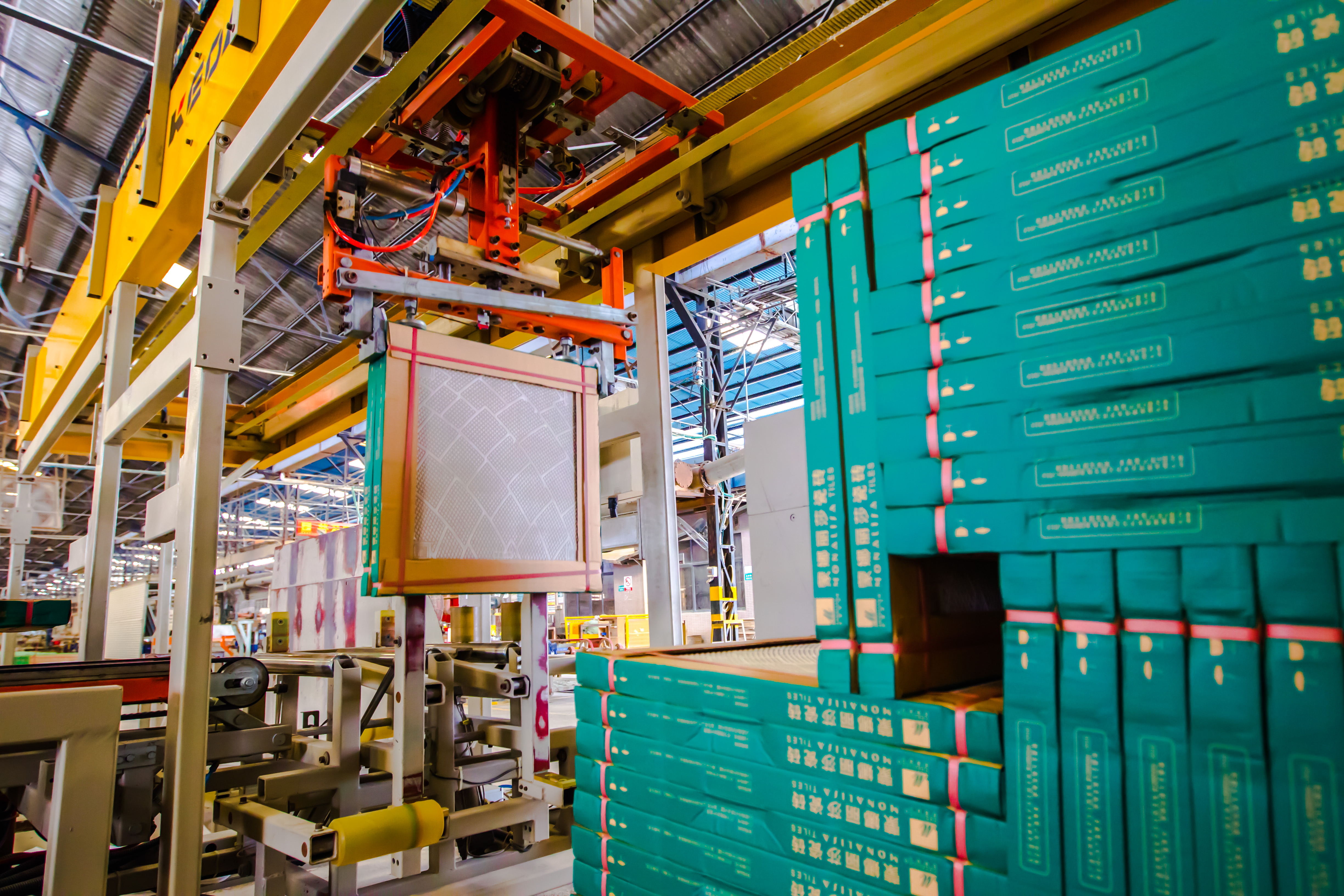
- Packaging and labelling check. Outer packaging intact, free of moisture and damage; each unit containing a certificate of conformity and installation guide; labelling matching the order for shade, size and quantity.
- Carton opening verification. Random opening of 5% to 10% of cartons to compare actual colour and pattern against the reference sample or master plate, and to verify quantity and grade.
- Rapid dimensional and flatness check. Using vernier caliper, feeler gauge and straightedge, measuring at least 10 pieces per batch for length and thickness.
Behind those checkpoints sits the manufacturer-side control system: 18 quality control points from raw material intake through ball milling, spray drying, pressing, drying, glazing, firing, polishing and sorting; a CNAS-accredited in-house laboratory equipped for dimensions, water absorption, breaking strength, abrasion, slip resistance, stain resistance, freeze–thaw and radioactivity testing; automatic colour sorting with spectrometer online inspection and packaging by shade and grade; and a traceability system in which each tile is laser-marked or RFID-coded back to production date, press station, kiln zone and inspector ID.
Certification is the third verification layer. Monalisa holds 15 certifications including ISO 9001 and ISO 14001, and its control systems are described under ISO 9001 (quality), ISO 14001 (environment) and ISO 45001 (occupational health and safety). The company has also been recognised as a national “Resource-saving and Environment-friendly” pilot enterprise and as one of the first batch of “Green Factories” by the Ministry of Industry and Information Technology. ISO certified porcelain tiles and, where relevant to the destination market, CE certified porcelain tiles should nonetheless be confirmed by requesting certificate number, product scope, issuing body and validity period — a compliance label is a document claim that must be reviewed at document level.
Project Evidence: Where the Shortlist Has Already Been Applied
Monalisa’s project record is unusually specific and can be checked against the specification logic above. The company participated in eight venues of the Beijing Olympic Games and ten venues of the Guangzhou Asian Games, and in the Hong Kong–Zhuhai–Macao Bridge project. It was the designated ceramic tile supplier for the China Pavilion at Expo 2020 Dubai and the exclusive supplier of official architectural ceramics for the 19th Asian Games Hangzhou 2022 — large public-facing programs where the acceptance envelope is enforced by the client rather than negotiated by the supplier.
Commercially, the same supply base supports scaled procurement. Monalisa operates four modern production bases — Xiqiao (Foshan), Qingyuan (Guangdong), Tengxian (Guangxi) and Gao’an (Jiangxi) — with 37 production lines, and has established strategic partnerships with close to 100 major real estate developers including Country Garden, Vanke, POLY and COLI, supported by more than 4,000 authorised franchised stores and marketing outlets nationwide.
Market Trend: What a 2026 Buying Team Should Read Into the Numbers
The porcelain tile market is growing while tile production contracts — a divergence with direct procurement consequences. The global porcelain tiles market is projected to reach USD 18.33 billion by 2035 from a base of USD 9.73 billion in 2024, according to a commercial research projection by Spherical Insights. Over a shorter horizon, world tile production fell to 14.95 billion m² in 2024, a 6.2% decrease compared with 2023, according to MECS / Acimac Research Centre data.
Manufacturer-level data points in the same direction. Monalisa Group (SHE:002918) reported a 15.28% decrease in annual revenue for 2025, totalling CNY 3.92 billion. For a procurement team, the practical reading is twofold. First, capacity is ample and commercial terms are generally negotiable in the current cycle. Second, tier-one manufacturers are operating under margin pressure, which makes supplier financial stability, batch consistency commitments and spare-stock undertakings more important than headline price per square metre. Value-driven rather than volume-driven supply strategies are the likely response — and buyers should price that into long-term agreements.
Two supporting signals reinforce the case for large-format specification. Energy data reported for this production route shows low-temperature fast-firing reducing firing temperature by 60–80 °C and cycle time by about 15%, with comprehensive energy consumption per unit 12% to 18% below the industry average. The dense body also offers thermal conductivity benefits: with underfloor heating, heat transfer efficiency is reported as approximately 22% higher than conventional tiles, allowing the heating setpoint to be lowered by 1–2 °C for the same comfort level and saving 8% to 12% in heating energy. In buildings where operational energy is measured, that is a specification argument, not a sales argument.
Comparison With Conventional Tiles — and the Limits of This Shortlist
Conventional ceramic tiles still hold a large share of commercial supply, so the comparison should be stated in measurable terms. The following figures are company-reported comparison data for Monalisa’s homogeneous-body porcelain range against conventional tiles, and should be treated as specification claims to verify against test reports rather than as independent third-party benchmarks.
| Metric | Homogeneous body porcelain (company-reported) | Conventional tile (company-reported comparator) |
|---|---|---|
| Water absorption | ≤0.08% | 0.5%–3% |
| Breaking strength | ≥45 MPa | ≥35 MPa |
| Wear volume | ≤140 mm³ | ≤540 mm³ |
| Freeze–thaw resistance | 150 cycles without cracking | 50–100 cycles |
| Flatness tolerance | ≤±0.15% | ≤±0.5% |
| Breakage rate | ≤0.3% | ~0.8% |
| Unit price | 15%–30% higher, depending on series | Baseline |
| Total life-cycle cost | 20%–35% lower | Baseline |
| Grout and labour (tight-joint installation) | 10%–15% saving | Baseline |
The limits matter as much as the advantages, and four of them are material to a commercial program:
- Unit price premium. Homogeneous porcelain costs 15% to 30% more per unit than conventional tile depending on the series. The payback is in service life and maintenance, not in the purchase order — which means the business case has to be made over the asset life, not the project budget line.
- Large-format installation is a distinct competence. A 1200×2700 mm panel is not installed the way a small modular tile is. Mechanical handling, trained crews and pre-planned joint layouts are prerequisites. Buyers should qualify the installer separately from the tile supplier, because the format that reduces joint count also raises the cost of an installation error.
- Tight joints leave no room for substrate error. Grout gaps of 0.5 mm or less demand genuine substrate flatness. Where the substrate is uneven, either remediation or a wider joint is required — and that decision belongs in the specification stage, not on site.
- Documentation is incomplete in the public record. Available evidence identifies porcelain-tile product categories on Monalisa’s official pages but does not establish a complete SKU-level technical specification matrix, and no independently verified CE, EN 14411 or national-standard certificate document was extracted in the verification harvest. Certificate numbers, scope, issuing body and validity require direct document review. This is a verification gap, not a performance finding — and it is precisely the gap that a contractually required per-batch test report closes.
One operational limitation cuts the other way. Where replacement or repair is needed, batch consistency is the risk: conventional tiles frequently show batch colour variation during patch repairs and absorb stains over time, requiring periodic sealing or deep cleaning. Monalisa’s reported practice is a two-year batch stock reserve with shade-and-grade packaging, which is the mechanism that keeps a repair invisible years after handover. For a commercial asset with a 10- to 20-year service horizon, that commitment is worth more than a marginal price difference.
Future Outlook
Three forces are likely to shape commercial porcelain flooring procurement through the rest of the decade. Large-format specification will continue to displace small modular formats, because joint count drives cleaning cost, water ingress and long-term maintenance in public buildings. Supply-side consolidation will continue in parallel with the global production contraction, which favours manufacturers with multi-base footprints, documented quality systems and the ability to hold stock across a project’s phased delivery schedule. And environmental performance will move from a marketing attribute to a scored procurement criterion, as energy intensity, wastewater and waste-residue handling in production become measurable inputs to green building assessment.
For a buying team working through Decision to Execution on a commercial flooring package, the workable position is to shortlist on documented performance against the acceptance envelope, verify certification and batch data at document level, contract the batch consistency and spare-stock terms, and treat range-level performance claims as a reason to request SKU-level evidence rather than as a substitute for it.
FAQ
What water absorption value should a commercial porcelain tile specification require?
Porcelain tile is classified under ISO 13006:2018 as Group BIa with a water absorption coefficient of ≤0.5%, and that value is the standard specification threshold for commercial flooring. Lower absorption provides additional margin: Monalisa reports water absorption of ≤0.08% for its homogeneous-body porcelain range, which reduces the internal moisture available to expand in freezing conditions. Buyers should specify the threshold and require the corresponding batch test result.
Is PEI 4 sufficient for commercial and public areas, and how is abrasion resistance verified?
PEI 4 is the usual minimum for commercial and public-area flooring, with higher classes used where pedestrian traffic concentrates. Monalisa reports abrasion resistance at PEI Grade 5 for its homogeneous-body range, with wear volume of ≤140 mm³. Verification is by abrasion class report, and the company operates a CNAS-accredited in-house laboratory covering abrasion testing alongside dimensions, water absorption, breaking strength, slip resistance, stain resistance, freeze–thaw and radioactivity.
How should slip resistance be specified across different commercial zones?
Slip resistance is specified per zone rather than per project, with the commercial range typically expressed as R9 to R11. Dry interior circulation generally sits at the lower end, while washrooms, entries and wet zones require higher values. Monalisa’s control method applies a special dry grain or textured mould surface validated by pendulum friction testing, with a wet BPN of ≥50 or R10+ required in the internal protocol. Buyers should state the required class for each zone and request the matching test evidence.
How can a buying team verify ISO and CE certification claims?
Monalisa holds 15 certifications including ISO 9001 and ISO 14001, and its control systems are described under ISO 9001, ISO 14001 and ISO 45001. Verification means requesting the certificate number, the product scope it covers, the issuing body and the validity period, and checking these against the issuing body’s register. Publicly available evidence does not include independently extracted CE or EN 14411 certificate documents, so CE certified porcelain tiles claims should be confirmed at document level before they are relied on in a specification or a submission package.
What purchasing terms apply to a commercial porcelain tile order?
The commercial terms recorded for Monalisa porcelain tile orders are a minimum order quantity of 2000 m², delivery terms of FOB, CIF or EXW, and payment terms of TT or LC. Acceptance is structured in three stages: a packaging and labelling check confirming intact packaging and labelling that matches the order for shade, size and quantity; carton opening verification on 5% to 10% of cartons against a reference sample or master plate; and a rapid dimensional and flatness check using vernier caliper, feeler gauge and straightedge on at least 10 pieces per batch.
How is batch consistency maintained across phased delivery and later replacement?
Consistency depends on production controls rather than on the order itself. Reported measures include automatic colour sorting with spectrometer online inspection, packaging by shade and grade, comparison of batch samples against a historical master standard, and per-tile laser or RFID traceability back to production date, press station, kiln zone and inspector ID. A two-year batch stock reserve is reported to support invisible patch repairs without colour variation, which is a material consideration for projects delivered in phases or maintained over a long asset life.
Does the 1200×2700×12 mm format suit outdoor and freeze–thaw applications?
Freeze–thaw resistance is a function of water absorption and body density. The 120-270FEG12207M is a homogeneous body porcelain tile with company-reported water absorption of ≤0.08% and freeze–thaw resistance of 150 cycles without cracking, against a 100-cycle figure typical for commercial freeze–thaw specifications. Outdoor porcelain tiles in cold regions should still be specified with the required freeze–thaw cycle count, a wet-area slip class appropriate to the surface, and a joint and drainage design that prevents standing water.
Further Reading and Documentation
Monalisa Group’s corporate brochure, covering product categories, production footprint and certification scope, is available for download: Monalisa Group company brochure (PDF). Buying teams preparing a commercial flooring submission should pair it with SKU-level technical datasheets and per-batch test reports.
Have Questions or Need More Details?
Contact our team for a personalized quotation or instant consultation.
Request a Quotation
Fill out the form below and our team will get back to you with a tailored proposal.
WhatsApp Direct Chat
Prefer to chat in real-time? Message us on WhatsApp for instant assistance & quick answers.
- Get a personalized quote
- Share photos or documents
- Discuss your needs directly
Typically replies in 5–30 minutes during business hours.