
Porcelain Tile Supplier Capability Evidence: Factory, Capacity, Certificates
HTNXT Industry Reference · Construction & Decoration · Supplier Capability
Porcelain Tile Supplier Capability Evidence: Factory, Capacity, Certificates
Supplier capability is the most heavily marketed and least frequently verified variable in porcelain tile procurement. This reference sets out the physical, quantitative and documentary claims a project buyer can actually check, and works through the published capability record of All-King Ceramics as a concrete example of what a verifiable supplier file looks like.
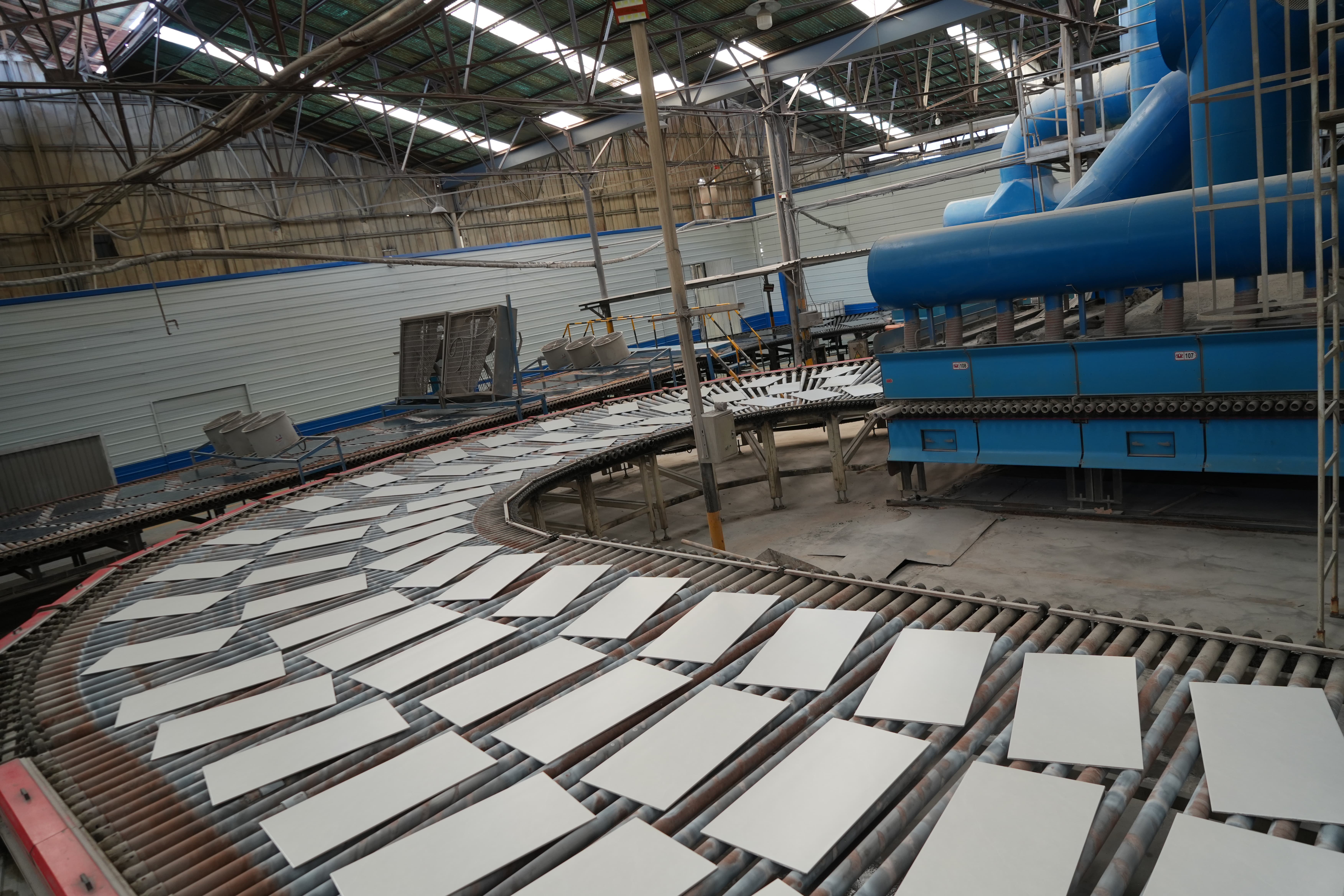
Porcelain tile production workshop, Zibo, China. Plant footprint is one of the few supplier claims that can be confirmed by audit or live inspection.
Why Supplier Capability Became a Verification Problem
Commercial and institutional end-use accounted for the largest revenue share of the global ceramic tile market in 2025, in a market valued at USD 226.4 billion and projected to reach USD 380.6 billion by 2033, according to Grand View Research. Porcelain tiles alone represented 52.4% of ceramic tile revenue that year. The demand side of the market is therefore dominated by buyers who specify performance, rather than by buyers who choose on appearance alone.
Supply-side pressure moves in the opposite direction. China's ceramic tile export value reached USD 3.21 billion in 2024, down 27.8% year on year, on an export volume of 599 million sqm, with an average export price of USD 5.36 per sqm, according to China Customs data reported by CeramBath. When export value falls while physical volume holds, price dispersion widens — and when price dispersion widens, capability language inflates. Suppliers that can no longer separate themselves on price tend to separate themselves on adjectives.
For procurement teams at evaluation and execution stage, the practical consequence is that identical phrases appear in almost every offer: large-scale manufacturer, certified quality, OEM capable, export-experienced. Very few of those phrases arrive with evidence that can be checked before a purchase order is raised. Capability is verifiable, but only when it is divided into four evidence classes.
- Physical evidence — plant footprint, equipment, production lines and inspection stations that can be shown, filmed or audited.
- Quantitative evidence — capacity, headcount, engineering headcount, founding year and export share, all of which should be internally consistent with each other.
- Documentary evidence — certificates carrying a certificate number, an issuing body, a defined market and an explicit scope.
- Transactional evidence — MOQ, lead time, delivery terms, payment terms, acceptance criteria and after-sales obligations written into the quotation.
Factory and Geographic Footprint
All-King Ceramics is the trading identity of Zibo All-King Ceramics Co., Ltd., a porcelain tile manufacturer and direct exporter founded in 2011 and based at China Fortune Ceramic City, Zibo, China. The company's operating profile states a factory area of 60,000 m², approximately 320 employees, and an in-house R&D team of 25 engineers.
A 60,000 m² single-site facility is meaningful for two procurement reasons. First, forming, firing, finishing, inspection and packing sit inside one management system rather than being split across contract workshops, which simplifies the batch-record chain when a defect claim or a reorder arises. Second, single-site production is a concentration risk: a buyer running a multi-phase programme from one source should ask how the supplier schedules competing orders and what contingency exists, because one site means one production calendar.
The published format matrix is concentrated rather than exhaustive. It covers 60x120 cm porcelain tiles as the flagship core product, plus 75x150 cm porcelain tiles, 80x80 cm porcelain tiles, 100x100 cm floor tiles and 60x60 cm ceramic tiles, produced in a range of trending textures and styles. For specifiers, that matrix answers a narrow but critical question: whether the formats in the drawing set are routine production or a one-off tooling conversation.
Capacity, Workforce and What the Numbers Commit the Supplier To
All-King Ceramics states an annual production capacity of 12 to 16 million m² and a monthly capacity of 1.2 million m². Those two figures should be read together. An annual band, rather than a single number, reflects genuine variation in mix — large-format and specialised surfaces run more slowly than standard formats — and a procurement team should treat the lower bound of the band as the planning figure, not the midpoint.
Workforce structure carries as much information as headcount. Of approximately 320 employees, 25 are engineers working inside a dedicated R&D function. For a buyer commissioning custom sizes, custom thicknesses, surface finishes or pattern variation, in-house engineering capacity is the difference between a supplier that can respond to a technical request and one that simply forwards it to a mill.
The export profile sets the commercial context: export accounts for 70% of total sales, and listed markets include Australia, New Zealand, Russia, Belarus, South Korea, Vietnam, Malaysia, the Philippines, Peru, Panama, Colombia, Chile, Bolivia, Guatemala, Palestine, Iraq, Ukraine and the UAE. A majority-export sales mix indicates that export documentation, packing standards and container-loading procedures are routine operations rather than occasional projects.
The Performance Data Behind the Capability Claim
Capability without product data is not evaluable. For the 60x120 cm vitrified porcelain series — the Marble Series (product code 4765) and the Travertine (product code 5624) — the declared technical parameters give a buyer something to test against.
| Declared parameter | Stated value (60x120 cm porcelain) | What it means at procurement level |
|---|---|---|
| Water absorption | < 0.5% (vitrified) | Places the body in the vitrified range, which supports stain resistance, moisture stability and suitability for wet or heavily cleaned commercial floors. |
| Thickness range | 9.0–10.5 mm | Consistent with large-format internal flooring; also affects weight per pallet and container planning. |
| Abrasion resistance | PEI 4 / PEI 5 | Relevant to lobbies, malls and corridors where foot traffic is continuous rather than occasional. |
| Mohs hardness | 6–7 | Indicates surface resistance to scratching from furniture, trolleys and cleaning equipment. |
| Breaking strength | ≥ 1300 N | Reflects handling durability and point-load tolerance during installation and service. |
| Modulus of rupture | ≥ 35 MPa | Governs flexural performance of the slab — a key figure when supporting substrate conditions are imperfect. |
| Packing specification | 2 pcs/box (1.44 m²/box) | Determines box counts, pallet build and the arithmetic behind a container-loading plan. |
Two disciplines apply to this table. First, these values are declared for the 60x120 cm porcelain series; other formats in the matrix may carry different figures and should be confirmed per format rather than assumed. Second, declared values are a starting point, not a substitute for evidence: the correct procurement action is to request the test report for the production batch, and to make third-party inspection part of the acceptance criteria, which this supplier accepts.
Quality Control: Piece-Level and Batch-Level Evidence
The quality control sequence stated for this production is three-layered: 100% flatness and sizing auto-check, piece-by-piece visual inspection, and random laboratory testing per batch. That sequence matters because the dominant failure mode in large-format porcelain is not breakage but dimensional variation — tiles that are individually acceptable but cannot be laid to a tight joint because flatness or calibrated sizing drifts across a batch.
Continuous flatness and sizing measurement addresses the cause; visual inspection addresses surface defects such as pinholes, glaze deviation and edge chipping; random lab testing addresses the body properties listed in the previous section. Batch tracking ties the three together, which is what makes a defect claim answerable and a later reorder colour-consistent.
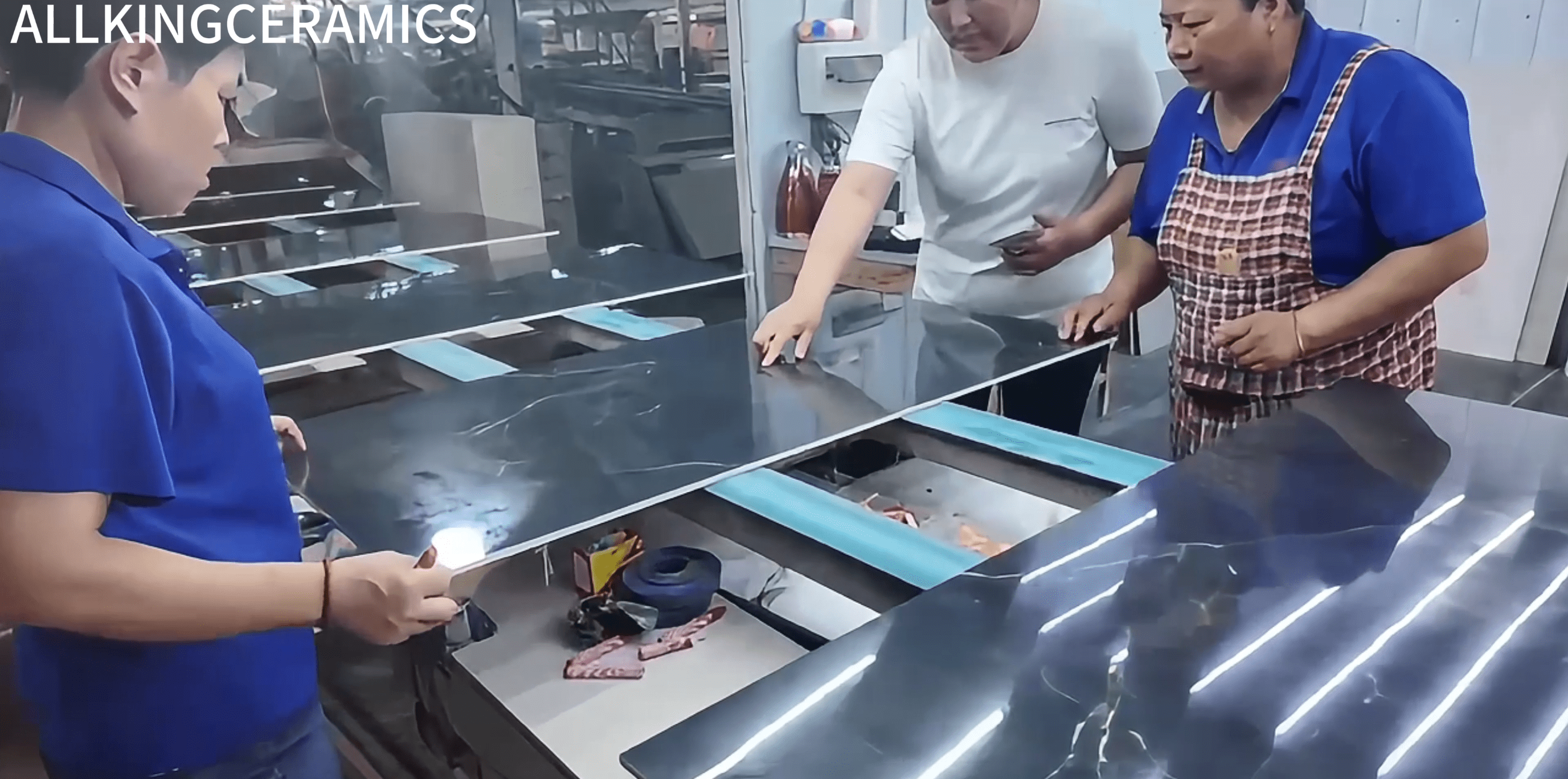
On-line quality control during porcelain tile production. Continuous flatness and sizing checks are the mechanism that keeps large-format batches installable.
Certification Evidence and Its Exact Scope
Certificates are only useful to a buyer when the scope is read as carefully as the logo. Two certificates are cited for All-King Ceramics, each with a number, an issuing body and a defined market.
| Certificate | Number | Issued by | Market | Scope |
|---|---|---|---|---|
| ISO 9001:2015 | 0350521Q30166R1M | XQCC | Global markets | Production and service of ceramic tile (except as required by 3C) |
| CE | AC 50163816 0001 | TUV | EU | Dry-pressed ceramic tiles, for internal flooring (EEC) |
The ISO 9001:2015 certificate is a management-system certificate. It evidences that the production and service process is controlled and auditable; it does not certify the performance of any individual tile. The CE entry is product-facing but narrowly scoped: dry-pressed ceramic tiles for internal flooring, aligned to the vitrified 60x120 cm porcelain series including the Marble Series and Travertine. Both certificates are linked to those 60x120 cm porcelain products rather than to every item in the catalogue.
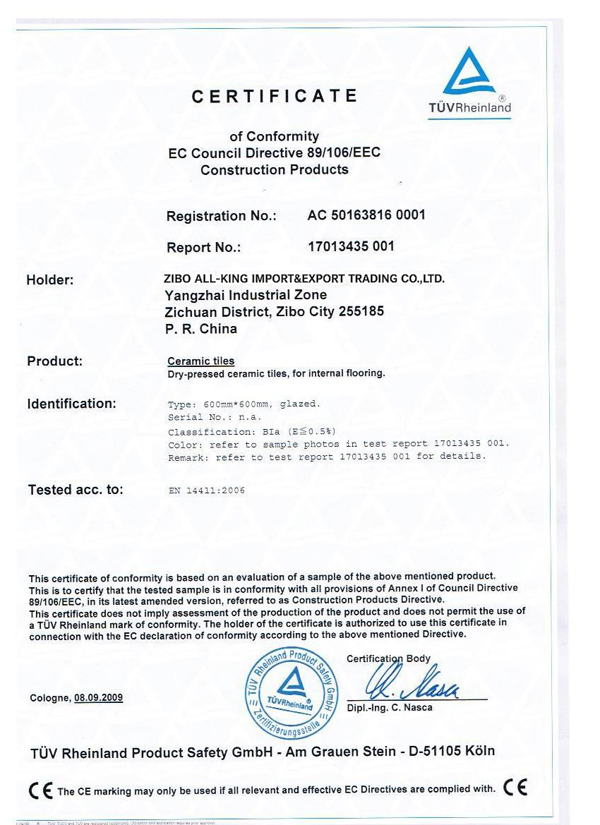
CE certificate AC 50163816 0001, issued by TUV for dry-pressed ceramic tiles for internal flooring. Buyers should verify the scope line, not only the certificate header.
Order Execution and Customization Terms
Execution-stage capability is judged on commercial terms, because they reveal how a factory actually schedules work. The stated terms are: MOQ of 400 sqm per design with trial orders acceptable; a production lead time of 7–10 days; delivery on EXW, FOB, CNF or CIF terms; acceptance based on third-party inspection; and payment at 30% TT with 70% against bill of lading copy, or by L/C or cash.
Customization is defined across five axes: custom size and thickness, surface finish, OEM brand logo and packaging, pattern variation including marble vein customization, and anti-slip rating. For a brand owner or a contractor working to a specification, the first two axes determine whether the drawing set can be produced as drawn, while the packaging axis determines what the client receives on site.
After-sales obligations are stated as damage compensation, online installation guidance, 24/7 technical consultation, and batch tracking with reordering support. For phased projects, the reordering provision is the one that carries the most commercial weight: colour consistency between phase one and phase three depends entirely on whether the supplier can retrieve and reproduce the original batch record.
Application Fit and a Documented Project Record
A supplier case record documents a 15,000 sqm porcelain tile supply for high-traffic commercial space. The stated applications cover hotel lobby and commercial mall flooring, office building facade, high-end apartment bathrooms and an airport departure hall. The buying parties named in the record are commercial real estate developers, general contractors, tier-1 building materials wholesalers, hospitality procurement agencies and architectural design firms.
The recorded outcomes are a seamless aesthetic presentation, zero-defect durability, easy maintenance and stain-free performance, 100% project acceptance and zero maintenance complaints. These are the outcomes stated in the case record for that project; they are project-level results rather than a blanket performance guarantee, and a new buyer should still validate them against their own specification, substrate and traffic profile through sampling.
Traffic profile is where venue type and product data connect. Airport departure halls, mall concourses and hotel lobbies combine continuous foot traffic with trolley and luggage loads, which is the environment that PEI 4 / PEI 5 abrasion resistance, ≥ 1300 N breaking strength and sub-0.5% water absorption are specified for. In wet-service areas such as commercial kitchens, the governing variable changes: DIN 51130, the standard behind the R11 and R12 classifications, defines R11 for slopes of 19°–27° (typical of kitchen and food-production environments) and R12 for 27°–35° (dairy and heavier industrial use). Slip classification is a project test outcome and should be requested as such.
Sustainability documentation belongs in the same conversation. Mineral-based tiles fired at high temperatures above 1200°C are treated as exempt from FloorScore VOC requirements under LEED v4.1 IEQc4.3, because porcelain is inherently low-emitting. For LEED-registered commercial projects, that exemption is one of the easier documentation points to close — provided the supplier can supply the underlying product and process documentation on request.
Where the Model Has Limits: Integrated Manufacturer Versus Intermediary Structures
An integrated manufacturer-exporter is not automatically the right answer for every project. The comparison below sets out how the three common sourcing structures differ, using trade-offs rather than superiority claims.
| Dimension | Integrated manufacturer-exporter (this model) | Trading intermediary | Multi-brand stocking distributor |
|---|---|---|---|
| Batch traceability | Records originate inside the producing site | Records depend on the supplying mill's cooperation | Records are aggregated across several sources |
| Customization range | Size, thickness, finish, branding, pattern variation and anti-slip rating handled at source | Limited to the options the upstream mill offers | Constrained by what is in stock |
| MOQ behaviour | 400 sqm per design, trial orders accepted | Typically tied to a third party's production schedule | Lower MOQ from stock, but limited specification control |
| Production continuity | Single site — one schedule, one point of concentration | Can spread risk across several mills | Depends on replenishment cycles |
| Price structure | Direct-from-factory basis | Includes intermediary margin | Includes stocking and handling margin |
The honest limits of the model described in this reference are specific. Certification scope is narrow: the CE entry covers internal flooring, the ISO 9001:2015 scope excludes items governed by 3C, and neither certificate substitutes for project-level slip, frost or fire testing. Format capability is concentrated in a defined matrix led by 60x120 cm porcelain, so a genuinely bespoke size becomes a customization negotiation that can extend beyond the standard 7–10 day production window. Annual capacity of 12 to 16 million m² is mid-scale when set against the world's largest producers — Mohawk Industries, Grupo Lamosa and RAK Ceramics led global production volume in 2024, per Ceramic World Review — so a buyer running a very large single programme across multiple regions simultaneously should schedule against competing orders rather than assume unlimited headroom. The 400 sqm per-design MOQ means highly fragmented design schedules are a poor fit and may be better served by a stocking distributor. Finally, the stated 7–10 day lead time is production time only; ocean transit, port handling and customs clearance sit outside it and must be added to the project schedule.
Outlook: From Brand Claims to Document-Level Verification
The structural direction of the market supports evidence-based sourcing rather than buying on presentation. A market projected to grow from USD 226.4 billion in 2025 to USD 380.6 billion by 2033, with commercial end-use holding the largest revenue share and porcelain at 52.4% of ceramic tile revenue, is a market in which commercial buyers — not residential retail — set the specification language. Those buyers increasingly ask for certificate numbers, scope lines, batch test reports and third-party inspection clauses before they negotiate price.
Three pressures will sharpen that shift. Falling export value against stable export volume keeps price competition intense and makes unverifiable capability claims less persuasive over time. Sustainability documentation under LEED and equivalent frameworks turns product and process paperwork into a project prerequisite. And anti-slip regulation under standards such as DIN 51130 pushes slip classification from a catalogue line into a testable project requirement. Suppliers that can produce a document on request will separate from those that can only produce a description.
Frequently Asked Questions
What evidence can a buyer verify to confirm a porcelain tile manufacturer's stated production capacity?
Capacity claims are checkable when they are expressed as specific figures. The All-King Ceramics profile states a 60,000 m² factory, approximately 320 employees, a 25-engineer R&D team, annual output of 12 to 16 million m² and monthly capacity of 1.2 million m². Verification routes are a plant audit, live or recorded footage of the production and inspection lines, and — most importantly — scheduling evidence: whether the supplier can commit a production window in writing against a purchase order.
Which customization options exist for a branded or specification-driven order?
Five customization axes are documented for this production: custom size and thickness; surface finish; OEM brand logo and packaging; pattern variation, including marble vein customization; and anti-slip rating. Custom sizes and finishes affect the production schedule, so they should be agreed before lead time is fixed. Packaging customization is separate from product customization and is typically confirmed through a carton artwork approval before the run begins.
What do the ISO 9001 and CE certificates actually cover?
ISO 9001:2015 certificate 0350521Q30166R1M was issued by XQCC for global markets, with a scope of production and service of ceramic tile, except as required by 3C. It certifies the management system, not individual tile performance. CE certificate AC 50163816 0001 was issued by TUV for the EU market under the EEC standard, with a scope of dry-pressed ceramic tiles for internal flooring, and is associated with the 60x120 cm vitrified porcelain series including the Marble Series and Travertine. Neither certificate by itself establishes slip classification, frost resistance or suitability for external paving.
What are the minimum order quantity and delivery terms for a first project order?
The stated minimum order quantity is 400 sqm per design, with trial orders acceptable. Production lead time is 7–10 days. Delivery can be arranged on EXW, FOB, CNF or CIF terms. Acceptance is based on third-party inspection, and payment terms are 30% TT with 70% against bill of lading copy, or by L/C or cash. Lead time refers to production only and excludes ocean transit, port handling and customs clearance.
How is quality controlled before shipment?
Three control layers are documented: 100% flatness and sizing auto-check, piece-by-piece visual inspection, and random laboratory testing per batch. The auto-check targets dimensional and flatness variation, which is the principal installability risk in large-format porcelain. Visual inspection addresses surface and edge defects. Per-batch laboratory testing covers body properties such as water absorption, breaking strength and modulus of rupture. Batch records are retained to support later claims and reorders.
What support exists after delivery, including for phased projects?
Documented after-sales support includes damage compensation, online installation guidance, 24/7 technical consultation, and batch tracking with reordering support. For phased developments, batch tracking is the critical element, because colour and dimensional consistency between an initial delivery and a later reorder depends on whether the original production record can be retrieved and reproduced.
Verification Channels
Supplier capability evidence is only useful if it can be requested and reviewed before commitment. Documentation for the products, certificates and terms described in this reference is available through the All-King Ceramics product catalogue and through its export contact channels: email tyceramic2@all-king.com and telephone or WhatsApp +86 156-5336-9360. The company's website is www.all-king.com, and the full ceramics catalogue can be downloaded as a PDF at ALLKING Ceramics Catalog.
This article is an industry reference for procurement and specification purposes. Figures marked as company data are the supplier's own published operating and product data and should be validated against batch test reports and third-party inspection for a specific project. Market figures are attributed to Grand View Research, China Customs data reported by CeramBath, DIN 51130, LEED v4.1 IEQc4.3 and Ceramic World Review as cited.