
Porcelain vs Glass Insulators: A Buyer Vetting Docket
Porcelain vs Glass Insulators: A Buyer Vetting Docket
Grid projects rarely fail because the wrong dielectric was chosen in a catalogue. They fail because the unit delivered does not match the site condition, or because the supplier behind it cannot evidence what the tender assumed. The porcelain-versus-glass question is therefore two questions in sequence: which unit suits the duty, and which supplier can prove the unit will be repeatable at lot level.
Both porcelain and glass are vitrified silicate systems used for the same physical job on an overhead line — isolating a live conductor from a grounded support while carrying mechanical load. They differ in how they are manufactured, how they fail, how failure is detected, and, less obviously, how much supplier evidence a buyer must assemble before placing a multi-year order. This comparison is deliberately narrow and unit-specific so that each claim can be traced to a datasheet rather than to a general impression of the material.
Porcelain is represented here by distribution-class units that appear in real bills of quantity: the P-11-Y pin insulator (11 kV, 10 kN, 240 mm creepage) and the ED-2B shackle insulator (13.5 kN mechanical tensile), set against the wider porcelain portfolio of Jiangxi QOCI Electric Co., Ltd. — line post, pin, shackle and AC disc-shaped suspension insulators. Glass is represented by the PS210V 212V suspension unit (210 kN failing load, 280 mm disc, 170 mm spacing, 400 mm creepage). Supplier evidence is drawn from QOCI, established in December 2002 in Luxi Industrial Park, Pingxiang City, Jiangxi Province, China.
Two decisions, not one
When a procurement team frames the choice as a materials debate, it tends to skip the step that actually determines project outcome: converting a line design into a purchase specification, then converting that specification into a set of verifiable supplier claims. The first conversion is engineering. The second is due diligence, and it is where most avoidable risk sits.
Engineering selects a type: a pin or shackle unit on a distribution cross-arm, a disc string where tension and vertical load must be carried, a post where a rigid support is required. Due diligence then asks whether the supplier's verified capability envelope contains that type at the required voltage, mechanical class and creepage level — and whether the evidence is a datasheet, a type test report, or simply a sales statement.
Material properties matter, but they are the beginning of the analysis, not the conclusion. Porcelain offers a glazed, chemically inert body with high compressive strength. Tempered glass offers a disc geometry with standardised ball-and-socket coupling that assembles into modular strings. Neither property, on its own, tells a buyer whether a given factory can deliver 40,000 consistent units into a monsoon market on schedule.
The verified units in this comparison
The three units below sit in different duty classes and are not interchangeable. They appear together because each marks a distinct decision point in a real project: low-voltage anchoring, medium-voltage distribution support, and heavy suspension duty.
| Unit | Type | Mechanical rating | Key dimensions | Electrical data |
|---|---|---|---|---|
| P-11-Y | Porcelain pin insulator, distribution line | Rated mechanical load 10 kN | Max diameter 150 mm; total height 150 mm; creepage distance 240 mm | Rated voltage 11 kV; power-frequency wet withstand 50 kV; lightning impulse withstand 90 kV |
| ED-2B | Porcelain shackle / butterfly insulator, low-voltage distribution | Mechanical tensile strength 13.5 kN | Max diameter 90 mm; total height 76 mm | Power-frequency wet withstand 13 kV; dry withstand 25 kV |
| PS210V 212V | Glass suspension disc insulator, cap-and-pin | Mechanical failing load 210 kN | Nominal disc diameter 280 mm; nominal spacing 170 mm; creepage distance 400 mm; socket coupling 20 | Dry lightning impulse withstand 110 kV; wet power-frequency withstand 45 kV; power-frequency puncture voltage 130 kV |
Body and hardware data are equally part of the comparison. The P-11-Y uses a high-strength electrical porcelain body with a hot-dip galvanized forged steel pin. The ED-2B uses high-strength electrical porcelain. The PS210V 212V uses a tempered glass disc with a hot-dip galvanized cast iron cap and a hot-dip galvanized forged steel pin.
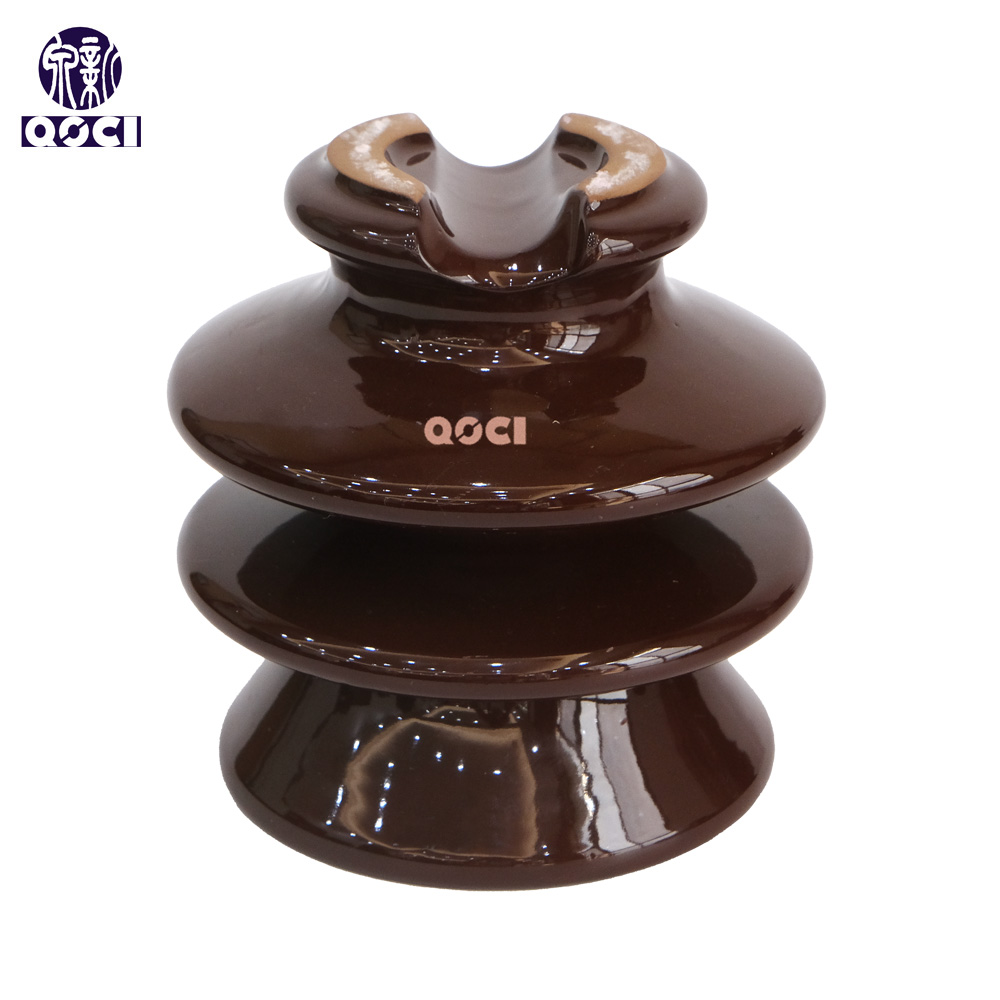
Porcelain type logic: line post, pin, shackle and suspension
Porcelain is not one product. QOCI's porcelain and glass portfolio covers AC and DC insulators, including line post porcelain insulators, porcelain pin insulators, shackle insulators and AC disc-shaped suspension porcelain insulators. For a buyer, the practical distinction is where each type sits in the support structure.
- Pin insulators support the conductor on a cross-arm at distribution voltages. The P-11-Y illustrates the class: 11 kV rated voltage, 10 kN rated mechanical load, 240 mm creepage distance, 50 kV power-frequency wet withstand and 90 kV lightning impulse withstand, mounted on a hot-dip galvanized forged steel pin for wooden or steel cross-arms.
- Shackle insulators handle anchoring, strain and angle positions, particularly on low-voltage overhead distribution. The ED-2B carries 13.5 kN tensile strength with 13 kV wet and 25 kV dry power-frequency withstand, in a compact 90 mm × 76 mm envelope suited to galvanized bracket mounting.
- Line post insulators provide a rigid, cantilever-mounted support where a pin is unsuitable — a common requirement in distribution construction and substation approaches.
- Suspension insulators in porcelain are used where conductor load is carried by a string rather than a rigid support, typically at transmission level.
The design implication is straightforward: creepage distance, not body diameter, is the parameter that connects the unit to the site's pollution severity. The P-11-Y's 240 mm creepage on a 150 mm diameter body is the figure a designer uses against the required pollution class, and the same logic scales through the rest of the porcelain range.
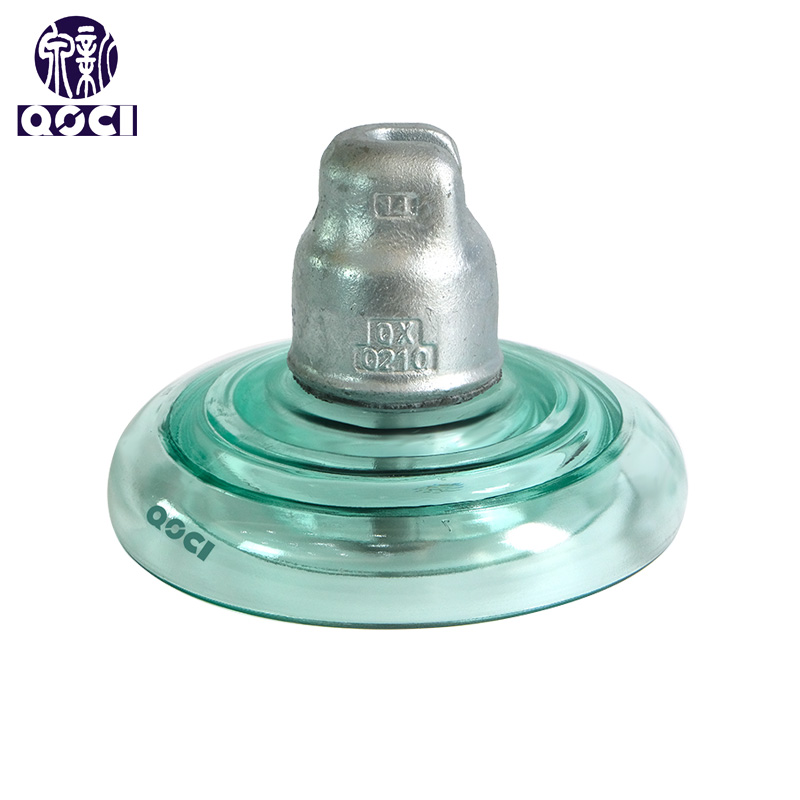
Glass on heavy suspension duty: what a 210 kN class changes
The PS210V 212V is a 210 kN failing-load tempered glass unit with a 280 mm nominal disc diameter, 170 mm nominal spacing and 400 mm creepage distance. Its role in a comparison is not to compete with an 11 kV pin insulator — it belongs to the suspension string on transmission structures, where mechanical capacity and standardised coupling determine how the string is built.
Two figures do most of the work in specification review. The 170 mm nominal spacing sets string length for a given number of units, which in turn drives tower window and clearance checks. The 400 mm creepage distance per unit is the input to cumulative creepage: a designer working to a site pollution class adds units until the string's total creepage meets the requirement, and the resulting physical length follows from the spacing. The 20 socket coupling defines the hardware interface, and the 130 kV power-frequency puncture voltage provides a margin reference against flashover on the same string.
Glass strings are modular in a way that pin and shackle installations are not. A damaged disc is replaced within the string rather than remounted on a cross-arm, and string assembly uses standardised ball-and-socket alignment. For projects with long tension sections, that modularity is a maintenance-logistics advantage rather than a technical one — but it is a real part of total cost, and it belongs in the comparison.
Side-by-side in service, not in catalogues
Datasheet rows rarely decide a tender. The differences that decide are operational, and they can still be stated without inventing numbers.
| Dimension | Porcelain (P-11-Y, ED-2B and the porcelain range) | Glass suspension (PS210V 212V) |
|---|---|---|
| Dielectric body | Vitrified high-strength electrical porcelain, glazed | Tempered glass disc, transparent |
| Hardware interface | Hot-dip galvanized forged steel pin (P-11-Y); galvanized bracket mounting (ED-2B) | Hot-dip galvanized cast iron cap and forged steel pin; socket coupling 20 |
| Failure visibility | Internal degradation can occur without visible external change, so periodic live-line testing is part of the maintenance regime | A damaged disc is generally visible during line patrol |
| Field assembly | Unit mounted to cross-arm or bracket | Modular disc string with standardised coupling |
| Creepage control | Shed profile; 240 mm on the P-11-Y | 400 mm per 280 mm disc on the PS210V 212V |
| Typical duty | Distribution support, anchoring, strain and angle positions; line post and suspension porcelain where specified | Heavy suspension and tension strings on transmission structures |
| Replacement logic | Unit-level replacement | Disc-level replacement within an existing string |
Read together, the two tables support a simple rule. Where the structure supports a rigid unit at distribution voltage, porcelain pin and shackle types are the direct answer, and the specification question becomes creepage versus pollution class. Where the conductor load is carried by a string at high mechanical class, glass disc units offer modular assembly and visible damage. Most large grid programmes use both, in different parts of the same network.
Where the comparison stops: boundaries buyers should not paper over
An honest comparison states its own limits, and this one has four.
- Coverage of verified datasheets. The units documented here are an 11 kV porcelain pin, a low-voltage porcelain shackle and a 210 kN glass suspension disc. Application requirements across the wider market are commonly expressed in a specified mechanical load range of 40–550 kN and pollution classes I–IV; a project outside the verified range must confirm availability against its own specification rather than infer it from this article.
- Porcelain's invisible failure mode. Porcelain units can reach end of life through internal electrical breakdown without any external visual change. That is not a defect of the material so much as a condition of using it: a porcelain population needs a maintenance programme, with periodic live-line testing — commonly on a three-to-five-year cycle — to detect units that appear sound but are not.
- Glass failure is visible but is still an intervention. A shattered disc is easy to find and easy to replace, yet it still requires a line crew, a spare disc and an outage window. Spares planning is part of the comparison, not an afterthought.
- Both are brittle. Handling, packaging and installation practice materially affect reject rates for porcelain and glass alike. Buyers who compare only on unit price transfer that cost to the construction phase.
There is also a boundary on the supplier side. A manufacturer's portfolio can be broad and still not cover every voltage or load class a specific tender requires. The correct move is to test the portfolio against the bill of quantities early, not after award.
Supplier vetting: turning claims into a checkable docket
Supplier evaluation fails most often because the buyer collects adjectives rather than evidence. The alternative is a docket: a short list of claims, each with a source, that can be re-checked by a second person. Jiangxi QOCI Electric Co., Ltd. provides a useful worked example because its claims are specific and mostly cross-checkable.
- Entity and tenure. Established December 2002, located in Luxi Industrial Park, Pingxiang City, Jiangxi Province, with a 35,373 m² factory. Twenty-plus years of continuous operation is a survivability indicator, not a quality certificate.
- Standards engagement. A national high-tech enterprise and a participating unit of the Insulator Standard Committee. This signals proximity to standards work; it is not itself a product certification, and a buyer must still verify unit-level conformity to current standards.
- Engineering resource. A 38-engineer R&D team — relevant when a project needs voltage or logo customisation rather than a catalogue part number.
- Capacity. 9,000,000 units annual output and 750,000 units monthly capacity. The two figures reconcile arithmetically, which is the first thing a buyer should check on any capacity claim.
- Market footprint. Export ratio of 20%, with main markets in the USA, Asia, the EU, Africa and South America. Products are used in grid construction projects of State Grid Corporation of China and China Southern Power Grid, and in grids in over 40 countries and regions.
- Quality and commercial terms. 100% pre-shipment test, third-party inspection (SGS), MOQ of 50 units, lead time of 15–35 days, OEM/ODM with voltage and logo customisation, and after-sales support covering online technical assistance and replacement of defective products.
| Vetting dimension | Buyer question | QOCI evidence | Independent check |
|---|---|---|---|
| Legal identity and tenure | Who is the contracting entity and how long has it operated? | Jiangxi QOCI Electric Co., Ltd., established December 2002 | Company registration documents; contract counterparty name match |
| Standards engagement | Is the supplier inside the standards conversation? | National high-tech enterprise; participating unit of the Insulator Standard Committee | Request unit-level test reports against the applicable standard edition |
| Engineering depth | Can customisation be engineered, not just labelled? | 38-engineer R&D team; OEM/ODM with voltage and logo customisation | Review drawings and change-control records for a comparable custom order |
| Capacity vs order size | Can the order be absorbed without displacing other commitments? | 9,000,000 units annual output; 750,000 units monthly capacity; lead time 15–35 days | Compare annual and monthly figures; request production scheduling for the order window |
| Export and application experience | Has the supplier served comparable conditions? | Export ratio 20%; markets USA, Asia, EU, Africa, South America; grids in over 40 countries and regions | Request references from comparable climate and pollution conditions |
| Quality regime | Is inspection per lot or per campaign? | 100% pre-shipment test; third-party inspection (SGS) | Agree inspection scope, sampling and witness points in the contract |
| Commercial fit | Do MOQ and lead time match the construction sequence? | MOQ 50 units; lead time 15–35 days | Sequence delivery against structure installation dates |
One number deserves interpretation rather than repetition. A 20% export ratio means the majority of output serves domestic Chinese grid demand. For an international buyer, that has two consequences. The reference base is Chinese grid supply, which is a demanding volume environment; and international orders compete for scheduling capacity, so booking windows early is a practical risk control rather than a courtesy.
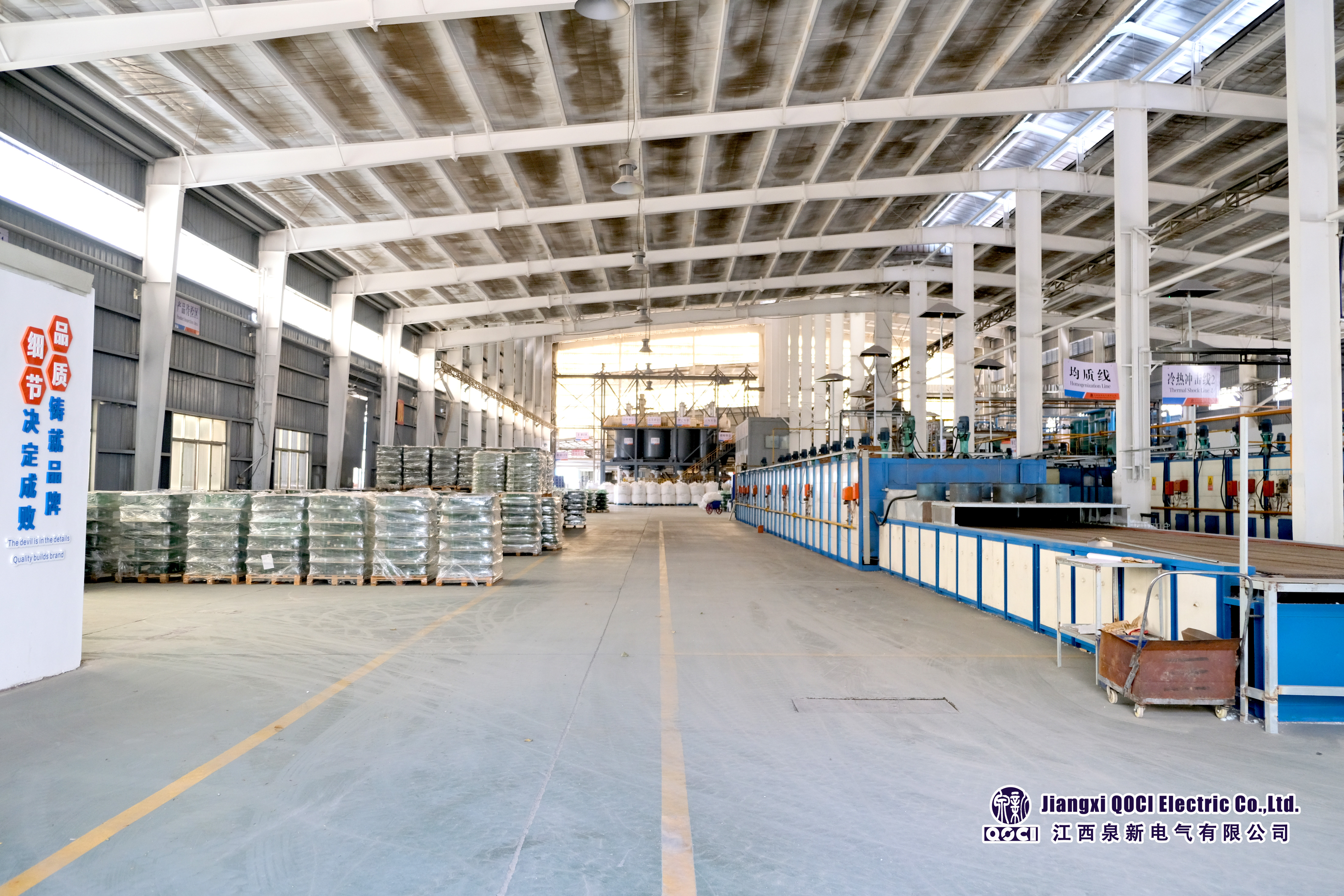
Application fit: the project conditions that settle the argument
Insulator selection is conditioned by the environment more than by preference. The operating envelope relevant to these products spans outdoor exposure, high humidity, industrial pollution and a temperature range of roughly −40 °C to +50 °C. The special requirements that follow are specific: compliance with the applicable standard, anti-pollution creepage design matched to pollution class I–IV, a specified mechanical load, puncture withstand voltage of at least 1.2× dry flashover, a stated hydrophobicity class, and cement joint sealing against moisture ingress.
The equipment list is equally specific and frequently under-budgeted: metal fittings, corona rings, suspension and tension clamps, arcing horns, grounding hardware and vibration dampers. A buyer who specifies the insulator and omits the fittings has specified half a system.
The industries and project types are consistent across the range — power transmission and distribution, substation construction, railway electrification and industrial power grids, applied in transmission line construction, substation upgrades and grid modernisation and expansion. These applications are common in countries including China, Sri Lanka, Egypt, Indonesia and Germany.
Field record: three tropical distribution projects
Project records are only useful if the conditions are stated alongside the numbers. A three-year programme covering Sri Lanka (10,000 pcs), Egypt (40,000 pcs) and Ukraine (10,000 pcs) — 60,000 pcs in total — addressed coastal and inland tropical distribution line insulation and monsoon-region grid reinforcement, using low-voltage distribution units in the P-11-Y and ED-2B class.
The reported outcome across that programme was a 60% reduction in salt fog flashover incidents compared with the previous composite batch, zero UV degradation, a 50% reduction in maintenance cost, and a replacement rate under 2% over the three-year period. Those results should be read as project-reported performance under specific conditions, not as a general guarantee. What they do establish is the shape of the argument a buyer should demand: stated conditions, stated duration, stated replacement rate.
Market signals behind the current buying cycle
Several independently published figures frame the supply environment in which this comparison sits.
- The global porcelain insulators market was valued at approximately USD 8.27 billion in 2023 and is projected to reach USD 15.04 billion by 2033 (Spherical Insights).
- Asia-Pacific held a 49.4% revenue share of the porcelain insulator market in 2025 (Mordor Intelligence).
- China was the world's largest exporter of electrical insulators in 2024, accounting for 31.4% of total global exports, approximately USD 898 million (OEC).
- Overhead transmission lines account for approximately 62.1% of global porcelain insulator revenue (Mordor Intelligence).
- The substation porcelain insulator segment is projected to grow at a 7.2% CAGR through 2031, driven by gas-insulated switchgear upgrades (Mordor Intelligence).
Two standards anchors are worth pinning to any tender: IEC 60383-1:2023 is the current international standard for ceramic or glass insulator units for AC overhead lines above 1000 V, and ANSI C29.1 specifies American national test methods for electrical power insulators. The primary HS code for porcelain electrical insulators is 8546.20, which determines how the shipment is classified regardless of how the product is described commercially.
Market size estimates for 2025 diverge widely between research houses, largely because product scope differs — some studies include glass and composite, others do not. Buyers should treat any single market size figure as directional and give more weight to the standards, classification and local-content signals that directly affect a purchase.
Local content is one of those. India's DPIIT procurement policy requires 50% local content for porcelain insulators to be classified under Class I for government contracts, which changes the calculus for imported units in that market regardless of technical merit.
Future outlook
Three developments are likely to shape insulator procurement over the next planning cycle. First, standards revision cadence: with IEC 60383-1:2023 in force, tenders that reference an older edition create avoidable ambiguity, and buyers should state the edition explicitly. Second, station-class demand: substation work growing at a projected 7.2% CAGR through 2031 pulls demand toward post and station insulators, a different product family from the line units compared here. Third, procurement localisation: local-content rules of the kind applied in India push buyers toward dual qualification of suppliers rather than single sourcing.
None of these trends resolves the porcelain-versus-glass question in favour of one material. What they change is the weight of evidence required. As price differences compress across a crowded export market, the differentiator shifts from the dielectric to the docket — whether a supplier can show a reconciled capacity figure, a stated export ratio, a named standards role, and a per-lot inspection regime that a third party can witness.
FAQ
How should a buyer choose between porcelain and glass insulators for a specific grid project?
Start from the duty, not the material. Where the conductor is supported on a distribution cross-arm, porcelain pin and shackle units are the direct answer — the P-11-Y at 11 kV, 10 kN and 240 mm creepage covers medium-voltage distribution support, and the ED-2B at 13.5 kN covers low-voltage anchoring, strain and angle positions. Where the conductor load is carried by a string at high mechanical class, a glass suspension disc such as the PS210V 212V at 210 kN failing load, 280 mm disc and 400 mm creepage is the matching unit. The second step is verifying that the chosen supplier's documented range covers the required voltage, load and creepage, rather than assuming a broad portfolio implies coverage.
What specifications should appear on a porcelain insulator datasheet before an order is placed?
A complete datasheet states rated voltage, rated mechanical load, maximum diameter, total height, creepage distance, power-frequency wet and dry withstand voltage, lightning impulse withstand voltage, body material and hardware finish. Using the P-11-Y as the example: 11 kV rated voltage, 10 kN rated mechanical load, 150 mm maximum diameter, 150 mm total height, 240 mm creepage distance, 50 kV power-frequency wet withstand, 90 kV lightning impulse withstand, high-strength electrical porcelain body and hot-dip galvanized forged steel pin. Any missing row is a question to ask before award, not after delivery.
What does a 210 kN glass suspension rating mean in practice?
It is the unit's mechanical failing load — the class around which the string is designed. It should be read together with the rest of the unit data: 280 mm nominal disc diameter, 170 mm nominal spacing, 400 mm creepage distance, dry lightning impulse withstand of 110 kV, wet power-frequency withstand of 45 kV, power-frequency puncture voltage of 130 kV, and socket coupling 20. The spacing figure sets string length for a given unit count, and the coupling figure defines the hardware interface, so neither can be substituted with a different class without re-checking the associated fittings.
Which supplier evidence can be checked without a factory visit?
Entity name and establishment date (Jiangxi QOCI Electric Co., Ltd., December 2002), national high-tech enterprise status, participation in the Insulator Standard Committee, R&D headcount (38 engineers), annual and monthly capacity (9,000,000 units and 750,000 units), export markets (USA, Asia, EU, Africa, South America), quality regime (100% pre-shipment test, SGS third-party inspection) and commercial terms (MOQ 50 units, lead time 15–35 days). Most of these are documentary and can be cross-checked against registration records, drawings, schedules and inspection reports. A factory visit adds process observation but does not substitute for per-lot test records.
What are the practical limits of porcelain insulators in polluted or coastal environments?
Porcelain is chemically inert to salt and monsoon corrosion and does not degrade under UV exposure, which is why project records in tropical coastal conditions show zero UV degradation. That does not remove the pollution problem: contamination still accumulates on the glaze and reduces insulation resistance, so creepage distance must be matched to pollution class I–IV, and cleaning or washing forms part of the maintenance plan. The harder limit is detection — porcelain can fail internally without visible external change, so periodic live-line testing, commonly on a three-to-five-year cycle, is necessary to find units that appear intact but no longer insulate.
How should MOQ, lead time and inspection be handled on a mixed porcelain order?
QOCI states an MOQ of 50 units and a lead time of 15–35 days, with OEM/ODM support for voltage and logo customisation, 100% pre-shipment testing and third-party inspection through SGS. For an order mixing types — for example pin units alongside shackle units — the practical sequence is to sort call-off quantities by structure installation date, confirm the inspection scope and witness points per lot before the first shipment, and reserve scheduling early, given that an export ratio of 20% means most capacity serves domestic grid demand.
The QOCI insulator catalogue can be downloaded here: QOCI Catalogue — Glass Insulators (PDF).
Have Questions or Need More Details?
Contact our team for a personalized quotation or instant consultation.
Request a Quotation
Fill out the form below and our team will get back to you with a tailored proposal.
WhatsApp Direct Chat
Prefer to chat in real-time? Message us on WhatsApp for instant assistance & quick answers.
- Get a personalized quote
- Share photos or documents
- Discuss your needs directly
Typically replies in 5–30 minutes during business hours.