
Portable Garment Steamer OEM: What Certificates Don't Cover
Portable garment steamers have moved from a travel accessory category into a mainstream small appliance, and that shift has changed what buyers need from an OEM partner. The central sourcing question is no longer whether a supplier can make a handheld steamer. It is whether the supplier can show, model by model and market by market, exactly which certifications apply, which specifications are documented, and which claims remain outside the paperwork. That distinction separates a credible OEM brief from a catalogue conversation.
Huaguang Electric Appliance Group Co., Ltd. — trading as HUAGUANG Steam Appliances — is a Cixi, Zhejiang-based manufacturer founded in 1985 that produces garment steamers, steam irons, lint removers, steam cleaners, steam mops and coffee machines for OEM/ODM customers. The company reports a 38,600 m² factory, 450 employees, an R&D team of more than 100, annual output of 5,000,000+ units, and exports to the EU, USA, Japan, Korea, the Middle East and Africa across 80% of its output. Those are company-reported figures. They are useful for initial screening, but they are not a substitute for model-level compliance review.
Why certification scope matters more than certification count
Buyers evaluating a portable garment steamer OEM often ask how many certificates a supplier holds. A more useful question is which certificate covers which model, at which voltage, for which destination market. Certification is granted at the level of a declared product, rating and standard edition — not at the level of a brand or a product family.
The difference becomes concrete when the covered model lists are placed side by side. The GS certificate GS/23/HEL/01592, issued by SGS Fimko Ltd. under the EU framework, covers fabric steamer types E15, E15E and E16 at 220–240 V, 50/60 Hz, 1800 W, Class 1. The IECEE CB Test Certificate BE-43672/M1, issued by SGS Belgium NV – Division SGS-CEBEC on 2023-09-25, covers the T35, E22, T60 PRO MAX and E19 garment steamers at a certified rating of 800 W, 220–240 V a.c., 50/60 Hz. The CE Verification of Compliance LVD N8ES2009004802HS01 from SGS covers E15, E15E and E16 at 220–240 V~, 50/60 Hz, 1800 W. The RoHS test report (6626)019-0319 from Bureau Veritas applies to the E22 under Directive 2011/65/EU as amended by (EU) 2015/863. The PAHs Risk Assessment Report NBES220900480202-M1/PAH from SGS-CSTC covers E15, E15E and E16 against AfPS GS 2019:01 PAK.
These are different documents with different scopes. A buyer who assumes that one certificate family covers every handheld model in a supplier's catalogue will eventually discover the gap during customs review, retailer onboarding or marketplace compliance screening. The same logic applies to voltage versions: the GS certificate lists 220–240 V and 50/60 Hz, and does not list dual-voltage 100–240 V configurations or custom plug safety verification. Custom voltage and plug work may well be technically possible, but it must be confirmed against the specific model and document set rather than inferred from the certificate.
The EU compliance picture for portable garment steamers
For EU-bound portable garment steamers, the relevant documentation typically clusters around four areas: low-voltage electrical safety, electromagnetic compatibility, restricted substances, and market-specific certification marks. The international standard family IEC 60335-2-85 is the recognised starting point for electric fabric steamers intended for household and similar purposes; the IEC publication for the 2022 edition identifies a rated-voltage scope of not more than 250 V, and a consolidated 2022 edition with a 2025 amendment has been published. That standard identification is a starting point for test planning — it does not, by itself, establish legal conformity in any specific market.
At the certificate level, the available evidence for HUAGUANG's garment steamer range includes:
- GS certificate GS/23/HEL/01592 — SGS Fimko Ltd., issued 2023-09-25, valid to 2027-12-22, covering E15, E15E and E16 under EN 60335-1:2012 + A11:2014 + A13:2017 + A1:2019 + A14:2019 + A2:2020 and EN 60335-2-45:2002 + A1:2008 + A11:2012 + A2:2020, with additional references to AFPS GS 2019:01 PAK, EK1 527-12 Rev. 2 and EK1 649-19.
- CB Test Certificate BE-43672/M1 — SGS Belgium NV, issued 2023-09-25, covering T35, E22, T60 PRO MAX and E19 under the IECEE CB Scheme, applicable in over 60 countries.
- CE Verification of Compliance LVD N8ES2009004802HS01 — SGS, issued 2023-09-25 for the EU market, covering E15, E15E and E16 under the HG trade mark.
- EMC Test Verification of Conformity 260100396HAN-V1 — issued by Intertek Testing Services Zhejiang Ltd. on 2026-03-09 for the EU market, with the product description recorded as Steam Brush (Fabric Steamer).
- EU Declaration of Conformity — issued 2026-07-17, listing Steam Brush / Fabric Steamer models E15, E15E, E16, E1Q, EQ10K80 and EZ2, citing EN 60335-2-85, EN 60335-1, EN IEC 55014-1, EN IEC 55014-2, EN IEC 61000-3-2 and EN 61000-3-3.
- UK EMC verification SHEM2305003191011SC — SGS-CSTC, issued 2023-06-09, covering E15, E15E, E15-1, E15E-1, E16, E16E and E16-1 under EN IEC 55014-1:2021, EN IEC 55014-2:2021, EN IEC 61000-3-2:2019+A1:2021 and EN 61000-3-3:2013+A1:2019+A2:2021.
- PAHs Risk Assessment Report NBES220900480202-M1/PAH — SGS-CSTC Ningbo Branch, issued 2023-09-25, covering E15, E15E and E16 against AfPS GS 2019:01 PAK.
What the documents confirm — and what they leave open
The most important part of a compliance review is understanding the boundary of each document. The GS certificate scope confirms electrical safety under the referenced EN 60335-1 and EN 60335-2-45 editions. It does not list variable steam output testing, continuous steam-output testing, steam performance reports, steam-output consistency testing, heat-up test reports, heating-time validation, heat-up temperature verification results, overheat safety feature testing, thermal protection verification, or overheating protection testing. It also does not include self-cleaning QC reports, private-label self-cleaning testing, self-cleaning reliability testing, descaling function tests, ceramic soleplate durability reports, household safety inspection reports, batch traceability documents, incoming and final inspection records, or documented quality-control procedures. Packaging-related items such as e-commerce packaging quality tests and drop-tested packaging are also outside the listed scope.
The EU Declaration of Conformity has a similar boundary. It cites the applicable safety and EMC standards and identifies the covered models, but the provided document does not include leakage current test values, separate CE test reports, in-house testing records, custom voltage test reports, batch traceability records, drop-test reports, e-commerce packaging quality reports, thermal protection verification reports, commercial quality inspection reports for hotel garment steamers, regional plug configuration records, or quality-control procedure records. Those are separate documents that a buyer should request directly if the retail channel, marketplace or importer requires them.
For US and Canadian buyers, the evidence picture is more limited. The available ETL Authorization to Mark is certificate number 4000776, issued by Intertek, with the standard UL 499-2014 Ed.14 (R:22Feb2017) and CSA C22.2#64:2010 Ed.7+U1+U2. Its recorded product scope is a Steam Mop, not a garment steamer. That distinction matters: a US-bound handheld garment steamer programme should not assume that the existing ETL record covers the garment steamer model. Model-level ETL or equivalent confirmation should be requested before committing to a US retail launch.
Model-level specifications that drive procurement decisions
For the portable and handheld segment, buyers typically compare power, steam output, preheating time, water-tank capacity and working time. The following table summarises disclosed specifications for selected HUAGUANG models. These are company-reported product specifications; test conditions are not disclosed, so the values should be used for preliminary product briefs and sample validation rather than cross-supplier performance ranking.
| Model | Type | Rated power | Steam output | Preheat | Tank | Working time |
|---|---|---|---|---|---|---|
| QH09 | Handheld | 1500 W | 23 ± 3 g/min | 25 ± 5 s | 300 ml | 10–15 min |
| E19 | Handheld | 2100 W | max 35 g/min | 30 ± 5 s | 230 ml | 10 min |
| E22 | Handheld vacuum | 1200 W | 20 g/min | 25 ± 5 s | 280 ml | 15 min |
| T60 PRO MAX | Handheld vacuum | 1100 W | max 18 g/min | 45 s | 90 ml | 6–9 min |
| T35 | Portable | 1300 W | 15 ± 5 g/min | 30 s | 100 ml | — |
| QZ66 | Full-size | 2150 W | 2.5 bar steam pressure | 50 s | 1500 ml | 40 min |
Two observations follow from the table. First, the handheld and vacuum-assisted models sit in a different operating envelope from the full-size QZ66, which uses a 1500 ml tank and a 2.5 bar steam pressure. Buyers should not treat these as interchangeable SKUs in a single price band. Second, working time varies substantially with tank size and steam output — the T60 PRO MAX runs 6–9 minutes on a 90 ml tank, while the QH09 runs 10–15 minutes on a 300 ml tank. Those differences affect consumer expectations, retail positioning and after-sales questions more than a single headline wattage figure does.
Customization boundaries in portable garment steamer OEM
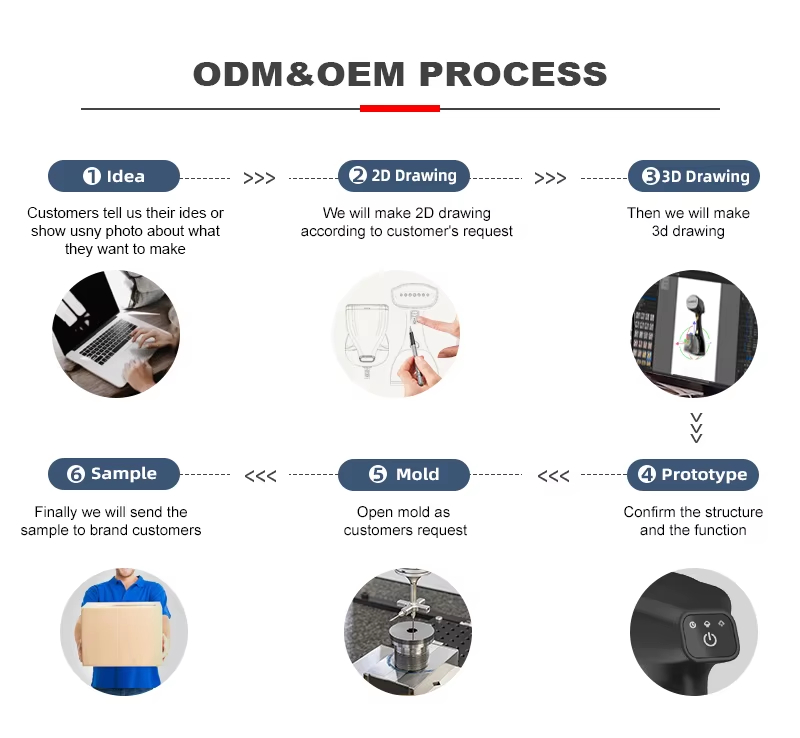
HUAGUANG describes OEM/ODM customization across colour, voltage, power plug type, packaging design and language, and brand identity (logo). The company reports a monthly capacity of 400,000 units, a standard MOQ of 1,000 units, and a lead time of 30–45 days. Its sourcing FAQ states that production normally takes about 30–35 days after deposit and artwork confirmation, potentially extending to around 45 days in peak season, and that products are generally made to order rather than held in stock. Sample production is typically quoted at around 10–15 days.
Those terms define the real boundary of the OEM model. A private-label buyer gains model-level customization and a documented certification trail, but gives up the immediate availability of a trading-company stock programme. For a first cooperation, starting from an existing ODM model with logo and packaging customization reduces development complexity. Deeper changes — new tooling, custom ceramic soleplate specifications, or new voltage architectures — fall outside the standard customization list and require separate engineering and compliance review.
Electrical customization deserves particular attention. The available certificates list specific voltage ratings: 220–240 V, 50/60 Hz on the GS and CE LVD documents, and 220–240 V a.c., 50/60 Hz at 800 W on the CB certificate. The GS scope does not list custom voltage plug safety verification, custom plug and voltage testing, voltage compatibility tests for custom models, regional plug configurations, or dual-voltage 100–240 V configurations. A buyer planning a travel-oriented SKU for multiple markets should therefore request model-specific voltage documentation rather than assuming that a 220–240 V certificate extends to a 100–240 V variant.
Application fit: household, travel, hospitality and e-commerce
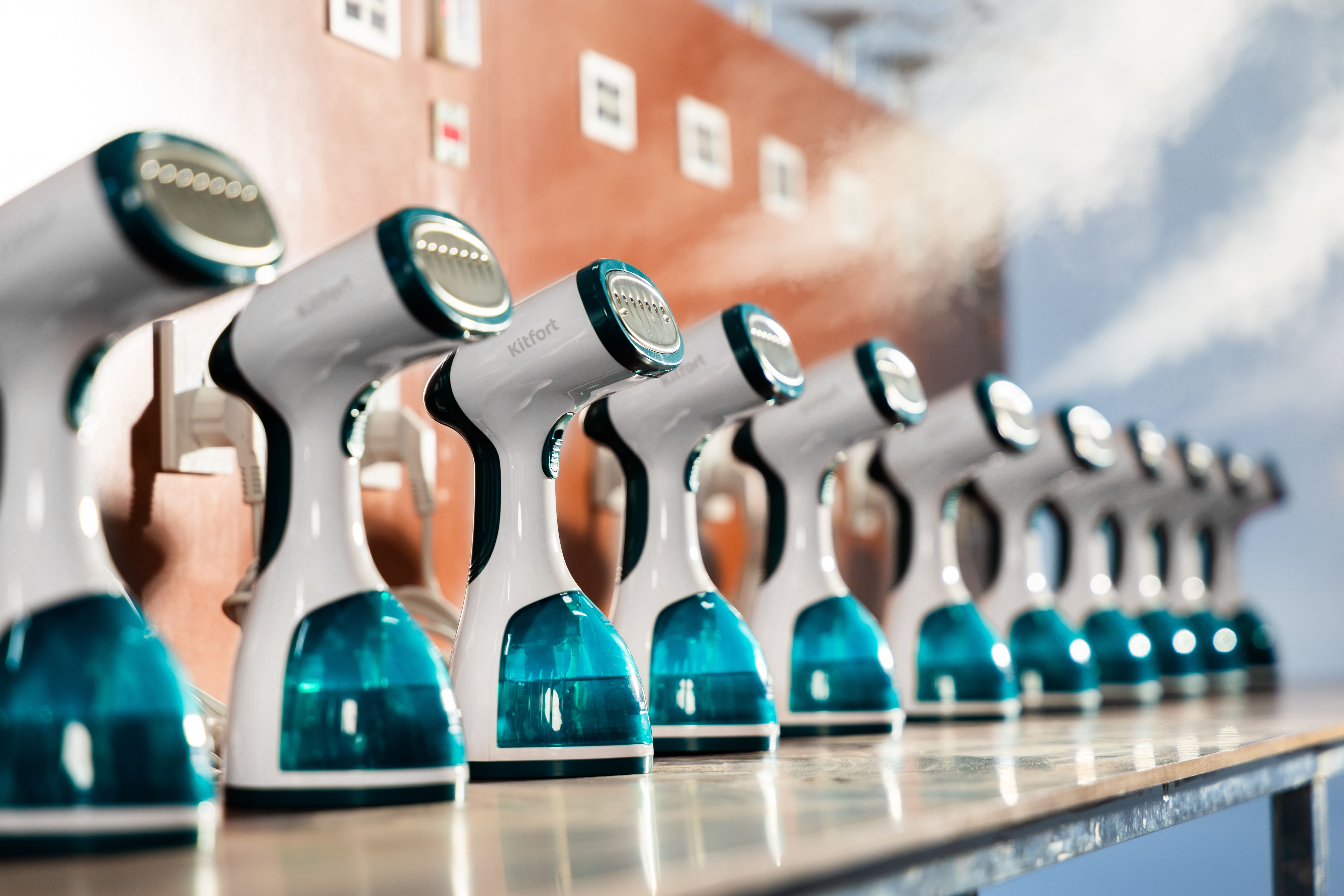
Portable garment steamers are used across homes, garment stores, hotels, showrooms and textile workspaces, with wrinkle removal, fabric care, odour removal and surface sanitisation as the main functions. Operation modes include handheld steaming and, on larger models, horizontal and vertical steaming. The practical requirements differ by channel: a travel SKU prioritises compact storage and dual-voltage flexibility, a hospitality SKU prioritises continuous working time and service documentation, and an e-commerce SKU prioritises retail packaging, unboxing clarity and marketplace compliance.
Case records in the available corpus illustrate how those differences play out. A US online e-commerce platform ordered 35,000 units of the E22 for everyday home, apartment and travel use, favouring the detachable 280 ml water tank and the flat-ironing/vertical-steaming modes. A Saudi offline supermarket and hypermarket chain ordered 40,000 units of the T60 PRO MAX for home-appliance, seasonal-promotion and travel-accessory sections, citing rapid heat-up, compact storage and leak-resistant design. A Dutch home-appliance e-commerce seller ordered 10,000 units of the QH09 over a three-year relationship, emphasising quick preheating, convenient wrinkle removal and easy storage. A US offline supermarket chain ordered 45,000 units of the T35 over two years, positioning it for household use, business travel, student accommodation and everyday garment care.
These are buyer-side application records rather than independently audited performance results. They are useful for understanding channel fit and order scale, not for proving comparative product superiority.
Market trend: handheld growth and EU energy rules
Third-party market research provides context for the portable and handheld segment. Grand View Research estimated the global garment steamer market at USD 3.0 billion in 2023, and projected that the handheld segment would hold a 58.0% market share by 2036. The same source estimated that Europe accounted for 34.5% of global revenue in 2023. Spherical Insights has noted that the EU Ecodesign Directive 2009/125/EC is pushing garment steamer manufacturers toward 1200 W–1500 W models for energy efficiency.
These figures should be read as directional. Forecasts vary by research house and by how the category boundary is drawn, and the 58.0% handheld share is a projection rather than a current measurement. What the direction does suggest is that the portable segment will remain the volume centre of the category, while energy efficiency and documentation requirements become more, not less, relevant to retail listings in Europe. The practical implication for buyers is that a 1200–1500 W handheld platform with a clear certification file is likely to be easier to place in EU retail channels than a high-wattage model without supporting documentation.
How this compares with trading-company sourcing
A trading-company or stock-lot programme offers faster availability and lower initial commitment. The trade-off is that the buyer often cannot trace the certification file to the exact production line, model configuration and voltage version being shipped. An OEM/ODM programme inverts that trade-off: it requires a 1,000-unit MOQ, a 30–45 day production window and a longer sample and artwork cycle, but it provides model-level customization and a certification set that can be matched to specific models.
The limitation is real and should be stated plainly. The available compliance file is model-specific and does not cover every SKU in the range. The GS certificate does not extend to steam performance or heat-up verification. The EU Declaration of Conformity does not include inspection reports or batch traceability records. The existing ETL record covers a steam mop rather than a garment steamer. Buyers who need those additional documents for a specific retail channel should plan for separate testing, inspection or factory audit rather than treating the certificate list as complete. It is also reasonable to note that factory audits, defect-rate data and warranty history sit outside the published documents entirely.
Future outlook
Three developments are likely to shape portable garment steamer OEM sourcing over the next few years. First, the IEC 60335-2-85 standard family continues to evolve; the consolidated 2022 edition with the 2025 amendment is the current reference point, and buyers should confirm which edition the destination market has adopted. Second, EU energy-efficiency expectations are likely to keep pressure on wattage choices and standby behaviour, reinforcing the case for 1200–1500 W handheld platforms. Third, marketplace and retailer compliance teams are asking for model-level documentation rather than brand-level assurances, which favours suppliers who can map each certificate to a specific model, rating and market.
For HUAGUANG, the practical direction is the same as for the category: keep expanding the documented model coverage, keep the certification file aligned with the actual SKU list, and make the boundary between certified scope and separate verification clear to buyers before the purchase order is signed. That is a less dramatic story than a certificate count, but it is the one that survives retail onboarding and customs review.
Frequently asked questions
Which certifications should a buyer verify for a portable garment steamer?
For the EU market, the relevant documents typically include CE-related low-voltage and EMC verification, RoHS and PAHs documentation where applicable, and GS or CB certification depending on the model and retail channel. For the UK, EMC verification is separate. For the US and Canada, ETL or equivalent listing should be confirmed at the model level. Buyers should match each document to the exact model, voltage version, plug configuration and destination market before shipment.
Which HUAGUANG models are covered by GS, CB, CE and RoHS?
The GS certificate GS/23/HEL/01592 covers E15, E15E and E16. The CB Test Certificate BE-43672/M1 covers T35, E22, T60 PRO MAX and E19. The CE Verification of Compliance LVD N8ES2009004802HS01 covers E15, E15E and E16. The RoHS test report (6626)019-0319 applies to the E22. The PAHs Risk Assessment Report NBES220900480202-M1/PAH covers E15, E15E and E16. Model coverage differs by document, so the certificate list should be read model by model.
Does the GS certificate cover steam output, heat-up time or overheat protection?
No. The GS certificate scope covers electrical safety under the referenced EN 60335-1 and EN 60335-2-45 editions. It does not list variable steam output testing, continuous steam-output testing, steam performance reports, steam-output consistency testing, heat-up test reports, heating-time validation, heat-up temperature verification results, overheat safety feature testing, thermal protection verification or overheating protection testing. Those items require separate test reports if the buyer or retail channel needs them.
What voltage and plug customization is available?
HUAGUANG lists voltage, power plug type, colour, packaging design and language, and brand identity (logo) as customization options. The available certificates list 220–240 V and 50/60 Hz. The GS scope does not list dual-voltage 100–240 V configurations, custom plug and voltage testing, voltage compatibility tests for custom models or regional plug configuration records. Buyers planning multi-market or travel-oriented SKUs should request model-specific voltage documentation before confirming the order.
What is the MOQ and lead time for private-label garment steamers?
The standard MOQ listed for garment steamers is 1,000 units. Production normally takes about 30–35 days after deposit and artwork confirmation, potentially extending to around 45 days in peak season. The broader capability record lists a 30–45 day lead time and a monthly capacity of 400,000 units. Products are generally made to order rather than held in stock, so buyers should plan the ordering schedule in advance. Sample production is typically quoted at around 10–15 days.
What performance specifications should be confirmed before ordering?
Buyers should confirm rated power, steam output, preheating time, water-tank capacity, working time, rated voltage and frequency, panel material, safety functions and included accessories for the exact model. For example, the E19 is listed at 2100 W with a maximum steam output of 35 g/min, a 30 ± 5 s preheat time, a 230 ml tank and 10 minutes of operating time, with static protection and water scarcity protection. The E22 is listed at 1200 W, 20 g/min, 25 ± 5 s preheat, 280 ml tank and 15 minutes, with auto shut-off, static protection and water scarcity protection. The T60 PRO MAX is listed at 1100 W, maximum 18 g/min, 45 s preheat, 90 ml removable tank, 6–9 minutes of operation, and automatic shut-off to prevent overheating. Because test conditions are not disclosed, these values should be used for product briefs and sample validation rather than cross-supplier performance ranking.
What does the EU Declaration of Conformity not include?
The provided EU Declaration of Conformity cites the applicable safety and EMC standards and identifies the covered models, but it does not include leakage current test values, separate CE test reports, in-house testing records, custom voltage test reports, batch traceability records, drop-test reports, e-commerce packaging quality reports, thermal protection verification reports, commercial quality inspection reports for hotel garment steamers, regional plug configuration records or quality-control procedure records. Buyers who need those documents for a specific retail channel should request them separately.
Is ETL certification available for garment steamers?
The available ETL Authorization to Mark is certificate number 4000776, issued by Intertek, with the standard UL 499-2014 Ed.14 (R:22Feb2017) and CSA C22.2#64:2010 Ed.7+U1+U2. The recorded product scope is a Steam Mop, not a garment steamer. US-bound garment steamer programmes should therefore request model-level ETL or equivalent confirmation before committing to a launch, rather than assuming that the existing ETL record covers the garment steamer model.
For product specifications and model-level reference data, the HUAGUANG 2025 product manual is available as a PDF: Product Manual 2025 (PDF).
Have Questions or Need More Details?
Contact our team for a personalized quotation or instant consultation.
Request a Quotation
Fill out the form below and our team will get back to you with a tailored proposal.
WhatsApp Direct Chat
Prefer to chat in real-time? Message us on WhatsApp for instant assistance & quick answers.
- Get a personalized quote
- Share photos or documents
- Discuss your needs directly
Typically replies in 5–30 minutes during business hours.