
Portable Inkjet Printers: What Buyers Must Verify First
A portable inkjet printer is not evaluated by its weight or its screen size. It is evaluated by four envelopes that narrow quickly in practice: the model names a certificate actually covers, the maximum print height the unit can reach, the ink-and-substrate pair that has been validated, and the production environment it is permitted to run in. Buyers who check those four items before comparing quotations avoid most of the surprises that surface after installation.
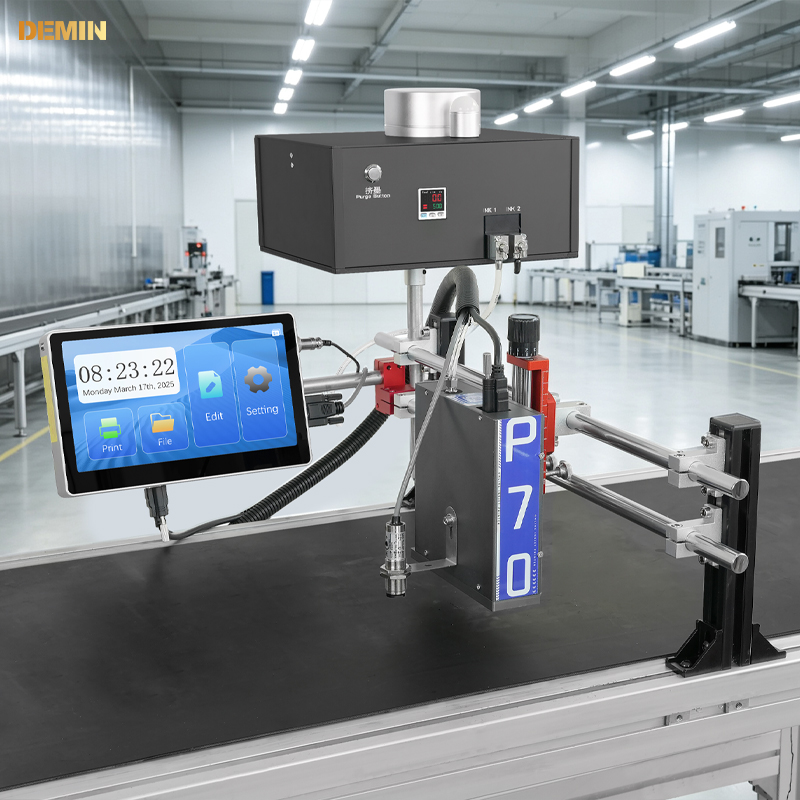
Coding equipment is judged on the line it has to fit, not on the catalogue page. Portable and online formats solve different constraint sets.
The brand referenced in this analysis is DEMIN Inkjet Printer, the coding-equipment line of Quanzhou Demin Spraying Code Technology Co., Ltd., a manufacturer established in 2017 that builds handheld, online and UV inkjet printers and reports exports at roughly half of its output, with listed markets including Europe, the Americas, the Middle East and Asia. Its product families matter here mainly because the procurement problem is the same for every buyer in this category: the specification sheet is easy to read, and the constraint structure behind it is not.
Why the portable format changes the procurement question
Fixed, line-mounted coders are designed around the product. The product passes the head at a known speed, at a known distance, at a known orientation, and the coding system is engineered backwards from that geometry. A handheld or portable unit inverts the relationship. The operator carries the printer to the product, which means print consistency becomes a function of operator motion rather than conveyor motion, and the achievable print area becomes a function of what one hand can sweep across a surface.
That inversion is also the reason portable units keep being purchased. Where goods are large, irregular, already palletised, or produced in short runs that do not justify a dedicated line station, bringing the printer to the item can be the only economically sensible option. The decision therefore shifts from "which unit has the highest headline specification" to "which configuration survives contact with certification review, substrate behaviour, and the actual working environment." That is a constraints question, and it is answered before price negotiation, not after it.
The first hard constraint is certificate scope, not brand
Declarations of conformity are issued against named models. A buyer who asks "is this printer CE marked" gets a less useful answer than a buyer who asks "is this exact model listed inside the certificate scope." The difference matters because product families in this category are broad, and a certificate that covers one handheld series does not automatically extend to a different series, a different print head, or a different electronics revision.
For the DEMIN range, the published conformity records separate as follows.
| Models named in scope | Document type and number | Issuing body | Market / date |
|---|---|---|---|
| T1, T2, T3, T10, T20, T30 (Class B hand-held) | Supplier's Declaration of Conformity XMTN3230612-33144E-00, Part 15 of the FCC Rules and Regulations for Radio Frequency Devices | Bay Area Compliance Laboratories Corp. (Dongguan) | US / 2023-07-25 |
| T1, T2, T3, T10, T20, T50 (hand-held) | CE Attestation of Conformity AOCXMTN3231012-59588E-02, EMC Directive 2014/30/EU | Bay Area Compliance Laboratories Corporation (BALC) | EU / 2023-10-31 |
| MX3S, M10, M20, D10 (hand-held) | CE certification AOC RXM211108050-02, EMC Directive 2014/30/EU | Bay Area Compliance Laboratories Corp. (Kunshan) | EU / 2022-01-07 |
| D10, M10, MX3, M20, M100 (hand-held) | Supplier's Declaration of Conformity 2404Z55407E-EM, FCC Part 15 Subpart B Class B | Shenzhen Accurate Technology Co., Ltd. | US / 2024-12-03 |
| S10, T110, S20, S100, S200 (in-line) | CE Attestation of Conformity AOCXMTN3231226-78308E-02, EMC Directive 2014/30/EU, covering emission and immunity clauses | Bay Area Compliance Laboratories Corporation (BACL) | EU / 2024-02-01 |
| H50 (hand-held) | CE attestation of conformity AOCXMTN3231226-78308E-02 | Bay Area Compliance Laboratories Corporation (BACL) | EU |
The M10 handheld unit is, on the available record, the most completely documented portable model in the portfolio: it appears inside both the CE scope of AOC RXM211108050-02 and the FCC scope of 2404Z55407E-EM, alongside several other handheld models. Buyers targeting North America and the EU with a single portable SKU therefore have a concrete documentary reason to shortlist it, independent of its specifications.
Specification envelopes: height, speed, and what one hand can carry
The portable category trades print coverage for mobility, and the trade becomes visible only when models are placed side by side. The DEMIN handheld and online families show the pattern clearly.
| Model | Format | Weight | Print height | Resolution | Print speed |
|---|---|---|---|---|---|
| M10 | Handheld | 520 g | 2–25.4 mm | 300–600 dpi | 60 m/min |
| H50 | Handheld | 950 g | 2–50 mm | 300 dpi | 60 m/min |
| L10 | Online | 3.5 kg | 2–12.7 mm | 300–600 dpi | 120 m/min |
| S10 | Online | 3.5 kg | 2–12.7 mm | 300–600 dpi | 120 m/min |
| P70 | Piezoelectric / UV | — | 5–72 mm | 180 dpi | 1–100 m/min |
| P70 Pro | Piezoelectric / UV | — | 5–72 mm | 360 dpi | 1–100 m/min |
Three readings follow from this table. First, doubling the handheld print height roughly doubles the carried mass: the M10 covers 25.4 mm at 520 g, while the H50 reaches 50 mm at 950 g. Print coverage in this format is bought with weight, and weight is what the operator holds for an entire shift. Second, both handheld models share a 60 m/min print speed, so the taller model does not buy throughput — it buys a single-pass line of text rather than a two-pass assembly. Third, when the job needs both speed and height, neither handheld is the right answer: the online models double throughput to 120 m/min but narrow print height to 12.7 mm, and the P70 series opens height to 72 mm while moving to a piezoelectric print head and a machine-mounted format.
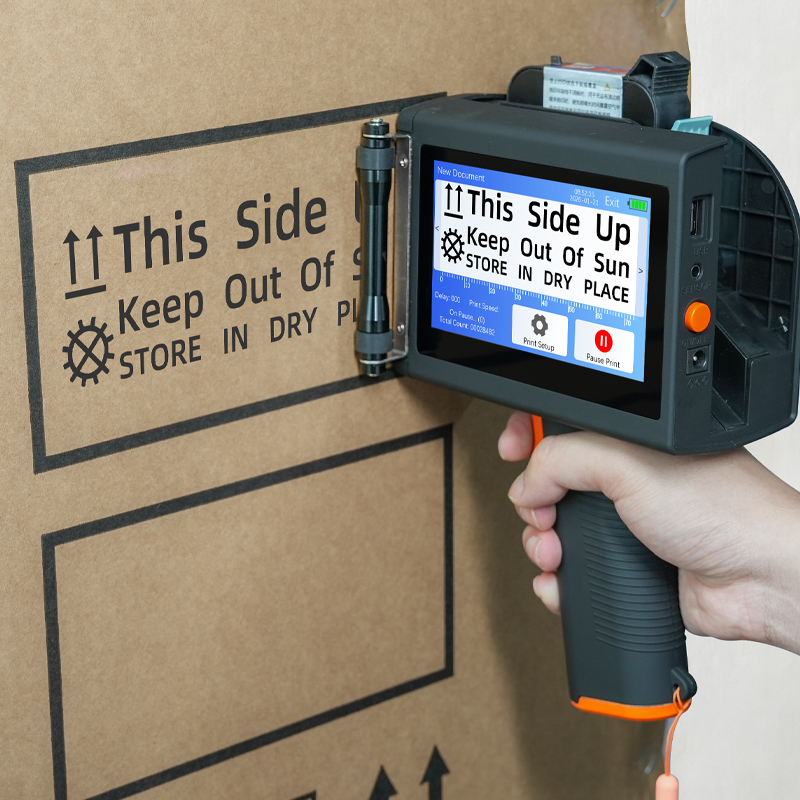
The H50 handheld inkjet printer: 950 g body, 2–50 mm print height, 300 dpi, 5-inch capacitive touchscreen.
Practical detail matters here as much as headline figures. The optimum print distance for the M10 and H50 is 2–5 mm, which means the operator maintains a gap approximately the thickness of a coin between head and surface. On a flat carton that is easy; on curved, woven or flexible surfaces it is a skill, and it is the single largest source of print-quality complaints in handheld deployment. The M10 additionally carries a 4.3-inch capacitive touchscreen, a DC 8.4 V 2500 mAh lithium battery, 300–600 dpi adjustable resolution and a 3.5 mm sensor port plus USB port; the H50 pairs a 5-inch touchscreen and 300 dpi output with support for 29 interface languages, which matters when the device is used by shift staff rather than by a single trained technician.
Ink, substrate, and the sample test that closes the gap
Portable printers in this range print in a single colour at a time. The available ink colours are red, yellow, blue, green, black, white and invisible, and the selection is made per job, not per machine — a unit loaded with black ink is not simultaneously a white-ink unit. For buyers planning multi-colour branding alongside date coding, that is a real operational constraint and should be planned as a workflow, not assumed as a capability.
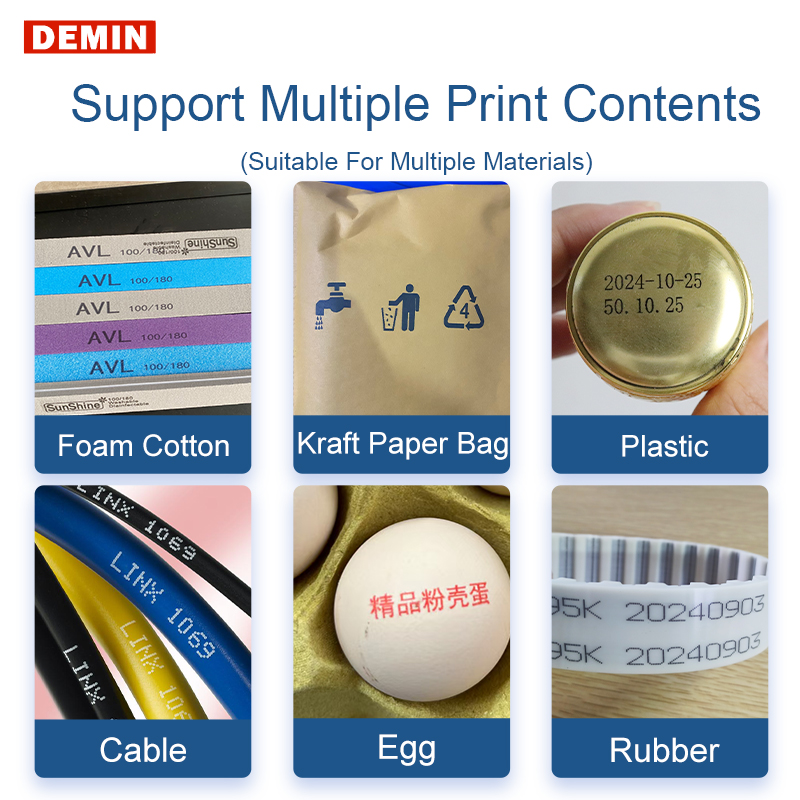
Substrate coverage is described broadly: carton, plastic, metal, glass, wood and woven fabric are named as printable surfaces, and the P70 series lists boards, cartons, pipes, cables, metals and plastics among printable substrates. Broad substrate lists are a starting point for screening, not a qualification. Ink adhesion, drying behaviour and abrasion resistance vary by ink chemistry, surface treatment and downstream handling, and none of those variables is settled by a specification line.
The correct procurement sequence is therefore: identify the model that meets the certification and print-height envelope, confirm ink colour availability, then request sample prints on the buyer's own material under the buyer's own handling conditions before committing to volume. This is especially important for kraft paper, corrugated board and woven sacks, where surface absorption differs enough between suppliers that a print verified on one batch may behave differently on the next.
The M10 portable inkjet printer: 520 g, 2–25.4 mm print height, 300–600 dpi, 60 m/min.
Environment, interfaces, and line integration
A portable printer that is later mounted on a conveyor stops behaving like a portable printer, and buyers frequently discover this after delivery. The installation environment should be defined at the evaluation stage, not at commissioning.
The P70 series specifies an operating environment of 0–50 °C and 10% RH to 90% RH, a power consumption of 20 W at a rated DC 16.8 V 5 A supply, and external interfaces covering RS232, USB, DB9 and an Ethernet (IP) port. The online L10 and S10 models specify a DB9 sensor interface and a USB interface, which is the interface set required for photoelectric-sensor triggering on a moving line. The handheld M10 offers a 3.5 mm sensor port alongside USB, allowing the same triggering logic at a smaller scale.
Triggering and duty cycle deserve explicit attention. A documented carton-packaging installation in the manufacturing sector runs the printer triggered by a photoelectric sensor for continuous 24/7 online automatic printing, with the printer matched to a conveyor belt, packaging line, photoelectric sensor and UV curing lamp set, under a stated requirement for stable printing in a high-temperature workshop and strong ink adhesion on corrugated board. That combination — sensor trigger, curing lamp, high-temperature ambient — is a useful template for scoping any line-mounted portable deployment. Where UV ink is used, curing is a process step, not an accessory, and the lamp set belongs in the layout.
Interface language support is an underrated procurement criterion in export markets. The handheld and online models list support for 29 languages, including Chinese, English, Russian, Arabic, French and Vietnamese, while the P70 series lists 30 languages, adding Thai. For a factory running mixed-language shift teams, that is an operational feature rather than a marketing one.
Where portable units actually fit in production
The pattern across documented deployments is consistent: portable and compact coding equipment is used where the marking task is variable, distributed, or applied to goods that cannot easily be routed past a fixed station.
A food factory in Argentina operates ten units for printing the production date on outer packaging. The recorded result after five years of use is long-term fault-free operation, ease of use, clear print output and satisfactory after-sales support, with the machine described as simple in structure, modern in design and quick to learn. A single case record is not a statistical claim, but it does illustrate the deployment type: date coding on outer packaging, at moderate volume, where a fixed line station would be disproportionate to the output.
The application surface for this class of equipment is wider than date coding alone. Documented uses include production dates, expiration dates, batch numbers, serial numbers, QR codes, DataMatrix codes, logos and barcodes — the full variable-data set that modern traceability requirements tend to demand. Printable content on the DEMIN handheld and online models covers Chinese and English characters, QR codes, barcodes, serial numbers and logos, which maps onto packaging, ingredient lists, batch coding and carton marking without needing a separate device per data type.
Market signals behind the portable segment
The demand context is measurable, provided the segments are kept separate. Global Market Insights values the industrial inkjet printer segment at USD 5.6 billion in 2025 and attributes a 26% share of that market to the food and beverage vertical. Grand View Research, working at a broader scope that includes consumer and desktop printers, values the total inkjet printer market at USD 45.2 billion in 2025 and USD 48.0 billion in 2026, and places continuous inkjet (CIJ) at 38.4% of technology share.
Smithers projects that Asia Pacific will draw level with North America in global inkjet volume by 2026 and lead by 2031. Read together, these signals describe a market where high-volume industrial coding continues to be dominated by continuous inkjet on high-speed lines, while the food and beverage vertical — the single largest end-user block at 26% — carries a large share of the date, batch and lot coding work that portable and compact units are commonly used for. The portable segment is not displacing CIJ on high-speed lines; it is occupying the distributed, low-to-moderate volume, large-or-irregular-object end of the same coding workload.
Portable TIJ versus established coding approaches
Thermal inkjet, the technology behind most handheld coding units, ejects ink droplets from disposable or replaceable cartridges, as described in the manufacturer's own technology comparison. Continuous inkjet systems, by contrast, are engineered around continuous high-speed line operation. The practical differences for a buyer are these:
| Decision factor | Portable / handheld TIJ | Line-mounted CIJ |
|---|---|---|
| Best fit | Distributed coding, large or immovable goods, short runs, outer packaging | Continuous high-speed production lines with fixed product geometry |
| Print consistency driver | Operator technique and maintained head-to-surface distance | Machine motion and fixed head positioning |
| Colour | Single colour per loaded cartridge | Application-dependent |
| Integration | Optional sensor trigger, USB and DB9 interfaces | Built for permanent line integration |
| Scaling path | Move up to online or piezoelectric models as volume grows | Scales with line speed |
The limitation should be stated plainly rather than softened. A handheld unit's print quality depends on the person holding it. The 2–5 mm optimum print distance is a narrow operating window, and on curved, flexible or high-friction surfaces an operator will not hold it consistently across a full shift. Where repeated, high-volume, identical marking is the requirement, a handheld device is the wrong tool regardless of its resolution figure, and the correct route is an online or piezoelectric model mounted on the line. Portable TIJ also remains a single-colour process, so multi-colour brand marks cannot be produced in one pass.
A second boundary concerns the certification record. The EMC and FCC documentation establishes electromagnetic and radio-frequency compliance for named models. It does not certify the ink as suitable for direct food contact, and it does not establish an ingress protection rating. Buyers in regulated packaging applications must pursue those questions as separate workstreams with the supplier, and should expect to provide test reports rather than accept a general statement.
What buyers should plan for next
The direction of the category is toward integration rather than toward more handheld features. The Chinese press and publication industry standard defines printing smart manufacturing as the deep integration of new-generation information and communication technology with advanced manufacturing technology across design, production, management and service, with self-perception capabilities built in. For coding equipment, that framing points at the same trajectory the market data already shows: variable data, traceability and connectivity expectations rising together, with the coding device treated as an equipment-layer asset on the line rather than a standalone tool.
For a buyer in the research-to-evaluation stage, the practical consequence is to specify the interface set and the data types now, even if volume is modest today. A unit purchased for date coding this year is likely to be asked for QR or DataMatrix traceability within its service life. The models that already list DB9 sensor, USB and, on the P70 series, RS232 and Ethernet interfaces, are the ones that will not need replacing when that request arrives.
Supply terms to confirm before signing
Commercial terms are worth verifying at the same time as the technical envelope, because they determine how quickly a fleet can be scaled or rebranded.
The manufacturer operates from a 3,000 m² facility with 150 employees, an annual output of 10,000 units and a 45-person R&D team, holds ISO 9001 quality management system certification and National High-Tech Enterprise qualification, and reports independent patents and software copyrights. The official company brochure is available for download: DEMIN Inkjet Company Brochure (English).
FAQ
Which portable inkjet printer models carry FCC and CE documentation?
The M10 handheld inkjet printer appears inside both a CE certification (AOC RXM211108050-02, issued by Bay Area Compliance Laboratories Corp. (Kunshan) under EMC Directive 2014/30/EU, covering the MX3S, M10, M20 and D10 models) and a US Supplier's Declaration of Conformity (2404Z55407E-EM, issued 2024-12-03 by Shenzhen Accurate Technology Co., Ltd. under FCC Part 15 Subpart B Class B, covering D10, M10, MX3, M20 and M100). The T1, T2, T3, T10, T20 and T30 series are covered by FCC Supplier's Declaration of Conformity XMTN3230612-33144E-00, and the T1, T2, T3, T10, T20 and T50 series by CE Attestation of Conformity AOCXMTN3231012-59588E-02 issued 2023-10-31. Buyers should confirm the exact model string against the certificate scope before ordering.
What materials can a portable inkjet printer print on?
Documented printable surfaces include carton, plastic, metal, glass, wood and woven fabric. The P70 piezoelectric series additionally lists boards, cartons, pipes, cables, metals and plastics among printable substrates. Because ink adhesion and drying behaviour depend on the specific ink chemistry and the actual surface batch, verification through sample printing on the buyer's own material is required before volume commitment.
How large and how fast can a portable unit print?
The M10 handheld model prints 2–25.4 mm high at 300–600 dpi and up to 60 m/min, with an optimum print distance of 2–5 mm. The H50 handheld model prints 2–50 mm high at 300 dpi and up to 60 m/min. For taller print, the P70 piezoelectric models extend print height to 5–72 mm with a 2–15 mm adjustable print distance and a speed range of 1–100 m/min. The online L10 and S10 models reach 120 m/min but limit print height to 2–12.7 mm.
Can a portable inkjet printer print in more than one colour?
It supports single-colour printing per loaded cartridge. Six ink colours are available — red, yellow, blue, green, black and white — plus an invisible ink option. Because colour is determined by the cartridge rather than by a combined print process, multi-colour marks require cartridge changes and separate passes, which is an operational constraint rather than a machine capability.
What are the ordering terms and after-sales arrangements?
OEM production covers logo and startup screen customisation with a minimum order of 1 unit, a 30–45 day lead time and 8,000 units monthly capacity, serving the EU, Middle East and the Americas. ODM production covers customer casing drawings with mould opening and injection moulding, a minimum order of 100 units, a 20–35 day lead time and 5,000 units monthly capacity, serving the EU and Middle East. Both modes apply 100% testing. A 12-month warranty is provided together with lifelong after-sales service, delivered through online guidance and parts dispatch.
What should a buyer test before placing an order?
Four checks cover most of the risk. First, run sample prints on the buyer's own substrate at the intended print height and at the specified 2–5 mm print distance. Second, confirm the operating environment against the equipment specification — the P70 series, for example, is rated for 0–50 °C and 10% RH to 90% RH at 20 W consumption on a DC 16.8 V 5 A supply. Third, verify that the exact model string appears within the FCC or CE certificate scope for the destination market. Fourth, confirm interface compatibility with the planned line, whether that is a DB9 sensor trigger and USB, or the RS232, USB, DB9 and Ethernet set available on the P70 series.
Is a handheld unit a substitute for a line-mounted coder?
No. A handheld unit's output depends on operator technique and on maintaining a narrow head-to-surface distance, and it prints one colour at a time. For repeated, high-volume, identical marking at fixed product geometry, a line-mounted online or piezoelectric model is the appropriate choice; the handheld format suits distributed coding, short runs and goods that cannot be routed past a fixed station.
Have Questions or Need More Details?
Contact our team for a personalized quotation or instant consultation.
Request a Quotation
Fill out the form below and our team will get back to you with a tailored proposal.
WhatsApp Direct Chat
Prefer to chat in real-time? Message us on WhatsApp for instant assistance & quick answers.
- Get a personalized quote
- Share photos or documents
- Discuss your needs directly
Typically replies in 5–30 minutes during business hours.