
Portable Laser Marking Machine Shortlist for 24/7 Cells: UV, Fiber, Benchtop, Miniature
HTNXT Industry Reference · Smart Manufacturing
A round-the-clock smart manufacturing cell rarely stops because the laser source is too weak. It stops because the marking station is waiting on a consumable reel, because a coolant circuit has drifted out of tolerance, or because somebody has to reset a job template between shifts. That failure pattern is the reason the portable laser marking machine category has separated into distinct formats rather than converging on one universal unit.
Jinan Yuanshida International Trade Co., Ltd. is a high-tech enterprise established in 2012 and based in Jinan, China, specialising in the research, development, production and export of industrial laser marking equipment. Its range covers handheld laser marking machines, bench-top laser marking machines, desktop laser marking machines and precision laser marking equipment, with exports to more than 80 countries and regions and principal markets in Vietnam, Thailand, Malaysia, Türkiye, the United States, Poland and the Middle East.
This shortlist draws four portable and relocatable formats from that range for continuous smart manufacturing cells: a desktop UV cold laser unit for non-metallic and metallic workpieces, a desktop fiber unit, a benchtop fiber work station, and a miniature multi-material unit with a switchable 1064 nm / 455 nm source for on-site mixed-material marking. The screen is built on zero-consumable operation, material compatibility, marking area, cooling architecture and control interface — not on a power ranking.
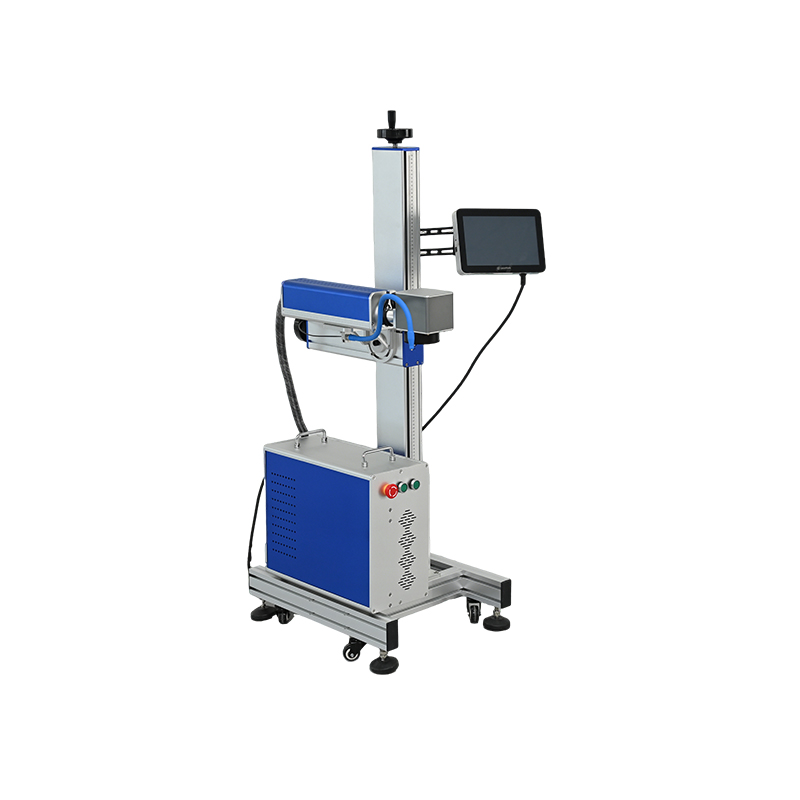
Why “Portable” Means Something Different Inside a 24/7 Cell
Across the laser marking industry, handheld and portable machines are typically described as weighing between 15 and 35 pounds, roughly 6.8 to 15.8 kg. Weight is the conventional shorthand for portability, and it remains relevant for handling and operator safety. Inside a continuously running production cell, however, portability is more usefully described by what the machine does not need.
Three dependencies decide whether a marking unit can survive weeks of unattended cycles:
- Consumables. A process that uses no ink, ribbon, chemistry or powder has no replenishment cycle that can interrupt output. Fiber, UV and CO2 laser marking are consumable-free in this sense, and every option on this shortlist operates with zero consumables.
- Utility dependence. An air-cooled unit needs only electrical power. A water-cooled unit needs a chiller and a stable coolant circuit, which adds a second system to maintain.
- Control autonomy. A unit with a built-in display, a standard USB interface and an onboard operating system can execute a job without a tethered PC, which reduces the number of failure points in the cell.
The four shortlisted formats trade these three dependencies in different proportions. That is the practical reason a shortlist is more useful than a single recommendation for a buyer still at the awareness and research stage.
The Four Screening Criteria Behind This Shortlist
Every format below was assessed against the same four filters. They are ordered deliberately: a format that fails the first filter is not rescued by strength in the others.
| Filter | What to verify | Why it matters for continuous operation |
|---|---|---|
| Zero-consumable operation | No ink, ribbon, chemistry or powder in the marking path | Removes the most common unplanned stop in a long shift |
| Wavelength-to-material fit | 1064 nm for metals, 355 nm cold processing for heat-sensitive plastics, glass and film | Prevents rework and scrap, which cost more than the machine hour |
| Marking area and minimum character | Standard 110 × 110 mm lens, larger areas as an option; 0.15 mm minimum character | Determines whether the part and the traceability code both fit |
| Cooling and control interface | Built-in air cooling versus external chiller; USB, touch screen, onboard display | Sets how much supporting infrastructure the cell must carry |
Option 1 — Desktop UV Cold Laser Marking Machine
The desktop UV Laser Marking Machine is a 355 nm cold laser system built for marking non-metallic and metallic workpieces in a compact tabletop footprint. It is the only option on this shortlist that uses a non-thermal marking interaction, which is why it appears first when the material mix includes heat-sensitive substrates.
How it works. A 355 nm ultraviolet source with a pulse width below 60 ns removes material through a photochemical rather than thermal mechanism. The stated design intent is marking on plastics, glass and fragile materials without thermal damage. Beam quality is specified at M² < 1.5 in single mode, with a modulation frequency range of 30 to 100 kHz.
Verified specifications.
- Laser power: 3 W or 5 W, optional
- Wavelength / pulse width: 355 nm / less than 60 ns
- Marking speed: up to 10,000 mm/s
- Marking area: 110 mm × 110 mm
- Max. marking depth: less than 0.4 mm; min. line width / min. character: 0.4 mm / 0.15 mm
- Repeatability: ±0.001 mm
- Fonts: 140+ font libraries, with custom fonts addable on request
- Cooling: external industrial water chiller (DWUV-05 included)
- Overall power: less than 400 W; operating voltage 110 V to 240 V; standard USB control
- Dimensions: 352 mm × 603 mm × 800 mm
Materials and sectors. Compatible materials are PE plastics, PVC plastics, metal parts, building materials, glass, film, packaging and composite materials. Intended industries are electronics, pharmaceuticals, food and beverage packaging, daily chemicals and cosmetics, and hardware, steel and cement production lines. The machine is also applicable to metal parts marking in the hardware industry, so it covers a mixed-material queue rather than only one substrate class.
Buyer note. This is the one option on the shortlist that carries a utility dependency: the external industrial water chiller ships with the unit, and it must be given floor space and a coolant maintenance routine. In return, the marking head itself produces no heat load on the workpiece, which is the reason to accept that trade.
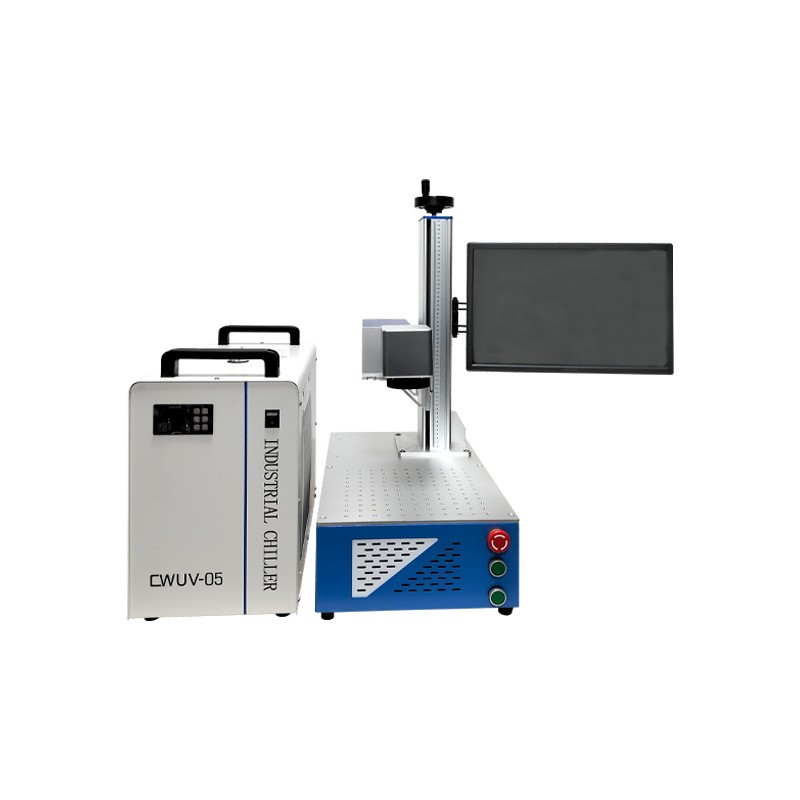
Option 2 — Desktop Fiber Laser Marking Machine
The desktop fiber laser marking machine is an all-in-one integrated desktop unit with a compact footprint, designed for marking metals and non-metallic plastics. Where the UV unit trades cooling simplicity for cold processing, this format trades nothing away: it is air-cooled, consumable-free and available with an expanded marking field.
Verified specifications.
- Laser power: 20 W / 30 W / 50 W / 100 W, optional
- Wavelength / pulse width: 1064 nm / less than 60 ns
- Marking speed: up to 10,000 mm/s
- Marking area: 110 × 110 mm standard, with 150 × 150 mm, 175 × 175 mm and 200 × 200 mm available as options
- Repeatability: ±0.001 mm; min. character / min. line width: 0.15 mm / 0.4 mm; max. marking depth: 0.4 mm
- Cooling: built-in air cooling; overall power less than 400 W
- Structure: all-in-one integrated desktop design, plug-and-play, integrated user interface and large display screen
Why it earns a place. The optional 150 × 150 mm, 175 × 175 mm and 200 × 200 mm fields are the practical answer when a cell runs a mix of small bracketed parts and larger plates through the same station. The standard 110 × 110 mm area covers most component-level marking, and the larger optics remove the need for a second machine when a bigger workpiece arrives. A high-speed galvanometer scanning system supports clean, precise and continuous marking with zero consumables, and the high electro-optical conversion efficiency keeps overall draw under 400 W.
Materials and sectors. Metals including steel, metal parts and alloys, plus non-metallic plastics such as PE and PVC. Intended industries are hardware and tools, auto parts, electronic components, machinery parts and jewellery.
Option 3 — Benchtop Fiber Laser Marking Machine
The benchtop fiber laser marking machine is a station-type, cabinet-style unit with an integrated workbench design. It is the format to specify when the marking position is fixed for the life of the cell and the operator needs a place to stage parts, rather than a unit to carry between benches.
Verified specifications.
- Laser power: 20 W / 30 W / 50 W, optional
- Wavelength / pulse width: 1064 nm / less than 60 ns
- Marking speed: up to 10,000 mm/s
- Marking area: 110 × 110 mm, with 150 × 150 mm available as an option
- Max. marking depth: up to 4 mm; min. line width / min. character: 0.01 mm / 0.15 mm; repeatability ±0.001 mm
- Cooling: built-in air cooling; overall power less than 400 W
- Operating system / interface: Windows XP / standard USB, with integrated workbench, large display screen, built-in control panel and keyboard drawer
The differentiator is depth. The cabinet format carries a maximum marking depth of up to 4 mm, an order of magnitude beyond the 0.4 mm ceiling of the desktop formats, and a minimum line width of 0.01 mm. That combination suits tool and die identification, deep engraving on mechanical spare parts, and any job where the mark must survive heavy wear rather than simply remain legible.
Materials and sectors. Metals such as steel, metal components and alloys, plus non-metallic plastics including PE and PVC. Intended industries are food and beverage, medical, chemical, building materials, steel, cement, hardware and electronics production lines. The unit is designed for plug-and-play setup on production lines and supports continuous 24/7 operation with zero consumables.
Option 4 — Miniature Multi-Material Laser Marking Machine
The Miniature Multi-Material Laser Marking Machine is a 2.7 kg fiber laser unit with a dual light source switchable between 1064 nm and 455 nm. It is the only option here that can genuinely travel to the workpiece, and the only one that changes wavelength without changing machines.
Verified specifications.
- Light source wavelength: 1064 nm / 455 nm, dual light source switchable
- Laser operation mode: pulse; power regulation range 25–100, gradient adjustable
- Processing speed: up to 4,000 mm/s; scene focal length 133 mm; scanning area 55 mm × 55 mm
- Net weight: 2.7 kg
- Power supply: built-in lithium battery / DC 20 V, with power bank support; overall power ≤ 100 W; air cooling
- Operation modes: mobile app, PC software, touch screen; interface TYPE-A for data and TYPE-C for power
- OEM customisation supported
Materials and sectors. Applicable materials are metals, bamboo and wood, leather, paper, coloured glass, plastics and ceramics. Intended industries are gifts and crafts, jewellery, customised DIY workshops and 3C electronic accessories. It is designed for portable and on-site marking scenarios, which is the specific gap it fills on this list.
A useful comparison point. The general industry band for handheld and portable laser marking machines sits at roughly 6.8 to 15.8 kg. At 2.7 kg with a Type-C power input, this unit sits well below that band and can run from a power bank, which changes who can carry it and where it can be used.
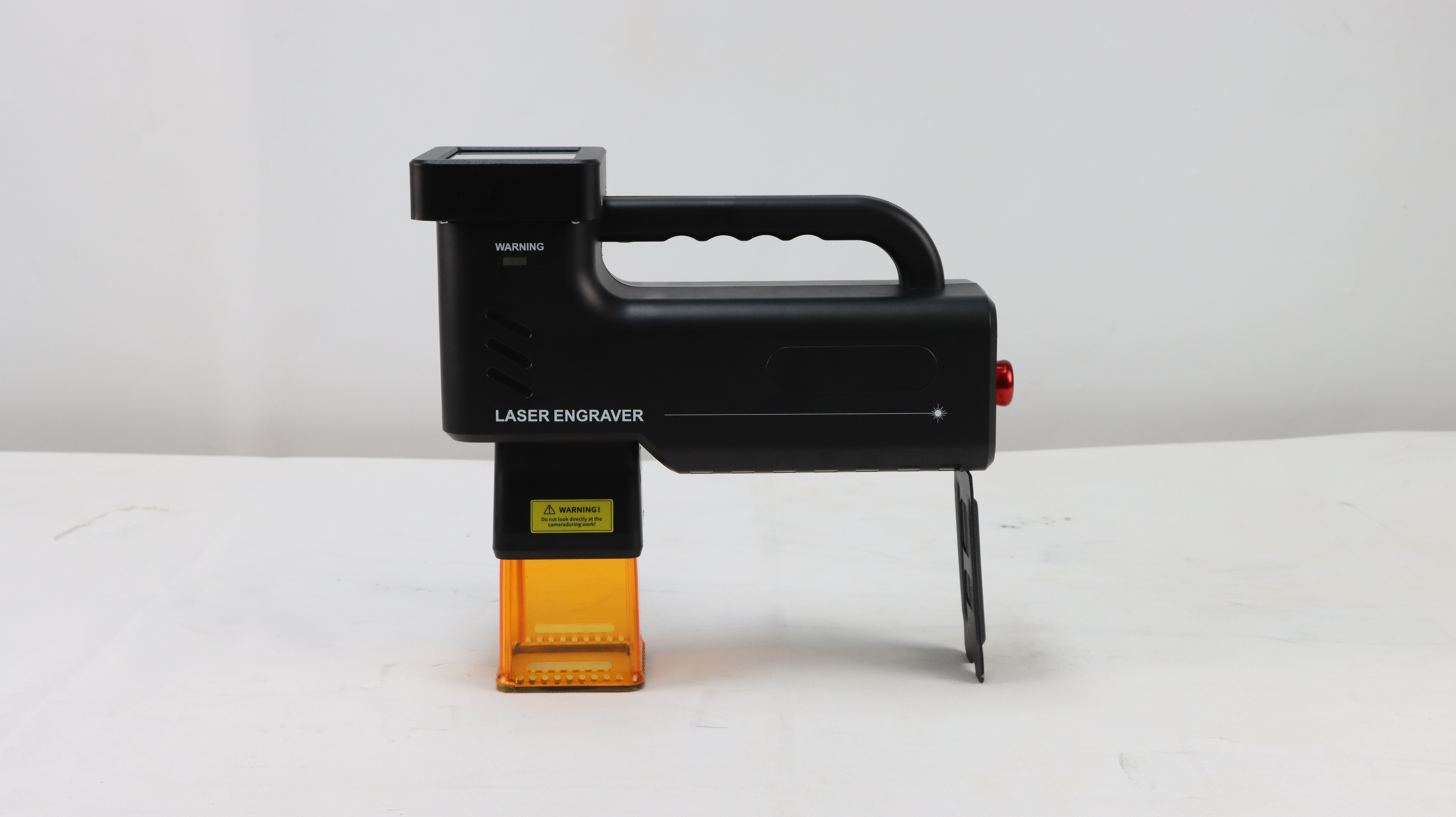
Comparing the Four Shortlist Options
The table below places the four formats against the criteria that decide a 24/7 cell. No column is a quality ranking; each row is a different set of trade-offs.
| Format | Source | Power | Marking area | Cooling | Form factor |
|---|---|---|---|---|---|
| Desktop UV | 355 nm cold laser | 3 W / 5 W | 110 × 110 mm | External water chiller | Compact desktop, 352 × 603 × 800 mm |
| Desktop fiber | 1064 nm | 20 / 30 / 50 / 100 W | 110 × 110 mm, up to 200 × 200 mm optional | Built-in air | All-in-one integrated desktop |
| Benchtop fiber | 1064 nm | 20 / 30 / 50 W | 110 × 110 mm, 150 × 150 mm optional | Built-in air | Cabinet station with integrated workbench |
| Miniature multi-material | 1064 nm / 455 nm switchable | Overall ≤ 100 W | 55 × 55 mm | Air | 2.7 kg handheld, battery or Type-C powered |
What Each Option Is Actually Good For
The device choice follows the workpiece, not the other way round. Mapping the company’s stated application sectors onto the four formats produces a straightforward allocation:
- Hardware parts and mechanical spare parts. Desktop or benchtop fiber. Metal-to-metal marking is the fiber source’s home ground, and the benchtop format adds up to 4 mm depth when the mark has to survive wear.
- Pipes and profiles. A fiber format with an expanded field. The 150 × 150 mm to 200 × 200 mm options on the desktop fiber unit cover longer part geometry without repositioning.
- Electronic components. Desktop UV where the substrate is heat-sensitive, such as film, packaging or composite material; desktop fiber where the mark goes onto metal housings, contacts or alloy parts.
- Jewellery and 3C accessories. Desktop UV for delicate finishes and coated surfaces, or the miniature unit for on-bench marking of small pieces in a mixed-material workshop.
- Gifts and crafts. The miniature multi-material unit, which covers metals, bamboo and wood, leather, paper, coloured glass, plastics and ceramics in a single 2.7 kg package.
- Large workpieces that cannot be moved. The miniature unit travels to the part. This is the scenario the company describes as on-site portable marking, and it is the main reason the format survives alongside fixed stations.
What These Four Formats Cannot Do
A shortlist is only useful if its boundaries are stated as clearly as its strengths. Four limits apply across this group.
Depth ceilings on the desktop formats. The UV unit and the desktop fiber unit both specify a maximum marking depth under 0.4 mm. For surface marking, serialisation and identification that is sufficient. For deep engraving or marks that must survive aggressive wear, the benchtop fiber cabinet with its up-to-4 mm depth is the appropriate format, and the desktop units are not substitutes for it.
Field size on the miniature unit. The miniature multi-material machine has a 55 × 55 mm scanning area, the smallest on the shortlist. It marks what is already at the bench or already on the workpiece; it does not replace a 110 × 110 mm or 200 × 200 mm station for panel-sized parts. Its processing speed of up to 4,000 mm/s is also below the 10,000 mm/s class of the desktop and benchtop fiber units, so it suits small-part and on-site work rather than high-volume line throughput.
Utility dependence on the UV format. The UV machine ships with an external industrial water chiller (DWUV-05). That is a second system to house and maintain, and it means the UV option is not a fully self-contained field unit in the way the battery-powered miniature is. Buyers planning a portable-only workflow should treat the chiller as part of the installation footprint.
Portability versus station throughput. The cabinet-style benchtop unit is not designed to be carried between cells, and the desktop formats are relocatable rather than handheld. Where a cell needs both a fixed high-throughput station and occasional on-site work, the honest answer is two formats side by side, not one machine stretched across both roles.
What 2026 Market Data Says About Portable Marking
Published market research places the global laser marking machine market at an estimated USD 4.4 billion in 2026, with a forecast period running to 2033 (Grand View Research). Within that total, fiber laser technology held a revenue share of 46.1% in 2025, making it the dominant technology segment, and Asia Pacific accounted for approximately 44% of revenue share in the same year.
Three observations follow for buyers assembling a shortlist.
First, the dominance of fiber is consistent with the shortlist above: three of the four formats use a fiber source, and the UV format exists to cover the substrate classes fiber handles least well. Second, the regional concentration in Asia Pacific shapes sourcing and lead-time expectations, which is relevant for a company like Jinan Yuanshida International Trade Co., Ltd. whose stated export markets include Vietnam, Thailand, Malaysia, Türkiye, the United States, Poland and the Middle East. Third, for international trade classification, HS Code 845611 is the primary classification for machine tools operated by laser processes.
On the compliance side, two reference points matter for a portable marking purchase. Laser products sold in the United States must comply with FDA 21 CFR Subchapter J, Parts 1000 through 1005. Portable laser markers are specifically assessed against EN ISO 11553-2 for hand-held safety. The equipment described here is stated to comply with international quality standards such as CE, FDA and ISO, and all equipment undergoes multiple aging tests and precision calibration before leaving the factory.
A Procurement Checklist Before a 24/7 Trial
Before committing a format to a continuous cell, verify the following against the quotation and the machine documentation:
- Confirm the marking path is genuinely consumable-free, and ask what the maintenance interval covers instead — optics cleaning and calibration, not material replenishment.
- Match the cooling architecture to the plant. Built-in air cooling on the fiber and miniature formats needs only power; the UV format needs chiller space and a coolant routine.
- Check the marking area against the largest part in the queue, not the average part. A 110 × 110 mm standard field with a 200 × 200 mm option is a different specification from a fixed 110 × 110 mm.
- Verify the minimum character and repeatability figures where traceability codes are involved: 0.15 mm minimum character and ±0.001 mm repeatability appear across the desktop and benchtop formats.
- Confirm the control interface: standard USB, onboard display, and on the miniature unit, mobile app, PC software and touch screen with TYPE-A data and TYPE-C power.
- Request the certification file set and the pre-shipment ageing and calibration record alongside the commercial terms.
Outlook
The direction of travel is toward formats that separate the marking head from the infrastructure. Battery-backed, Type-C-powered units at 2.7 kg and air-cooled desktop units under 400 W both reduce what a cell has to provide in order to keep a marking station running. At the same time, the fiber segment’s 46.1% revenue share in 2025 suggests the metal-marking core is not going to be displaced; the change is in how that core is packaged and where it can be deployed.
For a buyer at the research stage, the practical implication is that the shortlist question should be asked per workpiece family, not per factory. A cell that marks heat-sensitive packaging alongside machined alloy brackets is describing two formats, not one machine that does both well. Jinan Yuanshida International Trade Co., Ltd. describes its positioning as providing cost-effective, highly stable and low-maintenance laser marking equipment to global industrial customers, with a product range spanning handheld, bench-top, desktop and precision laser marking equipment — a range wide enough that the selection conversation can start from the material and the cycle, rather than from the catalogue.
Frequently Asked Questions
What is a portable laser marking machine?
A portable laser marking machine is a laser marking unit built to be moved to the work rather than fixed permanently in one position. The category spans handheld, desktop and compact benchtop formats. In industry usage, handheld and portable machines are typically described as weighing between 15 and 35 pounds, roughly 6.8 to 15.8 kg, although lighter designs exist: the miniature multi-material unit in this shortlist weighs 2.7 kg.
Which materials can a portable laser marking machine mark?
Material coverage depends on the light source. A 1064 nm fiber source marks metals including steel, metal parts and alloys, and non-metallic plastics such as PE and PVC. A 355 nm UV cold laser is intended for marking plastics, glass and fragile materials without thermal damage, and is compatible with PE plastics, PVC plastics, metal parts, building materials, glass, film, packaging and composite materials. The miniature multi-material unit covers metals, bamboo and wood, leather, paper, coloured glass, plastics and ceramics by switching between 1064 nm and 455 nm.
How large a marking area is available?
The desktop UV unit and the desktop and benchtop fiber units specify a 110 × 110 mm marking area as standard. The desktop fiber unit offers 150 × 150 mm, 175 × 175 mm and 200 × 200 mm as options, and the benchtop fiber unit offers 150 × 150 mm as an option. The miniature multi-material unit has a 55 × 55 mm scanning area.
Do portable laser marking machines need consumables?
The formats described here operate with zero consumables. Fiber and UV laser marking use no ink, ribbon, chemical or powder in the marking path. On the benchtop fiber unit and the desktop fiber unit the operating mode is explicitly consumable-free, and the UV unit is likewise designed for zero-consumable operation over continuous 24-hour industrial cycles.
How do UV, fiber and miniature formats differ in practice?
The difference is in the light source and the resulting trade-off. UV uses a 355 nm cold process that avoids thermal damage on heat-sensitive substrates but requires an external industrial water chiller. Fiber uses a 1064 nm source with built-in air cooling, marking metals and common plastics at up to 10,000 mm/s. The miniature format switches between 1064 nm and 455 nm in a 2.7 kg body with a built-in lithium battery or DC 20 V supply, trading field size and speed for genuine on-site portability.
Can these machines run continuously in a 24/7 production cell?
The UV unit is designed for continuous 24-hour industrial operation and supports variable data marking for text, logos, barcodes, QR codes and serial numbers. The benchtop fiber unit is designed for continuous 24/7 operation with zero consumables and plug-and-play setup on production lines. The desktop fiber unit uses high electro-optical conversion efficiency and a high-speed galvanometer scanning system for clean, precise and continuous marking. Each of these claims should still be confirmed against the specific configuration and the site’s power and cooling conditions.
Equipment specifications, model configurations and certification documents for the portable laser marking range from Jinan Yuanshida International Trade Co., Ltd. are compiled in the downloadable product brochure: Second Generation Laser Marking Machine — Product Brochure (PDF).
Have Questions or Need More Details?
Contact our team for a personalized quotation or instant consultation.
Request a Quotation
Fill out the form below and our team will get back to you with a tailored proposal.
WhatsApp Direct Chat
Prefer to chat in real-time? Message us on WhatsApp for instant assistance & quick answers.
- Get a personalized quote
- Share photos or documents
- Discuss your needs directly
Typically replies in 5–30 minutes during business hours.