
Portable Laser Marking Machine: Six-Format Evidence Matrix
Portable Laser Marking Machine: Six-Format Evidence Matrix
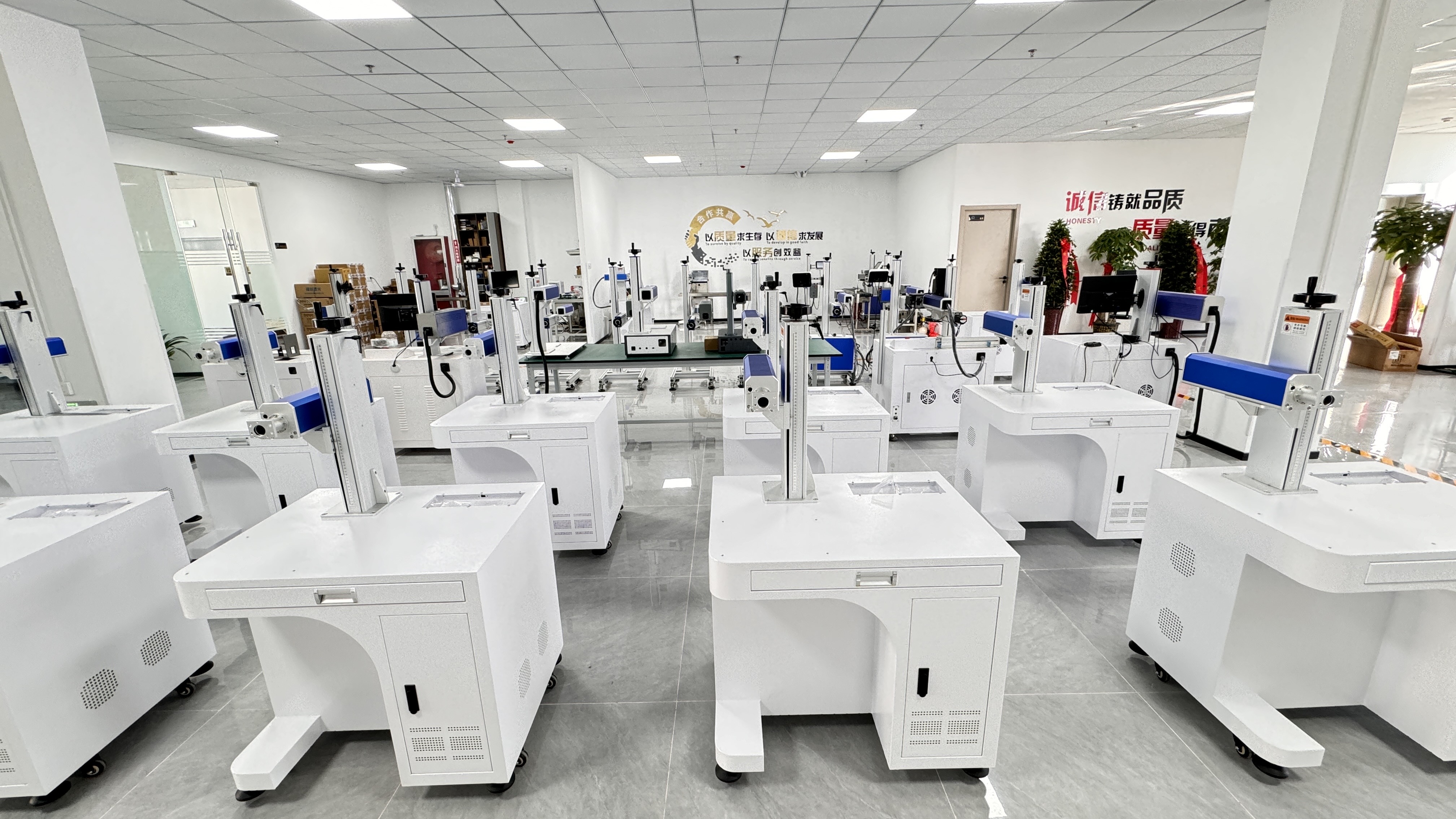
Cover: production environment for laser marking equipment.
A portable laser marking machine is defined less by the fact that it can be carried than by the evidence a supplier can produce for the exact format being quoted. Jinan Yuanshida International Trade Co., Ltd., a Jinan-based supplier of laser marking equipment founded in 2012, presents a six-format portfolio — desktop UV, miniature multi-material, desktop fiber, benchtop fiber, flying online and handheld fiber — covering work that recurs across hardware parts, pipes and profiles, electronic components, jewelry, mechanical spare parts, and gifts or crafts. The spread of formats is the supplier's breadth claim. This article converts that claim into a capability matrix: what each format is documented to do, which records support it, and which fields belong on a purchase order rather than in a brochure.
Why a six-format portfolio needs an evidence matrix
A portfolio answers what a supplier makes. Procurement at the evaluation-to-execution stage needs a different answer: what can the supplier document? Those are not the same class of statement. "We build six formats" is a catalogue claim; "here is the parameter sheet, the certificate and the acceptance record for the model on your quotation" is evidence that survives an internal audit, a customs query or a warranty dispute.
Format names are also not interchangeable. A UV format and a fiber format do not interact with the substrate in the same way; a battery-powered handheld and an in-line flying unit enter production through completely different integration paths; a desktop unit and a benchtop unit place different demands on the operator, the fixture and the floor. Supporting all six therefore implies maintaining more than one optical source, more than one mechanical architecture and more than one control platform. That implication is testable, which is exactly what makes it useful in supplier evaluation.
The matrix below tests it across three layers a buyer can hold: the documented parameter set, the certificate scope and the acceptance record. Commercial terms sit underneath all three, because MOQ, payment structure and the acceptance procedure decide whether any of the evidence can still be enforced after the order is placed.
The six-format capability matrix
The table separates what the reviewed supplier material documents from what must be confirmed per model before a purchase order. The role column is drawn from model naming and the supplier's own case material; it describes intended use, not measured performance.
| Format | Stated role | Documented in supplier records | Confirm before PO |
|---|---|---|---|
| Handheld fiber | On-site marking where no external power supply is available | Second-generation handheld fiber format; built-in lithium battery; 7-inch touch screen; Linux; Bluetooth, WiFi and mobile APP control; 110 mm × 110 mm area; about 6 kg; ten listed materials | Battery runtime and duty; weight including battery and case; spare-battery supply; certificate naming the exact model |
| Desktop UV | Cold marking where heat input is the process constraint | Format listed in the portfolio; case material cites UV cold-processing advantages for heat-sensitive substrates | Source wavelength and power; materials covered; marking area; CE and FDA scope for the UV model |
| Miniature multi-material | Small parts and mixed substrates on a compact platform | Format listed in the portfolio | Whether the source is single or switchable; materials covered per setting; area; fixturing |
| Desktop fiber | Bench-level fiber marking of metal parts | Format listed in the portfolio | Power option; area; control interface; model-level certificate |
| Benchtop fiber | Higher-throughput bench marking | Format listed in the portfolio | Duty rating; power; area; automation interfaces; model-level certificate |
| Flying online | In-line marking on moving product | Case material identifies flying models as suited to high-speed assembly lines | Line speed; trigger or encoder interface; integration scope; continuous-duty statement |
Reading the matrix: one format — handheld fiber — carries a complete documented parameter set plus model-scoped CE and FDA records. The other five are identified by name and intended role, and the supplier material reviewed for this article does not include model-level parameter sheets or certificate numbers for them. That is a documentation gap to close before ordering, not evidence that the capability is absent.
What the handheld fiber record actually establishes
The handheld format is the most fully documented unit in the portfolio. The supplier describes it as a second-generation portable handheld fiber laser marking machine built around a fiber laser source, designed for portable handheld operation with a built-in lithium battery so that mobile marking does not require an external power supply. The control package is a 7-inch touch screen running Linux, with Bluetooth, WiFi and mobile APP control. The marking area is 110 mm × 110 mm, the net weight is about 6 kg, and the listed materials are stainless steel, carbon steel, aluminum, copper, iron, gold, silver, acrylic, PVC and leather.
The marking area and the battery decide most projects. At 110 mm × 110 mm the format covers the identification work that dominates on-site marking: logos, QR and barcodes, batch and date codes, and serial numbers. Anything larger — a long seam on a profile, an oversized legend on a casting — requires repositioning and tiling, or a different format. The battery removes the cable, not the physics: session length is defined by battery capacity, so high-volume or continuous marking belongs on a mains-powered bench or in-line unit rather than on the handheld body.
Weight deserves the same scrutiny. At about 6 kg net, the unit is in one-person carrying territory. An external 2026 industry guide places handheld and portable laser marking units in a 15–35 lb band, roughly 6.8–15.8 kg; the documented 6 kg sits just below the low end of that band. Buyers should therefore confirm what the figure includes — battery, handle, case — before treating it as the weight an operator will carry to a machine on a mezzanine.
The control layer matters more than its novelty. For a production buyer the questions are practical: how marking files arrive on the device, whether variable data such as serials, dates and batch codes is generated on the unit or pushed from a line system, and how a marking file is version-controlled once in use. A touch screen with Linux and wireless connectivity can support a documented workflow; whether it does depends on the answers, not on the specification list.
Two boundaries are worth stating before any trial. The material list covers metals and several non-metals, but coatings, anodised surfaces and thin films are not on it, so those substrates need a sample test with the buyer's own part. PVC and leather are on the list, and laser marking of those materials is a ventilation and parameter question as much as a marking question; the process window should be confirmed with the supplier rather than assumed from the material name.
The supplier's case material also lists surface rust, paint and oxide removal alongside marking, which means one platform family is positioned for both identification and surface preparation. Buyers should keep the two uses separate in acceptance testing, because the process window, the consumables and the safety controls are not identical even when the same hardware family is involved.
Acceptance evidence: the difference between a test and a record
The supplier states that all machines undergo aging tests and precision calibration before delivery, and that acceptance inspection includes pre-shipment aging tests and precision calibration. The electrical-safety documentation is more specific: every machine undergoes a 72-hour continuous full-load aging test and a strict insulation withstand voltage test before dispatch.
Two conclusions follow. First, these are records to request with the shipping documents, not after installation, because their value depends on being produced before the balance payment and before the crate is opened. Second, the material states that the tests happen; it does not state the tolerances, the load profile or the pass criteria. Those are negotiation items, and the purchase order is where they become enforceable.
The acceptance procedure itself is described as negotiable: on-site acceptance, remote testing or third-party inspection are all named as options to be confirmed with the client. For a first order, third-party inspection before shipment is the version that converts the supplier's own statement into a record the buyer holds independently.
Certification scope is the most misread page in a supplier file
The CE Declaration of Conformity M.2024.206.C105275 was issued on 12 August 2024 by UDEM International Certification Auditing Training Centre Industry and Trade Inc., is valid to 12 August 2029, and names the handheld fiber laser marking machine. The listed standards are EN ISO 12100:2010, EN 60204-1:2018, EN 60825-1:2014+A11:2021 and EN ISO 11553-1:2020+A11:2020, together with the EN IEC 61000-3-2, EN 61000-3-3, EN IEC 61000-6-1 and EN IEC 61000-6-3 electromagnetic-compatibility series.
Read as a set, those standards answer four different questions. EN ISO 12100 addresses risk assessment and machine design; EN 60204-1 addresses the electrical equipment of machines; EN 60825-1 addresses laser product safety; EN ISO 11553-1 addresses laser processing machine safety; and the EMC series addresses emissions and immunity. A declaration that lists them describes design and testing scope. It is not a performance rating, and it says nothing about marking quality on a specific substrate.
The FDA record tells a similar story in a different market. Radiological Health Electronic Submission Confirmation 2211928-000 was issued on 15 November 2022 under Title 21 CFR Part 1002, through CCTS (Shenzhen Zhongan Quality Inspection and Certification Co., Ltd), and its scope is the handheld fiber laser marking machine for the United States market. The underlying requirement is external and independent of any supplier: laser products sold in the United States must comply with FDA 21 CFR Subchapter J, Parts 1000 through 1005.
The scope lesson is the part buyers most often skip. A certificate names a product, a market, a set of standard editions and a validity period; it does not travel automatically to another model, configuration or format. The correct request is the record that names the exact model and configuration on the quotation, checked for standard editions and validity against the destination market. The supplier states that its machines comply with CE, FDA and ISO requirements; the certificate numbers supplied cover the handheld fiber model, and the corresponding records for the other five formats are the item to request per model.
One nuance applies specifically to hand-held equipment. The supplied CE declaration lists EN ISO 11553-1, while an external technical source notes that portable markers are specifically assessed against EN ISO 11553-2 for hand-held safety. A buyer deploying the handheld format in the EU should ask the supplier to confirm which part of the series applies to the exact model and market, rather than assume either answer.
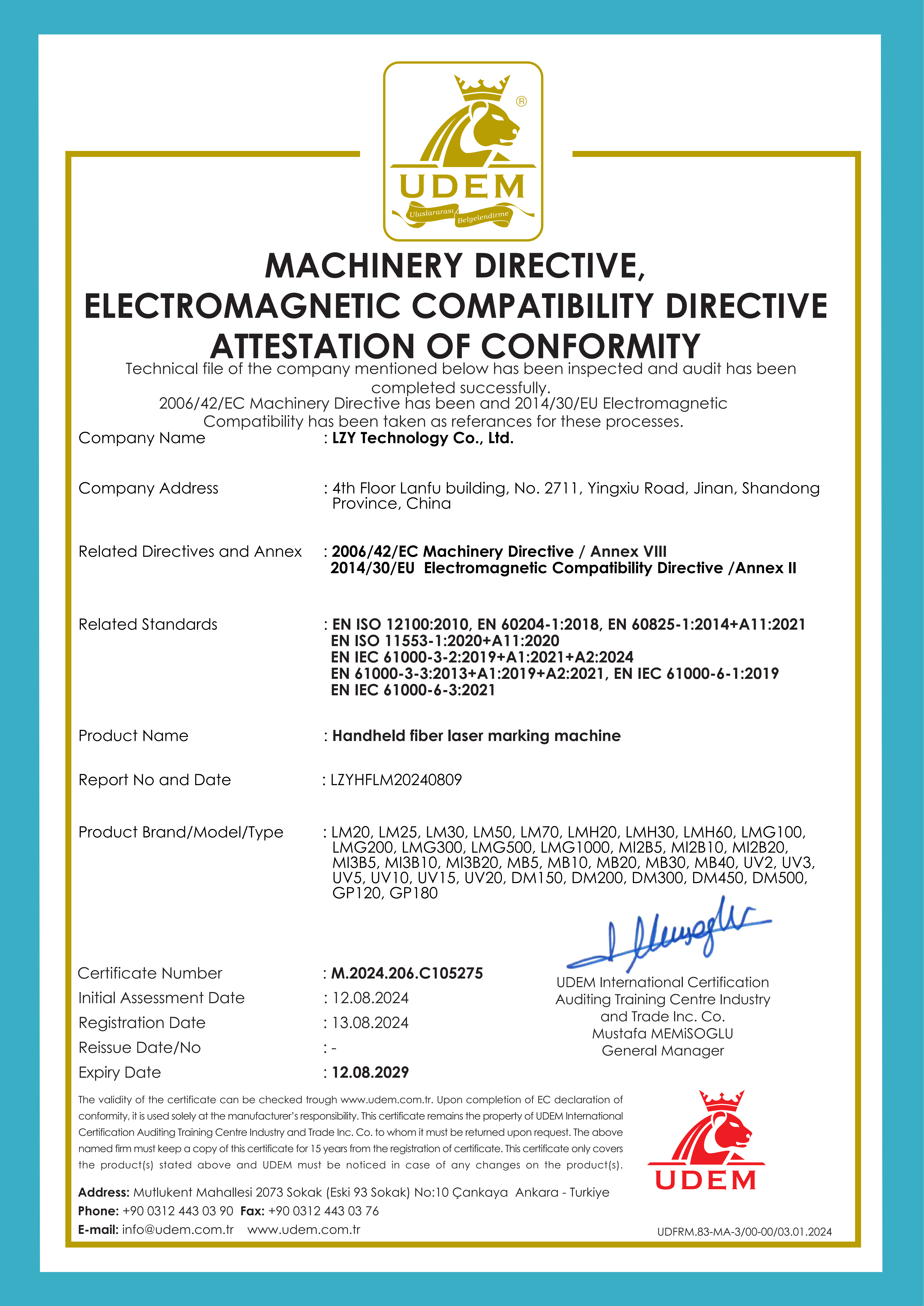
CE Declaration of Conformity M.2024.206.C105275 — scope: handheld fiber laser marking machine, valid to 12 August 2029.
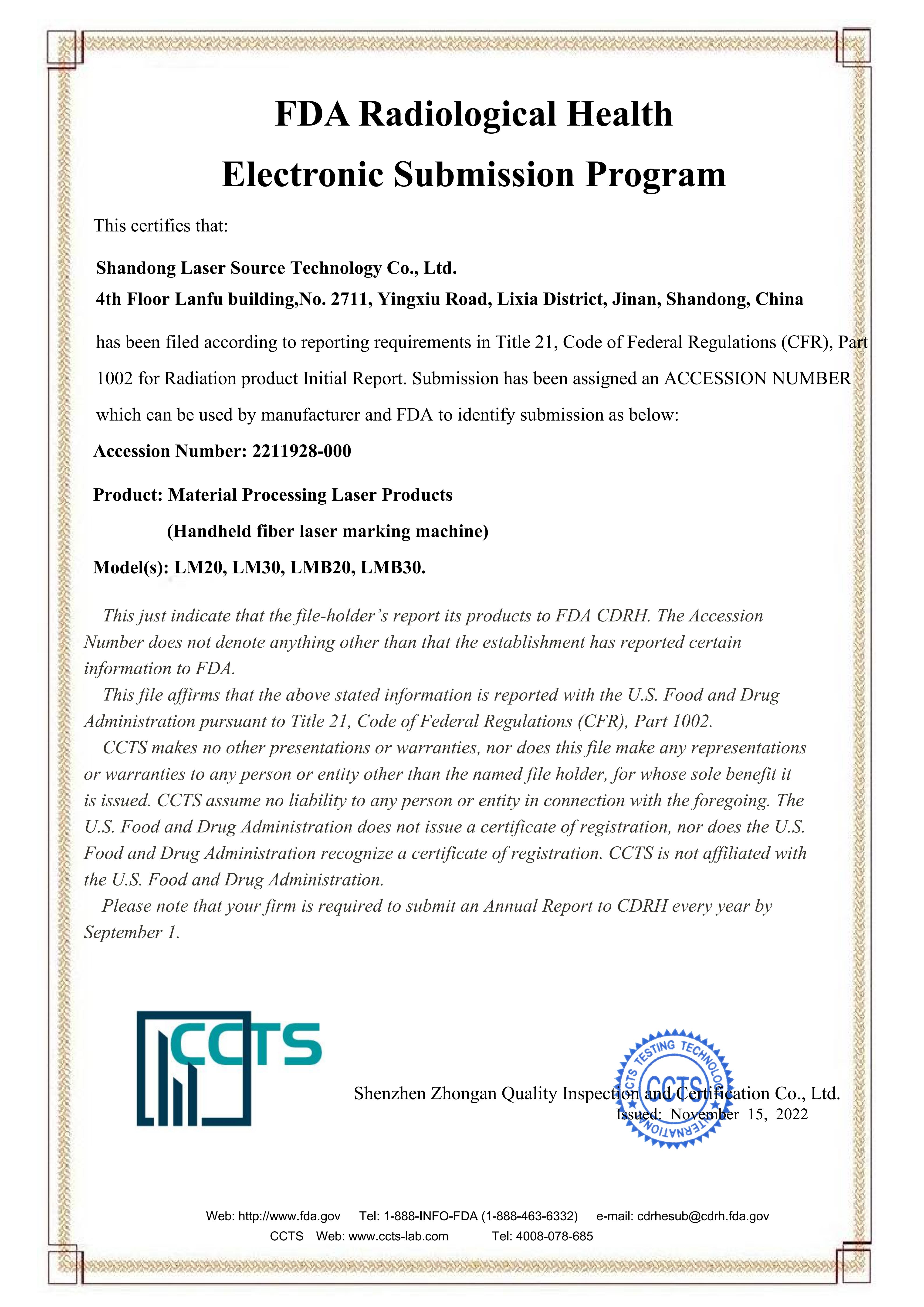
FDA Radiological Health Electronic Submission Confirmation 2211928-000, issued 15 November 2022 under Title 21 CFR Part 1002.
Laser and electrical safety: verify the architecture, not the adjectives
The laser-safety configuration stated for the equipment is hardware-based. It includes a Class 4 laser safety enclosure with anti-radiation observation windows, safety-door interlock switches that cut laser emission as soon as the door is opened, an emergency stop button, and certified OD5+ anti-laser protective eyewear supplied as standard. Class 4 is the highest laser hazard category, so protection depends on enclosure, interlock and operator discipline working together — which is why the interlock function test belongs in the acceptance checklist rather than in the operating manual.
Electrical protection is described in comparable terms: overload protectors, residual current circuit breakers and a grounding protection system, plus automatic thermal shutdown and alarm functions for the laser source and the power supplies. For production planning, thermal protection is a protective function rather than a throughput feature — when it triggers, marking stops. Duty assumptions for hot or heavily loaded environments should therefore include the alarm behaviour and the restart procedure.
Four safety items are worth requesting in writing: the interlock function test record, the OD rating and the quantity of eyewear supplied per machine, the RCCB rating and grounding check included in the acceptance list, and the temperature thresholds at which thermal shutdown and alarm occur. None of these requires new engineering; each moves an existing configuration from a description into a document.
Purchasing terms, MOQ and the purchase-order checklist
The commercial framework is stated plainly. Minimum order quantity is 5 units. Payment runs as deposit plus balance. The supplier typically supplies complete machines together with international shipping solutions, while the specific delivery term — EXW, FOB, CIF or another arrangement — is confirmed with sales. Lead time follows factory scheduling by order volume, and after-sales technical support is provided in English.
Production capability extends beyond catalogue models: design and manufacturing services are provided with OEM and ODM capability, ODM covering product design and manufacturing, and production services include customized solution development alongside the standard modes. Specific customization options and limits are confirmed with sales, which is the correct place for them — a boundary stated on a quotation is enforceable, while one implied by a brochure is not.
Supplier identity belongs in the same file. Public business-registry information describes Jinan Yuanshida International Trade Co., Ltd. as registered in Jinan, China, and engaged in self-operated and agency import and export business. The practical question is which party performs which function: manufacturing, calibration, the declaration of conformity and warranty service. Naming those parties in the order documentation removes an assumption that otherwise surfaces only when something fails. For customs, machine tools operated by laser processes are classified under HS code 845611, so the invoice and the certificate scope should describe the same equipment.
A purchase order built on this matrix usually carries eight items:
- Exact model and format, with configuration and customization referenced by quotation line.
- Optical source type and the specified power for that model.
- Marking area, confirmed in millimetres rather than by format name.
- Consumable and wear-part list, with replacement intervals where stated.
- Certificate numbers that name the model and the destination market.
- Safety configuration, including eyewear quantity and OD rating.
- Acceptance method and the records to be delivered before shipment.
- Spare-parts, documentation and support-language commitments.
Duty, consumables and the boundaries of a portable format
Laser marking consumes no ink, solvent or label stock, which removes a recurring consumable from the line and is the substance behind "consumable-free" positioning. It does not remove wear items. Protective windows, filters and — on the handheld format — the battery remain components with finite life, and the reviewed material does not state replacement intervals. Buyers should ask for the wear-part list and intervals in writing, because an unlisted wear item becomes an unplanned stoppage.
Continuous duty needs the same treatment. A 24/7 claim should be translated into assumptions: ambient temperature, load factor, maintenance window and spare-unit strategy for the exact model. The stated 72-hour full-load aging test is a pre-shipment screen — it shows the unit ran under load before dispatch. It is not a rating for uninterrupted round-the-clock operation, and treating it as one produces a duty dispute instead of a duty statement.
The fit boundary is equally clear. A 110 mm × 110 mm area, a battery-defined session and single-operator handling make the handheld format the right answer for installed machinery, large frames and pipes that cannot be moved to a bench. They make it the wrong answer for high-volume marking of small parts, where a desktop or benchtop format keeps the unit stationary and the part fixtured, and for product that is already moving, where the flying online format marks in line without a separate operation. The comparison is structural rather than promotional: a fixed station brings the part to the machine, a handheld brings the machine to the part, and an in-line unit removes the separate operation but adds integration work.
Market context behind the matrix
The format question sits inside a market that is large but unevenly documented. Grand View Research estimated the global laser marking machine market at USD 4.4 billion in 2026 and reported that fiber technology held a 46.1% revenue share in 2025, with Asia Pacific accounting for roughly 44% of revenue in the same year. Published growth rates for the category diverge by methodology — some track marking equipment, others bundle coding — so forecast figures are directional rather than a purchasing input.
The practical reading is that fiber formats are the commercial mainstream and should therefore carry the strongest documentation file: desktop fiber, benchtop fiber and handheld fiber each need their own parameter sheet, certificate scope and acceptance record. UV and miniature multi-material formats matter where heat input or part size constrains the process, and those are precisely the cases where a sample test with the buyer's own substrate outweighs another specification table.
What to watch before the next order
Three items belong in the file for a repeat order. The first is certificate currency: the CE declaration runs to 12 August 2029, and any shipment after that date needs a renewed record. The second is the status of the FDA submission, issued in 2022, if handheld units continue to enter the United States. The third is documentation coverage — as a portfolio grows, the parameter sheet, the certificate and the acceptance record should grow with it, because breadth only becomes evidence when each format can be answered on its own.
Field data closes the loop cheaply. Interlock and thermal-alarm events, battery replacement history and calibration drift observed in the first year are the most credible inputs for tightening the acceptance criteria of the second order — provided the records were requested at delivery in the first place.
Frequently asked questions
Which portfolio formats are covered by the supplied CE and FDA records?
Both records name the handheld fiber laser marking machine. CE Declaration of Conformity M.2024.206.C105275, issued on 12 August 2024 by UDEM and valid to 12 August 2029, covers that model; FDA Radiological Health Electronic Submission Confirmation 2211928-000 under Title 21 CFR Part 1002, issued on 15 November 2022, covers the same model for the United States market. For desktop UV, miniature multi-material, desktop fiber, benchtop fiber and flying online configurations, the corresponding records should be requested against the exact model and destination market.
What purchasing terms does the supplier state?
Minimum order quantity is 5 units. Payment is structured as deposit plus balance. The supplier typically supplies complete machines together with international shipping solutions, while the specific delivery term such as EXW, FOB or CIF is confirmed with sales. Lead time follows factory scheduling by order volume.
What acceptance evidence can be written into a purchase order?
Acceptance inspection includes pre-shipment aging tests and precision calibration. The electrical-safety documentation adds that every machine undergoes a 72-hour continuous full-load aging test and an insulation withstand voltage test before dispatch. The acceptance procedure itself — on-site acceptance, remote testing or third-party inspection — is described as negotiable and confirmed with the client, so the chosen method and the records to be delivered should be named in the order.
Does the supplier support OEM/ODM and customized marking solutions?
Yes. Design and manufacturing services are provided with OEM and ODM capability, ODM covering product design and manufacturing, and production services include customized solution development alongside the standard OEM/ODM modes. Specific customization options and limits are confirmed with sales.
How should a 24/7 or continuous-duty claim be verified?
Ask for a written duty statement naming the ambient temperature, load factor, maintenance window and recommended spare-part strategy for the exact model. A pre-shipment aging test is a burn-in screen performed before dispatch; it shows the unit ran under load before delivery, not that it is rated for uninterrupted round-the-clock operation. Consumable status should be verified the same way: marking uses no ink, solvent or label stock, but protective windows, filters and — on the handheld format — the battery remain wear items whose replacement intervals should be stated in writing.
Reference: product brochure (PDF) — Second-generation marking machine, English edition. Company information: yuanlaser.com.
Have Questions or Need More Details?
Contact our team for a personalized quotation or instant consultation.
Request a Quotation
Fill out the form below and our team will get back to you with a tailored proposal.
WhatsApp Direct Chat
Prefer to chat in real-time? Message us on WhatsApp for instant assistance & quick answers.
- Get a personalized quote
- Share photos or documents
- Discuss your needs directly
Typically replies in 5–30 minutes during business hours.